Philippines Sports Nutrition Market Size, Share & Growth Rate
The Philippines Sports Nutrition Market was estimated at USD 158 Million in 2025 and is projected to reach USD 223 Million by 2032, growing at a CAGR of 5.0% from 2026 to 2032. This impressive trajectory can be attributed to the rapid increase in fitness-related activities across the country, ranging from gym workouts to yoga classes. As more Filipinos embrace healthier lifestyle choices and the consumption of nutritional supplements rises among both amateur and professional athletes, the demand for innovative sports nutrition products is set to soar.
Philippines Sports Nutrition Market Year-wise Growth Rate and Key Drivers
This graph highlights how the Philippines Sports Nutrition Market has steadily grown over the years, supported by major growth factors.
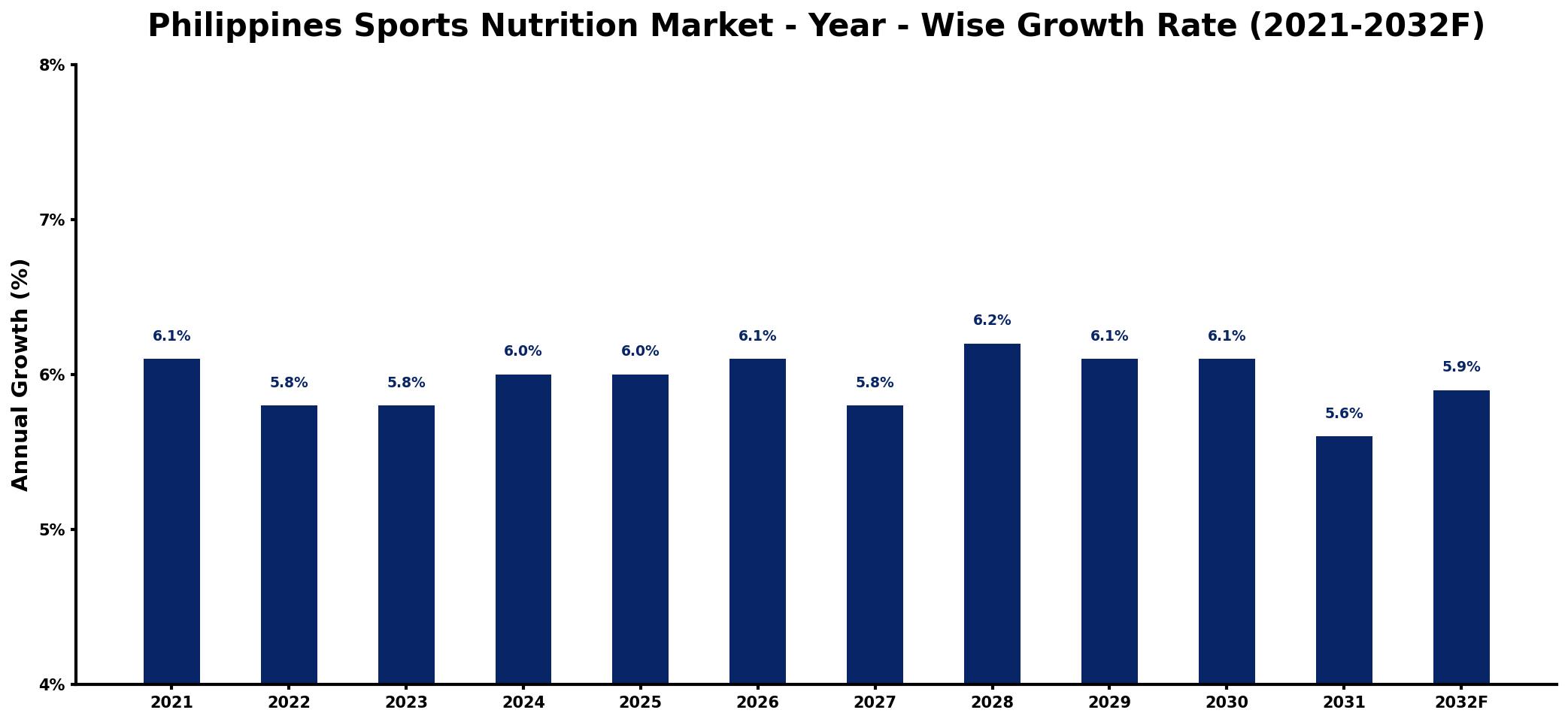
The table below presents the year‑wise growth rates along with the key drivers influencing the market
| Year | Growth Rate | Major Drivers |
| 2021 | 6.1% | Rise in health consciousness trends |
| 2022 | 5.8% | Growing fitness center memberships |
| 2023 | 5.8% | Increase in online fitness classes |
| 2024 | 6.0% | Expansion of health food stores |
| 2025 | 6.0% | Investment in fitness technology |
| 2026 | 6.1% | Surge in wellness events popularity |
| 2027 | 5.8% | Rising interest in vegan diets |
| 2028 | 6.2% | Growth in athletic training programs |
| 2029 | 6.1% | improved processing technologies adoption |
| 2030 | 6.1% | Enhancement of e-commerce platforms |
| 2031 | 5.6% | Shift towards holistic health approaches |
| 2032 | 5.9% | Development of personalized wellness plans |
Note: Market size estimations and growth projections presented in this report are based on 6Wresearch's proprietary forecasting methodology, utilizing the latest available industry data, government publications, and primary research inputs.
Philippines Sports Nutrition Market Synopsis
The landscape of the Philippines Sports Nutrition Market is rapidly evolving, propelled by a growing focus on personal health and fitness. As urbanization accelerates, the prevalence of sports and fitness activities has surged, encouraging a shift towards consuming specialized nutrition products. This changing dynamic is not only reshaping consumer preferences but is also fostering a culture of health-consciousness among the population.
Additionally, the pandemic has acted as a catalyst for this market's growth, prompting consumers to prioritize their well-being. Innovations, particularly in ready-to-drink (RTD) supplements that feature natural ingredients, have gained significant traction, allowing manufacturers to meet the rising demand for convenient and healthy options amid lifestyle changes. Major cities like Metro Manila and Cebu City are witnessing this trend first-hand.
Philippines Sports Nutrition Market Key Takeaways
- The market is driven by increasing health consciousness and rising participation in fitness activities.
- Urbanization and changing lifestyle habits are significantly influencing consumer preferences.
- The popularity of RTD supplements is on the rise, enhancing product accessibility.
- The ongoing trend toward natural ingredients in nutrition products is becoming more prevalent.
- Online distribution channels are playing a crucial role in reaching a broader customer base.
Evaluation of Restraints in Philippines Sports Nutrition Market
Despite the promising growth outlook, several real constraints pose challenges for the Philippines Sports Nutrition Market. One of the primary hurdles is the affordability of premium products, which can deter a significant portion of the population from accessing these nutrition supplements. Additionally, there's a critical need for consumer education regarding the benefits and proper use of these products. Without adequate knowledge, potential customers may be reluctant to invest in sports nutrition, limiting market expansion.
Philippines Sports Nutrition Market Trends
The Philippines Sports Nutrition Market is currently witnessing several emerging trends that are shaping its growth trajectory. First and foremost, the emphasis on health and wellness has led to a significant demand for plant-based supplements, reflecting a shift towards more sustainable nutrition choices. Moreover, the integration of technology into nutrition, such as the use of fitness tracking apps that complement dietary intake, is becoming increasingly popular. Finally, a notable trend is the personalization of nutrition, with consumers seeking tailored products that align with their specific fitness goals and dietary needs.
Philippines Sports Nutrition Market Opportunities
The future of the Philippines Sports Nutrition Market holds substantial opportunities for growth and investment. As the health-conscious consumer base expands, brands that can innovate with unique flavors, natural ingredients, and formulations tailored to specific demographics will find a receptive audience. Additionally, the rise of e-commerce platforms presents an excellent opportunity for brands to reach consumers directly, enhancing sales and brand loyalty. There is also potential for collaboration with fitness centers and sports teams to promote co-branded products, tapping into targeted marketing strategies.
Government Initiatives in the Philippines Sports Nutrition Market
The Philippine government has shown a commitment to promoting healthier lifestyles through various public health initiatives and programs. Investment in sports infrastructure, along with campaigns aimed at increasing public awareness of nutrition and physical fitness, serves to encourage a culture of health across the population. Policies designed to support local producers of nutritional supplements can further enhance the market's growth, creating an environment conducive to innovation and product development.
Future Insights of the Philippines Sports Nutrition Market
Looking ahead to 2026-2032, the Philippines Sports Nutrition Market is poised for considerable expansion. The combination of a young population increasingly engaged in fitness and the growing trend of health awareness will drive demand for sports nutrition products. As companies continue to innovate and adapt to changing consumer preferences, the market is likely to see an influx of new products that cater to diverse needs. Furthermore, as more Filipinos adopt fitness as a lifestyle choice, the overall market dynamics will align favorably toward sustained growth.
Philippines Sports Nutrition Market Latest Developments (2025 - 2026)
Recent developments within the Philippines Sports Nutrition Market reflect an industry in transformation. Many companies are focusing on reformulating existing products to incorporate more natural ingredients and meet the growing demand for clean labels. Additionally, brands are leveraging digital marketing strategies to enhance consumer engagement and expand their online presence. As the market continues to evolve, we anticipate further innovations in product delivery methods and formulations that will cater to the increasingly diverse consumer base.
Philippines Sports Nutrition Market - Key Attractiveness of the Report
- 10 Years of Market Numbers
- Historical Data Starting from 2022 to 2025
- Base Year: 2025
- Forecast Data until 2032
- Key Performance Indicators Impacting the Market
- Major Upcoming Developments and Projects
Key Highlights of the Report:
- Philippines Sports Nutrition Market Outlook
- Market Size of Philippines Sports Nutrition Market, 2025
- Forecast of Philippines Sports Nutrition Market, 2032
- Historical Data and Forecast of Philippines Sports Nutrition Revenues & Volume for the Period 2022-2032F
- Philippines Sports Nutrition Market Trend Evolution
- Philippines Sports Nutrition Market Drivers and Challenges
- Philippines Sports Nutrition Price Trends
- Philippines Sports Nutrition Porter's Five Forces
- Philippines Sports Nutrition Industry Life Cycle
- Historical Data and Forecast of Philippines Sports Nutrition Market Revenues & Volume By Type for the Period 2022-2032F
- Historical Data and Forecast of Philippines Sports Nutrition Market Revenues & Volume By Sports Food for the Period 2022-2032F
- Historical Data and Forecast of Philippines Sports Nutrition Market Revenues & Volume By Sports Drinks for the Period 2022-2032F
- Historical Data and Forecast of Philippines Sports Nutrition Market Revenues & Volume By Sports Supplements for the Period 2022-2032F
- Historical Data and Forecast of Philippines Sports Nutrition Market Revenues & Volume By Distribution Channel for the Period 2022-2032F
- Historical Data and Forecast of Philippines Sports Nutrition Market Revenues & Volume By Supermarkets/Hypermarkets for the Period 2022-2032F
- Historical Data and Forecast of Philippines Sports Nutrition Market Revenues & Volume By Specialty Stores for the Period 2022-2032F
- Historical Data and Forecast of Philippines Sports Nutrition Market Revenues & Volume By Convenience Stores for the Period 2022-2032F
- Historical Data and Forecast of Philippines Sports Nutrition Market Revenues & Volume By Online Stores for the Period 2022-2032F
- Historical Data and Forecast of Philippines Sports Nutrition Market Revenues & Volume By Other Distribution Channels for the Period 2022-2032F
- Philippines Sports Nutrition Import Export Trade Statistics
- Market Opportunity Assessment By Type
- Market Opportunity Assessment By Distribution Channel
- Philippines Sports Nutrition Top Companies Market Share
- Philippines Sports Nutrition Competitive Benchmarking By Technical and Operational Parameters
- Philippines Sports Nutrition Company Profiles
- Philippines Sports Nutrition Key Strategic Recommendations






































