Philippines Sweeteners for Food and Beverage Market (2025-2031) | Analysis, Growth, Outlook, Size & Revenue, Competitive Landscape, Share, Segmentation, Forecast, Value, Industry, Trends, Companies
Market Forecast By Type (Oligosaccharide, Inulin, Sugar Alcohols, Others), By Application (Food, Beverages) And Competitive Landscape
| Product Code: ETC8852869 | Publication Date: Sep 2024 | Updated Date: Nov 2025 | Product Type: Market Research Report | |
| Publisher: 6Wresearch | Author: Summon Dutta | No. of Pages: 75 | No. of Figures: 35 | No. of Tables: 20 |
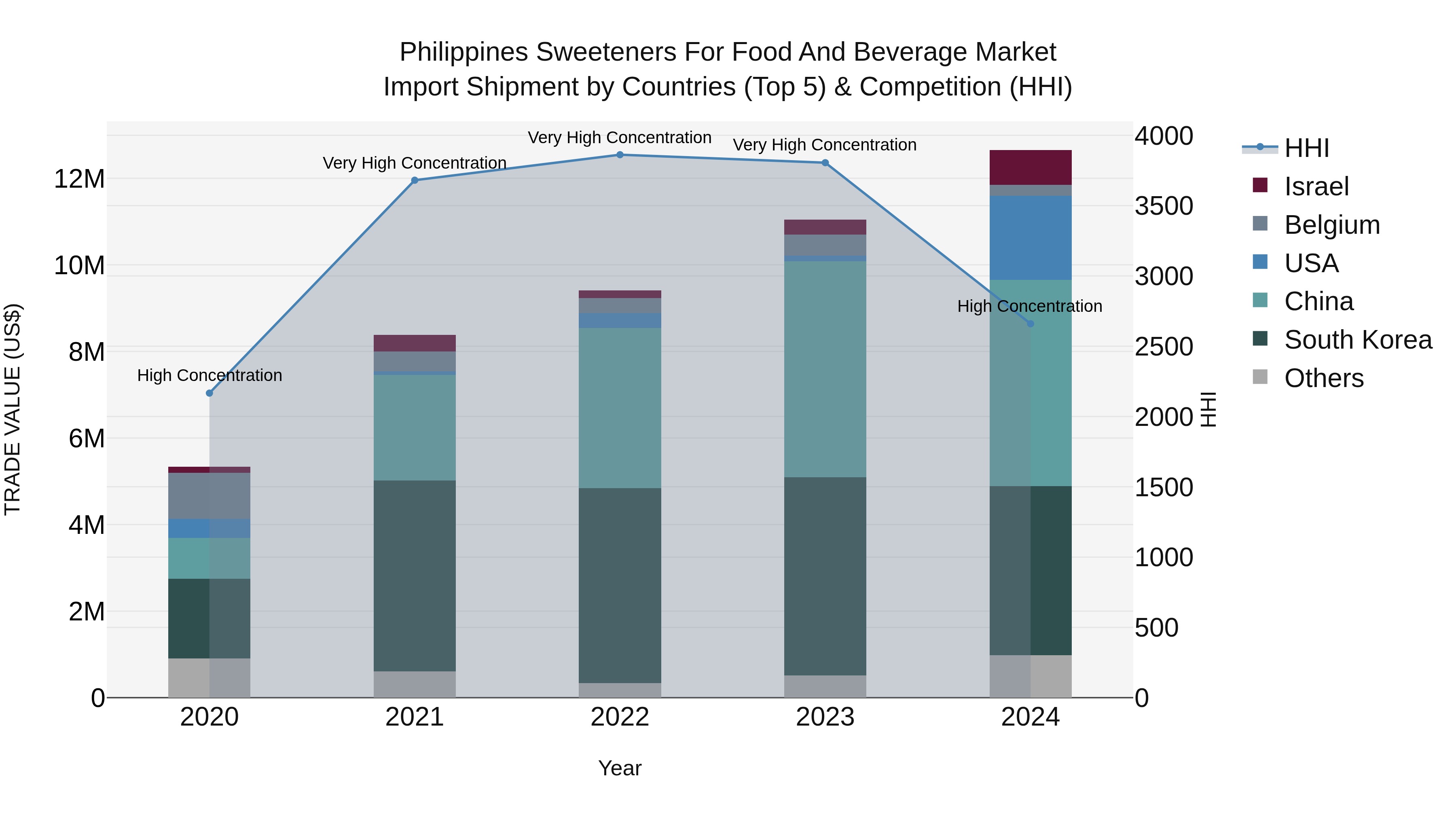
Philippines Sweeteners For Food And Beverage Market Top 5 Importing Countries and Market Competition (HHI) Analysis
The Philippines sweeteners market for food and beverage import shipments saw significant growth in 2024, with top exporting countries including China, South Korea, USA, Israel, and Finland. Despite a high concentration level in 2023, the market continued to show strong growth in 2024. The impressive compound annual growth rate (CAGR) of 24.1% from 2020 to 2024 reflects a thriving industry. The growth rate from 2023 to 2024 at 14.56% indicates a continued upward trajectory. The market`s increasing popularity and diverse range of suppliers suggest a promising outlook for the future.
Philippines Sweeteners for Food and Beverage Market Overview
The sweeteners market in the Philippines is growing as consumers seek healthier alternatives to traditional sugar. Natural and artificial sweeteners are widely used in food and beverage applications, including soft drinks, dairy, and baked goods. With increasing awareness of lifestyle diseases like diabetes and obesity, demand for low-calorie and zero-calorie sweeteners is rising. Regulatory approvals and product innovations are helping local and international manufacturers meet this demand.
Drivers of the market
The sweeteners market for food and beverage in the Philippines is witnessing consistent growth due to rising demand for low-calorie and sugar-free alternatives. Health-conscious consumers are driving the popularity of natural sweeteners such as stevia and monk fruit, while synthetic options like sucralose and aspartame remain relevant in processed foods and beverages. Local manufacturers are also innovating with blends to meet taste and regulatory standards.
Challenges of the market
The sweeteners market grapples with shifting consumer preferences, price competition between synthetic and natural variants, and evolving food safety regulations. Import dependency for key ingredients and inconsistent supply chains create additional challenges, particularly for small-scale food producers.
Investment opportunities in the Market
The Philippines` sweeteners market for food and beverages presents significant investment potential due to rising consumer preference for sugar alternatives, particularly among health-conscious consumers. With growing incidences of diabetes and obesity, the demand for natural and low-calorie sweeteners like stevia and monk fruit is climbing. Manufacturers and investors can benefit from localized production, innovative product formulations, and partnerships with health-focused food brands.
Government Policy of the market
Sweeteners are regulated by the FDA, with mandatory labeling for both natural and synthetic types. The government promotes alternatives to high-fructose corn syrup through public health campaigns and importation programs for stevia and other natural options.
Key Highlights of the Report:
- Philippines Sweeteners for Food and Beverage Market Outlook
- Market Size of Philippines Sweeteners for Food and Beverage Market, 2024
- Forecast of Philippines Sweeteners for Food and Beverage Market, 2031
- Historical Data and Forecast of Philippines Sweeteners for Food and Beverage Revenues & Volume for the Period 2021- 2031
- Philippines Sweeteners for Food and Beverage Market Trend Evolution
- Philippines Sweeteners for Food and Beverage Market Drivers and Challenges
- Philippines Sweeteners for Food and Beverage Price Trends
- Philippines Sweeteners for Food and Beverage Porter's Five Forces
- Philippines Sweeteners for Food and Beverage Industry Life Cycle
- Historical Data and Forecast of Philippines Sweeteners for Food and Beverage Market Revenues & Volume By Type for the Period 2021- 2031
- Historical Data and Forecast of Philippines Sweeteners for Food and Beverage Market Revenues & Volume By Oligosaccharide for the Period 2021- 2031
- Historical Data and Forecast of Philippines Sweeteners for Food and Beverage Market Revenues & Volume By Inulin for the Period 2021- 2031
- Historical Data and Forecast of Philippines Sweeteners for Food and Beverage Market Revenues & Volume By Sugar Alcohols for the Period 2021- 2031
- Historical Data and Forecast of Philippines Sweeteners for Food and Beverage Market Revenues & Volume By Others for the Period 2021- 2031
- Historical Data and Forecast of Philippines Sweeteners for Food and Beverage Market Revenues & Volume By Application for the Period 2021- 2031
- Historical Data and Forecast of Philippines Sweeteners for Food and Beverage Market Revenues & Volume By Food for the Period 2021- 2031
- Historical Data and Forecast of Philippines Sweeteners for Food and Beverage Market Revenues & Volume By Beverages for the Period 2021- 2031
- Philippines Sweeteners for Food and Beverage Import Export Trade Statistics
- Market Opportunity Assessment By Type
- Market Opportunity Assessment By Application
- Philippines Sweeteners for Food and Beverage Top Companies Market Share
- Philippines Sweeteners for Food and Beverage Competitive Benchmarking By Technical and Operational Parameters
- Philippines Sweeteners for Food and Beverage Company Profiles
- Philippines Sweeteners for Food and Beverage Key Strategic Recommendations
Frequently Asked Questions About the Market Study (FAQs):
6Wresearch actively monitors the Philippines Sweeteners for Food and Beverage Market and publishes its comprehensive annual report, highlighting emerging trends, growth drivers, revenue analysis, and forecast outlook. Our insights help businesses to make data-backed strategic decisions with ongoing market dynamics. Our analysts track relevent industries related to the Philippines Sweeteners for Food and Beverage Market, allowing our clients with actionable intelligence and reliable forecasts tailored to emerging regional needs.
Yes, we provide customisation as per your requirements. To learn more, feel free to contact us on sales@6wresearch.com
1 Executive Summary |
2 Introduction |
2.1 Key Highlights of the Report |
2.2 Report Description |
2.3 Market Scope & Segmentation |
2.4 Research Methodology |
2.5 Assumptions |
3 Philippines Sweeteners for Food and Beverage Market Overview |
3.1 Philippines Country Macro Economic Indicators |
3.2 Philippines Sweeteners for Food and Beverage Market Revenues & Volume, 2021 & 2031F |
3.3 Philippines Sweeteners for Food and Beverage Market - Industry Life Cycle |
3.4 Philippines Sweeteners for Food and Beverage Market - Porter's Five Forces |
3.5 Philippines Sweeteners for Food and Beverage Market Revenues & Volume Share, By Type, 2021 & 2031F |
3.6 Philippines Sweeteners for Food and Beverage Market Revenues & Volume Share, By Application, 2021 & 2031F |
4 Philippines Sweeteners for Food and Beverage Market Dynamics |
4.1 Impact Analysis |
4.2 Market Drivers |
4.2.1 Increasing consumer awareness about health and wellness leading to a shift towards low-calorie sweeteners. |
4.2.2 Rising prevalence of diabetes and obesity driving demand for sugar alternatives in food and beverages. |
4.2.3 Growing adoption of natural sweeteners like stevia due to their perceived health benefits. |
4.2.4 Expanding food and beverage industry in the Philippines creating opportunities for sweetener manufacturers. |
4.2.5 Government initiatives promoting healthy eating habits and reducing sugar consumption. |
4.3 Market Restraints |
4.3.1 High costs associated with natural sweeteners impacting their affordability for manufacturers and consumers. |
4.3.2 Limited consumer acceptance of artificial sweeteners due to health concerns and taste preferences. |
4.3.3 Regulatory challenges and stringent standards for sweetener ingredients in food and beverages. |
4.3.4 Lack of awareness and education about the benefits of alternative sweeteners among consumers. |
4.3.5 Competition from traditional sugar market and availability of low-cost sugar substitutes. |
5 Philippines Sweeteners for Food and Beverage Market Trends |
6 Philippines Sweeteners for Food and Beverage Market, By Types |
6.1 Philippines Sweeteners for Food and Beverage Market, By Type |
6.1.1 Overview and Analysis |
6.1.2 Philippines Sweeteners for Food and Beverage Market Revenues & Volume, By Type, 2021- 2031F |
6.1.3 Philippines Sweeteners for Food and Beverage Market Revenues & Volume, By Oligosaccharide, 2021- 2031F |
6.1.4 Philippines Sweeteners for Food and Beverage Market Revenues & Volume, By Inulin, 2021- 2031F |
6.1.5 Philippines Sweeteners for Food and Beverage Market Revenues & Volume, By Sugar Alcohols, 2021- 2031F |
6.1.6 Philippines Sweeteners for Food and Beverage Market Revenues & Volume, By Others, 2021- 2031F |
6.2 Philippines Sweeteners for Food and Beverage Market, By Application |
6.2.1 Overview and Analysis |
6.2.2 Philippines Sweeteners for Food and Beverage Market Revenues & Volume, By Food, 2021- 2031F |
6.2.3 Philippines Sweeteners for Food and Beverage Market Revenues & Volume, By Beverages, 2021- 2031F |
7 Philippines Sweeteners for Food and Beverage Market Import-Export Trade Statistics |
7.1 Philippines Sweeteners for Food and Beverage Market Export to Major Countries |
7.2 Philippines Sweeteners for Food and Beverage Market Imports from Major Countries |
8 Philippines Sweeteners for Food and Beverage Market Key Performance Indicators |
8.1 Consumer adoption rate of low-calorie sweeteners in food and beverages. |
8.2 Number of new product launches with alternative sweeteners in the market. |
8.3 Growth in the usage of natural sweeteners like stevia in food and beverage products. |
8.4 Percentage of food and beverage companies incorporating sugar reduction strategies. |
8.5 Consumer sentiment towards sugar alternatives and awareness of health benefits. |
9 Philippines Sweeteners for Food and Beverage Market - Opportunity Assessment |
9.1 Philippines Sweeteners for Food and Beverage Market Opportunity Assessment, By Type, 2021 & 2031F |
9.2 Philippines Sweeteners for Food and Beverage Market Opportunity Assessment, By Application, 2021 & 2031F |
10 Philippines Sweeteners for Food and Beverage Market - Competitive Landscape |
10.1 Philippines Sweeteners for Food and Beverage Market Revenue Share, By Companies, 2024 |
10.2 Philippines Sweeteners for Food and Beverage Market Competitive Benchmarking, By Operating and Technical Parameters |
11 Company Profiles |
12 Recommendations |
13 Disclaimer |
Pricing
- Single User License$ 1,995
- Department License$ 2,400
- Site License$ 3,120
- Global License$ 3,795

Search
Thought Leadership and Analyst Meet





Our Clients








Related Reports
- Germany Breakfast Food Market (2026-2032) | Industry, Share, Growth, Size, Companies, Value, Analysis, Revenue, Trends, Forecast & Outlook
- Australia Briquette Market (2025-2031) | Growth, Size, Revenue, Forecast, Analysis, Trends, Value, Share, Industry & Companies
- Vietnam System Integrator Market (2025-2031) | Size, Companies, Analysis, Industry, Value, Forecast, Growth, Trends, Revenue & Share
- ASEAN and Thailand Brain Health Supplements Market (2025-2031) | Strategy, Consumer Insights, Analysis, Investment Trends, Opportunities, Growth, Size, Share, Industry, Revenue, Segments, Value, Segmentation, Supply, Forecast, Restraints, Outlook, Competition, Drivers, Trends, Demand, Pricing Analysis, Competitive, Strategic Insights, Companies, Challenges
- ASEAN Bearings Market (2025-2031) | Strategy, Consumer Insights, Analysis, Investment Trends, Opportunities, Growth, Size, Share, Industry, Revenue, Segments, Value, Segmentation, Supply, Forecast, Restraints, Outlook, Competition, Drivers, Trends, Demand, Pricing Analysis, Competitive, Strategic Insights, Companies, Challenges
- Europe Flooring Market (2025-2031) | Outlook, Share, Industry, Trends, Forecast, Companies, Revenue, Size, Analysis, Growth & Value
- Saudi Arabia Manlift Market (2025-2031) | Outlook, Size, Growth, Trends, Companies, Industry, Revenue, Value, Share, Forecast & Analysis
- Uganda Excavator, Crane, and Wheel Loaders Market (2025-2031) | Strategy, Consumer Insights, Analysis, Investment Trends, Opportunities, Growth, Size, Share, Industry, Revenue, Segments, Value, Segmentation, Supply, Forecast, Restraints, Outlook, Competition, Drivers, Trends, Demand, Pricing Analysis, Competitive, Strategic Insights, Companies, Challenges
- Rwanda Excavator, Crane, and Wheel Loaders Market (2025-2031) | Strategy, Consumer Insights, Analysis, Investment Trends, Opportunities, Growth, Size, Share, Industry, Revenue, Segments, Value, Segmentation, Supply, Forecast, Restraints, Outlook, Competition, Drivers, Trends, Demand, Pricing Analysis, Competitive, Strategic Insights, Companies, Challenges
- Kenya Excavator, Crane, and Wheel Loaders Market (2025-2031) | Strategy, Consumer Insights, Analysis, Investment Trends, Opportunities, Growth, Size, Share, Industry, Revenue, Segments, Value, Segmentation, Supply, Forecast, Restraints, Outlook, Competition, Drivers, Trends, Demand, Pricing Analysis, Competitive, Strategic Insights, Companies, Challenges
Industry Events and Analyst Meet

Startup Hub Expo 2025

Automechanika Dubai 2024

Mobile India Expo 2025

Media Expo New Delhi 2025

Consumer Electronics World Expo 2025
Whitepaper
- Middle East & Africa Commercial Security Market Click here to view more.
- Middle East & Africa Fire Safety Systems & Equipment Market Click here to view more.
- GCC Drone Market Click here to view more.
- Middle East Lighting Fixture Market Click here to view more.
- GCC Physical & Perimeter Security Market Click here to view more.
6WResearch In News
- Doha a strategic location for EV manufacturing hub: IPA Qatar
- Demand for luxury TVs surging in the GCC, says Samsung
- Empowering Growth: The Thriving Journey of Bangladesh’s Cable Industry
- Demand for luxury TVs surging in the GCC, says Samsung
- Video call with a traditional healer? Once unthinkable, it’s now common in South Africa
- Intelligent Buildings To Smooth GCC’s Path To Net Zero


