Philippines Viscose Filament Yarns Market Size, Share & Growth Rate
The Philippines Viscose Filament Yarns Market was estimated at USD 427 Million in 2025 and is projected to reach USD 614 Million by 2032, growing at a CAGR of 5.3% from 2026 to 2032. This robust growth trajectory is primarily driven by the increasing demand from the textile and apparel industries, where viscose filament yarns are celebrated for their versatility and eco-friendliness. As consumer preferences shift towards sustainable materials, the market is poised to benefit significantly from the rising production of apparel and home textiles.
Philippines Viscose Filament Yarns Market Year-wise Growth Rate and Key Drivers
This graph highlights how the Philippines Viscose Filament Yarns Market has steadily grown over the years, supported by major growth factors.
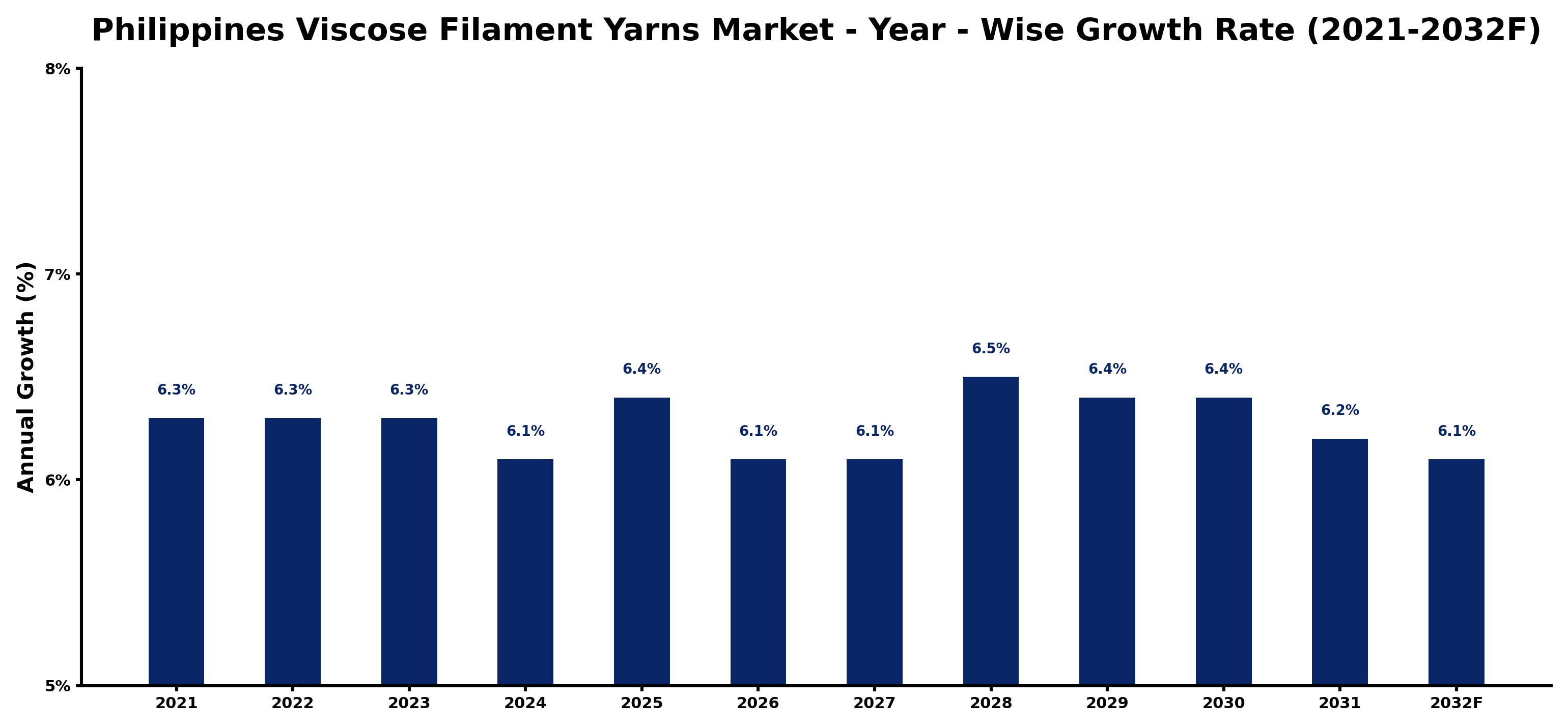
The table below presents the year‑wise growth rates along with the key drivers influencing the market
| Year | Growth Rate | Major Drivers |
| 2021 | 6.3% | Automation integration boosts efficiency in viscose filament yarn production |
| 2022 | 6.3% | Higher demand for eco friendly products boosts filament yarn production capacity |
| 2023 | 6.3% | Domestic textile manufacturers prioritize investments in sustainable yarn production |
| 2024 | 6.1% | Local textile manufacturers upgrade facilities to enhance production efficiency |
| 2025 | 6.4% | Export driven textile demand bolstered filament yarn production capacities |
| 2026 | 6.1% | Modernized textile manufacturing techniques boost viscose filament yarn production |
| 2027 | 6.1% | Local yarn manufacturers upgraded equipment to boost production efficiency |
| 2028 | 6.5% | Digital weaving technology adoption boosts filament yarn production efficiency |
| 2029 | 6.4% | Domestic fiber production investments boosted viscose yarn export capacity |
| 2030 | 6.4% | Filament yarn demand surge spurred local weaving mill investments |
| 2031 | 6.2% | Infrastructure development projects boost demand for textile manufacturing equipment |
| 2032 | 6.1% | Factory upgrades enhance capacity for viscose filament yarn production |
Note - Market size estimations and growth projections presented in this report are based on 6Wresearch’s advanced forecasting approach, validated with industry datasets as of June 2026.
Philippines Viscose Filament Yarns Market Synopsis
A pivotal force shaping the Philippines viscose filament yarns market is the soaring demand from the apparel production sector. With a growing emphasis on sustainable materials, manufacturers are increasingly turning to viscose yarns, which are derived from plant-based cellulose and align with environmentally conscious consumer choices.
The market is also influenced by the flourishing leather goods manufacturing activities in the region, particularly within ASEAN nations. This expanding sector necessitates high-quality filament yarns, further driving investments from major vendors seeking to innovate and meet the evolving demands of consumers.
Philippines Viscose Filament Yarns Market Key Takeaways
- The market is projected to grow significantly, driven by rising consumer demand for sustainable textiles.
- Major players are investing in R&D, fostering innovation and product development.
- Increased awareness of eco-friendly products is shaping consumer preferences towards natural fibers.
- The competitive landscape includes challenges from alternative fibers and environmental sustainability issues.
- Post-pandemic recovery is bolstering demand for versatile materials in the fashion and home furnishing sectors.
Evaluation of Restraints in Philippines Viscose Filament Yarns Market
Despite the favorable growth outlook, the Philippines viscose filament yarns market faces some notable restraints. Competition from both synthetic and natural fibers continues to encroach on market share, challenging the positioning of viscose products. Furthermore, supply chain disruptions can impede the procurement of high-quality cellulose, which is essential for viscose production. Environmental concerns surrounding sustainable sourcing and eco-friendly manufacturing processes must also be effectively addressed to ensure the long-term viability of the market.
Philippines Viscose Filament Yarns Market Trends
Emerging trends within the Philippines viscose filament yarns market include a heightened focus on product innovation and sustainability. Brands are prioritizing the use of eco-friendly fibers to cater to the growing consumer base that prioritizes environmental responsibility. Additionally, the integration of technology in production processes is enhancing efficiency and quality, while trends towards versatile, multi-functional textiles are influencing product development strategies in this dynamic market.
Philippines Viscose Filament Yarns Market Opportunities
The market presents several genuine growth opportunities for stakeholders. Investments in R&D aimed at developing innovative, sustainable materials could yield significant returns. There is potential for expansion in export markets, especially as demand for eco-friendly textiles grows globally. Collaboration with fashion designers and textile manufacturers can also pave the way for new product applications, creating a competitive advantage and fostering long-term growth.
Government Initiatives in the Philippines Viscose Filament Yarns Market
The Philippine government has been increasingly supportive of the textile industry through various policies and incentives. Initiatives aimed at promoting sustainable manufacturing practices are being developed, encouraging the adoption of eco-friendly materials in production. Public investments are being channeled into programs that aim to bolster the textile sector, thereby enhancing competitiveness within the regional and global markets.
Future Insights of the Philippines Viscose Filament Yarns Market
Looking ahead to 2026-2032, the Philippines viscose filament yarns market is set to evolve significantly. With the increasing importance placed on sustainability, manufacturers who innovate in eco-friendly production methods will likely lead the market. As consumer preferences continue to shift towards natural fibers, those businesses that adapt quickly will find themselves well-positioned to capitalize on this trend, ensuring robust growth and market share expansion in the coming years.
Philippines Viscose Filament Yarns Market Latest Developments (May 2025 - June 2026)
In recent months, the industry has witnessed a marked shift towards sustainability as companies implement greener manufacturing practices. Collaboration between textile manufacturers and eco-conscious brands has increased, fostering innovation in product offerings. The adaptation of digital platforms for marketing and distribution has also gained traction, allowing for enhanced consumer engagement and outreach, which is crucial as the market continues to recover and adapt post-pandemic.
Philippines Viscose Filament Yarns Market - Key Attractiveness of the Report
- 10 Years of Market Numbers
- Historical Data Starting from 2022 to 2025
- Base Year: 2025
- Forecast Data until 2032
- Key Performance Indicators Impacting the Market
- Major Upcoming Developments and Projects
Key Highlights of the Report:
- Philippines Viscose Filament Yarns Market Outlook
- Market Size of Philippines Viscose Filament Yarns Market, 2025
- Forecast of Philippines Viscose Filament Yarns Market, 2032
- Historical Data and Forecast of Philippines Viscose Filament Yarns Revenues & Volume for the Period 2022-2032F
- Philippines Viscose Filament Yarns Market Trend Evolution
- Philippines Viscose Filament Yarns Market Drivers and Challenges
- Philippines Viscose Filament Yarns Price Trends
- Philippines Viscose Filament Yarns Porter's Five Forces
- Philippines Viscose Filament Yarns Industry Life Cycle
- Historical Data and Forecast of Philippines Viscose Filament Yarns Market Revenues & Volume By Type for the Period 2022-2032F
- Historical Data and Forecast of Philippines Viscose Filament Yarns Market Revenues & Volume By Continuous for the Period 2022-2032F
- Historical Data and Forecast of Philippines Viscose Filament Yarns Market Revenues & Volume By Semi-contunuous for the Period 2022-2032F
- Historical Data and Forecast of Philippines Viscose Filament Yarns Market Revenues & Volume By Application for the Period 2022-2032F
- Historical Data and Forecast of Philippines Viscose Filament Yarns Market Revenues & Volume By Garment industry for the Period 2022-2032F
- Historical Data and Forecast of Philippines Viscose Filament Yarns Market Revenues & Volume By Auto industry for the Period 2022-2032F
- Historical Data and Forecast of Philippines Viscose Filament Yarns Market Revenues & Volume By other for the Period 2022-2032F
- Philippines Viscose Filament Yarns Import Export Trade Statistics
- Market Opportunity Assessment By Type
- Market Opportunity Assessment By Application
- Philippines Viscose Filament Yarns Top Companies Market Share
- Philippines Viscose Filament Yarns Competitive Benchmarking By Technical and Operational Parameters
- Philippines Viscose Filament Yarns Company Profiles
- Philippines Viscose Filament Yarns Key Strategic Recommendations






































