Poland Advertising Market Size, Share & Growth Rate
The Poland Advertising Market was estimated at USD 384 Million in 2025 and is projected to reach USD 533 Million by 2032, growing at a CAGR of 4.8% from 2026 to 2032. This growth trajectory is largely fueled by the ongoing digitalization across various sectors and the increasing consumer appetite for innovative advertising methods. As brands recognize the importance of engaging with digitally savvy consumers, investments in mobile and programmatic advertising are likely to accelerate, further propelling market expansion.
Poland Advertising Market Year-wise Growth Rate and Key Drivers
This graph highlights how the Poland Advertising Market has steadily grown over the years, supported by major growth factors.
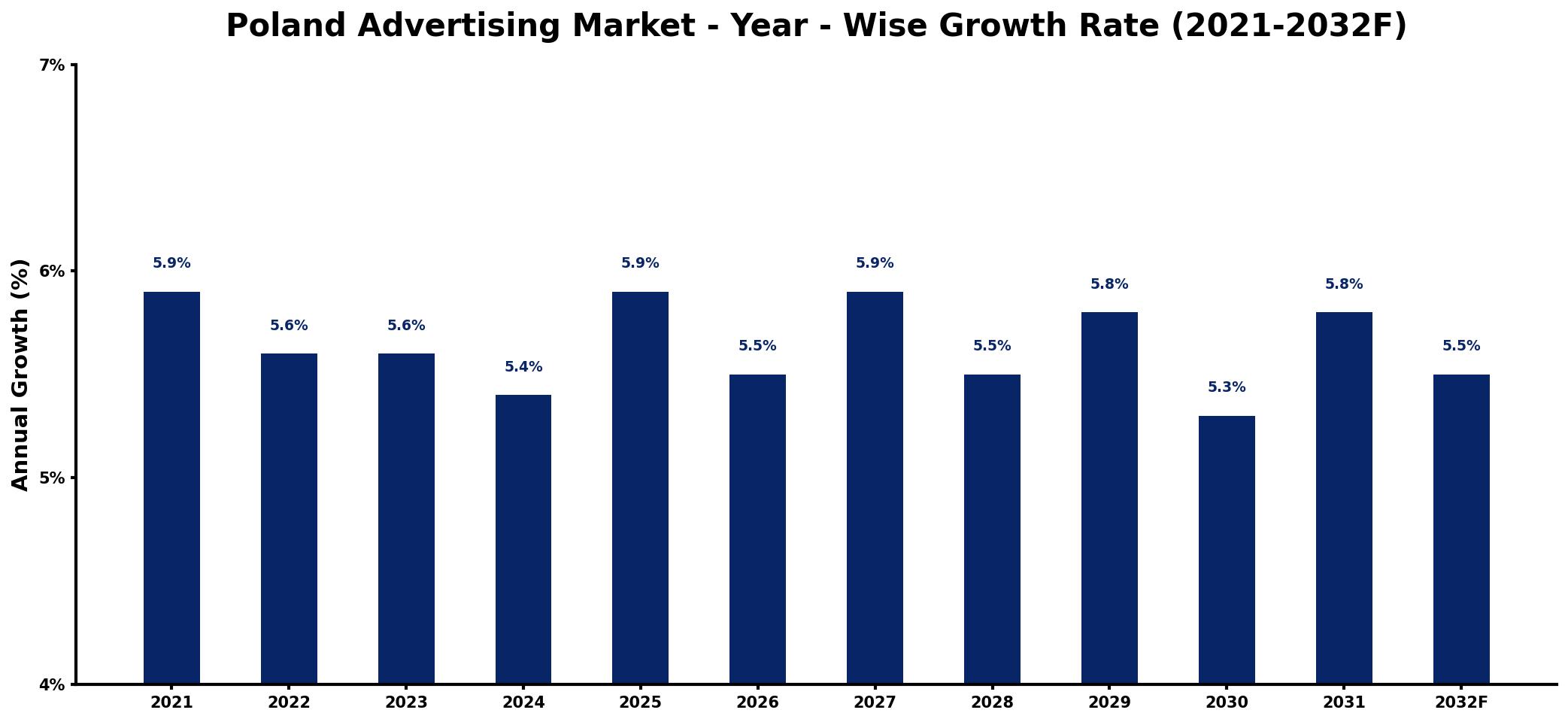
The table below presents the year‑wise growth rates along with the key drivers influencing the market
| Year | Growth Rate | Major Drivers |
| 2021 | 5.9% | Digital transformation accelerating brand visibility |
| 2022 | 5.6% | Increased consumer spending on experiences |
| 2023 | 5.6% | Emergence of new media channels |
| 2024 | 5.4% | Rise in influencer marketing strategies |
| 2025 | 5.9% | Growing investment in content creation |
| 2026 | 5.5% | Expansion of e-commerce platforms |
| 2027 | 5.9% | Enhanced data analytics capabilities adopted |
| 2028 | 5.5% | Increased focus on sustainability initiatives |
| 2029 | 5.8% | Development of immersive technologies growth |
| 2030 | 5.3% | Shift towards personalized marketing approaches |
| 2031 | 5.8% | Strengthening community engagement efforts |
| 2032 | 5.5% | increased pharmaceutical industry usage |
Note: Market size estimations and growth projections presented in this report are based on 6Wresearch's proprietary forecasting methodology, utilizing the latest available industry data, government publications, and primary research inputs.
Poland Advertising Market Synopsis
The demand for targeted and personalized advertising in Poland is burgeoning, particularly as brands leverage data analytics to refine their strategies. The shift from traditional media towards digital platforms is reshaping how companies connect with their audiences, making it imperative for advertisers to adopt modern approaches.
Television still commands a significant share of advertising spend, but digital channels are quickly gaining ground, especially with the increasing penetration of mobile internet. Brands are actively seeking to capitalize on this trend, utilizing social media and influencer marketing to enhance their reach and engagement.
Poland Advertising Market Key Takeaways
- Digital advertising is rapidly becoming the dominant force, driven by consumer preferences and technological advancements.
- Television remains a critical channel for brand messaging, although digital channels are growing at an accelerated pace.
- Personalized marketing strategies are essential for engagement, with advertisers investing in data-driven approaches.
- Competition is intensifying among local and international advertising firms, necessitating innovative solutions.
- Investment opportunities are particularly strong in mobile and programmatic advertising, reflecting changing consumer behaviors.
Evaluation of Restraints in Poland Advertising Market
Despite its promising trajectory, the Poland Advertising Market faces notable challenges. The increasing competition among advertising agencies complicates the landscape, as brands vie for consumer attention across fragmented media channels. This fragmentation can hinder the effectiveness of campaigns, leading to challenges in audience reach. Additionally, the rise of ad-blocking technologies threatens the effectiveness of digital advertising strategies. Advertisers must continuously evolve their tactics to adapt to shifting consumer preferences and navigate the complexities introduced by regulatory frameworks, particularly concerning data privacy and advertising standards.
Poland Advertising Market Trends
The focus on digital advertising within the Poland market is unparalleled, with significant investments directed towards social media and programmatic strategies. Video advertising is on the rise, reflecting consumers increasing engagement with visual content across digital platforms. Influencer marketing continues to gain momentum as brands tap into the popularity of social media personalities to connect with target demographics. Personalized, interactive advertising experiences are being prioritized, as companies leverage consumer insights to create relevant campaigns. Additionally, the emphasis on data-driven strategies is shaping the future of advertising, allowing brands to optimize their outreach effectively.
Poland Advertising Market Opportunities
Investment opportunities abound in the Poland Advertising Market, particularly within the digital sphere. The escalating internet penetration and smartphone usage create a fertile ground for digital solutions, especially in social media and programmatic advertising. Furthermore, while traditional channels like TV and print retain their value, theres a noticeable shift toward innovative digital approaches. Companies involved in advertising technology, digital agency services, or media buying platforms can expect significant returns in this evolving market. The strong economic performance of Poland enhances the appeal for advertising investments, as various sectors look to enhance their market presence.
Government Initiatives in the Poland Advertising Market
In Poland, government initiatives surrounding the advertising market are primarily driven by regulatory frameworks that prioritize fair competition and consumer protection. The Act on Combating Unfair Competition and the Act on Consumer Rights ensure that advertising practices are ethical and transparent. Furthermore, the Polish Advertising Standards Council plays a crucial role in maintaining industry standards, advocating for responsible advertising practices. There are also restrictions on advertising certain products, such as tobacco and alcohol, aimed at safeguarding public health. These measures collectively foster a regulated environment conducive to ethical advertising.
Future Insights of the Poland Advertising Market
Looking forward to 2026-2032, the Poland Advertising Market is poised for sustained growth as digital transformation continues to redefine consumer interactions. With brands expected to allocate more resources to digital marketing, the evolution of advertising strategies will be marked by enhanced personalization and technological advancements. Programmatic advertising and advanced data analytics will further empower advertisers to engage effectively with audiences. The burgeoning e-commerce landscape and increased mobile advertising will unlock additional pathways for growth. While competition will remain fierce, the adaptability of firms in navigating the regulatory landscape will be crucial in seizing emerging opportunities.
Poland Advertising Market Latest Developments (2025 - 2026)
Recent developments in the Poland advertising market underscore a shift towards more data-driven, consumer-centric approaches. Brands are increasingly investing in advanced analytics and technology to refine their marketing strategies. Additionally, there is a noticeable trend towards sustainability in advertising campaigns, with brands keen on aligning their messaging with social responsibility initiatives. The rise of virtual and augmented reality in advertising is also becoming evident, presenting new avenues for engaging audiences in innovative ways.
Poland Advertising Market - Key Attractiveness of the Report
- 10 Years of Market Numbers
- Historical Data Starting from 2022 to 2025
- Base Year: 2025
- Forecast Data until 2032
- Key Performance Indicators Impacting the Market
- Major Upcoming Developments and Projects
Key Highlights of the Report:
- Poland Advertising Market Outlook
- Market Size of Poland Advertising Market, 2025
- Forecast of Poland Advertising Market, 2032
- Historical Data and Forecast of Poland Advertising Revenues & Volume for the Period 2022-2032F
- Poland Advertising Market Trend Evolution
- Poland Advertising Market Drivers and Challenges
- Poland Advertising Price Trends
- Poland Advertising Porter's Five Forces
- Poland Advertising Industry Life Cycle
- Historical Data and Forecast of Poland Advertising Market Revenues & Volume By Type for the Period 2022-2032F
- Historical Data and Forecast of Poland Advertising Market Revenues & Volume By Television for the Period 2022-2032F
- Historical Data and Forecast of Poland Advertising Market Revenues & Volume By Print (Newspaper and Magazine) for the Period 2022-2032F
- Historical Data and Forecast of Poland Advertising Market Revenues & Volume By Radio for the Period 2022-2032F
- Historical Data and Forecast of Poland Advertising Market Revenues & Volume By Outdoor for the Period 2022-2032F
- Historical Data and Forecast of Poland Advertising Market Revenues & Volume By Internet (Search, Display, Classified, Video) for the Period 2022-2032F
- Historical Data and Forecast of Poland Advertising Market Revenues & Volume By Mobile for the Period 2022-2032F
- Historical Data and Forecast of Poland Advertising Market Revenues & Volume By Cinema for the Period 2022-2032F
- Poland Advertising Import Export Trade Statistics
- Market Opportunity Assessment By Type
- Poland Advertising Top Companies Market Share
- Poland Advertising Competitive Benchmarking By Technical and Operational Parameters
- Poland Advertising Company Profiles
- Poland Advertising Key Strategic Recommendations






































