Poland Apiculture Market Size, Share & Growth Rate
The Poland Apiculture Market was estimated at USD 443 Million in 2025 and is projected to reach USD 647 Million by 2032, growing at a CAGR of 5.6% from 2026 to 2032. This growth trajectory is bolstered by an increasing consumer preference for natural and organic honey, as well as a heightened awareness of the health benefits associated with bee products. The EU membership further amplifies trade opportunities, allowing Polish honey to penetrate international markets.
Poland Apiculture Market Year-wise Growth Rate and Key Drivers
This graph highlights how the Poland Apiculture Market has steadily grown over the years, supported by major growth factors.
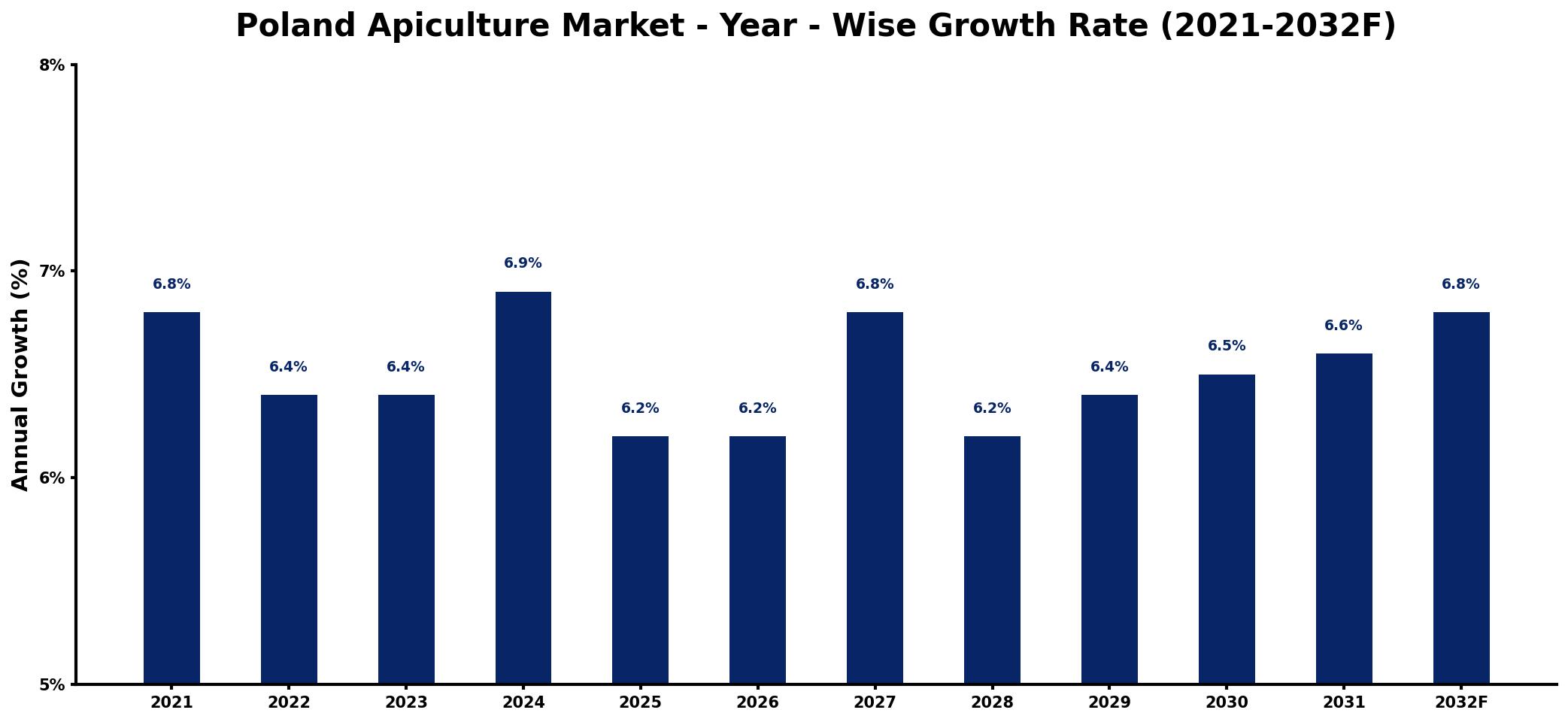
The table below presents the year‑wise growth rates along with the key drivers influencing the market
| Year | Growth Rate | Major Drivers |
| 2021 | 6.8% | rising consumer health consciousness |
| 2022 | 6.4% | increased organic farming initiatives |
| 2023 | 6.4% | growing demand for natural sweeteners |
| 2024 | 6.9% | expansion of sustainable agriculture practices |
| 2025 | 6.2% | enhanced bee conservation efforts |
| 2026 | 6.2% | increased investment in beekeeping technology |
| 2027 | 6.8% | growing popularity of local products |
| 2028 | 6.2% | rising end-use demand growth |
| 2029 | 6.4% | rising interest in urban beekeeping |
| 2030 | 6.5% | increased collaboration with environmental groups |
| 2031 | 6.6% | growing market for artisanal goods |
| 2032 | 6.8% | improved processing technologies adoption |
Note: Market size estimations and growth projections presented in this report are based on 6Wresearch's proprietary forecasting methodology, utilizing the latest available industry data, government publications, and primary research inputs.
Poland Apiculture Market Synopsis
The Poland Apiculture Market is undergoing a transformative phase, moving from a historical focus on traditional practices towards a more modernized approach that incorporates sustainability and technology. The country boasts a rich beekeeping heritage supported by a diverse floral landscape, providing a solid foundation for honey production.
Looking ahead, the market is poised for expansion, driven by rising domestic and international demand for high-quality honey and bee products. However, beekeepers are challenged by environmental issues and competition from imported honey, necessitating adaptation and innovation to sustain growth.
Poland Apiculture Market Key Takeaways
- The market is witnessing robust growth due to increasing consumer awareness of honey's health benefits.
- Sustainable practices in beekeeping are becoming a focal point for both consumers and producers.
- There is a marked shift towards e-commerce, providing beekeepers with new sales avenues.
- Investment opportunities exist in honey production, beeswax processing, and value-added products.
- Government policies aim to bolster the apiculture sector through subsidies and quality regulations.
Evaluation of Restraints in Poland Apiculture Market
The Poland Apiculture Market faces significant challenges that can hinder its growth. The increasing prevalence of pests and diseases, such as Varroa mites, threatens bee populations, directly affecting honey yield. Fluctuating climate conditions are also a concern, as inconsistent weather patterns can disrupt flowering cycles and honey production. Furthermore, the industry grapples with a shortage of skilled beekeepers, which may limit productivity and quality. Competition from lower-priced imported honey adds another layer of complexity, compelling local producers to enhance their offerings and remain competitive.
Poland Apiculture Market Trends
Several current trends are shaping the Poland Apiculture Market. There is a growing consumer preference for organic and locally sourced honey, which is prompting beekeepers to adopt sustainable and ethical practices. Awareness of the importance of bee health is leading to increased adoption of natural remedies and integrated pest management strategies. Additionally, the rise of e-commerce platforms offers innovative channels for direct sales, further connecting producers with health-conscious consumers seeking quality bee products.
Poland Apiculture Market Opportunities
Investment prospects in the Poland Apiculture Market are abundant. The focus on high-quality honey production presents opportunities for both domestic sales and exports. The growing popularity of products such as propolis, royal jelly, and bee pollen opens additional revenue streams for beekeepers. Furthermore, integrating technology into beekeeping practices can lead to enhanced efficiency and productivity, positioning market participants favorably as consumer preferences shift towards natural and organic offerings.
Government Initiatives in the Poland Apiculture Market
The Polish government plays a crucial role in supporting the apiculture industry through various initiatives and policies. Financial subsidies are provided for hive maintenance, disease control, and honey production to encourage beekeepers. Regulatory frameworks ensure the safety and quality of honey products, with strict standards for labeling and packaging. Additionally, government efforts to promote biodiversity through initiatives such as planting bee-friendly flora contribute positively to the sustainability of the sector.
Future Insights of the Poland Apiculture Market
Looking forward to the period between 2026 and 2032, the Poland Apiculture Market is expected to thrive, driven by heightened consumer interest in health-oriented products and natural sweeteners. The favorable climate conditions in Poland will continue to support beekeeping endeavors, while advancements in technology will likely enhance operational efficiency. As both domestic and international demand for honey and bee products escalates, the market is set for robust growth, presenting numerous opportunities for stakeholders in the apiculture industry.
Poland Apiculture Market Latest Developments (2025 - 2026)
Recent developments in the Poland Apiculture Market reflect a significant trend towards modernization and sustainability. Beekeepers are increasingly adopting advanced technologies to monitor bee health and hive conditions, ensuring better yields. There is also a growing collaboration among producers to enhance collective marketing efforts, positioning Polish honey as a premium product on both domestic and international stages. Additionally, initiatives aimed at improving bee health and environmental sustainability are gaining traction, aligning with consumer demand for responsibly sourced products.
Poland Apiculture Market - Key Attractiveness of the Report
- 10 Years of Market Numbers
- Historical Data Starting from 2022 to 2025
- Base Year: 2025
- Forecast Data until 2032
- Key Performance Indicators Impacting the Market
- Major Upcoming Developments and Projects
Key Highlights of the Report:
- Poland Apiculture Market Outlook
- Market Size of Poland Apiculture Market, 2025
- Forecast of Poland Apiculture Market, 2032
- Historical Data and Forecast of Poland Apiculture Revenues & Volume for the Period 2022-2032F
- Poland Apiculture Market Trend Evolution
- Poland Apiculture Market Drivers and Challenges
- Poland Apiculture Price Trends
- Poland Apiculture Porter's Five Forces
- Poland Apiculture Industry Life Cycle
- Historical Data and Forecast of Poland Apiculture Market Revenues & Volume By Product Type for the Period 2022-2032F
- Historical Data and Forecast of Poland Apiculture Market Revenues & Volume By Honey for the Period 2022-2032F
- Historical Data and Forecast of Poland Apiculture Market Revenues & Volume By Beeswax for the Period 2022-2032F
- Historical Data and Forecast of Poland Apiculture Market Revenues & Volume By Live-bees for the Period 2022-2032F
- Historical Data and Forecast of Poland Apiculture Market Revenues & Volume By Others for the Period 2022-2032F
- Historical Data and Forecast of Poland Apiculture Market Revenues & Volume By Application for the Period 2022-2032F
- Historical Data and Forecast of Poland Apiculture Market Revenues & Volume By Medical for the Period 2022-2032F
- Historical Data and Forecast of Poland Apiculture Market Revenues & Volume By Food Beverages for the Period 2022-2032F
- Historical Data and Forecast of Poland Apiculture Market Revenues & Volume By Cosmetics for the Period 2022-2032F
- Historical Data and Forecast of Poland Apiculture Market Revenues & Volume By Others for the Period 2022-2032F
- Poland Apiculture Import Export Trade Statistics
- Market Opportunity Assessment By Product Type
- Market Opportunity Assessment By Application
- Poland Apiculture Top Companies Market Share
- Poland Apiculture Competitive Benchmarking By Technical and Operational Parameters
- Poland Apiculture Company Profiles
- Poland Apiculture Key Strategic Recommendations






































