Poland Bicycle Lights Market: Import Trend Analysis
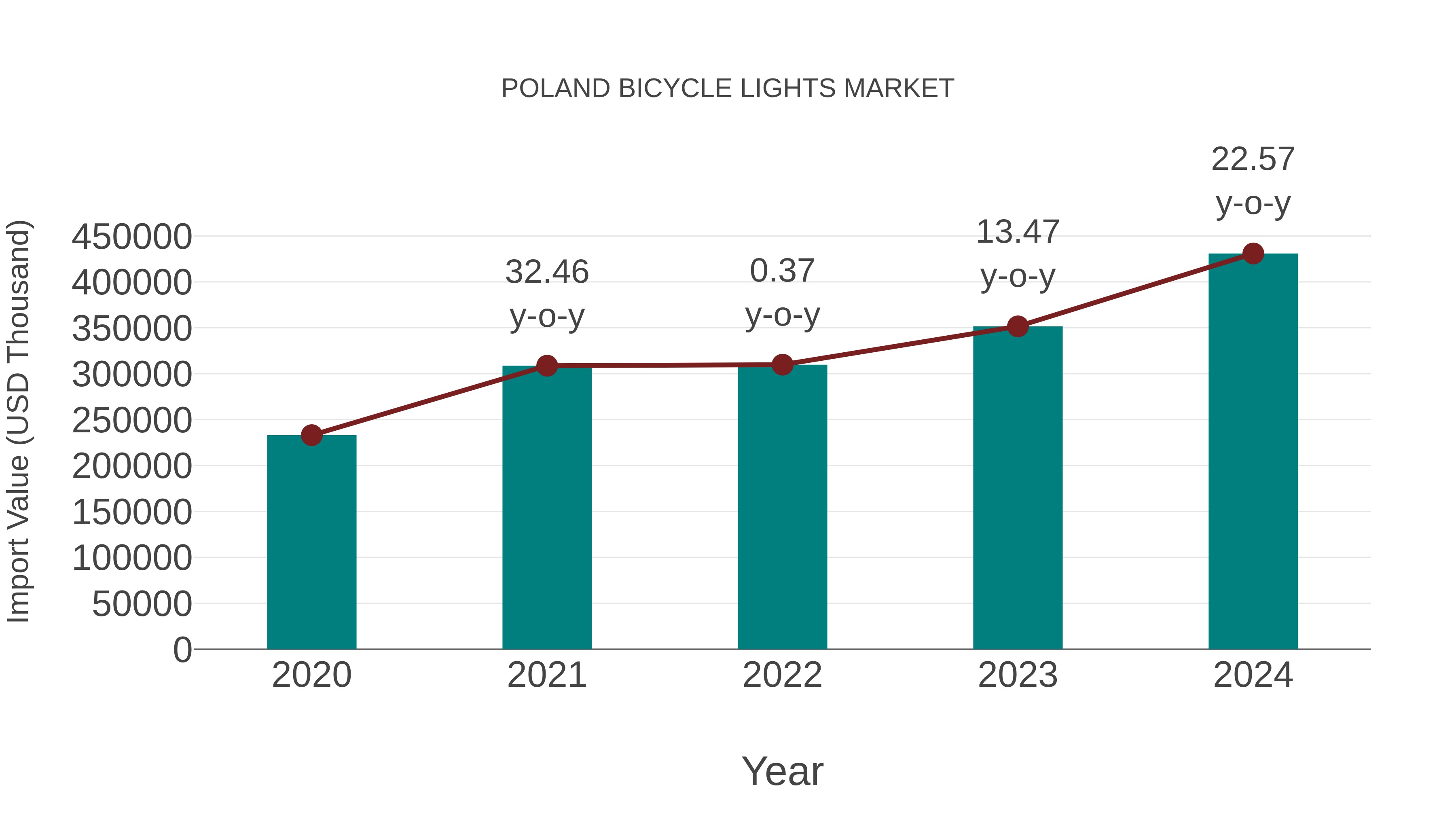
Poland import trend for the bicycle lights market showed a notable growth rate of 22.57% from 2023 to 2024, with a compound annual growth rate (CAGR) of 16.61% from 2020 to 2024. This increase could be attributed to a surge in demand for cycling accessories, potentially driven by a growing interest in sustainable transportation alternatives or increased focus on safety measures within the biking community.
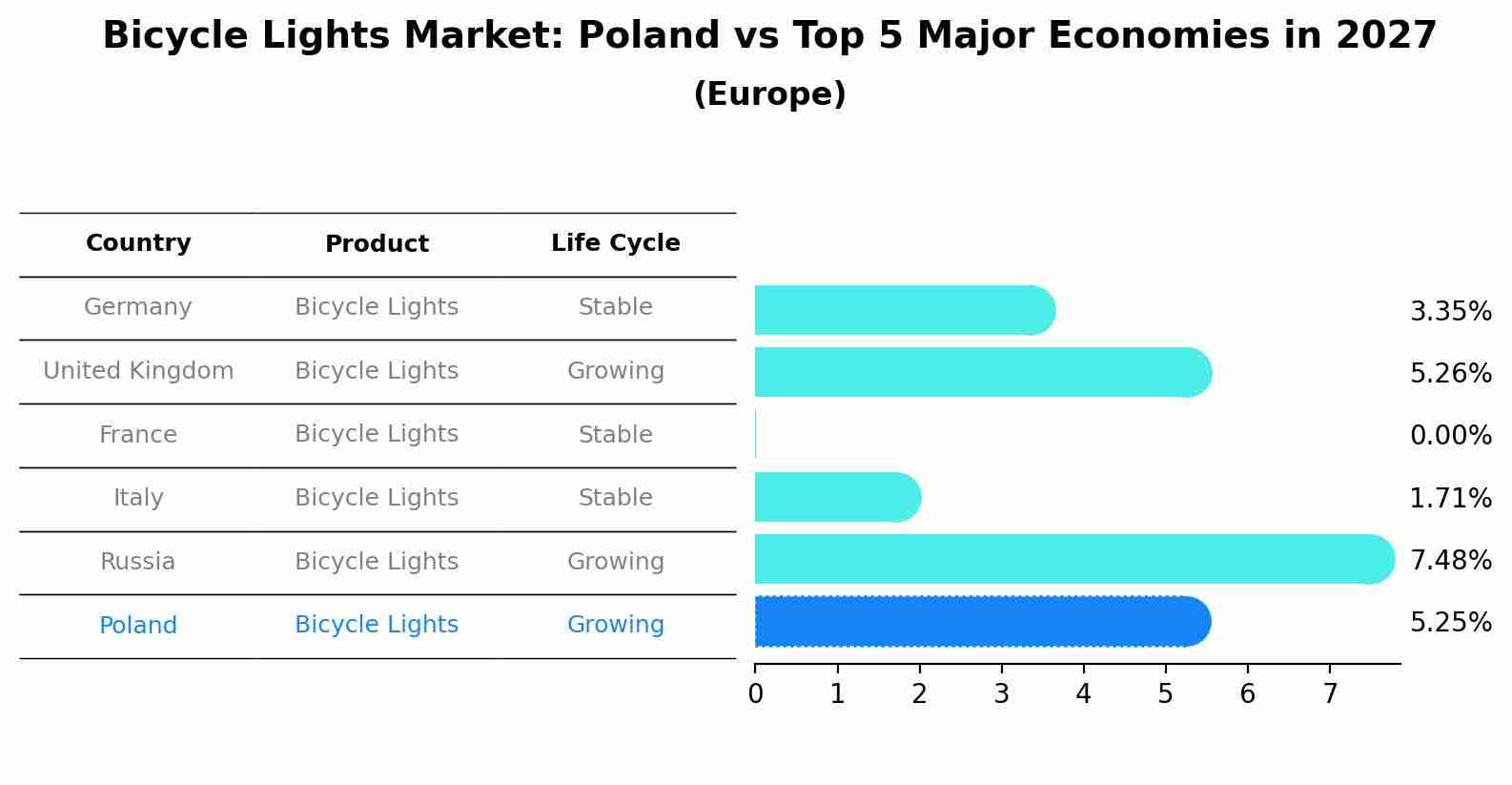
Bicycle Lights Market: Poland vs Top 5 Major Economies in 2027 (Europe)
By 2027, the Bicycle Lights market in Poland is anticipated to reach a growth rate of 5.25%, as part of an increasingly competitive Europe region, where Germany remains at the forefront, supported by United Kingdom, France, Italy and Russia, driving innovations and market adoption across sectors.
Poland Bicycle Lights Market Overview
The Poland Bicycle Lights Market is experiencing steady growth driven by increasing awareness about safety among cyclists. The market is characterized by a wide range of products including front lights, rear lights, and wheel lights, with a growing preference for rechargeable and LED lights due to their energy efficiency and brightness. Key factors influencing market growth include the rising popularity of cycling as a recreational activity, government initiatives to promote cycling infrastructure, and a growing emphasis on sustainable transportation solutions. Major players in the market are focusing on product innovation, such as incorporating smart features like automatic brightness adjustment and USB charging capabilities. The competitive landscape is moderately fragmented with both domestic and international manufacturers competing to cater to the diverse needs of cyclists in Poland.
Poland Bicycle Lights Market Trends
In the Poland Bicycle Lights Market, a notable trend is the increasing demand for high-quality, durable, and technologically advanced bike lights. Consumers are seeking lights with powerful illumination, long battery life, and multiple lighting modes for enhanced visibility and safety during night rides. There is a growing preference for rechargeable lights over traditional battery-operated ones due to their eco-friendly nature and cost-effectiveness in the long run. Additionally, there is a rising interest in smart lights that can be connected to smartphones for customizable settings and features. With a focus on safety and performance, manufacturers in the Poland Bicycle Lights Market are innovating to meet the evolving needs of cyclists and capitalize on the growing popularity of cycling as a recreational and commuting activity.
Poland Bicycle Lights Market Challenges
In the Poland Bicycle Lights Market, some key challenges include increasing competition from both domestic and international brands, fluctuating consumer demand due to economic factors, and the need for continuous innovation to meet changing safety regulations and consumer preferences. The market is also affected by seasonality, with higher demand during the summer months and lower demand in the winter. Additionally, price sensitivity among consumers and the presence of counterfeit or low-quality products in the market pose challenges for established brands in maintaining market share and brand reputation. Overall, companies operating in the Poland Bicycle Lights Market need to stay agile, invest in research and development, and build strong distribution networks to navigate these challenges and remain competitive in the market.
Poland Bicycle Lights Market Investment Opportunities
The Poland Bicycle Lights Market presents promising investment opportunities driven by the growing popularity of cycling as a recreational and commuting activity. With increasing awareness of safety measures among cyclists, there is a rising demand for innovative and high-quality bicycle lights in the market. Investors can capitalize on this trend by investing in companies that manufacture and distribute bicycle lights with advanced features such as LED technology, rechargeable batteries, and waterproof designs. Additionally, there is potential for growth in the smart bicycle lights segment, integrating technology such as Bluetooth connectivity and motion sensors. Investing in research and development to create eco-friendly and sustainable lighting solutions can also be a strategic move to capture a larger market share in Poland`s evolving bicycle lights industry.
Poland Bicycle Lights Market Government Policy
Government policies related to the Poland Bicycle Lights Market primarily focus on enhancing road safety for cyclists. Regulations mandate that all bicycles must be equipped with front and rear lights when riding after dark or in low visibility conditions. The lights must meet specific brightness and visibility requirements to ensure that cyclists are easily seen by other road users. Additionally, the government encourages the use of high-quality, durable lights that are resistant to weather conditions and provide adequate illumination for the cyclist. Compliance with these regulations is enforced through regular checks by law enforcement officials, and non-compliance can result in fines or other penalties. Overall, the government`s policies aim to promote safe cycling practices and reduce the risk of accidents on the roads.
Poland Bicycle Lights Market Future Outlook
The Poland Bicycle Lights Market is projected to experience steady growth in the coming years, driven by increasing awareness of safety measures among cyclists and the rising popularity of cycling as a means of transportation and recreation. The market is expected to benefit from technological advancements leading to the development of innovative, high-performance, and energy-efficient bicycle lights. Additionally, the growing emphasis on sustainable and eco-friendly modes of transportation is likely to further fuel the demand for bicycle lights in Poland. As more people adopt cycling as a part of their lifestyle, the market is anticipated to witness a rise in sales of bicycle lights, particularly those equipped with features such as rechargeable batteries, long battery life, and enhanced visibility to ensure safe riding experiences.
Key Highlights of the Report:
- Poland Bicycle Lights Market Outlook
- Market Size of Poland Bicycle Lights Market, 2021
- Forecast of Poland Bicycle Lights Market, 2027
- Historical Data and Forecast of Poland Bicycle Lights Revenues & Volume for the Period 2018 - 2027
- Poland Bicycle Lights Market Trend Evolution
- Poland Bicycle Lights Market Drivers and Challenges
- Poland Bicycle Lights Price Trends
- Poland Bicycle Lights Porter's Five Forces
- Poland Bicycle Lights Industry Life Cycle
- Historical Data and Forecast of Poland Bicycle Lights Market Revenues & Volume By Product Type for the Period 2018 - 2027
- Historical Data and Forecast of Poland Bicycle Lights Market Revenues & Volume By Headlight for the Period 2018 - 2027
- Historical Data and Forecast of Poland Bicycle Lights Market Revenues & Volume By Taillight for the Period 2018 - 2027
- Historical Data and Forecast of Poland Bicycle Lights Market Revenues & Volume By Application for the Period 2018 - 2027
- Historical Data and Forecast of Poland Bicycle Lights Market Revenues & Volume By Mountain Bicycle for the Period 2018 - 2027
- Historical Data and Forecast of Poland Bicycle Lights Market Revenues & Volume By Road Bicycle for the Period 2018 - 2027
- Historical Data and Forecast of Poland Bicycle Lights Market Revenues & Volume By Commuting Bicycle for the Period 2018 - 2027
- Poland Bicycle Lights Import Export Trade Statistics
- Market Opportunity Assessment By Product Type
- Market Opportunity Assessment By Application
- Poland Bicycle Lights Top Companies Market Share
- Poland Bicycle Lights Competitive Benchmarking By Technical and Operational Parameters
- Poland Bicycle Lights Company Profiles
- Poland Bicycle Lights Key Strategic Recommendations






































