Poland Biscuits and Crackers Market: Import Trend Analysis
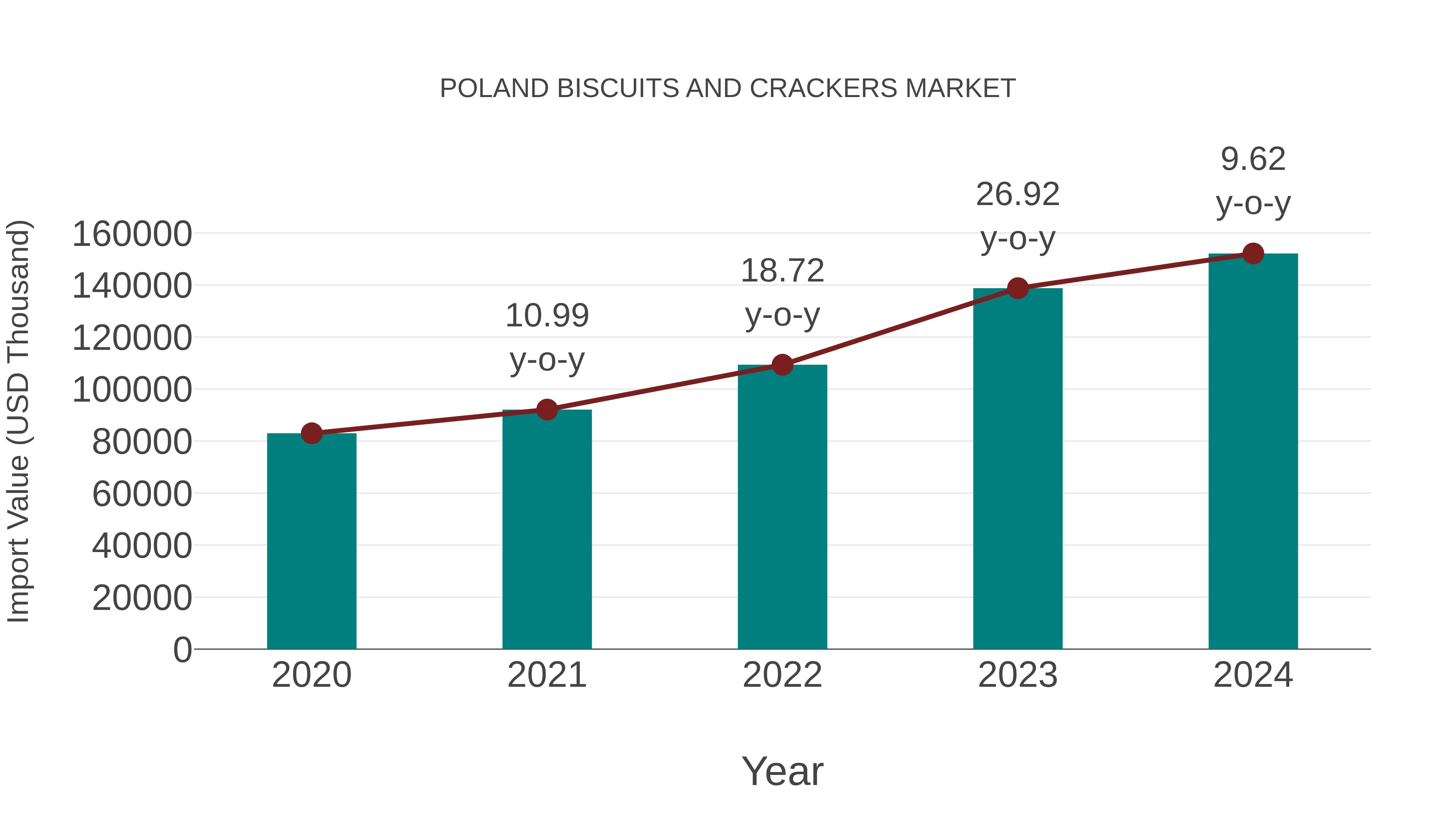
In the Poland biscuits and crackers market, the import trend showed a notable growth rate of 9.62% from 2023 to 2024, with a compound annual growth rate (CAGR) of 16.36% for the period 2020-2024. This uptrend in imports could be attributed to shifting consumer preferences towards convenience snacks, indicating a potential increase in market demand and consumption patterns during this period.
Poland Biscuits and Crackers Market Synopsis
Poland biscuits and crackers market is one of the leading markets in Central Europe, with a total sales value of EUR 1.3 billion in 2020. The country is known for its wide variety of traditional biscuit recipes such as piernik (gingerbread), mazurek (butter cake) and babka (yeast cake). However, over the last five years there has been an increase in consumption of more modern biscuit varieties such as chocolate-covered wafers, cookies and cereal bars. Furthermore, health awareness among consumers has led to increased demand for healthier products like whole wheat biscuits or low calorie options. In addition to biscuits, crackers are becoming increasingly popular in Poland due to their convenience and diversity when it comes to flavors - they can be enjoyed both on their own or used as a base ingredient for appetizers. The overall outlook for the Polish biscuits and crackers market remains positive with manufacturers focusing on product innovation by introducing new flavors and formats that appeal to current consumer trends.
Key Highlights of the Report:
- Poland Biscuits and Crackers Market Outlook
- Market Size of Poland Biscuits and Crackers Market, 2019
- Forecast of Poland Biscuits and Crackers Market, 2026
- Historical Data and Forecast of Poland Biscuits and Crackers Revenues & Volume for the Period 2016 - 2026
- Poland Biscuits and Crackers Market Trend Evolution
- Poland Biscuits and Crackers Market Drivers and Challenges
- Poland Biscuits and Crackers Price Trends
- Poland Biscuits and Crackers Porter's Five Forces
- Poland Biscuits and Crackers Industry Life Cycle
- Historical Data and Forecast of Poland Biscuits and Crackers Market Revenues & Volume By Product for the Period 2016 - 2026
- Historical Data and Forecast of Poland Biscuits and Crackers Market Revenues & Volume By Biscuits for the Period 2016 - 2026
- Historical Data and Forecast of Poland Biscuits and Crackers Market Revenues & Volume By Crackers for the Period 2016 - 2026
- Historical Data and Forecast of Poland Biscuits and Crackers Market Revenues & Volume By Applications for the Period 2016 - 2026
- Historical Data and Forecast of Poland Biscuits and Crackers Market Revenues & Volume By Online for the Period 2016 - 2026
- Historical Data and Forecast of Poland Biscuits and Crackers Market Revenues & Volume By Supermarket for the Period 2016 - 2026
- Historical Data and Forecast of Poland Biscuits and Crackers Market Revenues & Volume By Food Store for the Period 2016 - 2026
- Poland Biscuits and Crackers Import Export Trade Statistics
- Market Opportunity Assessment By Product
- Market Opportunity Assessment By Applications
- Poland Biscuits and Crackers Top Companies Market Share
- Poland Biscuits and Crackers Competitive Benchmarking By Technical and Operational Parameters
- Poland Biscuits and Crackers Company Profiles
- Poland Biscuits and Crackers Key Strategic Recommendations






































