Poland Carbonated Beverages Market: Import Trend Analysis
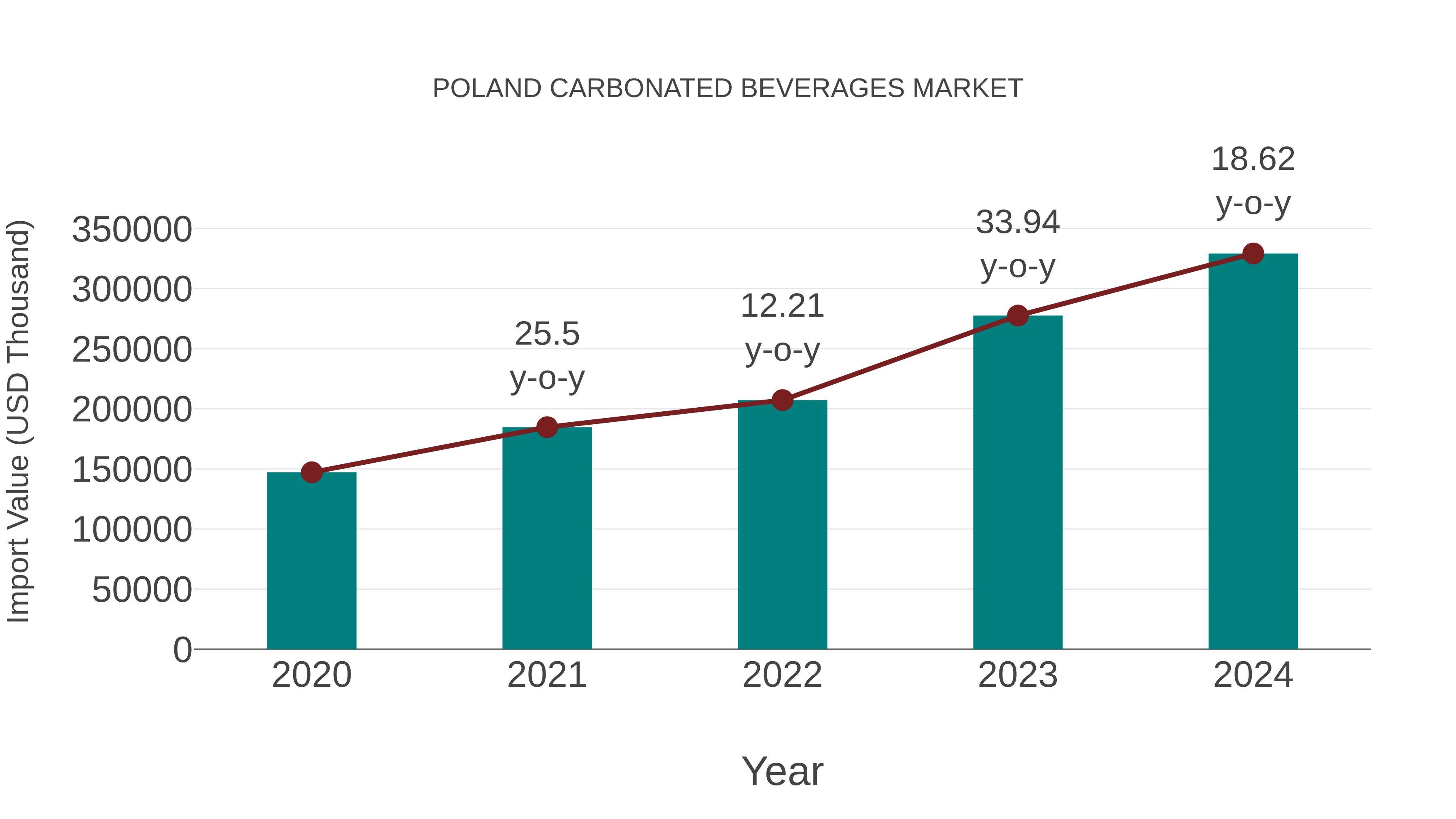
In the Poland carbonated beverages market, the import trend showed a notable growth rate of 18.62% from 2023 to 2024, with a compound annual growth rate (CAGR) of 22.3% from 2020 to 2024. This surge in imports can be attributed to shifting consumer preferences towards a wider variety of beverages and increased demand for international brands in the market.
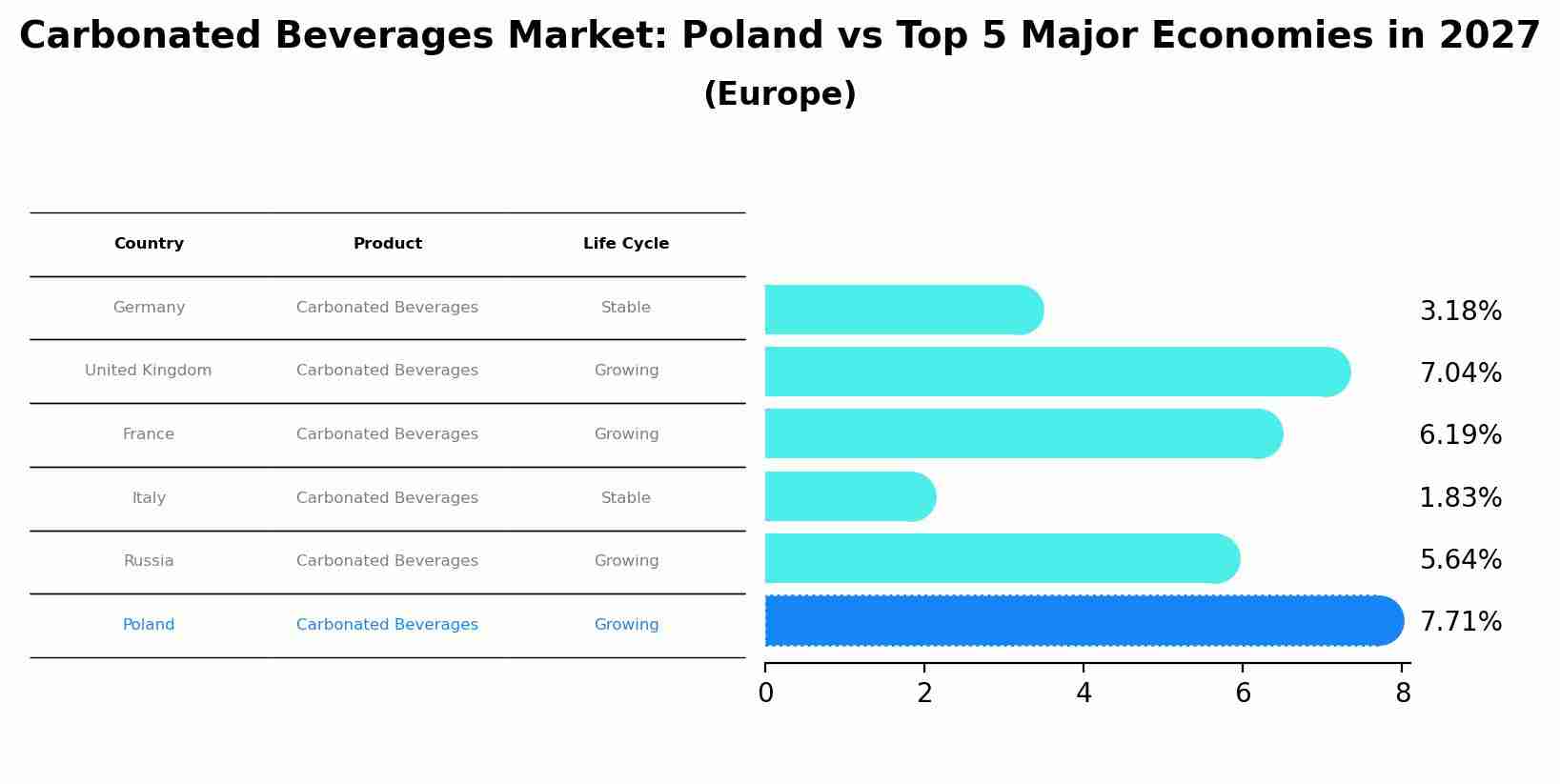
Carbonated Beverages Market: Poland vs Top 5 Major Economies in 2027 (Europe)
In the Europe region, the Carbonated Beverages market in Poland is projected to expand at a growing growth rate of 7.71% by 2027. The largest economy is Germany, followed by United Kingdom, France, Italy and Russia.
Poland Carbonated Beverages Market Overview
The Poland Carbonated Beverages Market is seeing steady growth due to the popularity of soft drinks, flavored carbonated water, and energy drinks. As consumer preferences evolve towards healthier options, manufacturers are also focusing on low-calorie and sugar-free variants.
Drivers of the market
The carbonated beverages market in Poland benefits from the widespread consumption of soft drinks, sparkling waters, and flavored sodas. The market is influenced by changing consumer preferences, including the demand for healthier and low-calorie options. The growth in the beverage industry, coupled with innovations in product formulations and packaging, drives market demand. Additionally, the rise in premium and artisanal carbonated beverages, along with marketing strategies targeting diverse consumer segments, supports market expansion.
Challenges of the market
Polands carbonated beverages market faces challenges from increasing health consciousness among consumers, leading to a decline in the consumption of sugary drinks. The market is also impacted by growing government regulations on sugar content and advertising, which add compliance costs for manufacturers. Additionally, competition from healthier beverage alternatives, such as flavored water and juices, limits market growth.
Government Policy of the market
The carbonated beverages market in Poland is shaped by regulations focused on food safety, labeling, and environmental sustainability. Government policies ensure that carbonated beverages comply with EU standards on product safety and consumer information. Regulations on packaging and waste management influence market practices. Government support for innovations in beverage formulation and sustainable packaging technologies impacts market dynamics.
Key Highlights of the Report:
- Poland Carbonated Beverages Market Outlook
- Market Size of Poland Carbonated Beverages Market, 2025
- Forecast of Poland Carbonated Beverages Market, 2032
- Historical Data and Forecast of Poland Carbonated Beverages Revenues & Volume for the Period 2022-2032F
- Poland Carbonated Beverages Market Trend Evolution
- Poland Carbonated Beverages Market Drivers and Challenges
- Poland Carbonated Beverages Price Trends
- Poland Carbonated Beverages Porter's Five Forces
- Poland Carbonated Beverages Industry Life Cycle
- Historical Data and Forecast of Poland Carbonated Beverages Market Revenues & Volume By Product Types for the Period 2022-2032F
- Historical Data and Forecast of Poland Carbonated Beverages Market Revenues & Volume By Soft Drinks for the Period 2022-2032F
- Historical Data and Forecast of Poland Carbonated Beverages Market Revenues & Volume By Carbonated Water for the Period 2022-2032F
- Historical Data and Forecast of Poland Carbonated Beverages Market Revenues & Volume By Sports & Energy Drinks for the Period 2022-2032F
- Historical Data and Forecast of Poland Carbonated Beverages Market Revenues & Volume By Others for the Period 2022-2032F
- Historical Data and Forecast of Poland Carbonated Beverages Market Revenues & Volume By Flavour for the Period 2022-2032F
- Historical Data and Forecast of Poland Carbonated Beverages Market Revenues & Volume By Cola for the Period 2022-2032F
- Historical Data and Forecast of Poland Carbonated Beverages Market Revenues & Volume By Fruit Based for the Period 2022-2032F
- Historical Data and Forecast of Poland Carbonated Beverages Market Revenues & Volume By Others for the Period 2022-2032F
- Historical Data and Forecast of Poland Carbonated Beverages Market Revenues & Volume By Distribution Channel for the Period 2022-2032F
- Historical Data and Forecast of Poland Carbonated Beverages Market Revenues & Volume By Hypermarkets & Supermarkets for the Period 2022-2032F
- Historical Data and Forecast of Poland Carbonated Beverages Market Revenues & Volume By Convenience Stores for the Period 2022-2032F
- Historical Data and Forecast of Poland Carbonated Beverages Market Revenues & Volume By Food Service Outlets for the Period 2022-2032F
- Historical Data and Forecast of Poland Carbonated Beverages Market Revenues & Volume By Transport Terminals for the Period 2022-2032F
- Historical Data and Forecast of Poland Carbonated Beverages Market Revenues & Volume By Online Stores & D2C for the Period 2022-2032F
- Poland Carbonated Beverages Import Export Trade Statistics
- Market Opportunity Assessment By Product Types
- Market Opportunity Assessment By Flavour
- Market Opportunity Assessment By Distribution Channel
- Poland Carbonated Beverages Top Companies Market Share
- Poland Carbonated Beverages Competitive Benchmarking By Technical and Operational Parameters
- Poland Carbonated Beverages Company Profiles
- Poland Carbonated Beverages Key Strategic Recommendations






































