Poland Chlorine Dioxide Market Size, Share & Growth Rate
The Poland Chlorine Dioxide Market was estimated at USD 352 Million in 2025 and is projected to reach USD 515 Million by 2032, growing at a CAGR of 5.6% from 2026 to 2032. This growth trajectory is primarily fueled by the escalating demand for effective water treatment solutions across various sectors, including food and beverage, healthcare, and municipal applications. Additionally, the pulp and paper industrys pivot towards sustainable practices further drives the adoption of chlorine dioxide, reinforcing its significance in modern manufacturing processes.
Poland Chlorine Dioxide Market Year-wise Growth Rate and Key Drivers
This graph highlights how the Poland Chlorine Dioxide Market has steadily grown over the years, supported by major growth factors.
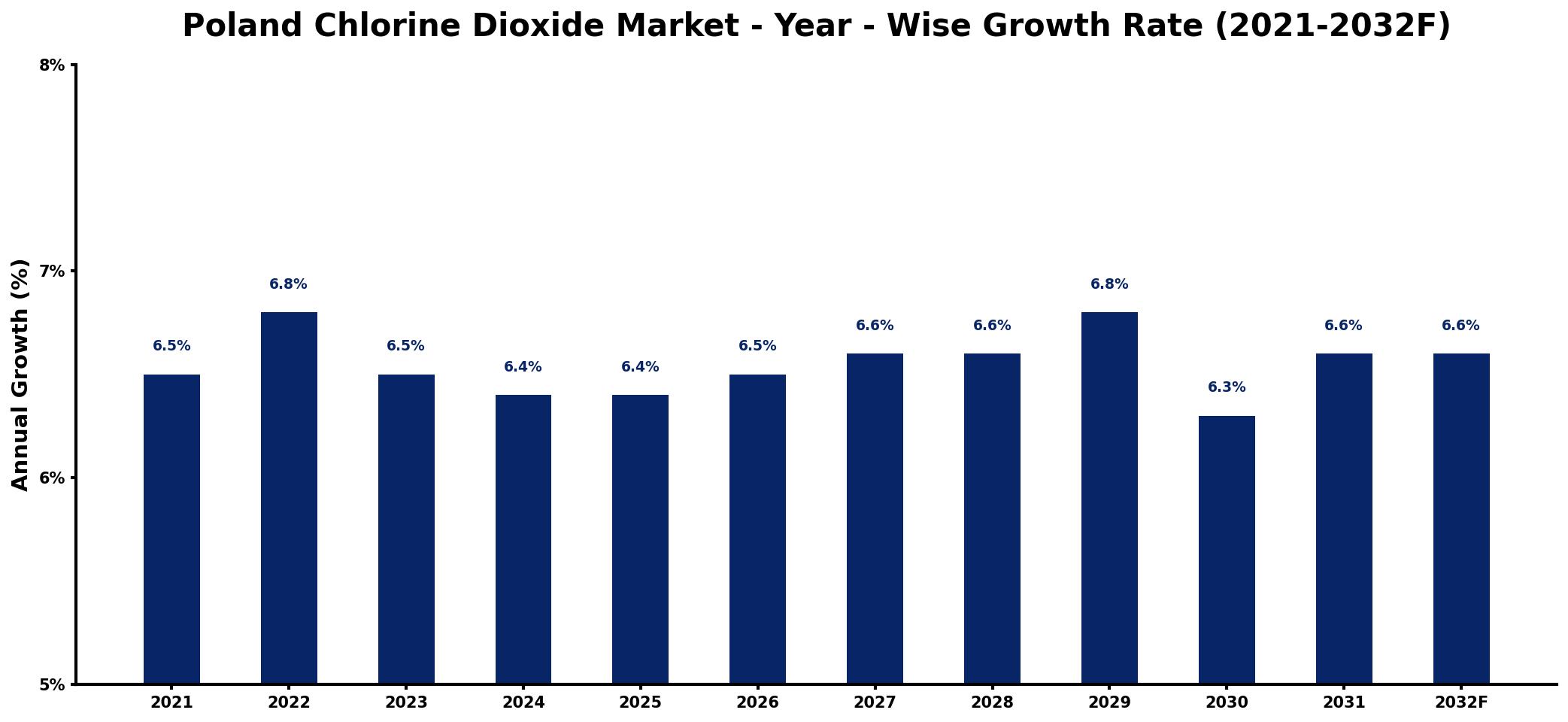
The table below presents the year‑wise growth rates along with the key drivers influencing the market
| Year | Growth Rate | Major Drivers |
| 2021 | 6.5% | Rising demand for water treatment |
| 2022 | 6.8% | Increased industrial applications adoption |
| 2023 | 6.5% | Growing awareness of sanitation needs |
| 2024 | 6.4% | Expansion in healthcare sector usage |
| 2025 | 6.4% | Investments in environmental sustainability projects |
| 2026 | 6.5% | Surge in food safety regulations |
| 2027 | 6.6% | Boost in agricultural applications growth |
| 2028 | 6.6% | Development of new distribution channels |
| 2029 | 6.8% | Enhanced efficacy in disinfection processes |
| 2030 | 6.3% | Emerging technologies in sanitation solutions |
| 2031 | 6.6% | Strengthened regulatory compliance requirements |
| 2032 | 6.6% | Collaborations with research institutions |
Note: Market size estimations and growth projections presented in this report are based on 6Wresearch's proprietary forecasting methodology, utilizing the latest available industry data, government publications, and primary research inputs.
Poland Chlorine Dioxide Market Synopsis
The most potent force currently shaping the Poland Chlorine Dioxide Market is the surging need for water treatment solutions. As water quality becomes increasingly prioritized, chlorine dioxide is recognized for its efficacy in disinfection and purification, positioning it as an essential component in various industries.
Moreover, the trend towards environmentally friendly production methods is fostering greater acceptance of chlorine dioxide, particularly in the pulp and paper sector, where it serves as a sustainable bleaching agent. The healthcare industrys ongoing reliance on chlorine dioxide for sterilization applications further underscores its growing importance in maintaining public health standards.
Poland Chlorine Dioxide Market Key Takeaways
- The market is driven by rising demand for effective water treatment solutions.
- Chlorine dioxide is becoming a preferred alternative to traditional chlorine products.
- Regulatory compliance and environmental safety standards are critical market influencers.
- Investment opportunities are emerging in R&D and efficient distribution channels.
- Technological advancements are key to addressing market challenges and enhancing product effectiveness.
Evaluation of Restraints in Poland Chlorine Dioxide Market
The Poland Chlorine Dioxide Market is indeed navigating a set of real constraints that could impede its growth. Stringent regulatory frameworks surrounding the handling and usage of chlorine dioxide add complexity for manufacturers, as compliance is both essential and costly. Additionally, competition from alternative disinfection technologies poses a challenge, particularly as some of these may be perceived as more environmentally friendly or cost-effective. The fluctuating prices of raw materials can introduce instability, further complicating operational planning for businesses in this sector. Ultimately, these factors necessitate a strategic approach to market engagement, emphasizing innovation and adaptability.
Poland Chlorine Dioxide Market Trends
Several current and emerging trends are influencing the Poland Chlorine Dioxide Market. A noteworthy trend is the heightened awareness of the benefits associated with chlorine dioxide, specifically its roles in effective disinfection and odor control, which are increasingly valued in both industrial and municipal applications. The focus on sustainable practices is prompting companies to explore alternative disinfection methods, shifting away from traditional chlorine solutions. Furthermore, the ongoing advancements in chlorine dioxide generation technology are enhancing product efficiency, thereby driving its adoption across more sectors.
Poland Chlorine Dioxide Market Opportunities
Investment opportunities abound in the Poland Chlorine Dioxide Market, particularly due to the increasing demand for innovative water treatment solutions. Companies focusing on the production and distribution of chlorine dioxide generators are well-positioned to capitalize on the growing awareness of water quality importance. Additionally, investments in R&D initiatives to improve the effectiveness and safety of chlorine dioxide applications could yield substantial returns. Expanding marketing and distribution strategies to reach under-penetrated customer bases represents another avenue for growth, creating a fertile landscape for both new and existing players in the market.
Government Initiatives in the Poland Chlorine Dioxide Market
Government policies in Poland are significantly shaping the Chlorine Dioxide Market, emphasizing safety and compliance. The Chemical Substances and Preparations Act mandates strict registration, labeling, and packaging requirements to ensure safe handling. Moreover, the Occupational Safety and Health Act outlines comprehensive guidelines to protect workers from exposure risks. The Polish government aligns its chemical safety regulations with broader European Union directives, promoting consistency and compliance across member states. These initiatives not only protect public health but also foster a regulated environment conducive to market growth.
Future Insights of the Poland Chlorine Dioxide Market
Looking ahead to 2026-2032, the Poland Chlorine Dioxide Market is expected to maintain a positive growth trajectory. The ongoing emphasis on water quality and environmental sustainability will drive demand in various sectors. Additionally, increased investment in R&D aimed at enhancing chlorine dioxides efficiency and safety will likely bolster its market presence. However, companies must remain vigilant about regulatory changes and market dynamics to navigate potential challenges effectively. Overall, this market is poised to grow, supported by a robust foundation of demand across key industries.
Poland Chlorine Dioxide Market Latest Developments (2025 - 2026)
In the recent months, industry players have increasingly focused on technological innovations to optimize the efficiency of chlorine dioxide applications. There has been a notable shift toward enhancing existing chlorine dioxide generation systems, improving both safety measures and effectiveness in various settings. Furthermore, manufacturers are exploring partnerships to streamline distribution channels, ensuring wider access to their products in Poland. As the regulatory landscape evolves, companies are proactively adapting their practices to ensure compliance, fostering a stable market environment amidst changing conditions.
Poland Chlorine Dioxide Market - Key Attractiveness of the Report
- 10 Years of Market Numbers
- Historical Data Starting from 2022 to 2025
- Base Year: 2025
- Forecast Data until 2032
- Key Performance Indicators Impacting the Market
- Major Upcoming Developments and Projects
Key Highlights of the Report:
- Poland Chlorine Dioxide Market Outlook
- Market Size of Poland Chlorine Dioxide Market, 2025
- Forecast of Poland Chlorine Dioxide Market, 2032
- Historical Data and Forecast of Poland Chlorine Dioxide Revenues & Volume for the Period 2022-2032F
- Poland Chlorine Dioxide Market Trend Evolution
- Poland Chlorine Dioxide Market Drivers and Challenges
- Poland Chlorine Dioxide Price Trends
- Poland Chlorine Dioxide Porter's Five Forces
- Poland Chlorine Dioxide Industry Life Cycle
- Historical Data and Forecast of Poland Chlorine Dioxide Market Revenues & Volume By Application for the Period 2022-2032F
- Historical Data and Forecast of Poland Chlorine Dioxide Market Revenues & Volume By Industrial Water Treatment for the Period 2022-2032F
- Historical Data and Forecast of Poland Chlorine Dioxide Market Revenues & Volume By Pulp & Paper Processing for the Period 2022-2032F
- Historical Data and Forecast of Poland Chlorine Dioxide Market Revenues & Volume By Oil & Gas for the Period 2022-2032F
- Historical Data and Forecast of Poland Chlorine Dioxide Market Revenues & Volume By Medical for the Period 2022-2032F
- Historical Data and Forecast of Poland Chlorine Dioxide Market Revenues & Volume By Food & Beverages for the Period 2022-2032F
- Historical Data and Forecast of Poland Chlorine Dioxide Market Revenues & Volume By Others for the Period 2022-2032F
- Poland Chlorine Dioxide Import Export Trade Statistics
- Market Opportunity Assessment By Application
- Poland Chlorine Dioxide Top Companies Market Share
- Poland Chlorine Dioxide Competitive Benchmarking By Technical and Operational Parameters
- Poland Chlorine Dioxide Company Profiles
- Poland Chlorine Dioxide Key Strategic Recommendations






































