Poland Cloud Computing Market Size & Growth Rate (2026-2032)
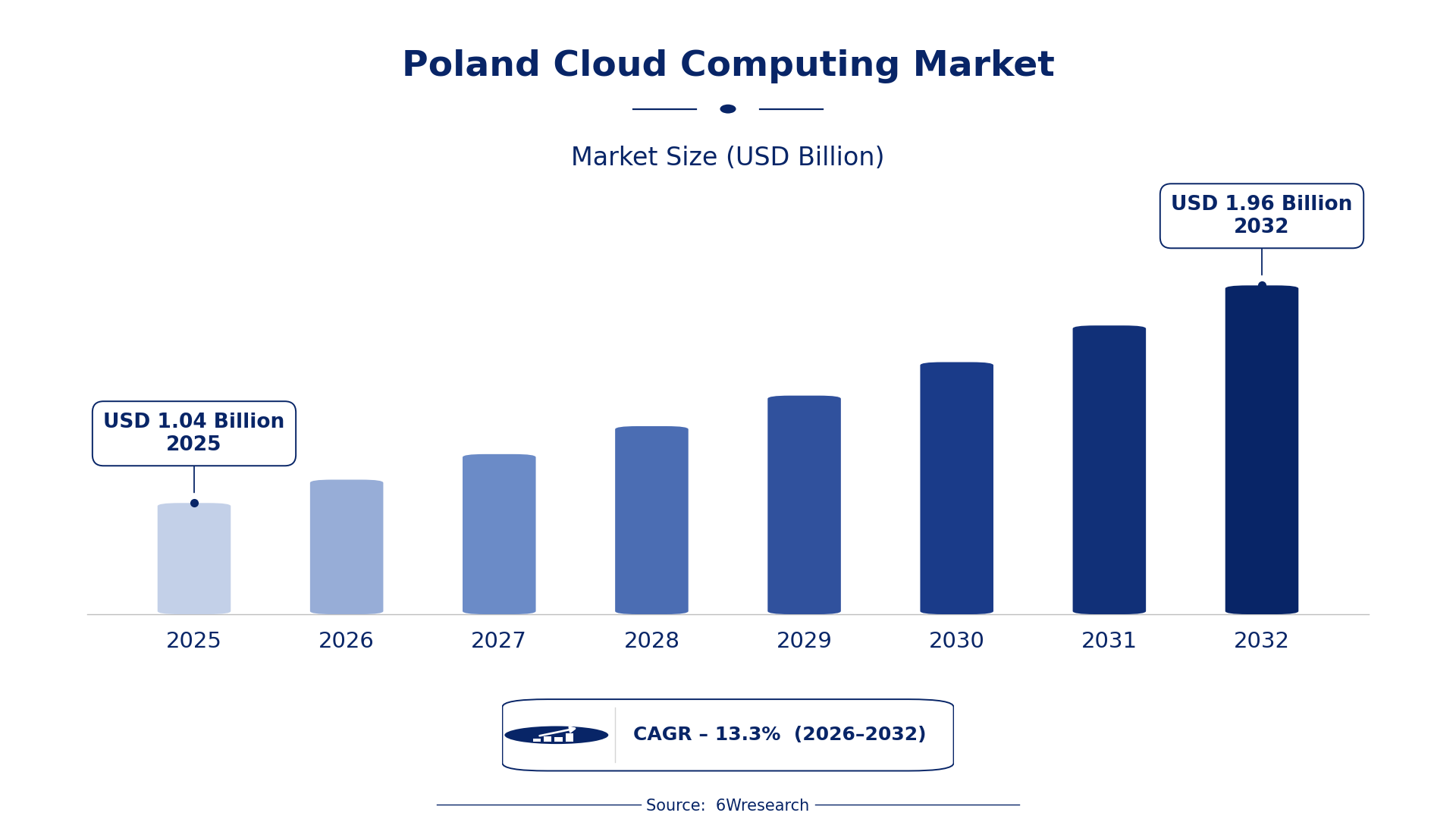
The Poland Cloud Computing Market was estimated at USD 1043 Million in 2025 and is projected to reach USD 1961 Million by 2032, growing at a CAGR of 13.3% from 2026 to 2032.
Poland Cloud Computing Market Synopsis
The driving force behind the Poland Cloud Computing Market is the rapid adoption of cloud services, which has become essential for businesses aiming for greater operational efficiency. Enterprises across various sectors are increasingly recognizing the value of cloud solutions for enhancing flexibility and reducing costs.
In addition to cost savings, the move toward digital transformation is propelling demand for Software as a Service (SaaS), Infrastructure as a Service (IaaS), and Platform as a Service (PaaS). This trend reflects a broader shift where organizations are looking to innovate and streamline their processes through technology.
Poland Cloud Computing Market Year-wise Growth Rate and Key Drivers
This graph illustrates the annual growth rates of the Poland Cloud Computing Market from 2021 to 2032, highlighting a steady upward trajectory and projected expansion over the forecast period.
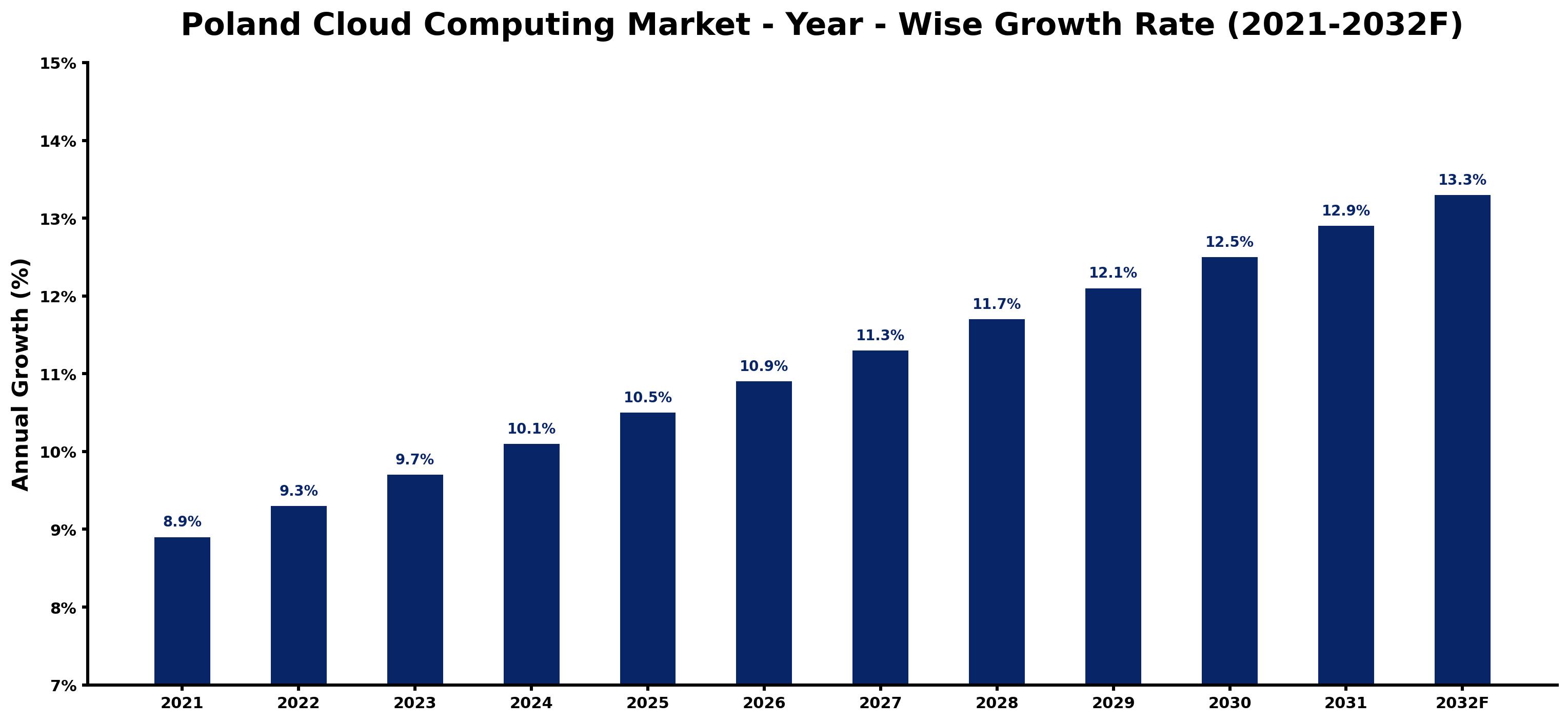
The table below presents the year‑wise growth rates along with the key drivers influencing the market
| Year | Growth Rate | Major Drivers |
| 2021 | 8.9% | Growing adoption of SaaS solutions among Polish SMEs. |
| 2022 | 9.3% | Increased investment in cybersecurity solutions drives cloud migration. |
| 2023 | 9.7% | Remote work policies boost demand for digital workspace solutions. |
| 2024 | 10.1% | Government grants for startups fuel cloud technology adoption. |
| 2025 | 10.5% | Poland's 5G rollout enhances cloud service accessibility. |
| 2026 | 10.9% | Rise of AI initiatives stimulates cloud computing needs. |
| 2027 | 11.3% | Regional tech hubs attract foreign cloud service investments. |
| 2028 | 11.7% | E-commerce boom accelerates demand for scalable cloud solutions. |
| 2029 | 12.1% | Increased focus on data analytics drives cloud computing growth. |
| 2030 | 12.5% | Emerging fintech startups require robust cloud infrastructures. |
| 2031 | 12.9% | Healthcare digitization encourages adoption of cloud services. |
| 2032 | 13.3% | Polish universities emphasize cloud technologies in curricula. |
Note: Market size estimations and growth projections presented in this report are based on 6Wresearch's proprietary forecasting methodology, utilizing the latest available industry data, government publications, and primary research inputs.
Poland Cloud Computing Market Key Takeaways
Below are some of the specific key takeaways from the market, including:
- The market is experiencing accelerated growth due to a surge in digital transformation initiatives.
- Demand for hybrid cloud solutions is on the rise as businesses look for flexible deployment options.
- Data security and compliance are emerging as top priorities for companies adopting cloud services.
- The popularity of AI and machine learning capabilities within cloud platforms is increasing.
- Government initiatives are actively promoting the growth and adoption of cloud technologies.
Evaluation of Restraints in Poland Cloud Computing Market
The Poland Cloud Computing Market faces challenges that could hinder its growth. A primary concern is data security, as cyber threats continue to escalate. Businesses are also grappling with compliance issues related to data protection regulations, which can complicate cloud adoption. Additionally, many small and medium-sized enterprises (SMEs) lack the awareness or understanding of cloud services, which restricts their participation in the market. The shortage of skilled IT professionals in cloud computing further exacerbates these challenges, creating barriers for effective implementation and management of cloud solutions.
Poland Cloud Computing Market Trends
Several trends are shaping the Poland Cloud Computing Market. A notable shift towards hybrid cloud solutions is evident, as businesses seek to combine public and private cloud capabilities. Edge computing is also gaining traction, driven by the need for real-time data processing and reduced latency. As companies embrace multi-cloud environments, the demand for integrated solutions is expected to grow. The integration of AI and machine learning into cloud platforms is becoming increasingly important, enabling businesses to harness data analytics for competitive advantage.
Poland Cloud Computing Market Opportunities
The opportunities within the Poland Cloud Computing Market are abundant. As businesses prioritize data security, there is a growing demand for solutions that ensure compliance with regulations. This focus on security presents a chance for cloud providers to differentiate themselves with specialized offerings. Additionally, the rise of AI and machine learning capabilities within cloud platforms offers significant potential for innovation. As organizations seek to enhance their agility and scalability, service providers can capitalize on this trend by tailoring solutions to meet specific business needs.
Government Initiatives in the Poland Cloud Computing Market
The Polish government plays a crucial role in shaping the cloud computing environment through various policies and initiatives. Its focus on digital transformation in both public and private sectors is evident in programs that support cloud adoption. Such regulatory frameworks are vital for ensuring data security and privacy, thereby fostering a conducive atmosphere for cloud growth.
- A National Cloud Program initiated in 2013 aims to enhance cloud service adoption across various sectors.
- Currently underway is a digital infrastructure upgrade program, focusing on improving connectivity to support cloud service development.
- New data protection regulations aligned with the EU's GDPR were introduced to bolster data security in cloud environments.
- Planned initiatives include a public-private partnership expected to enhance cloud service capabilities and infrastructure by 2028.
Future Insights of the Poland Cloud Computing Market
Looking ahead to 2026-2032, the Poland Cloud Computing Market is on track for substantial growth. The increasing digitization across various industries, combined with an ongoing push for advanced technologies, will likely drive demand for cloud solutions. Organizations will continue to prioritize cost-effective and scalable IT solutions, particularly as remote work and data analytics become integral to business operations. Government initiatives and investments in digital infrastructure will further support this upward trajectory, ensuring that the market remains vibrant and competitive.
Poland Cloud Computing Market Latest Developments
In the past year, the Poland Cloud Computing Market has witnessed dynamic activity characterized by technological advancements and strategic partnerships. Businesses are increasingly focused on enhancing their cloud offerings to meet evolving customer demands and industry standards.
- A leading technology vendor launched a new cloud service suite in early 2025, aimed at improving operational efficiencies for SMEs.
- In mid-2025, a regional operator announced an ongoing initiative to expand its cloud data centers, enhancing service reliability across Poland.
- A major provider is currently rolling out a hybrid cloud solution, expected to be fully operational by late 2026, catering to businesses with diverse needs.
- Upcoming in Q1 2026, an initiative is set to introduce advanced AI capabilities into cloud platforms, enhancing data processing and analytics.
Poland Cloud Computing Market - Key Attractiveness of the Report
- 10 Years of Market Numbers
- Historical Data Starting from 2022 to 2025
- Base Year: 2025
- Forecast Data until 2032
- Key Performance Indicators Impacting the Market
- Major Upcoming Developments and Projects
Key Highlights of the Report:
- Poland Cloud Computing Market Outlook
- Market Size of Poland Cloud Computing Market, 2025
- Forecast of Poland Cloud Computing Market, 2032
- Historical Data and Forecast of Poland Cloud Computing Revenues & Volume for the Period 2022-2032F
- Poland Cloud Computing Market Trend Evolution
- Poland Cloud Computing Market Drivers and Challenges
- Poland Cloud Computing Price Trends
- Poland Cloud Computing Porter's Five Forces
- Poland Cloud Computing Industry Life Cycle
- Historical Data and Forecast of Poland Cloud Computing Market Revenues & Volume By Service Model for the Period 2022-2032F
- Historical Data and Forecast of Poland Cloud Computing Market Revenues & Volume By Infrastructure as a Service for the Period 2022-2032F
- Historical Data and Forecast of Poland Cloud Computing Market Revenues & Volume By Platform as a Service for the Period 2022-2032F
- Historical Data and Forecast of Poland Cloud Computing Market Revenues & Volume By Software as a Service for the Period 2022-2032F
- Historical Data and Forecast of Poland Cloud Computing Market Revenues & Volume By Infrastructure as a Service for the Period 2022-2032F
- Historical Data and Forecast of Poland Cloud Computing Market Revenues & Volume By Primary Storage for the Period 2022-2032F
- Historical Data and Forecast of Poland Cloud Computing Market Revenues & Volume By Disaster Recovery and Backup for the Period 2022-2032F
- Historical Data and Forecast of Poland Cloud Computing Market Revenues & Volume By Archiving for the Period 2022-2032F
- Historical Data and Forecast of Poland Cloud Computing Market Revenues & Volume By Computer for the Period 2022-2032F
- Historical Data and Forecast of Poland Cloud Computing Market Revenues & Volume By Platform as a Service for the Period 2022-2032F
- Historical Data and Forecast of Poland Cloud Computing Market Revenues & Volume By Application Development and Platforms for the Period 2022-2032F
- Historical Data and Forecast of Poland Cloud Computing Market Revenues & Volume By Application Testing and Quality for the Period 2022-2032F
- Historical Data and Forecast of Poland Cloud Computing Market Revenues & Volume By Analytics and Reporting for the Period 2022-2032F
- Historical Data and Forecast of Poland Cloud Computing Market Revenues & Volume By Integration and Orchestration for the Period 2022-2032F
- Historical Data and Forecast of Poland Cloud Computing Market Revenues & Volume By Data Management for the Period 2022-2032F
- Historical Data and Forecast of Poland Cloud Computing Market Revenues & Volume By Software as a Service for the Period 2022-2032F
- Historical Data and Forecast of Poland Cloud Computing Market Revenues & Volume By Customer Relationship Management for the Period 2022-2032F
- Historical Data and Forecast of Poland Cloud Computing Market Revenues & Volume By Enterprise Resource Management for the Period 2022-2032F
- Historical Data and Forecast of Poland Cloud Computing Market Revenues & Volume By Human Capital Management for the Period 2022-2032F
- Historical Data and Forecast of Poland Cloud Computing Market Revenues & Volume By Content Management for the Period 2022-2032F
- Historical Data and Forecast of Poland Cloud Computing Market Revenues & Volume By Collaboration and Productivity Suites for the Period 2022-2032F
- Historical Data and Forecast of Poland Cloud Computing Market Revenues & Volume By Supply Chain Management for the Period 2022-2032F
- Historical Data and Forecast of Poland Cloud Computing Market Revenues & Volume By Others for the Period 2022-2032F
- Historical Data and Forecast of Poland Cloud Computing Market Revenues & Volume By Organization Size for the Period 2022-2032F
- Historical Data and Forecast of Poland Cloud Computing Market Revenues & Volume By Large Enterprises for the Period 2022-2032F
- Historical Data and Forecast of Poland Cloud Computing Market Revenues & Volume By SMEs for the Period 2022-2032F
- Historical Data and Forecast of Poland Cloud Computing Market Revenues & Volume By Deployment Model for the Period 2022-2032F
- Historical Data and Forecast of Poland Cloud Computing Market Revenues & Volume By Public Cloud for the Period 2022-2032F
- Historical Data and Forecast of Poland Cloud Computing Market Revenues & Volume By Private Cloud for the Period 2022-2032F
- Historical Data and Forecast of Poland Cloud Computing Market Revenues & Volume By Verticals for the Period 2022-2032F
- Historical Data and Forecast of Poland Cloud Computing Market Revenues & Volume By BFSI for the Period 2022-2032F
- Historical Data and Forecast of Poland Cloud Computing Market Revenues & Volume By Telecommunication for the Period 2022-2032F
- Historical Data and Forecast of Poland Cloud Computing Market Revenues & Volume By IT & ITeS for the Period 2022-2032F
- Historical Data and Forecast of Poland Cloud Computing Market Revenues & Volume By Government & Public Sector for the Period 2022-2032F
- Historical Data and Forecast of Poland Cloud Computing Market Revenues & Volume By Retail & Consumer Goods for the Period 2022-2032F
- Historical Data and Forecast of Poland Cloud Computing Market Revenues & Volume By Manufacturing for the Period 2022-2032F
- Historical Data and Forecast of Poland Cloud Computing Market Revenues & Volume By Energy & Utility for the Period 2022-2032F
- Historical Data and Forecast of Poland Cloud Computing Market Revenues & Volume By Media & Entertainment for the Period 2022-2032F
- Poland Cloud Computing Import Export Trade Statistics
- Market Opportunity Assessment By Service Model
- Market Opportunity Assessment By Infrastructure as a Service
- Market Opportunity Assessment By Platform as a Service
- Market Opportunity Assessment By Software as a Service
- Market Opportunity Assessment By Organization Size
- Market Opportunity Assessment By Deployment Model
- Market Opportunity Assessment By Verticals
- Poland Cloud Computing Top Companies Market Share
- Poland Cloud Computing Competitive Benchmarking By Technical and Operational Parameters
- Poland Cloud Computing Company Profiles
- Poland Cloud Computing Key Strategic Recommendations






































