Poland Cyber Security Market Size & Growth Rate (2026-2032)
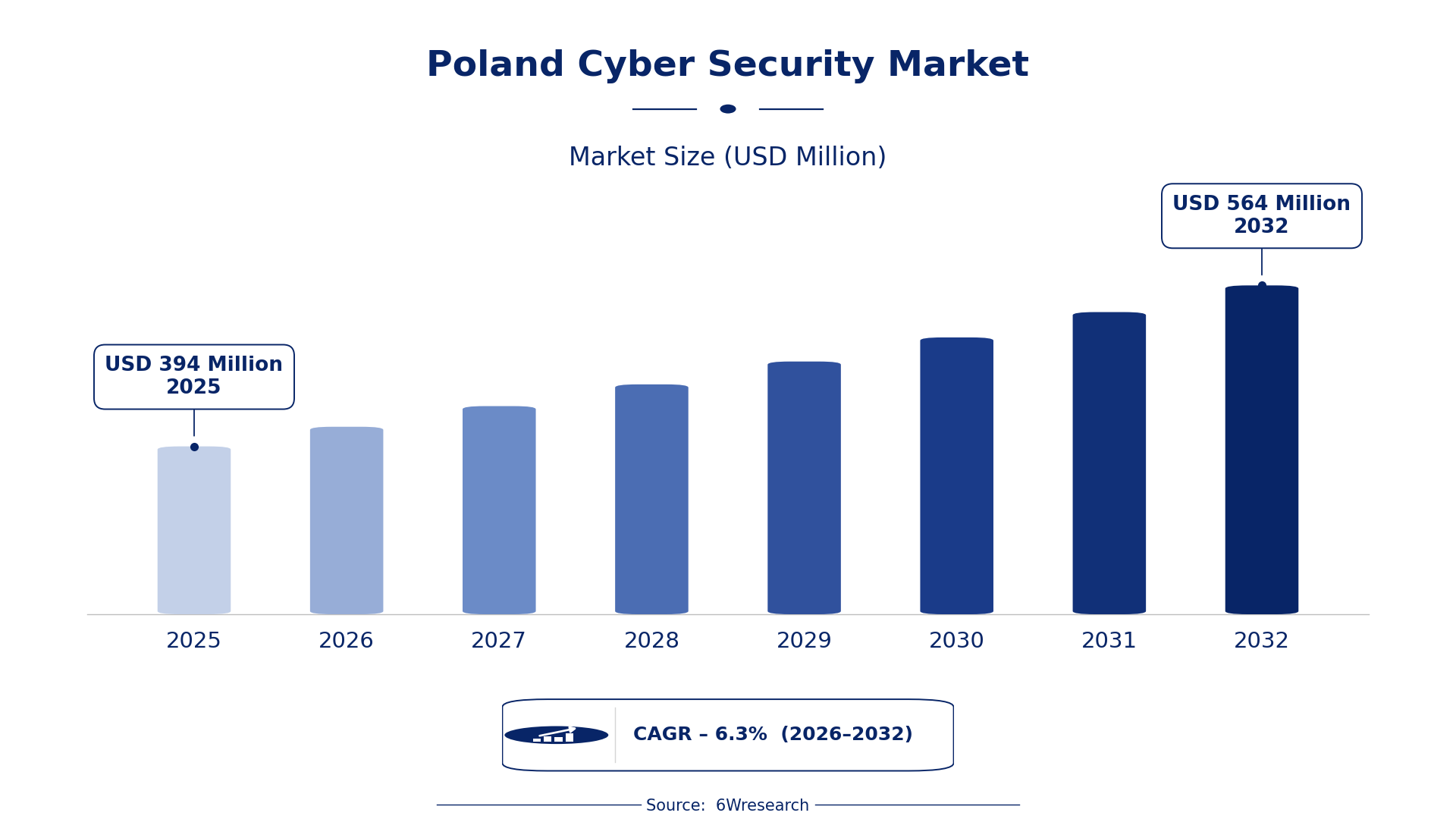
The Poland Cyber Security Market was estimated at USD 394 Million in 2025 and is projected to reach USD 564 Million by 2032, growing at a CAGR of 6.3% from 2026 to 2032.
Poland Cyber Security Market Synopsis
The dominant force driving the Poland Cyber Security Market today is the relentless rise in cyber threats. As both businesses and government entities face increasing attacks, the urgency to bolster security measures has never been greater. This demand spans from SMEs to large enterprises, all eager to protect sensitive data and maintain trust.
Government regulations further intensify the focus on cybersecurity, particularly with the stringent requirements of the GDPR. Organizations must not only defend against threats but also ensure compliance with evolving legislation, creating a robust impetus for investment in advanced cybersecurity solutions.
Poland Cyber Security Market Year-wise Growth Rate and Key Drivers
This graph illustrates the annual growth rates of the Poland Cyber Security Market from 2021 to 2032, highlighting a steady upward trajectory and projected expansion over the forecast period.
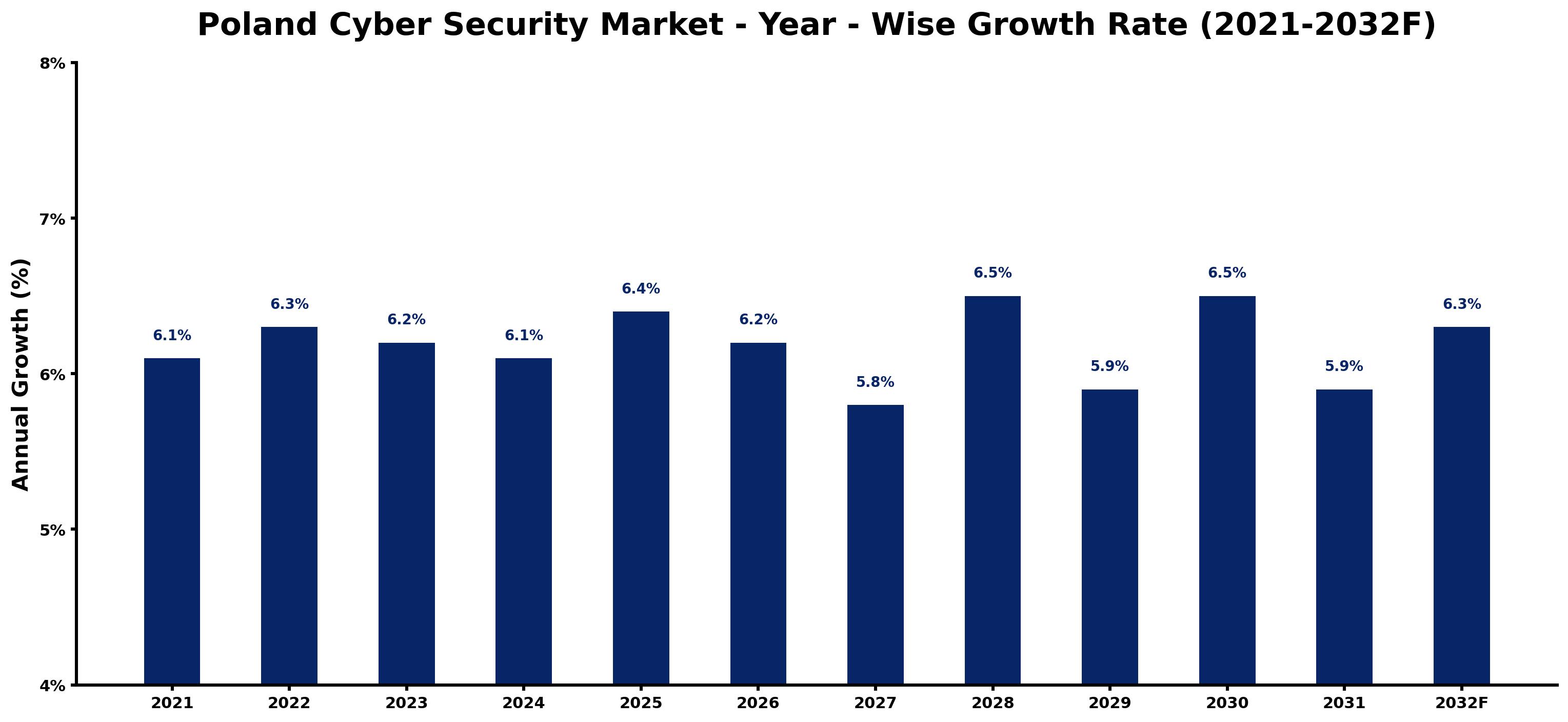
The table below presents the year‑wise growth rates along with the key drivers influencing the market
| Year | Growth Rate | Major Drivers |
| 2021 | 6.1% | Increased EU cybersecurity regulations enhancing compliance requirements. |
| 2022 | 6.3% | Growing cyber threats against Polish financial institutions. |
| 2023 | 6.2% | Poland's national cybersecurity strategy prioritizing critical infrastructure protection. |
| 2024 | 6.1% | Boost in investments from Polish startups in cybersecurity solutions. |
| 2025 | 6.4% | Adoption of stricter GDPR-like policies driving security upgrades. |
| 2026 | 6.2% | Surge in cybersecurity awareness due to high-profile security breaches. |
| 2027 | 5.8% | Growing number of cyber training programs in Polish universities. |
| 2028 | 6.5% | Enhanced collaboration among Polish firms for cybersecurity resource sharing. |
| 2029 | 5.9% | Rise in demand for cloud security services among SMEs. |
| 2030 | 6.5% | Implementation of national cloud computing strategy promoting security. |
| 2031 | 5.9% | Increased public sector budgets for cybersecurity infrastructure. |
| 2032 | 6.3% | Emerging AI technologies fostering innovative cybersecurity solutions. |
Note: Market size estimations and growth projections presented in this report are based on 6Wresearch's proprietary forecasting methodology, utilizing the latest available industry data, government publications, and primary research inputs.
Poland Cyber Security Market Key Takeaways
Below are some of the specific key takeaways from the market, including:
- Continued investment in cybersecurity solutions is critical as digital transformation accelerates.
- Compliance with data protection regulations remains a top priority, shaping security strategies across sectors.
- Small and medium-sized enterprises are increasingly aware of their vulnerability, driving demand for tailored solutions.
- AI and machine learning technologies are being integrated into cybersecurity offerings for enhanced protection.
- Training and skill development initiatives are essential to address the shortage of qualified cybersecurity professionals.
Evaluation of Restraints in Poland Cyber Security Market
Despite the growth momentum, certain barriers hinder the Poland Cyber Security Market. A critical shortage of skilled cybersecurity professionals presents a significant challenge, leaving many organizations struggling to fill essential roles. This talent gap complicates the implementation of effective security measures, as companies often lack the expertise necessary to combat sophisticated threats. Furthermore, as cyber threats grow in complexity, organizations are required to adapt continuously. This demands substantial resources, which can strain budgets and operational capacities.
Poland Cyber Security Market Trends
The market is witnessing notable trends reshaping its dynamics. A pronounced shift toward cloud security solutions is evident, as businesses increasingly migrate to cloud infrastructures. Consequently, demand for cloud-native cybersecurity tools has surged. There's also a marked emphasis on data privacy, fueled by compliance demands with GDPR and similar regulations. Additionally, organizations are prioritizing advanced threat intelligence and monitoring capabilities to proactively address vulnerabilities. The infusion of AI and machine learning in security frameworks is transforming how threats are detected and mitigated.
Poland Cyber Security Market Opportunities
The market presents various investment opportunities across multiple sectors. Areas such as network security, data protection, and threat intelligence are ripe for innovation and growth. As businesses digitize their operations, the demand for comprehensive cybersecurity solutions escalates. Investment in cybersecurity consulting services is also becoming increasingly lucrative, addressing the skill gap while enhancing organizational resilience. Furthermore, developing security solutions tailored to local market needs offers a competitive edge.
Government Initiatives in the Poland Cyber Security Market
Government action plays a crucial role in enhancing cybersecurity across Poland. A concerted effort is underway to bolster the nation’s defenses against increasing cyber threats. By implementing policies and frameworks, the government is aligning public sector priorities with private sector needs, ensuring a coordinated response to vulnerabilities.
- A recently completed initiative involved the launch of the National Cybersecurity System (NCS), which aims to strengthen collaboration between various stakeholders.
- Currently ongoing is the Act on the National Cybersecurity System, which outlines responsibilities for protecting critical infrastructure.
- A planned public-private initiative, expected to enhance cybersecurity capabilities, aims to support training programs for cybersecurity professionals by 2026.
- The government has allocated funding for the development of cybersecurity technologies, underlining its commitment to fostering innovation in the sector.
- Poland's participation in the EU Cybersecurity Strategy emphasizes regional cooperation and collective defense against cyber threats.
Future Insights of the Poland Cyber Security Market
Looking ahead, the Poland Cyber Security Market is on a trajectory of consistent growth. Rising awareness of cybersecurity threats among organizations is a fundamental driver. Digital transformation initiatives across sectors will create new security challenges, necessitating advanced solutions. The government’s emphasis on enhancing cybersecurity measures, combined with increased investments from businesses, will catalyze market expansion. The integration of AI and machine learning in security practices is expected to open up innovative pathways for addressing emerging threats.
Poland Cyber Security Market Latest Developments
Recent activities in the Poland Cyber Security Market indicate a proactive approach to addressing growing cybersecurity challenges. Organizations are making strides to enhance their security frameworks and improve incident response capabilities. The past year has been marked by significant developments that highlight the industry's evolving nature.
- A major technology vendor launched a new suite of cloud security solutions in early 2025, aiming to meet the growing demand for cloud-based protections.
- An initiative that began in mid-2025 focuses on enhancing cybersecurity skills through partnerships with educational institutions.
- A public-private collaboration expected to start by the end of 2026 will aim to develop advanced threat intelligence platforms tailored to local market needs.
- Ongoing upgrades to the National Cybersecurity System are enhancing coordination among public and private sectors to better respond to threats.
- A rollout of new regulatory guidelines focused on data privacy compliance is slated for implementation in Q3 2025.
Poland Cyber Security Market - Key Attractiveness of the Report
- 10 Years of Market Numbers
- Historical Data Starting from 2022 to 2025
- Base Year: 2025
- Forecast Data until 2032
- Key Performance Indicators Impacting the Market
- Major Upcoming Developments and Projects
Key Highlights of the Report:
- Poland Cyber Security Market Outlook
- Market Size of Poland Cyber Security Market, 2025
- Forecast of Poland Cyber Security Market, 2032
- Historical Data and Forecast of Poland Cyber Security Revenues & Volume for the Period 2022-2032F
- Poland Cyber Security Market Trend Evolution
- Poland Cyber Security Market Drivers and Challenges
- Poland Cyber Security Price Trends
- Poland Cyber Security Porter's Five Forces
- Poland Cyber Security Industry Life Cycle
- Historical Data and Forecast of Poland Cyber Security Market Revenues & Volume By Component for the Period 2022-2032F
- Historical Data and Forecast of Poland Cyber Security Market Revenues & Volume By Software for the Period 2022-2032F
- Historical Data and Forecast of Poland Cyber Security Market Revenues & Volume By Hardware for the Period 2022-2032F
- Historical Data and Forecast of Poland Cyber Security Market Revenues & Volume By Services for the Period 2022-2032F
- Historical Data and Forecast of Poland Cyber Security Market Revenues & Volume By Software for the Period 2022-2032F
- Historical Data and Forecast of Poland Cyber Security Market Revenues & Volume By IAM for the Period 2022-2032F
- Historical Data and Forecast of Poland Cyber Security Market Revenues & Volume By Antivirus/Antimalware for the Period 2022-2032F
- Historical Data and Forecast of Poland Cyber Security Market Revenues & Volume By Log Management and SIEM for the Period 2022-2032F
- Historical Data and Forecast of Poland Cyber Security Market Revenues & Volume By Encryption and Tokenization for the Period 2022-2032F
- Historical Data and Forecast of Poland Cyber Security Market Revenues & Volume By Compliance and Policy Management for the Period 2022-2032F
- Historical Data and Forecast of Poland Cyber Security Market Revenues & Volume By Patch Management for the Period 2022-2032F
- Historical Data and Forecast of Poland Cyber Security Market Revenues & Volume By Other Software for the Period 2022-2032F
- Historical Data and Forecast of Poland Cyber Security Market Revenues & Volume By Security Type for the Period 2022-2032F
- Historical Data and Forecast of Poland Cyber Security Market Revenues & Volume By Network Security for the Period 2022-2032F
- Historical Data and Forecast of Poland Cyber Security Market Revenues & Volume By Cloud Security for the Period 2022-2032F
- Historical Data and Forecast of Poland Cyber Security Market Revenues & Volume By Application Security for the Period 2022-2032F
- Historical Data and Forecast of Poland Cyber Security Market Revenues & Volume By Endpoint and IoT Security for the Period 2022-2032F
- Historical Data and Forecast of Poland Cyber Security Market Revenues & Volume By Deployment Mode for the Period 2022-2032F
- Historical Data and Forecast of Poland Cyber Security Market Revenues & Volume By Cloud for the Period 2022-2032F
- Historical Data and Forecast of Poland Cyber Security Market Revenues & Volume By On-premises for the Period 2022-2032F
- Historical Data and Forecast of Poland Cyber Security Market Revenues & Volume By Organization Size for the Period 2022-2032F
- Historical Data and Forecast of Poland Cyber Security Market Revenues & Volume By Large Enterprises for the Period 2022-2032F
- Historical Data and Forecast of Poland Cyber Security Market Revenues & Volume By SMEs for the Period 2022-2032F
- Historical Data and Forecast of Poland Cyber Security Market Revenues & Volume By Vertical for the Period 2022-2032F
- Historical Data and Forecast of Poland Cyber Security Market Revenues & Volume By Aerospace and Defense for the Period 2022-2032F
- Historical Data and Forecast of Poland Cyber Security Market Revenues & Volume By BFSI for the Period 2022-2032F
- Historical Data and Forecast of Poland Cyber Security Market Revenues & Volume By IT and ITeS for the Period 2022-2032F
- Historical Data and Forecast of Poland Cyber Security Market Revenues & Volume By Telecommunication for the Period 2022-2032F
- Historical Data and Forecast of Poland Cyber Security Market Revenues & Volume By Energy and Utilities for the Period 2022-2032F
- Historical Data and Forecast of Poland Cyber Security Market Revenues & Volume By Retail and eCommerce for the Period 2022-2032F
- Historical Data and Forecast of Poland Cyber Security Market Revenues & Volume By Healthcare for the Period 2022-2032F
- Historical Data and Forecast of Poland Cyber Security Market Revenues & Volume By Transportation and Logistics for the Period 2022-2032F
- Poland Cyber Security Import Export Trade Statistics
- Market Opportunity Assessment By Component
- Market Opportunity Assessment By Software
- Market Opportunity Assessment By Security Type
- Market Opportunity Assessment By Deployment Mode
- Market Opportunity Assessment By Organization Size
- Market Opportunity Assessment By Vertical
- Poland Cyber Security Top Companies Market Share
- Poland Cyber Security Competitive Benchmarking By Technical and Operational Parameters
- Poland Cyber Security Company Profiles
- Poland Cyber Security Key Strategic Recommendations






































