Poland Decorative tile Market Summary
The poland decorative tile market was estimated at USD 1216 Million in 2025 and is projected to reach USD 1743 Million by 2032, growing at a CAGR of 6.1% from 2026 to 2032.
Poland Decorative tile Market Year-wise Growth Rate and Key Drivers
This graph highlights how the Poland Decorative tile Market has steadily grown over the past five years, supported by major growth factors.
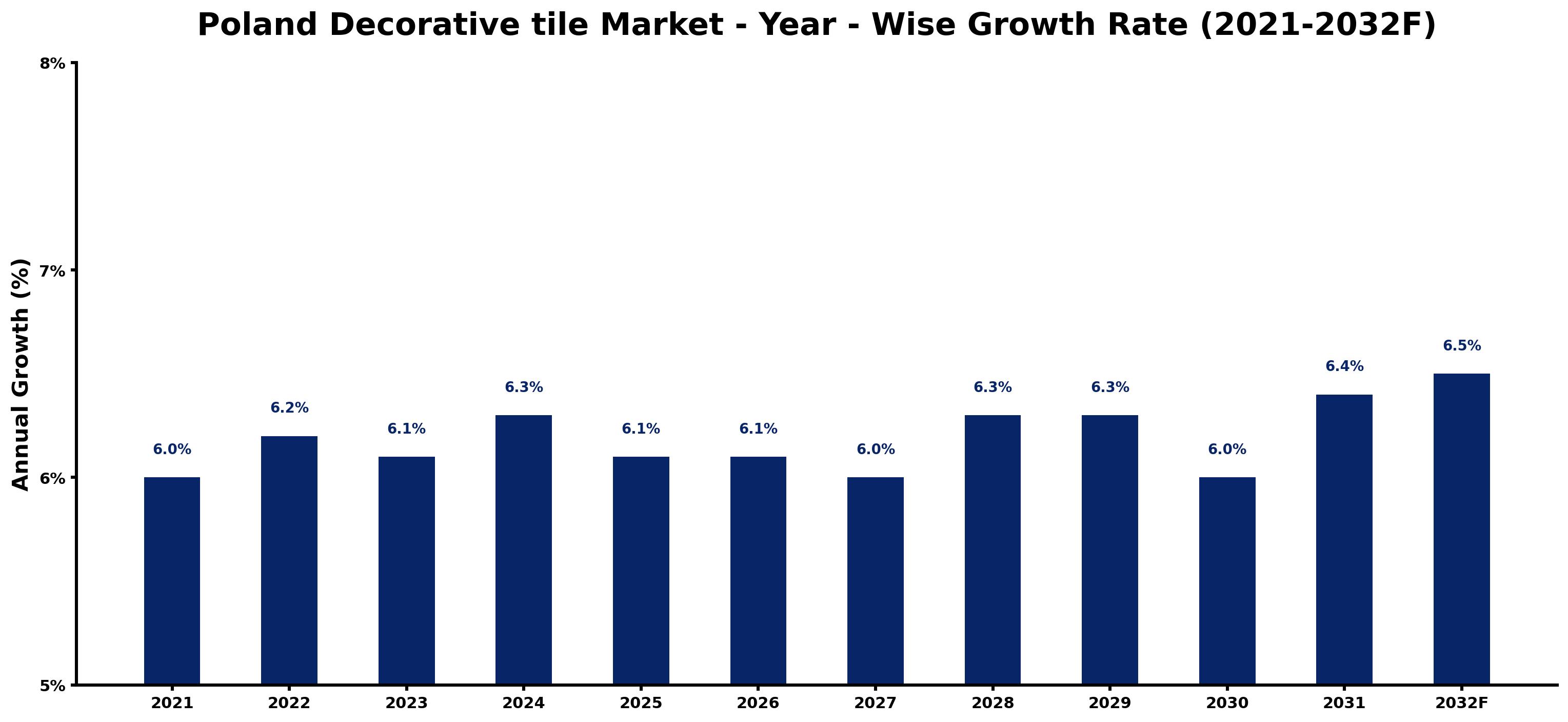
The table below presents the year wise growth rates along with the key drivers influencing the market
| Year | Growth Rate | Major Drivers |
| 2021 | 6.0% | Post-lockdown retail projects catalyzed a revival in interior design preferences. |
| 2022 | 6.2% | Home renovation trends surged as homeowners focused on aesthetic improvements. |
| 2023 | 6.1% | Regional builders embraced eco-friendly materials, impacting tile manufacturing trends significantly. |
| 2024 | 6.3% | Local artisans gained visibility, enhancing unique decorative tile offerings across Poland. |
| 2025 | 6.1% | Digital marketing strategies evolved, allowing brands to reach niche consumer segments. |
| 2026 | 6.1% | Urbanization patterns shifted, increasing demand for customizable interior decoration solutions. |
| 2027 | 6.0% | Collaboration between designers and manufacturers fostered innovative tile designs for modern spaces. |
| 2028 | 6.3% | Sustainability concerns prompted consumers to prefer recycled materials in decorative tiles. |
| 2029 | 6.3% | International design fairs showcased Polish talent, attracting foreign investment to the market. |
| 2030 | 6.0% | Technological innovations streamlined production processes, enhancing quality and reducing costs. |
| 2031 | 6.4% | Consumer preferences leaned towards smart homes, integrating tech with decorative tile options. |
| 2032 | 6.5% | Luxury real estate developments prioritized high-end decorative tiles, elevating market standards. |
Note - Market size estimations and growth projections presented in this report are based on 6Wresearch's advanced forecasting approach, validated with industry datasets as of June 2026.
Poland Decorative tile Market Synopsis
The Poland Decorative tile Market is projected to reach 6.1% and witness significant growth during the forecast period (2026-2032). This market is characterized by ongoing urbanization efforts, escalating disposable incomes, and an increasing consumer inclination towards home renovation and interior design. Decorative tiles have emerged as a popular choice for enhancing not only the functional aspects of living spaces but also their aesthetic appeal. The diverse offerings, which include tiles made from ceramic, porcelain, glass, and natural stone, cater to various consumer preferences and budget ranges.
Poland Decorative tile Market Growth Drivers
Several factors are driving the growth of the Poland Decorative tile Market. Firstly, urbanization is leading to a rise in new housing projects, increasing demand for decorative tiles as homeowners look to personalize their spaces. Secondly, the improvement in disposable incomes is enabling consumers to invest in higher-quality materials for home renovations. Thirdly, there is a notable shift towards interior design as a means of self-expression; consumers are seeking unique tile designs that reflect their individuality. Fourthly, product innovation, with a focus on aesthetic and functional features, has expanded the options available in the market. Lastly, the trend towards sustainability is prompting consumers to seek eco-friendly materials, thus driving demand for tiles produced with sustainable practices.
Poland Decorative tile Market Trends and Opportunities
The Poland Decorative tile Market is experiencing notable trends that signify evolving consumer preferences. Increasingly, patterned and textured tiles are in demand, as homeowners seek to introduce artistic elements into their interiors. Popular choices include tiles featuring geometric patterns, floral designs, and artisanal craftsmanship. Additionally, sustainability trends are pushing consumers towards eco-friendly production processes and materials. The popularity of large-format tiles is also on the rise, as they offer seamless designs conducive to modern aesthetics in both residential and commercial spaces. Moreover, advancements in digital printing technology are facilitating intricate designs, allowing for customized tile options that resonate with the contemporary consumer's desire for individuality.
Poland Decorative tile Market Challenges and Restraints
Despite the positive growth trajectory, the Poland Decorative tile Market faces several challenges. Significant competition among both local and international manufacturers creates a saturated market environment, making differentiation a critical necessity for success. Furthermore, fluctuations in raw material prices and currency exchange rates pose challenges in maintaining stable production costs and pricing strategies. The consumer shift towards sustainable products also necessitates heavy investments in research and development for manufacturers aiming to comply with eco-friendly demands. Lastly, continual changes in consumer preferences and design trends mean that market participants must remain agile and innovative to cater to shifting market dynamics.
Poland Decorative tile Market Investment Opportunities
The Poland Decorative tile Market holds substantial investment potential driven by numerous factors. The rise in construction activities, combined with an increasing number of home renovations, presents a significant opportunity for prospective investors. Within this landscape, segments such as ceramic, porcelain, glass, and natural stone tiles continue to evolve, each catering to distinct consumer preferences. Investors can capitalize on innovative tile designs and eco-friendly materials, as these align with current market trends. Collaborations with interior designers, architects, and real estate developers offer avenues for expanding market presence and fostering sustainable growth. As the demand for high-quality decorative tiles grows, particularly in residential, commercial, and hospitality sectors, the market presents a compelling opportunity for strategic investments.
Poland Decorative tile Market Government Investment and Initiatives
Government policies in Poland play an essential role in shaping the Decorative tile Market. Regulatory frameworks focus on product quality and safety, ensuring that decorative tiles adhere to stringent standards that protect consumers and foster fair competition among manufacturers. Environmental sustainability practices are also mandated, guiding the industry towards more responsible production processes. Additionally, the Polish government supports initiatives that promote innovation and eco-friendliness within the sector. Trade agreements with other countries influence the import and export dynamics, thereby impacting market accessibility. Through public funding and incentive programs, the government encourages modernization and development in the decorative tile industry, highlighting its significance as part of Poland's broader economic landscape.
Poland Decorative tile Market Latest Developments (May 2025 - June 2026)
Recent developments within the Poland Decorative tile Market have illustrated significant industry shifts. Manufacturers are increasingly adopting sustainable practices, aligning operations with environmental regulations and responding to consumer demand. Enhanced production technologies are being integrated into manufacturing processes to facilitate innovative designs and increase efficiency. Moreover, there is a marked rise in digital marketing strategies, enabling manufacturers to reach consumers directly through online platforms. Industry players are actively launching new marketing campaigns to emphasize the versatility and aesthetic appeal of decorative tiles. These trends indicate a positive trajectory for the market, enhancing overall growth potential and consumer engagement.
Poland Decorative tile Market - Key Attractiveness of the Report
- 10 Years of Market Numbers
- Historical Data Starting from 2022 to 2025
- Base Year: 2025
- Forecast Data until 2032
- Key Performance Indicators Impacting the Market
- Major Upcoming Developments and Projects
Key Highlights of the Report:
- Poland Decorative tile Market Outlook
- Market Size of Poland Decorative tile Market, 2025
- Forecast of Poland Decorative tile Market, 2032F
- Historical Data and Forecast of Poland Decorative tile Revenues & Volume for the Period 2022-2032F
- Poland Decorative tile Market Trend Evolution
- Poland Decorative tile Market Drivers and Challenges
- Poland Decorative tile Price Trends
- Poland Decorative tile Porter's Five Forces
- Poland Decorative tile Industry Life Cycle
- Historical Data and Forecast of Poland Decorative tile Market Revenues & Volume By Type for the Period 2022-2032F
- Historical Data and Forecast of Poland Decorative tile Market Revenues & Volume By Ceramic Wall Tiles for the Period 2022-2032F
- Historical Data and Forecast of Poland Decorative tile Market Revenues & Volume By Vinyl Wall Tiles for the Period 2022-2032F
- Historical Data and Forecast of Poland Decorative tile Market Revenues & Volume By Stone Wall Tiles for the Period 2022-2032F
- Historical Data and Forecast of Poland Decorative tile Market Revenues & Volume By Other Types for the Period 2022-2032F
- Historical Data and Forecast of Poland Decorative tile Market Revenues & Volume By End-users for the Period 2022-2032F
- Historical Data and Forecast of Poland Decorative tile Market Revenues & Volume By Residential for the Period 2022-2032F
- Historical Data and Forecast of Poland Decorative tile Market Revenues & Volume By Commercial for the Period 2022-2032F
- Historical Data and Forecast of Poland Decorative tile Market Revenues & Volume By Application for the Period 2022-2032F
- Historical Data and Forecast of Poland Decorative tile Market Revenues & Volume By Flooring for the Period 2022-2032F
- Historical Data and Forecast of Poland Decorative tile Market Revenues & Volume By Wall Coverings for the Period 2022-2032F
- Historical Data and Forecast of Poland Decorative tile Market Revenues & Volume By Other Applications for the Period 2022-2032F
- Poland Decorative tile Import Export Trade Statistics
- Market Opportunity Assessment By Type
- Market Opportunity Assessment By End-users
- Market Opportunity Assessment By Application
- Poland Decorative tile Top Companies Market Share
- Poland Decorative tile Competitive Benchmarking By Technical and Operational Parameters
- Poland Decorative tile Company Profiles
- Poland Decorative tile Key Strategic Recommendations






































