Poland Engineered Wood Market Size, Share & Growth Rate
The Poland Engineered Wood Market was estimated at USD 546 Million in 2025 and is projected to reach USD 779 Million by 2032, growing at a CAGR of 5.2% from 2026 to 2032. This robust growth is being propelled by a surge in construction activities and a significant shift towards sustainable building practices. As urbanization intensifies, the demand for cost-effective and environmentally friendly materials in both residential and commercial projects continues to rise, solidifying engineered wood's position in the market.
Poland Engineered Wood Market Year-wise Growth Rate and Key Drivers
This graph highlights how the Poland Engineered Wood Market has steadily grown over the years, supported by major growth factors.
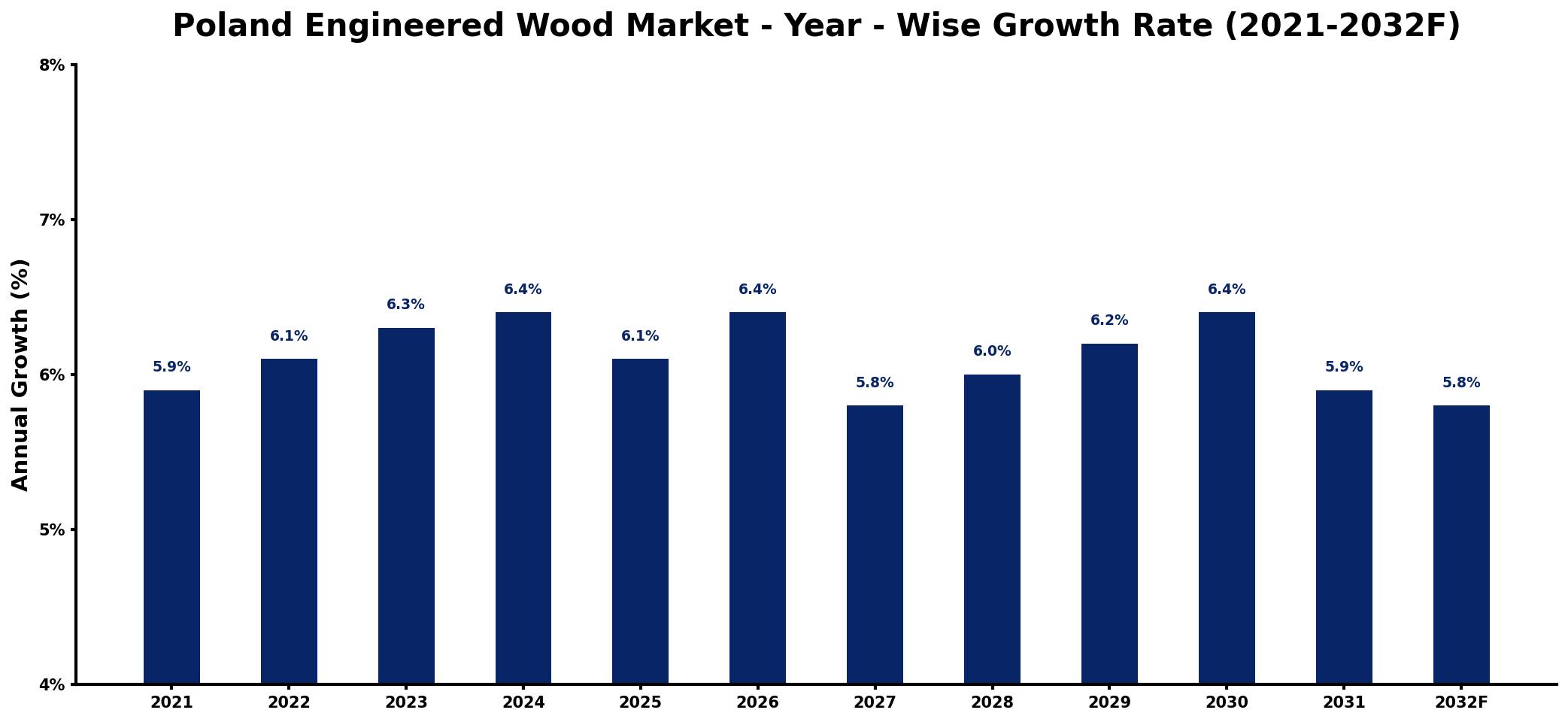
The table below presents the year‑wise growth rates along with the key drivers influencing the market
| Year | Growth Rate | Major Drivers |
| 2021 | 5.9% | Rising residential construction projects |
| 2022 | 6.1% | Increased consumer spending trends |
| 2023 | 6.3% | Expansion in furniture manufacturing |
| 2024 | 6.4% | Growth in home renovation activities |
| 2025 | 6.1% | Surge in sustainable building practices |
| 2026 | 6.4% | Investment in infrastructure development |
| 2027 | 5.8% | Emerging trends in DIY projects |
| 2028 | 6.0% | Strengthening of export markets |
| 2029 | 6.2% | Technological advancements in production |
| 2030 | 6.4% | Growing popularity of eco-friendly materials |
| 2031 | 5.9% | Enhanced urban development initiatives |
| 2032 | 5.8% | Rising demand for custom solutions |
Note: Market size estimations and growth projections presented in this report are based on 6Wresearch's proprietary forecasting methodology, utilizing the latest available industry data, government publications, and primary research inputs.
Poland Engineered Wood Market Synopsis
The Poland Engineered Wood Market is witnessing a transformative phase, underpinned by an increasing emphasis on sustainability. Products such as plywood, laminated veneer lumber, and particleboard are becoming essential components in contemporary construction due to their strength and environmental credentials.
As Polands construction sector grows, fueled by both residential developments and infrastructural projects, the preference for engineered wood is also on the rise. This trend reflects broader global shifts towards eco-friendly materials, marking a decisive movement away from traditional solid wood products.
Poland Engineered Wood Market Key Takeaways
- Engineered wood products are increasingly favored for their strength, durability, and sustainability.
- The construction boom in Poland is a primary driver of market growth.
- Technological advancements in manufacturing processes are enhancing the appeal of engineered wood.
- Growing eco-consciousness among consumers is influencing building material choices.
- Investment opportunities are emerging in production and R&D, focusing on innovative applications.
Evaluation of Restraints in Poland Engineered Wood Market
Despite its promising growth trajectory, the Poland Engineered Wood Market faces several challenges. Traditional solid wood products continue to pose competition, often appealing to consumers with established familiarity and perceived quality. Additionally, fluctuations in raw material costs can lead to pricing instability, making it difficult for manufacturers to maintain competitive pricing. The sector must also prioritize continuous innovation, as consumer preferences shift rapidly towards newer, eco-friendly alternatives. Navigating these market dynamics will be crucial for sustained growth.
Poland Engineered Wood Market Trends
Current trends in the Poland Engineered Wood Market reveal a shift towards prefabrication and modular construction methods, which are gaining momentum in response to the need for rapid construction timelines and cost efficiency. Moreover, advancements in manufacturing technologies are improving the quality and variety of engineered wood products, making them more appealing to builders and consumers alike. The emphasis on green building certifications is driving demand further, as more stakeholders aim to comply with stringent environmental standards.
Poland Engineered Wood Market Opportunities
With increasing urbanization and a focus on sustainable construction, the Poland Engineered Wood Market presents numerous investment opportunities. The rising demand for products such as laminated veneer lumber, glued laminated timber, and oriented strand board positions these materials as favored choices in modern building practices. Companies can explore avenues in manufacturing and distribution, and there is a significant potential for R&D initiatives aimed at developing innovative engineered wood solutions.
Government Initiatives in the Poland Engineered Wood Market
The Polish government is actively promoting the use of engineered wood products through various initiatives aimed at encouraging sustainable construction practices. Financial incentives for companies investing in eco-friendly wood processing technologies are part of this strategy. Additionally, regulatory frameworks are being introduced to favor the inclusion of engineered wood in public infrastructure projects. These government measures aim to enhance the competitiveness of the domestic engineered wood sector while supporting environmental sustainability goals.
Future Insights of the Poland Engineered Wood Market
Looking ahead to 2026-2032, the Poland Engineered Wood Market is expected to continue its upward trend, bolstered by the growing preference for sustainable and efficient building materials. As green building practices gain traction and regulations surrounding traditional timber usage tighten, the advantages of engineered wood in terms of cost-effectiveness and environmental impact will likely drive further adoption. Innovations in product development will also play a crucial role in shaping the future landscape of this market.
Poland Engineered Wood Market Latest Developments (2025 - 2026)
In recent months, the Poland Engineered Wood Market has seen a notable increase in collaborative initiatives between manufacturers and research institutions aimed at enhancing product sustainability. These collaborations focus on developing new processing techniques and materials that align with eco-friendly standards. Furthermore, industry events and exhibitions are showcasing advancements in engineered wood applications, reflecting the growing interest among builders and developers to explore innovative construction solutions.
Poland Engineered Wood Market - Key Attractiveness of the Report
- 10 Years of Market Numbers
- Historical Data Starting from 2022 to 2025
- Base Year: 2025
- Forecast Data until 2032
- Key Performance Indicators Impacting the Market
- Major Upcoming Developments and Projects
Key Highlights of the Report:
- Poland Engineered Wood Market Outlook
- Market Size of Poland Engineered Wood Market, 2025
- Forecast of Poland Engineered Wood Market, 2032
- Historical Data and Forecast of Poland Engineered Wood Revenues & Volume for the Period 2022-2032F
- Poland Engineered Wood Market Trend Evolution
- Poland Engineered Wood Market Drivers and Challenges
- Poland Engineered Wood Price Trends
- Poland Engineered Wood Porter's Five Forces
- Poland Engineered Wood Industry Life Cycle
- Historical Data and Forecast of Poland Engineered Wood Market Revenues & Volume By Type for the Period 2022-2032F
- Historical Data and Forecast of Poland Engineered Wood Market Revenues & Volume By I-Beams for the Period 2022-2032F
- Historical Data and Forecast of Poland Engineered Wood Market Revenues & Volume By Plywood for the Period 2022-2032F
- Historical Data and Forecast of Poland Engineered Wood Market Revenues & Volume By Laminated Veneer Lumber (LVL) for the Period 2022-2032F
- Historical Data and Forecast of Poland Engineered Wood Market Revenues & Volume By Glulam (Glued Laminated Timber) for the Period 2022-2032F
- Historical Data and Forecast of Poland Engineered Wood Market Revenues & Volume By Oriented Strand Boards (OSB) for the Period 2022-2032F
- Historical Data and Forecast of Poland Engineered Wood Market Revenues & Volume By Cross-Laminated Timber (CLT) for the Period 2022-2032F
- Historical Data and Forecast of Poland Engineered Wood Market Revenues & Volume By Others for the Period 2022-2032F
- Historical Data and Forecast of Poland Engineered Wood Market Revenues & Volume By Application for the Period 2022-2032F
- Historical Data and Forecast of Poland Engineered Wood Market Revenues & Volume By Construction for the Period 2022-2032F
- Historical Data and Forecast of Poland Engineered Wood Market Revenues & Volume By Furniture for the Period 2022-2032F
- Historical Data and Forecast of Poland Engineered Wood Market Revenues & Volume By Flooring for the Period 2022-2032F
- Historical Data and Forecast of Poland Engineered Wood Market Revenues & Volume By Packaging for the Period 2022-2032F
- Historical Data and Forecast of Poland Engineered Wood Market Revenues & Volume By Others for the Period 2022-2032F
- Historical Data and Forecast of Poland Engineered Wood Market Revenues & Volume By End-User for the Period 2022-2032F
- Historical Data and Forecast of Poland Engineered Wood Market Revenues & Volume By Residential for the Period 2022-2032F
- Historical Data and Forecast of Poland Engineered Wood Market Revenues & Volume By Commercial & Industrial for the Period 2022-2032F
- Poland Engineered Wood Import Export Trade Statistics
- Market Opportunity Assessment By Type
- Market Opportunity Assessment By Application
- Market Opportunity Assessment By End-User
- Poland Engineered Wood Top Companies Market Share
- Poland Engineered Wood Competitive Benchmarking By Technical and Operational Parameters
- Poland Engineered Wood Company Profiles
- Poland Engineered Wood Key Strategic Recommendations






































