United States (US) Engineered Wood Market Size, Share & Growth Rate
The United States (US) Engineered Wood Market was estimated at USD 217 Million in 2025 and is projected to reach USD 254 Million by 2032, growing at a CAGR of 2.3% from 2026 to 2032. This steady growth trajectory is largely fueled by an increasing demand for sustainable construction materials and the rising adoption of engineered wood products in various construction projects. Enhanced performance characteristics over traditional wood and a growing construction industry significantly contribute to the market's optimistic outlook.
United States (US) Engineered Wood Market Year-wise Growth Rate and Key Drivers
This graph highlights how the United States (US) Engineered Wood Market has steadily grown over the years, supported by major growth factors.
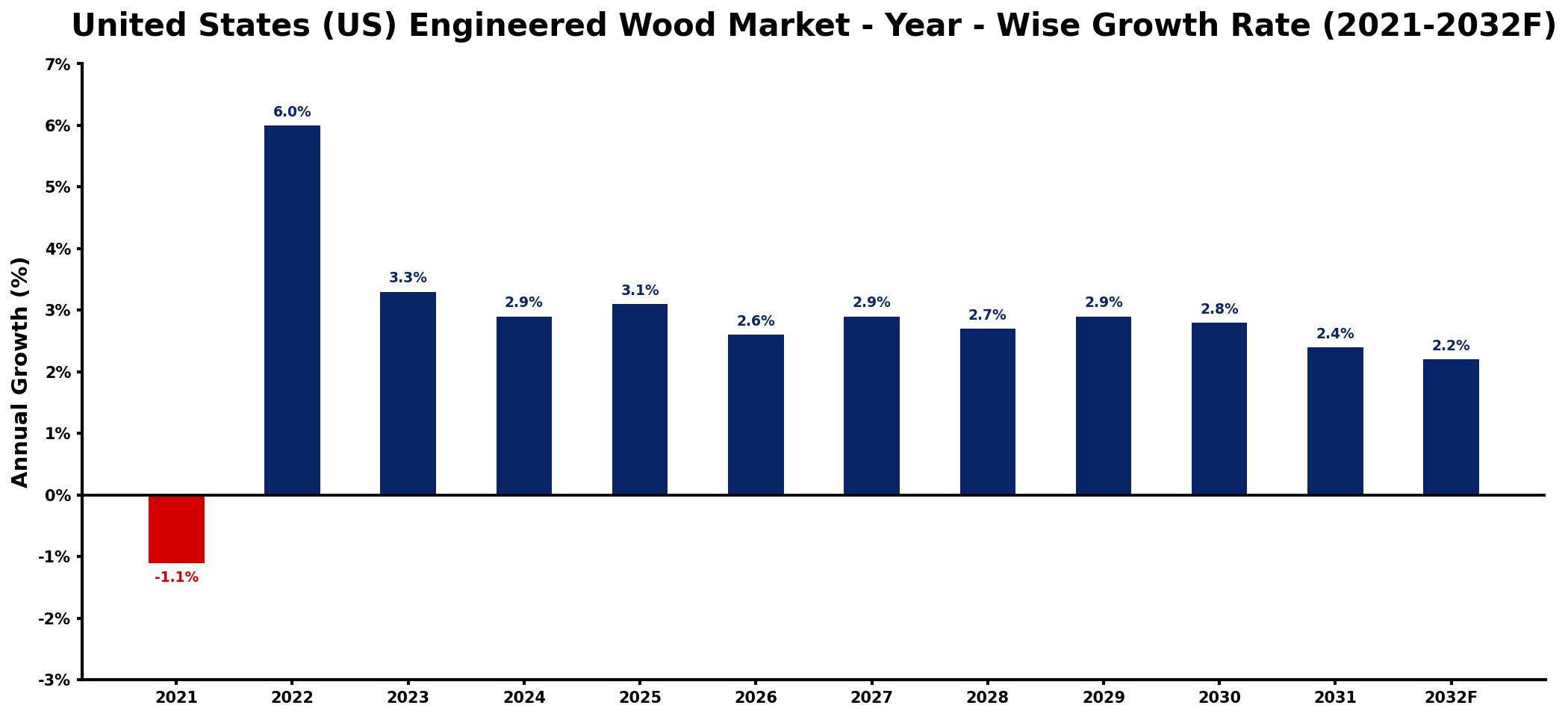
The table below presents the year‑wise growth rates along with the key drivers influencing the market
| Year | Growth Rate | Major Drivers |
| 2021 | -1.1% | Construction activity slowed down significantly |
| 2022 | 6.0% | Residential building projects increased rapidly |
| 2023 | 3.3% | Sustainable materials demand surged sharply |
| 2024 | 2.9% | Commercial real estate investments rose |
| 2025 | 3.1% | Renovation projects expanded nationwide |
| 2026 | 2.6% | Green building initiatives gained traction |
| 2027 | 2.9% | Infrastructure development plans accelerated growth |
| 2028 | 2.7% | Export markets expanded significantly |
| 2029 | 2.9% | Technological advancements improved efficiency |
| 2030 | 2.8% | Home improvement spending increased substantially |
| 2031 | 2.4% | Public sector investments boosted demand |
| 2032 | 2.2% | Urban development projects flourished widely |
Note: Market size estimations and growth projections presented in this report are based on 6Wresearch's proprietary forecasting methodology, utilizing the latest available industry data, government publications, and primary research inputs.
United States (US) Engineered Wood Market Synopsis
The US Engineered Wood Market is being propelled by a notable shift towards sustainable building practices, with engineered products such as laminated veneer lumber (LVL) and oriented strand board (OSB) gaining traction. This shift aligns with the broader trend of eco-consciousness in construction, where environmentally friendly alternatives are being prioritized.
Additionally, engineered wood offers advantages such as cost-effectiveness and enhanced durability, making it a preferred choice among builders and architects. The ongoing growth in both residential and commercial construction sectors in the United States has resulted in a robust demand for these innovative materials, cementing their role in the future of the construction industry.
United States (US) Engineered Wood Market Key Takeaways
- The market is driven by a rising preference for sustainable building materials.
- Innovations in manufacturing processes are enhancing product quality and performance.
- The housing market's recovery is providing a solid foundation for growth.
- Government policies are increasingly supporting eco-friendly construction practices.
- Investment opportunities are expanding, particularly in the residential sector.
Evaluation of Restraints in United States (US) Engineered Wood Market
Despite the promising outlook, the US Engineered Wood Market faces certain constraints. Fluctuating prices of key raw materials, such as adhesives and resins, can impact production costs, affecting profitability. Furthermore, increasing competition from alternative materials, including steel and concrete, challenges the penetration of engineered wood in the market. Consumer concerns regarding sustainability and emissions associated with engineered wood production also necessitate innovative solutions to address these issues effectively.
United States (US) Engineered Wood Market Trends
The market is currently witnessing significant trends, including an accelerating shift towards green building practices and energy-efficient solutions. These trends are characterized by the increased incorporation of engineered wood products in prefabricated construction, aligning with the rising demand for speed and efficiency in building processes. Additionally, technological advancements are continually improving the quality and versatility of engineered wood, solidifying its position as a top choice among builders and contractors.
United States (US) Engineered Wood Market Opportunities
Investment opportunities in the US Engineered Wood Market appear particularly robust as the demand for eco-friendly materials continues to rise. Companies engaged in the manufacture of LVL, OSB, and glulam are well-positioned to capitalize on emerging trends in sustainable construction. Additionally, as the construction industry evolves, there is an increasing interest in innovative building solutions, presenting avenues for long-term growth and profitability.
Government Initiatives in the United States (US) Engineered Wood Market
The US government plays a crucial role in shaping the Engineered Wood Market through various policies and regulations. These include stringent building codes and standards aimed at ensuring quality and safety in construction practices. Furthermore, initiatives promoting sustainable forestry practices facilitate the responsible sourcing of raw materials for engineered wood products. Tax incentives and subsidies are also in place to encourage the adoption of engineered wood, emphasizing its role in reducing carbon emissions and supporting environmental conservation efforts.
Future Insights of the United States (US) Engineered Wood Market
Looking ahead to the period from 2026 to 2032, the United States Engineered Wood Market is projected to continue its upward trend, driven by ongoing construction activities and a growing preference for sustainable building solutions. As awareness of the benefits of engineered wood products expands, both residential and commercial sectors are likely to embrace these innovative materials. Additionally, technological advancements in manufacturing and product development will enhance their appeal, ensuring that engineered wood remains at the forefront of modern construction.
United States (US) Engineered Wood Market Latest Developments (2025 - 2026)
Recent developments in the US Engineered Wood Market have highlighted a focus on sustainability and enhanced manufacturing technologies. Industry players are increasingly investing in research and development to innovate and improve product offerings. This focus is fostering collaborative efforts among stakeholders to create more efficient and eco-friendly engineered wood solutions, which is crucial as demand for sustainable materials continues to grow across various construction sectors.
United States (US) Engineered Wood Market - Key Attractiveness of the Report
- 10 Years of Market Numbers
- Historical Data Starting from 2022 to 2025
- Base Year: 2025
- Forecast Data until 2032
- Key Performance Indicators Impacting the Market
- Major Upcoming Developments and Projects
Key Highlights of the Report:
- United States (US) Engineered Wood Market Outlook
- Market Size of United States (US) Engineered Wood Market, 2025
- Forecast of United States (US) Engineered Wood Market, 2032
- Historical Data and Forecast of United States (US) Engineered Wood Revenues & Volume for the Period 2022-2032F
- United States (US) Engineered Wood Market Trend Evolution
- United States (US) Engineered Wood Market Drivers and Challenges
- United States (US) Engineered Wood Price Trends
- United States (US) Engineered Wood Porter's Five Forces
- United States (US) Engineered Wood Industry Life Cycle
- Historical Data and Forecast of United States (US) Engineered Wood Market Revenues & Volume By Type for the Period 2022-2032F
- Historical Data and Forecast of United States (US) Engineered Wood Market Revenues & Volume By I-Beams for the Period 2022-2032F
- Historical Data and Forecast of United States (US) Engineered Wood Market Revenues & Volume By Plywood for the Period 2022-2032F
- Historical Data and Forecast of United States (US) Engineered Wood Market Revenues & Volume By Laminated Veneer Lumber (LVL) for the Period 2022-2032F
- Historical Data and Forecast of United States (US) Engineered Wood Market Revenues & Volume By Glulam (Glued Laminated Timber) for the Period 2022-2032F
- Historical Data and Forecast of United States (US) Engineered Wood Market Revenues & Volume By Oriented Strand Boards (OSB) for the Period 2022-2032F
- Historical Data and Forecast of United States (US) Engineered Wood Market Revenues & Volume By Cross-Laminated Timber (CLT) for the Period 2022-2032F
- Historical Data and Forecast of United States (US) Engineered Wood Market Revenues & Volume By Others for the Period 2022-2032F
- Historical Data and Forecast of United States (US) Engineered Wood Market Revenues & Volume By Application for the Period 2022-2032F
- Historical Data and Forecast of United States (US) Engineered Wood Market Revenues & Volume By Construction for the Period 2022-2032F
- Historical Data and Forecast of United States (US) Engineered Wood Market Revenues & Volume By Furniture for the Period 2022-2032F
- Historical Data and Forecast of United States (US) Engineered Wood Market Revenues & Volume By Flooring for the Period 2022-2032F
- Historical Data and Forecast of United States (US) Engineered Wood Market Revenues & Volume By Packaging for the Period 2022-2032F
- Historical Data and Forecast of United States (US) Engineered Wood Market Revenues & Volume By Others for the Period 2022-2032F
- Historical Data and Forecast of United States (US) Engineered Wood Market Revenues & Volume By End-User for the Period 2022-2032F
- Historical Data and Forecast of United States (US) Engineered Wood Market Revenues & Volume By Residential for the Period 2022-2032F
- Historical Data and Forecast of United States (US) Engineered Wood Market Revenues & Volume By Commercial & Industrial for the Period 2022-2032F
- United States (US) Engineered Wood Import Export Trade Statistics
- Market Opportunity Assessment By Type
- Market Opportunity Assessment By Application
- Market Opportunity Assessment By End-User
- United States (US) Engineered Wood Top Companies Market Share
- United States (US) Engineered Wood Competitive Benchmarking By Technical and Operational Parameters
- United States (US) Engineered Wood Company Profiles
- United States (US) Engineered Wood Key Strategic Recommendations






































