Poland Industrial Machinery Market: Import Trend Analysis
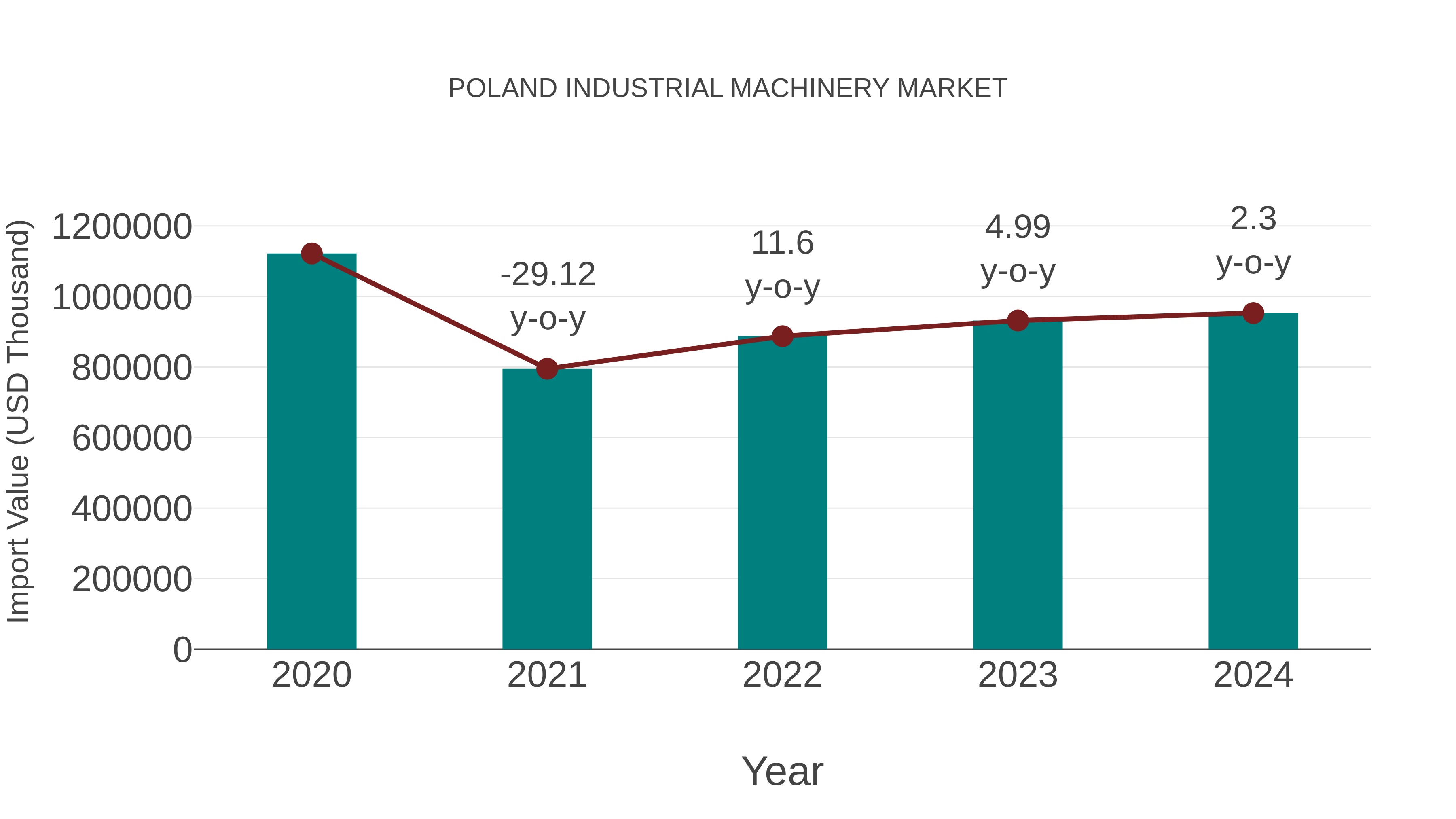
In the Poland industrial machinery market, the import trend from 2023 to 2024 exhibited a growth rate of 2.3%, contrasting with a compound annual growth rate (CAGR) of -3.99% for the period 2020-2024. This shift in import momentum could be attributed to evolving demand patterns or adjustments in trade policies impacting market stability.
Poland Industrial Machinery Market Overview
Poland`s industrial machinery market is growing with increased investments in automation and advanced manufacturing technologies. The market encompasses a wide range of machinery used in various industries, including automotive, aerospace, and consumer goods.
Drivers of the market
The industrial machinery market in Poland is growing with the increasing demand for machinery used in various industrial processes, including manufacturing and construction. Industrial machinery includes equipment such as mills, lathes, and presses. The market expansion is supported by advancements in machinery technology, rising industrial activities, and the need for efficient and high-performance equipment.
Challenges of the market
The industrial machinery market in Poland faces challenges related to technological advancements and market competition. Developing machinery that offers improved performance, reliability, and efficiency while meeting industry-specific requirements is essential. Managing raw material costs and navigating a competitive market where differentiation through advanced features and quality is crucial are key challenges.
Government Policy of the market
The Polish government has established a supportive environment for the industrial machinery market through policies that promote innovation and modernization. Financial incentives and grants are available for companies investing in advanced manufacturing technologies. The government emphasizes adherence to safety and environmental standards, ensuring that the industrial machinery sector remains competitive while contributing to sustainable economic growth.
Key Highlights of the Report:
- Poland Industrial Machinery Market Outlook
- Market Size of Poland Industrial Machinery Market, 2025
- Forecast of Poland Industrial Machinery Market, 2032
- Historical Data and Forecast of Poland Industrial Machinery Revenues & Volume for the Period 2022-2032F
- Poland Industrial Machinery Market Trend Evolution
- Poland Industrial Machinery Market Drivers and Challenges
- Poland Industrial Machinery Price Trends
- Poland Industrial Machinery Porter's Five Forces
- Poland Industrial Machinery Industry Life Cycle
- Historical Data and Forecast of Poland Industrial Machinery Market Revenues & Volume By Application for the Period 2022-2032F
- Historical Data and Forecast of Poland Industrial Machinery Market Revenues & Volume By Agriculture for the Period 2022-2032F
- Historical Data and Forecast of Poland Industrial Machinery Market Revenues & Volume By Construction for the Period 2022-2032F
- Historical Data and Forecast of Poland Industrial Machinery Market Revenues & Volume By Packaging for the Period 2022-2032F
- Historical Data and Forecast of Poland Industrial Machinery Market Revenues & Volume By Food Processing for the Period 2022-2032F
- Historical Data and Forecast of Poland Industrial Machinery Market Revenues & Volume By Mining for the Period 2022-2032F
- Historical Data and Forecast of Poland Industrial Machinery Market Revenues & Volume By Semiconductor Manufacturing for the Period 2022-2032F
- Poland Industrial Machinery Import Export Trade Statistics
- Market Opportunity Assessment By Application
- Poland Industrial Machinery Top Companies Market Share
- Poland Industrial Machinery Competitive Benchmarking By Technical and Operational Parameters
- Poland Industrial Machinery Company Profiles
- Poland Industrial Machinery Key Strategic Recommendations






































