Poland IoT Market Size & Growth Rate (2026-2032)
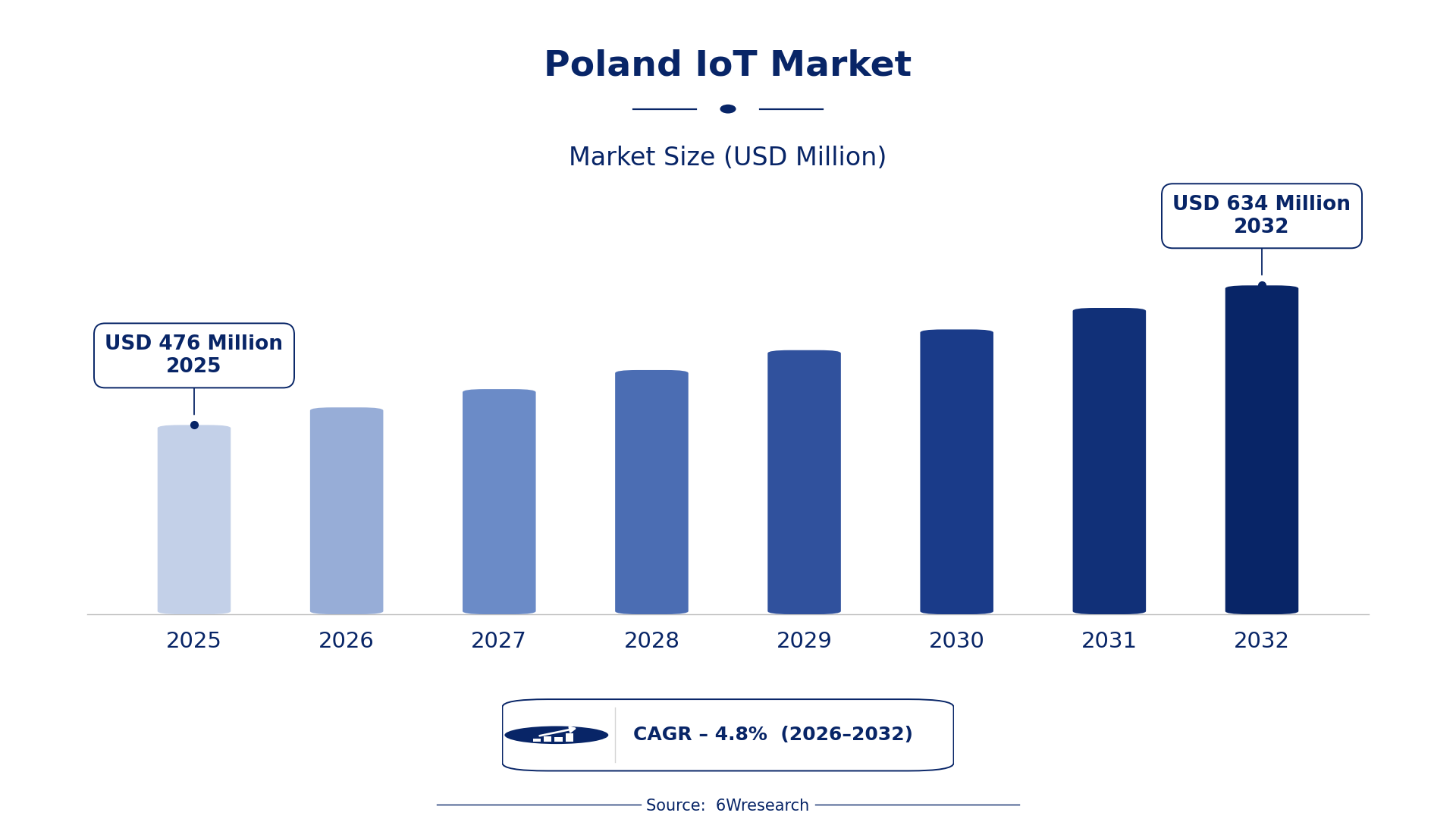
The Poland IoT Market was estimated at USD 476 Million in 2025 and is projected to reach USD 634 Million by 2032, growing at a CAGR of 4.8% from 2026 to 2032.
Poland IoT Market Synopsis
The Poland IoT Market has witnessed a surge in recent years, driven by increasing demand for smart technologies across various sectors. As businesses recognize the potential of IoT to enhance operational efficiency, the landscape is evolving towards a more interconnected future.
Looking ahead, the market is set for substantial growth, fueled by advancements in connectivity infrastructure and government support for digital initiatives. The integration of IoT with emerging technologies like AI and machine learning is expected to further accelerate adoption, unlocking new capabilities across industries.
Poland IoT Market Year-wise Growth Rate and Key Drivers
This graph illustrates the annual growth rates of the Poland IoT Market from 2021 to 2032, highlighting a steady upward trajectory and projected expansion over the forecast period.
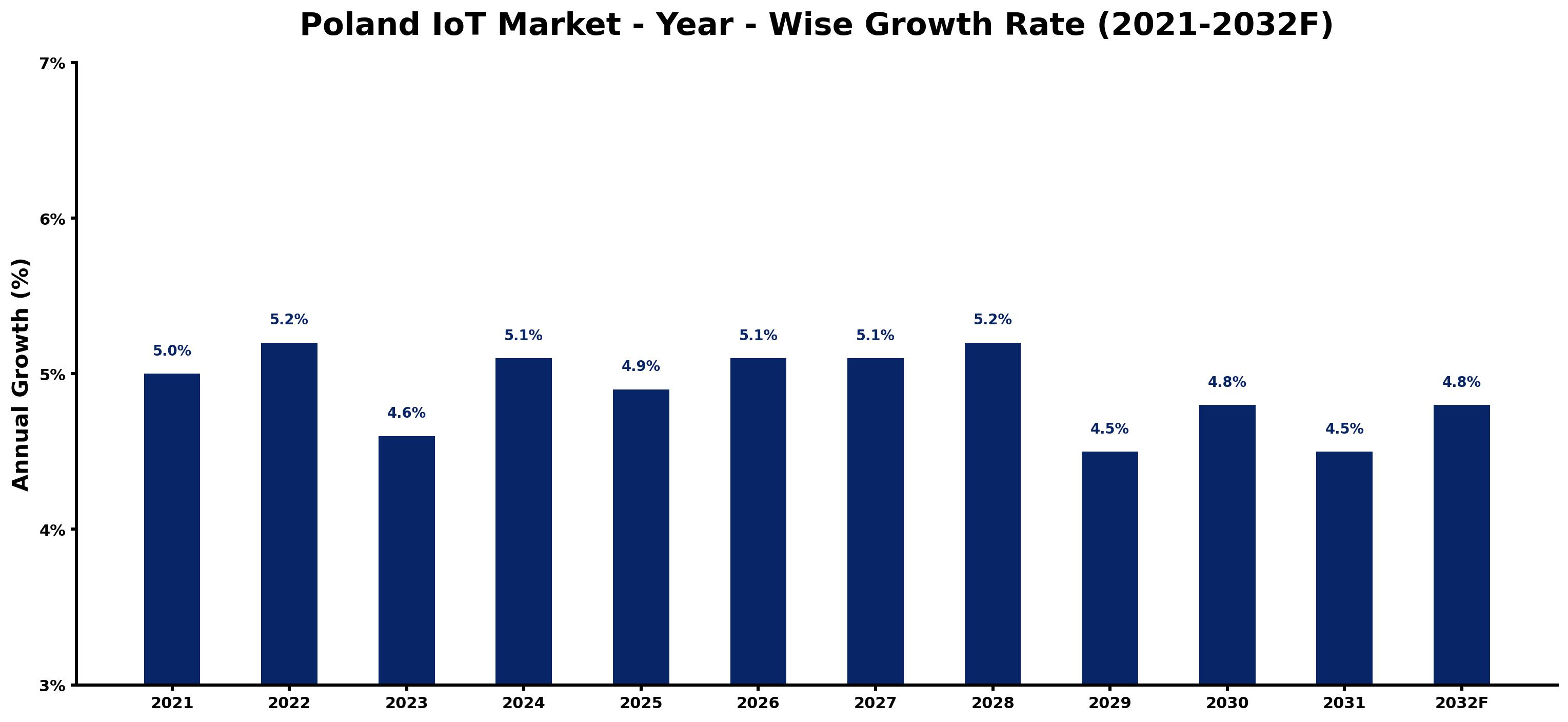
The table below presents the year‑wise growth rates along with the key drivers influencing the market
| Year | Growth Rate | Major Drivers |
| 2021 | 5.0% | Increased government support for IoT research initiatives. |
| 2022 | 5.2% | Development of 5G networks enhances IoT connectivity capabilities. |
| 2023 | 4.6% | Surge in industrial IoT adoption among manufacturing firms. |
| 2024 | 5.1% | Local startups driving innovation in smart city applications. |
| 2025 | 4.9% | EU funding available for IoT security enhancements. |
| 2026 | 5.1% | Growing telehealth solutions boost demand for IoT devices. |
| 2027 | 5.1% | Regulatory support for IoT in energy management systems. |
| 2028 | 5.2% | E-commerce growth fuels logistics IoT technology integration. |
| 2029 | 4.5% | Increased urbanization leads to smart traffic management needs. |
| 2030 | 4.8% | Focus on sustainability drives smart waste management solutions. |
| 2031 | 4.5% | Rise in demand for asset tracking in logistics. |
| 2032 | 4.8% | Partnerships between tech firms enhance IoT platform functionalities. |
Note: Market size estimations and growth projections presented in this report are based on 6Wresearch's proprietary forecasting methodology, utilizing the latest available industry data, government publications, and primary research inputs.
Poland IoT Market Key Takeaways
Below are some of the specific key takeaways from the market, including:
- The market is expanding rapidly, driven by the adoption of IoT technologies in manufacturing, healthcare, and agriculture.
- Government initiatives are fostering a conducive environment for IoT growth through funding and regulatory support.
- Emerging trends include the rise of edge computing and enhanced data security measures for IoT devices.
- There are significant opportunities in smart city projects and connected healthcare solutions.
- Challenges such as interoperability and data privacy remain critical issues that need addressing.
Evaluation of Restraints in Poland IoT Market
Despite its promising trajectory, the Poland IoT Market faces several constraints that could hinder growth. Data security and privacy remain top concerns, as businesses grapple with the implications of increased connectivity. The lack of standardized regulations complicates interoperability among devices, often leading to integration challenges. High implementation costs can deter smaller enterprises from adopting IoT solutions, further stifling market expansion. Finally, a shortage of skilled professionals in IoT technology presents a significant barrier to fully harnessing the potential of these innovations.
Poland IoT Market Trends
Several trends are currently shaping the Poland IoT Market. The integration of AI and machine learning with IoT technologies is enhancing data analytics capabilities, allowing businesses to make better-informed decisions. Edge computing is gaining traction, enabling faster data processing and reducing latency in critical applications. on top of that, there is a growing emphasis on developing secure IoT devices and networks to address consumer and business concerns about data breaches and privacy. These trends indicate a shift towards more sophisticated and reliable IoT solutions.
Poland IoT Market Opportunities
The Poland IoT Market is ripe with opportunities for businesses willing to invest in innovative solutions. Smart city initiatives present a lucrative avenue for growth, with various projects aiming to enhance urban living through interconnected devices. The manufacturing sector is increasingly adopting IoT for predictive maintenance, optimizing equipment performance, and reducing downtime. Precision agriculture is also on the rise, leveraging IoT to improve crop yields and streamline operations. Finally, the healthcare sector is witnessing a surge in connected devices, particularly for remote patient monitoring, which can significantly enhance patient care.
Government Initiatives in the Poland IoT Market
The Polish government has taken proactive steps to bolster the IoT market through various initiatives. Their focus on digital transformation aims to create a supportive ecosystem for IoT technologies. Current policies emphasize enhancing digital infrastructure and fostering innovation, which is critical for the market's growth.
- A national digital infrastructure upgrade programme is currently underway, aimed at enhancing connectivity across urban and rural areas.
- Poland's "Digital Poland 2020" strategy has been implemented to promote the adoption of IoT technologies in various sectors.
- Recent funding initiatives have been rolled out to support research and development in IoT, encouraging innovation among local firms.
- Ongoing discussions are taking place to establish a regulatory framework that focuses on data security and privacy for IoT devices.
- Plans are in motion for upcoming public-private partnerships to expand the reach of IoT solutions within the agricultural sector.
Future Insights of the Poland IoT Market
In the next few years, the Poland IoT Market is set to experience transformative growth driven by technological advancements and increased adoption across various sectors. The integration of 5G technology will enhance connectivity, making IoT applications more efficient and reliable. As businesses continue to seek real-time data analytics and automation solutions, the demand for IoT devices and services will likely surge. This evolving landscape will present ample opportunities for companies to innovate and capitalize on the growing interconnected ecosystem.
Poland IoT Market Latest Developments
Recent developments in the Poland IoT Market highlight a vibrant industry adapting to technological advancements and evolving consumer needs. Companies are increasingly launching initiatives that reflect a commitment to innovation and improved connectivity.
- A major technology vendor launched a new IoT platform in early 2025, designed to integrate seamlessly with existing enterprise systems.
- An initiative focused on enhancing IoT device security is currently underway, aiming to establish industry-wide standards for data protection.
- By mid-2026, a rollout is expected for a nationwide smart city project that will implement IoT solutions for traffic management and urban planning.
- A partnership between several regional operators was completed in late 2025, aimed at expanding IoT network coverage in rural areas.
- Upcoming plans for a public-private initiative targeting precision agriculture technologies are set to begin in late 2026, focusing on sustainability and efficiency.
Poland IoT Market - Key Attractiveness of the Report
- 10 Years of Market Numbers
- Historical Data Starting from 2022 to 2025
- Base Year: 2025
- Forecast Data until 2032
- Key Performance Indicators Impacting the Market
- Major Upcoming Developments and Projects
Key Highlights of the Report:
- Poland IoT Market Outlook
- Market Size of Poland IoT Market, 2025
- Forecast of Poland IoT Market, 2032
- Historical Data and Forecast of Poland IoT Revenues & Volume for the Period 2022-2032F
- Poland IoT Market Trend Evolution
- Poland IoT Market Drivers and Challenges
- Poland IoT Price Trends
- Poland IoT Porter's Five Forces
- Poland IoT Industry Life Cycle
- Historical Data and Forecast of Poland IoT Market Revenues & Volume By Component for the Period 2022-2032F
- Historical Data and Forecast of Poland IoT Market Revenues & Volume By Platform for the Period 2022-2032F
- Historical Data and Forecast of Poland IoT Market Revenues & Volume By Service for the Period 2022-2032F
- Historical Data and Forecast of Poland IoT Market Revenues & Volume By Software Solution for the Period 2022-2032F
- Historical Data and Forecast of Poland IoT Market Revenues & Volume By Application for the Period 2022-2032F
- Historical Data and Forecast of Poland IoT Market Revenues & Volume By Building & Home Automation for the Period 2022-2032F
- Historical Data and Forecast of Poland IoT Market Revenues & Volume By Smart Energy for the Period 2022-2032F
- Historical Data and Forecast of Poland IoT Market Revenues & Volume By Smart Manufacturing for the Period 2022-2032F
- Historical Data and Forecast of Poland IoT Market Revenues & Volume By Connected Logistics for the Period 2022-2032F
- Historical Data and Forecast of Poland IoT Market Revenues & Volume By Connected Health for the Period 2022-2032F
- Historical Data and Forecast of Poland IoT Market Revenues & Volume By Smart Retail for the Period 2022-2032F
- Historical Data and Forecast of Poland IoT Market Revenues & Volume By Smart Mobility & Transportation for the Period 2022-2032F
- Historical Data and Forecast of Poland IoT Market Revenues & Volume By Security & Emergencies for the Period 2022-2032F
- Historical Data and Forecast of Poland IoT Market Revenues & Volume By Platform for the Period 2022-2032F
- Historical Data and Forecast of Poland IoT Market Revenues & Volume By Device Management Platform for the Period 2022-2032F
- Historical Data and Forecast of Poland IoT Market Revenues & Volume By Application Management Software for the Period 2022-2032F
- Historical Data and Forecast of Poland IoT Market Revenues & Volume By Network Management Software for the Period 2022-2032F
- Historical Data and Forecast of Poland IoT Market Revenues & Volume By Software Solution for the Period 2022-2032F
- Historical Data and Forecast of Poland IoT Market Revenues & Volume By Real-time Stream Analytics for the Period 2022-2032F
- Historical Data and Forecast of Poland IoT Market Revenues & Volume By Security Solution for the Period 2022-2032F
- Historical Data and Forecast of Poland IoT Market Revenues & Volume By Data Management for the Period 2022-2032F
- Historical Data and Forecast of Poland IoT Market Revenues & Volume By Remote Monitoring System for the Period 2022-2032F
- Historical Data and Forecast of Poland IoT Market Revenues & Volume By Network Bandwidth Management for the Period 2022-2032F
- Historical Data and Forecast of Poland IoT Market Revenues & Volume By Service for the Period 2022-2032F
- Historical Data and Forecast of Poland IoT Market Revenues & Volume By Professional Services for the Period 2022-2032F
- Historical Data and Forecast of Poland IoT Market Revenues & Volume By Managed Services for the Period 2022-2032F
- Poland IoT Import Export Trade Statistics
- Market Opportunity Assessment By Component
- Market Opportunity Assessment By Application
- Market Opportunity Assessment By Platform
- Market Opportunity Assessment By Software Solution
- Market Opportunity Assessment By Service
- Poland IoT Top Companies Market Share
- Poland IoT Competitive Benchmarking By Technical and Operational Parameters
- Poland IoT Company Profiles
- Poland IoT Key Strategic Recommendations






































