Poland Managed Services Market Size & Growth Rate (2026-2032)
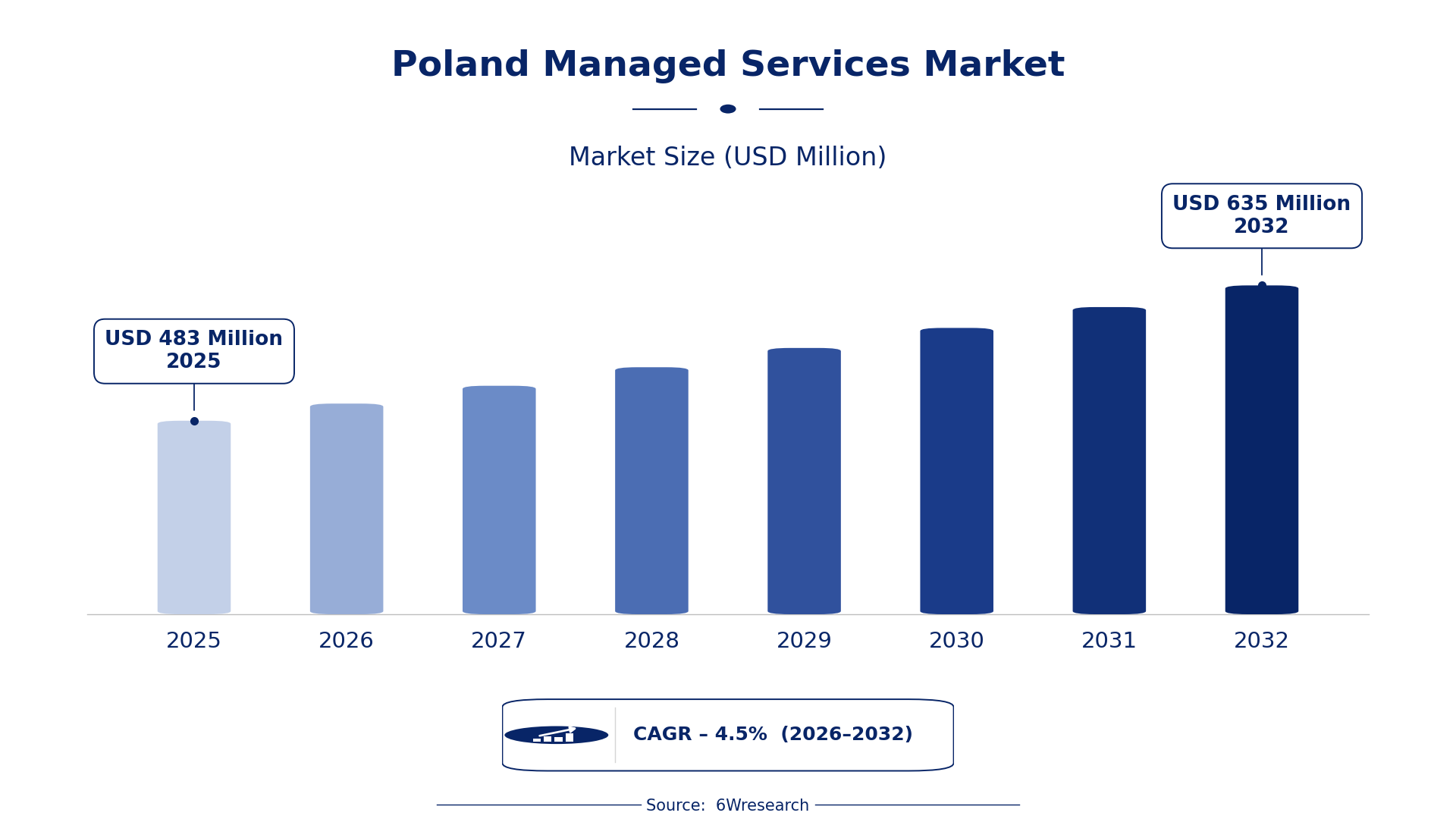
The Poland Managed Services Market was estimated at USD 483 Million in 2025 and is projected to reach USD 635 Million by 2032, growing at a CAGR of 4.5% from 2026 to 2032.
Poland Managed Services Market Synopsis
The Poland Managed Services Market is currently witnessing a surge, driven by the rising reliance on cloud technologies and the critical need for comprehensive IT management. Organizations are increasingly outsourcing their IT services to focus on core competencies, resulting in heightened demand for specialized managed services.
Cybersecurity threats have become a primary concern for businesses, further propelling the need for managed security services. As the complexity of IT environments grows, particularly within small and medium-sized enterprises, the requirement for expert management solutions is clear and pressing.
Poland Managed Services Market Year-wise Growth Rate and Key Drivers
This graph illustrates the annual growth rates of the Poland Managed Services Market from 2021 to 2032, highlighting a steady upward trajectory and projected expansion over the forecast period.
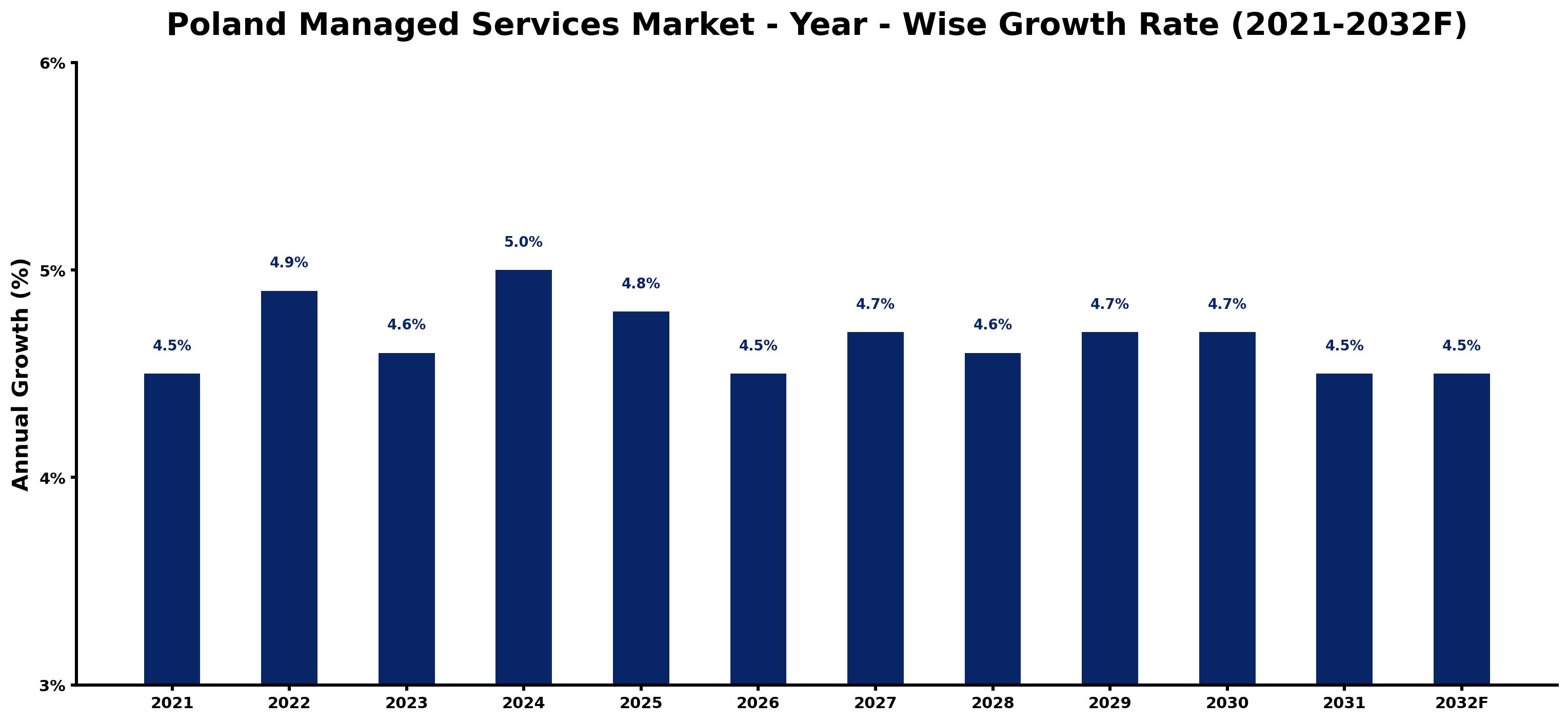
The table below presents the year‑wise growth rates along with the key drivers influencing the market
| Year | Growth Rate | Major Drivers |
| 2021 | 4.5% | Increased cybersecurity measures by Poland's national cybersecurity strategy. |
| 2022 | 4.9% | Growing adoption of AI-driven solutions in local businesses. |
| 2023 | 4.6% | Rising digital economy policies boosting managed IT service uptake. |
| 2024 | 5.0% | Poland's increasing focus on IT skills development programs. |
| 2025 | 4.8% | Demand for IT service providers due to EU funding. |
| 2026 | 4.5% | Adoption of smart technologies in public sector services. |
| 2027 | 4.7% | Enhanced data protection laws driving managed services necessity. |
| 2028 | 4.6% | Growing e-commerce sector requiring expanded IT support solutions. |
| 2029 | 4.7% | Increasing interest in IoT solutions across Polish industries. |
| 2030 | 4.7% | Regional tech startups driving innovation in managed services. |
| 2031 | 4.5% | Demand for compliance services due to new regulations. |
| 2032 | 4.5% | Local demand for outsourcing due to skilled labor shortages. |
Note: Market size estimations and growth projections presented in this report are based on 6Wresearch's proprietary forecasting methodology, utilizing the latest available industry data, government publications, and primary research inputs.
Poland Managed Services Market Key Takeaways
Below are some of the specific key takeaways from the market, including:
- Increasing outsourcing of IT functions is reshaping the managed services sector.
- Cloud services adoption is a key driver of market growth and demand.
- Cybersecurity remains a critical focus area, with rising investments in managed security services.
- SMEs are increasingly recognizing the value of managed services for operational efficiency.
- Advanced technologies like AI and IoT are driving the development of specialized service offerings.
Evaluation of Restraints in Poland Managed Services Market
While the market is flourishing, it faces hurdles that could impede growth. Intense competition among service providers is leading to pricing pressures, making it challenging for smaller firms to compete effectively. on top of that, a shortage of skilled IT professionals limits the ability of companies to deliver high-quality services. Compliance with evolving data security regulations poses another significant challenge, as firms must ensure they meet stringent standards while maintaining operational efficiency.
Poland Managed Services Market Trends
Current trends highlight a growing demand for managed security services, reflecting businesses' acute awareness of cyber threats. The shift towards hybrid cloud environments is also notable, as organizations seek flexibility and scalability. Additionally, the integration of artificial intelligence and automation into service offerings is becoming increasingly prevalent, allowing providers to enhance service delivery and efficiency.
Poland Managed Services Market Opportunities
The market presents several compelling opportunities, particularly in sectors like healthcare, finance, and manufacturing, which are in dire need of tailored managed services. As SMEs look to outsource IT operations to focus on their core business, providers can capitalize on this trend by offering customized solutions. on top of that, the burgeoning interest in data analytics and advanced technologies creates avenues for managed service providers to differentiate their offerings and capture market share.
Government Initiatives in the Poland Managed Services Market
Government policy is playing a crucial role in shaping the direction of the Poland Managed Services Market. Initiatives aimed at promoting digital transformation and enhancing cybersecurity infrastructure are central to this environment. The government’s focus on improving access to digital technologies and fostering a skilled workforce is creating an advantageous climate for managed services to thrive.
- A recently completed initiative under the Digital Poland program aimed to improve nationwide internet access, significantly benefiting managed services providers.
- A current focus on enhancing digital skills training is underway, aimed at equipping the workforce with the necessary capabilities to support the managed services sector.
- Planned regulations set to be introduced by 2026 will mandate increased transparency in billing practices for managed services, aiming to foster consumer trust.
- The government is implementing an ongoing cybersecurity enhancement strategy to bolster infrastructure and protect critical data.
- A public-private partnership initiative is expected to launch in 2027, aimed at expanding digital infrastructure across rural areas.
Future Insights of the Poland Managed Services Market
Looking ahead to 2026-2032, the Poland Managed Services Market is likely to continue its upward trajectory. As businesses become more reliant on technology, the demand for outsourced IT services will grow. The increasing complexity of IT environments and the imperative for robust cybersecurity measures will drive further investments in managed services. Providers that adapt to the evolving needs of businesses and embrace innovation will be well-positioned for success.
Poland Managed Services Market Latest Developments
In the past year, the Poland Managed Services Market has seen notable activity reflecting the dynamic nature of the sector. Companies are actively investing in new technologies and expanding their service portfolios to meet rising demand.
- A leading regional operator launched a new managed security service offering in Q1 2025, focusing on advanced threat detection and response capabilities.
- An initiative that began in mid-2025 is currently underway, aimed at enhancing service delivery through automation and AI integration in managed services.
- A major technology vendor is expected to roll out a new cloud management platform by late 2026, designed to streamline operations for SMEs.
- A partnership established in early 2025 between multiple service providers is focused on creating an integrated cybersecurity framework to address complex threats.
- By mid-2026, a new training program for IT professionals is set to launch, aimed at addressing the skills gap within the managed services sector.
Poland Managed Services Market - Key Attractiveness of the Report
- 10 Years of Market Numbers
- Historical Data Starting from 2022 to 2025
- Base Year: 2025
- Forecast Data until 2032
- Key Performance Indicators Impacting the Market
- Major Upcoming Developments and Projects
Key Highlights of the Report:
- Poland Managed Services Market Outlook
- Market Size of Poland Managed Services Market, 2025
- Forecast of Poland Managed Services Market, 2032
- Historical Data and Forecast of Poland Managed Services Revenues & Volume for the Period 2022-2032F
- Poland Managed Services Market Trend Evolution
- Poland Managed Services Market Drivers and Challenges
- Poland Managed Services Price Trends
- Poland Managed Services Porter's Five Forces
- Poland Managed Services Industry Life Cycle
- Historical Data and Forecast of Poland Managed Services Market Revenues & Volume By Service Type for the Period 2022-2032F
- Historical Data and Forecast of Poland Managed Services Market Revenues & Volume By Managed Security Services for the Period 2022-2032F
- Historical Data and Forecast of Poland Managed Services Market Revenues & Volume By Managed Network Services for the Period 2022-2032F
- Historical Data and Forecast of Poland Managed Services Market Revenues & Volume By Managed Data Center and IT Infrastructure Services for the Period 2022-2032F
- Historical Data and Forecast of Poland Managed Services Market Revenues & Volume By Managed Communication and Collaboration Services for the Period 2022-2032F
- Historical Data and Forecast of Poland Managed Services Market Revenues & Volume By Managed Mobility Services for the Period 2022-2032F
- Historical Data and Forecast of Poland Managed Services Market Revenues & Volume By Managed Information Services for the Period 2022-2032F
- Historical Data and Forecast of Poland Managed Services Market Revenues & Volume By Deployment Type for the Period 2022-2032F
- Historical Data and Forecast of Poland Managed Services Market Revenues & Volume By Cloud for the Period 2022-2032F
- Historical Data and Forecast of Poland Managed Services Market Revenues & Volume By On-Premises for the Period 2022-2032F
- Historical Data and Forecast of Poland Managed Services Market Revenues & Volume By Organization Size for the Period 2022-2032F
- Historical Data and Forecast of Poland Managed Services Market Revenues & Volume By Small and Medium-sized Enterprises (SMEs) for the Period 2022-2032F
- Historical Data and Forecast of Poland Managed Services Market Revenues & Volume By Large Enterprises for the Period 2022-2032F
- Historical Data and Forecast of Poland Managed Services Market Revenues & Volume By Vertical for the Period 2022-2032F
- Historical Data and Forecast of Poland Managed Services Market Revenues & Volume By BFSI for the Period 2022-2032F
- Historical Data and Forecast of Poland Managed Services Market Revenues & Volume By IT and Telecom for the Period 2022-2032F
- Historical Data and Forecast of Poland Managed Services Market Revenues & Volume By Retail and Consumer Goods for the Period 2022-2032F
- Historical Data and Forecast of Poland Managed Services Market Revenues & Volume By Manufacturing for the Period 2022-2032F
- Historical Data and Forecast of Poland Managed Services Market Revenues & Volume By Government for the Period 2022-2032F
- Historical Data and Forecast of Poland Managed Services Market Revenues & Volume By Healthcare and Life Sciences for the Period 2022-2032F
- Historical Data and Forecast of Poland Managed Services Market Revenues & Volume By Energy and Utilities for the Period 2022-2032F
- Historical Data and Forecast of Poland Managed Services Market Revenues & Volume By Media and Entertainment for the Period 2022-2032F
- Poland Managed Services Import Export Trade Statistics
- Market Opportunity Assessment By Service Type
- Market Opportunity Assessment By Deployment Type
- Market Opportunity Assessment By Organization Size
- Market Opportunity Assessment By Vertical
- Poland Managed Services Top Companies Market Share
- Poland Managed Services Competitive Benchmarking By Technical and Operational Parameters
- Poland Managed Services Company Profiles
- Poland Managed Services Key Strategic Recommendations






































