Poland Metal Recycling Market Size, Share & Growth Rate
The Poland Metal Recycling Market was estimated at USD 894 Million in 2025 and is projected to reach USD 1273 Million by 2032, growing at a CAGR of 5.2% from 2026 to 2032. This growth trajectory is fueled by heightened environmental awareness among consumers and businesses alike, alongside government regulations that are increasingly advocating for sustainable practices. The automotive and construction sectors, both significant users of recycled metals, are also experiencing expansion, further elevating demand in the recycling market.
Poland Metal Recycling Market Year-wise Growth Rate and Key Drivers
This graph highlights how the Poland Metal Recycling Market has steadily grown over the years, supported by major growth factors.
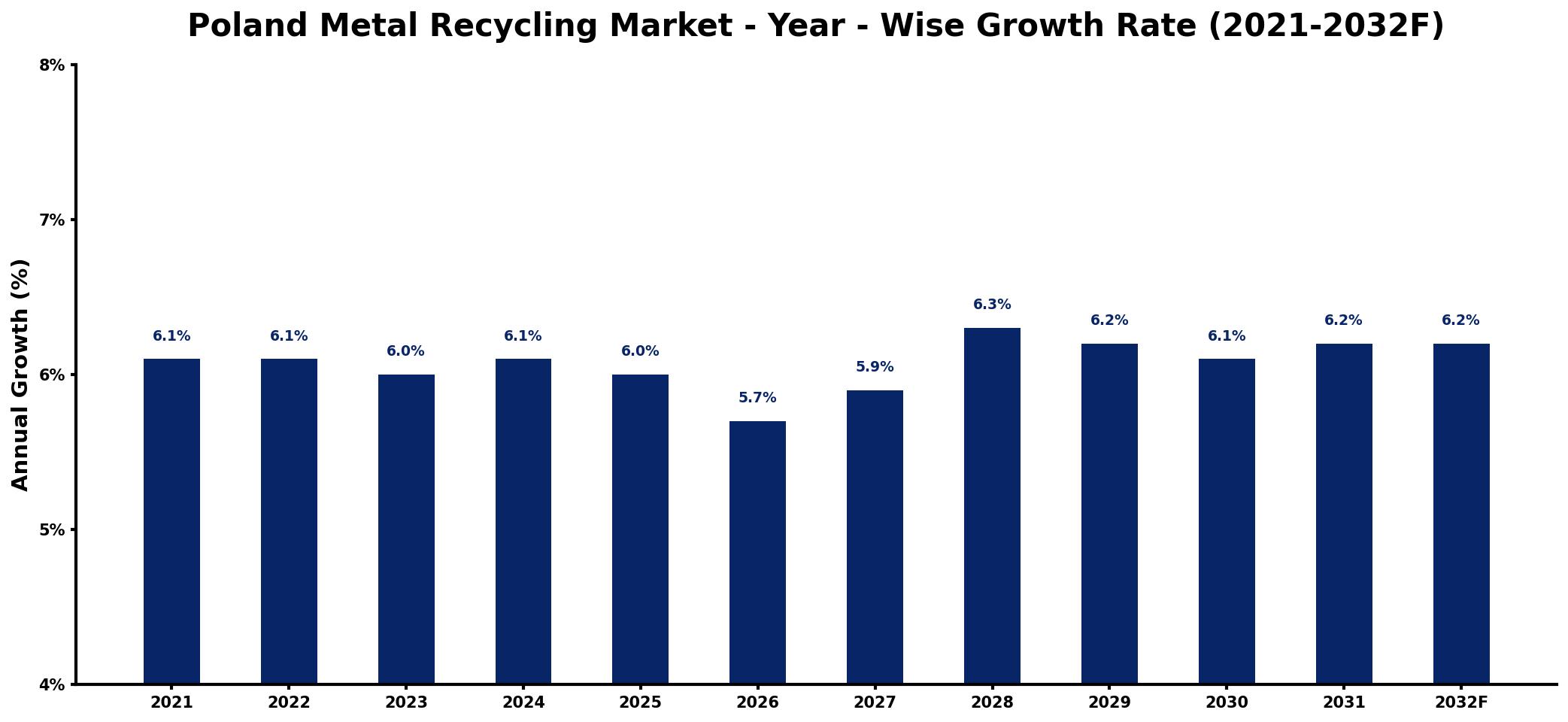
The table below presents the year‑wise growth rates along with the key drivers influencing the market
| Year | Growth Rate | Major Drivers |
| 2021 | 6.1% | Rising demand for sustainable practices |
| 2022 | 6.1% | Increased investment in infrastructure |
| 2023 | 6.0% | Growing automotive industry requirements |
| 2024 | 6.1% | Expansion of renewable energy projects |
| 2025 | 6.0% | Technological advancements in processing |
| 2026 | 5.7% | Strengthening regulatory frameworks globally |
| 2027 | 5.9% | Surge in construction sector activities |
| 2028 | 6.3% | Higher consumer awareness initiatives |
| 2029 | 6.2% | Increased industrial production rates |
| 2030 | 6.1% | Improved efficiency in logistics operations |
| 2031 | 6.2% | Enhanced collaboration among stakeholders |
| 2032 | 6.2% | Emergence of circular economy models |
Note: Market size estimations and growth projections presented in this report are based on 6Wresearch's proprietary forecasting methodology, utilizing the latest available industry data, government publications, and primary research inputs.
Poland Metal Recycling Market Synopsis
The Poland Metal Recycling Market is on an upward trajectory, driven by robust environmental initiatives and an evolving industrial landscape. A substantial shift towards sustainability has been observed, making recycling a pivotal element in the metal supply chain.
Technological innovations are also playing a critical role, enhancing efficiency and reducing operational costs for recyclers. This dynamic environment encourages stakeholders to invest in state-of-the-art recycling technologies, allowing for more effective sorting, processing, and repurposing of metals.
Poland Metal Recycling Market Key Takeaways
- The market is experiencing growth driven by environmental awareness and regulatory support for recycling practices.
- Technological advancements are improving operational efficiency and reducing costs across the recycling sector.
- The automotive and construction industries are significant drivers of demand for recycled metals in Poland.
- Investment opportunities are expanding as sustainability becomes a focal point for businesses and government initiatives.
- The market is characterized by intense competition, requiring companies to innovate to stay relevant.
Evaluation of Restraints in Poland Metal Recycling Market
Despite its growth potential, the Poland Metal Recycling Market faces several constraints. Fluctuating metal prices present a challenge for recyclers, complicating revenue projections and profitability. Additionally, intense competition among recycling firms amplifies pressure on profit margins, pushing companies to innovate continuously. Regulatory uncertainties can further complicate compliance and operational strategies, making it essential for companies to remain adaptive in this evolving landscape.
Poland Metal Recycling Market Trends
The trend towards sustainability is becoming more pronounced in the Poland Metal Recycling Market, with increased governmental and societal emphasis on the circular economy. Companies are integrating advanced technologies such as automated sorting and AI-driven processing to enhance efficiency. Moreover, the growing importance of lifecycle assessments in industrial practices is pushing manufacturers to prioritize recycled materials, further solidifying the market's growth.
Poland Metal Recycling Market Opportunities
Investment opportunities in the Poland Metal Recycling Market are particularly promising. The focus on establishing efficient recycling infrastructure is creating avenues for new entrants and existing players alike to expand their operations. Collaborations with local businesses for scrap metal collection and investments in innovative processing technologies can yield substantial returns, especially as demand for recycled metals continues to rise across various sectors.
Government Initiatives in the Poland Metal Recycling Market
The Polish government is actively promoting the metal recycling sector through several key policies and incentives. The Waste Act of 2012 has laid the groundwork for enhanced waste management practices, directing efforts towards increasing recycling efficiency. Additionally, financial incentives and subsidies are offered to encourage businesses to develop recycling infrastructure and invest in advanced technologies, underscoring the governments commitment to environmental sustainability.
Future Insights of the Poland Metal Recycling Market
The outlook for the Poland Metal Recycling Market between 2026 and 2032 is highly optimistic. As industries increasingly recognize the need to minimize their environmental impact, the demand for recycled materials is expected to escalate. Investments in innovative recycling technologies will likely enhance efficiency and attract further capital into the sector. However, market participants will need to navigate challenges such as fluctuating material prices and international competition to secure their positions.
Poland Metal Recycling Market Latest Developments (2025 - 2026)
In the latest phase of the Poland Metal Recycling Market, industry stakeholders are increasingly focusing on collaboration to streamline operations and enhance processing capabilities. Companies are actively exploring partnerships for more efficient scrap collection networks and embracing technological solutions to optimize recycling processes. Regulatory changes are also emerging, aimed at further promoting sustainability and reducing landfill waste, indicating a significant shift towards a more circular economy.
Poland Metal Recycling Market - Key Attractiveness of the Report
- 10 Years of Market Numbers
- Historical Data Starting from 2022 to 2025
- Base Year: 2025
- Forecast Data until 2032
- Key Performance Indicators Impacting the Market
- Major Upcoming Developments and Projects
Key Highlights of the Report:
- Poland Metal Recycling Market Outlook
- Market Size of Poland Metal Recycling Market, 2025
- Forecast of Poland Metal Recycling Market, 2032
- Historical Data and Forecast of Poland Metal Recycling Revenues & Volume for the Period 2022-2032F
- Poland Metal Recycling Market Trend Evolution
- Poland Metal Recycling Market Drivers and Challenges
- Poland Metal Recycling Price Trends
- Poland Metal Recycling Porter's Five Forces
- Poland Metal Recycling Industry Life Cycle
- Historical Data and Forecast of Poland Metal Recycling Market Revenues & Volume By Scrap Type for the Period 2022-2032F
- Historical Data and Forecast of Poland Metal Recycling Market Revenues & Volume By Old Scrap for the Period 2022-2032F
- Historical Data and Forecast of Poland Metal Recycling Market Revenues & Volume By New Scrap for the Period 2022-2032F
- Historical Data and Forecast of Poland Metal Recycling Market Revenues & Volume By Type for the Period 2022-2032F
- Historical Data and Forecast of Poland Metal Recycling Market Revenues & Volume By Ferrous for the Period 2022-2032F
- Historical Data and Forecast of Poland Metal Recycling Market Revenues & Volume By Non-Ferrous for the Period 2022-2032F
- Historical Data and Forecast of Poland Metal Recycling Market Revenues & Volume By Equipment for the Period 2022-2032F
- Historical Data and Forecast of Poland Metal Recycling Market Revenues & Volume By Shredders for the Period 2022-2032F
- Historical Data and Forecast of Poland Metal Recycling Market Revenues & Volume By Shears for the Period 2022-2032F
- Historical Data and Forecast of Poland Metal Recycling Market Revenues & Volume By Granulating Machines for the Period 2022-2032F
- Historical Data and Forecast of Poland Metal Recycling Market Revenues & Volume By Briquetting Machines for the Period 2022-2032F
- Historical Data and Forecast of Poland Metal Recycling Market Revenues & Volume By End-use Sector for the Period 2022-2032F
- Historical Data and Forecast of Poland Metal Recycling Market Revenues & Volume By Building & Construction for the Period 2022-2032F
- Historical Data and Forecast of Poland Metal Recycling Market Revenues & Volume By Automotive for the Period 2022-2032F
- Historical Data and Forecast of Poland Metal Recycling Market Revenues & Volume By Equipment Manufacturing for the Period 2022-2032F
- Historical Data and Forecast of Poland Metal Recycling Market Revenues & Volume By Shipbuilding for the Period 2022-2032F
- Historical Data and Forecast of Poland Metal Recycling Market Revenues & Volume By Packaging for the Period 2022-2032F
- Historical Data and Forecast of Poland Metal Recycling Market Revenues & Volume By Consumer Appliances for the Period 2022-2032F
- Historical Data and Forecast of Poland Metal Recycling Market Revenues & Volume By Others for the Period 2022-2032F
- Poland Metal Recycling Import Export Trade Statistics
- Market Opportunity Assessment By Scrap Type
- Market Opportunity Assessment By Type
- Market Opportunity Assessment By Equipment
- Market Opportunity Assessment By End-use Sector
- Poland Metal Recycling Top Companies Market Share
- Poland Metal Recycling Competitive Benchmarking By Technical and Operational Parameters
- Poland Metal Recycling Company Profiles
- Poland Metal Recycling Key Strategic Recommendations






































