Poland Outdoor LED Lighting Market Summary
The poland outdoor led lighting market was estimated at USD 413 Million in 2025 and is projected to reach USD 551 Million by 2032, growing at a CAGR of 4.8% from 2026 to 2032.
Poland Outdoor LED Lighting Market Year-wise Growth Rate and Key Drivers
This graph highlights how the Poland Outdoor LED Lighting Market has steadily grown over the past five years, supported by major growth factors.
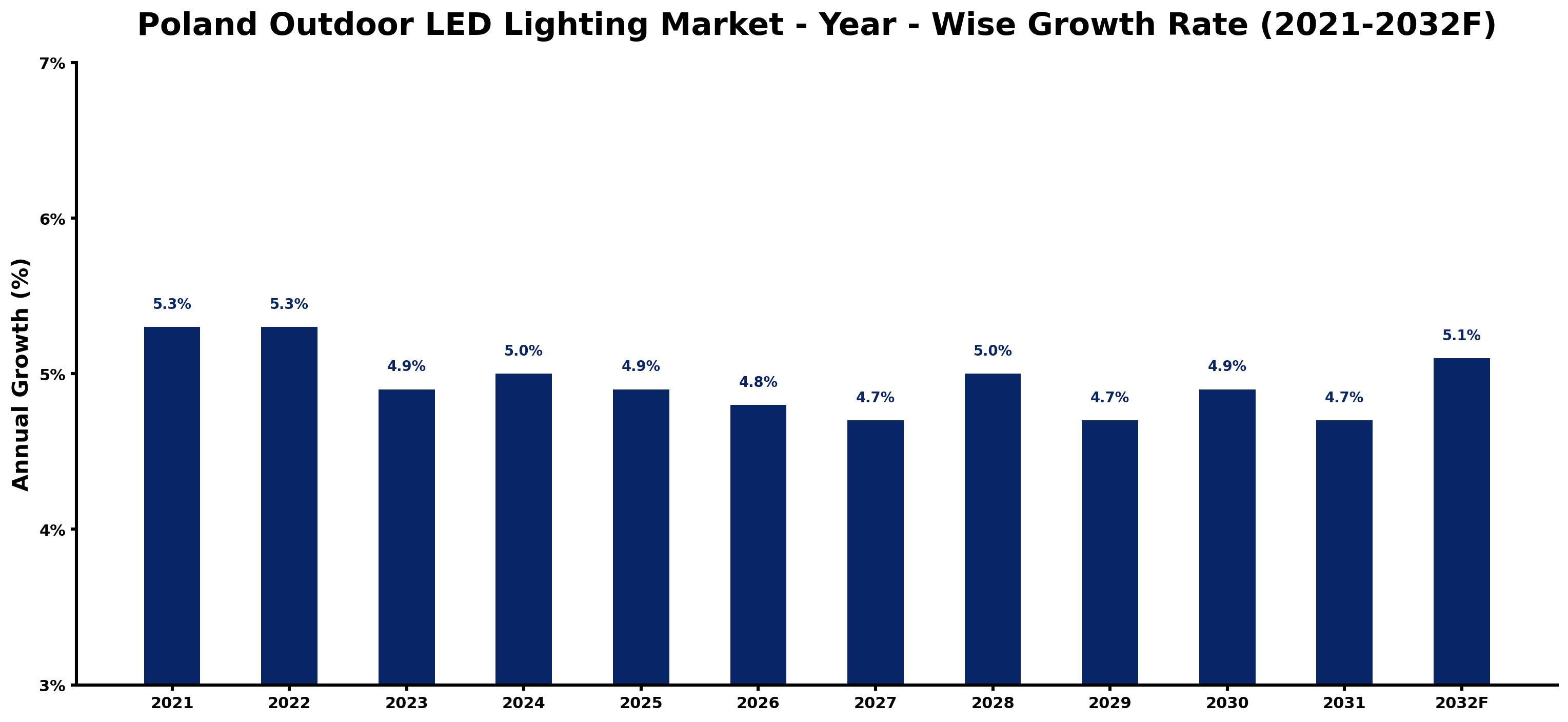
The table below presents the year wise growth rates along with the key drivers influencing the market
| Year | Growth Rate | Major Drivers |
| 2021 | 5.3% | A shift towards energy efficiency in public infrastructure shaped lighting specifications. |
| 2022 | 5.3% | Emerging smart city projects emphasized the importance of advanced outdoor lighting solutions. |
| 2023 | 4.9% | An increase in urbanization led to heightened investments in outdoor lighting systems. |
| 2024 | 5.0% | Post-pandemic community spaces required improved lighting for safety and accessibility. |
| 2025 | 4.9% | Technological enhancements in LEDs offered longer lifespans and reduced energy costs. |
| 2026 | 4.8% | Consumer awareness around sustainability influenced purchasing decisions in outdoor lighting. |
| 2027 | 4.7% | Corporate sustainability commitments triggered funding for eco-friendly lighting alternatives. |
| 2028 | 5.0% | Integration of IoT in lighting systems provided enhanced control and operational efficiency. |
| 2029 | 4.7% | Growing interest in smart technologies increased the demand for connected lighting solutions. |
| 2030 | 4.9% | Climate resilience initiatives focused on adaptive outdoor lighting strategies in urban areas. |
| 2031 | 4.7% | A shift towards renewable energy sources supported outdoor lighting electrification efforts. |
| 2032 | 5.1% | Local manufacturing capabilities improved supply chain reliability for outdoor lighting products. |
Note - Market size estimations and growth projections presented in this report are based on 6Wresearch's advanced forecasting approach, validated with industry datasets as of June 2026.
Poland Outdoor LED Lighting Market Synopsis
The Poland Outdoor LED Lighting Market is projected to reach 4.8% and witness significant growth during the forecast period (2026-2032). The market is poised for a compound annual growth rate (CAGR) of 7.4%, driven by the increasing demand for energy-efficient lighting solutions and a collective societal push towards sustainability. The recent trends indicate a marked transition from traditional lighting technologies to LEDs due to their cost efficiency, longevity, and environmental benefits.
Poland Outdoor LED Lighting Market Growth Drivers
Several interlinked factors are propelling the growth of the Poland Outdoor LED Lighting Market. Firstly, the rising demand for energy-efficient solutions is significantly influencing the adoption of LED lights in outdoor settings. As businesses and municipalities prioritize optimizing energy consumption, the efficiency of LED technology stands out as a key advantage.
- Government initiatives aimed at promoting sustainability have created a favorable environment for LED adoption, influencing both public and private sectors.
- The technological advancements in LED lighting, such as smart lighting systems, are enhancing the functionality and performance of outdoor lighting solutions.
- Commercial establishments, including airports, hotels, and shopping malls, are increasingly upgrading their lighting infrastructure to improve cost-efficiency and aesthetic appeal.
- Consumer awareness regarding the environmental impact of lighting choices is growing, driving demand for products that align with eco-friendly practices.
- The focus on reducing carbon footprints and energy costs is compelling various sectors, including public lighting systems, to transition towards LED solutions.
Poland Outdoor LED Lighting Market Trends and Opportunities
The Poland Outdoor LED Lighting Market is characterized by a series of evolving trends that present unique opportunities for growth. The integration of smart technologies within outdoor lighting systems is a leading trend, enabling enhanced control and energy savings.
- The rise of smart city initiatives fosters the implementation of advanced lighting solutions, contributing to improved urban infrastructure.
- The demand for connected lighting systems is increasing, enabling users to control lighting remotely, further driving the adoption of outdoor LEDs.
- There is a growing preference for solar-powered LED lights, reflecting widespread interest in renewable energy solutions and cost savings.
- The emphasis on aesthetics in outdoor lighting design is leading to innovative fixture designs and customizable options to meet diverse consumer requirements.
- Partnerships and collaborations among technology providers and municipalities are fostering new projects that leverage shared expertise and resources.
Poland Outdoor LED Lighting Market Government Investment and Initiatives
The Polish government has recognized the significance of energy-efficient outdoor lighting in its broader sustainability objectives. Various initiatives are being undertaken to promote the transition to LED lighting across public infrastructures.
- Government policies encourage local authorities to invest in energy-efficient lighting projects, often accompanied by financial incentives and grants.
- Public spending on infrastructure upgrades increasingly emphasizes the integration of LED technology to meet energy reduction targets.
- The government's commitment to reducing greenhouse gas emissions supports the growth of the LED market within urban planning and development frameworks.
- Regular updates to building codes now include provisions that favor the installation of energy-efficient lighting solutions, reinforcing market growth.
- Strategic initiatives are also focused on public awareness campaigns, aiming to inform citizens about the benefits of adopting LED technology in outdoor settings.
Poland Outdoor LED Lighting Market Latest Developments (May 2025 - June 2026)
In the recent period from May 2025 to June 2026, the Poland Outdoor LED Lighting Market has experienced notable advancements. Industry stakeholders are increasingly focusing on smart lighting solutions, recognizing their potential to enhance energy efficiency and user experience.
- There has been a significant rise in projects aimed at retrofitting existing street lighting systems with LED alternatives, which are more energy-efficient and longer-lasting.
- The trend of integrating IoT technologies with outdoor lighting is gaining traction, allowing for real-time monitoring and maintenance.
- Public-private partnerships have become more common, facilitating collaborative efforts to install sustainable lighting solutions in urban areas.
- Research and development in LED technology continue to push boundaries, improving product performance and expanding the range of applications.
- The increasing availability of funding and grants for sustainability projects is further driving demand for outdoor LED lighting installations.
Poland Outdoor LED Lighting Market - Key Attractiveness of the Report
- 10 Years of Market Numbers
- Historical Data Starting from 2022 to 2025
- Base Year: 2025
- Forecast Data until 2032
- Key Performance Indicators Impacting the Market
- Major Upcoming Developments and Projects
Key Highlights of the Report:
- Poland Outdoor LED Lighting Market Outlook
- Market Size of Poland Outdoor LED Lighting Market, 2025
- Forecast of Poland Outdoor LED Lighting Market, 2032F
- Historical Data and Forecast of Poland Outdoor LED Lighting Revenues & Volume for the Period 2022-2032F
- Poland Outdoor LED Lighting Market Trend Evolution
- Poland Outdoor LED Lighting Market Drivers and Challenges
- Poland Outdoor LED Lighting Price Trends
- Poland Outdoor LED Lighting Porter's Five Forces
- Poland Outdoor LED Lighting Industry Life Cycle
- Historical Data and Forecast of Poland Outdoor LED Lighting Market Revenues & Volume By Installation Type for the Period 2022-2032F
- Historical Data and Forecast of Poland Outdoor LED Lighting Market Revenues & Volume By New for the Period 2022-2032F
- Historical Data and Forecast of Poland Outdoor LED Lighting Market Revenues & Volume By Retrofit for the Period 2022-2032F
- Historical Data and Forecast of Poland Outdoor LED Lighting Market Revenues & Volume By Wattage Type for the Period 2022-2032F
- Historical Data and Forecast of Poland Outdoor LED Lighting Market Revenues & Volume By Less than 50W for the Period 2022-2032F
- Historical Data and Forecast of Poland Outdoor LED Lighting Market Revenues & Volume By 50W to 100W for the Period 2022-2032F
- Historical Data and Forecast of Poland Outdoor LED Lighting Market Revenues & Volume By More than 100W for the Period 2022-2032F
- Poland Outdoor LED Lighting Import Export Trade Statistics
- Market Opportunity Assessment By Installation Type
- Market Opportunity Assessment By Wattage Type
- Poland Outdoor LED Lighting Top Companies Market Share
- Poland Outdoor LED Lighting Competitive Benchmarking By Technical and Operational Parameters
- Poland Outdoor LED Lighting Company Profiles
- Poland Outdoor LED Lighting Key Strategic Recommendations






































