Poland RegTech Market Size & Growth Rate (2026-2032)
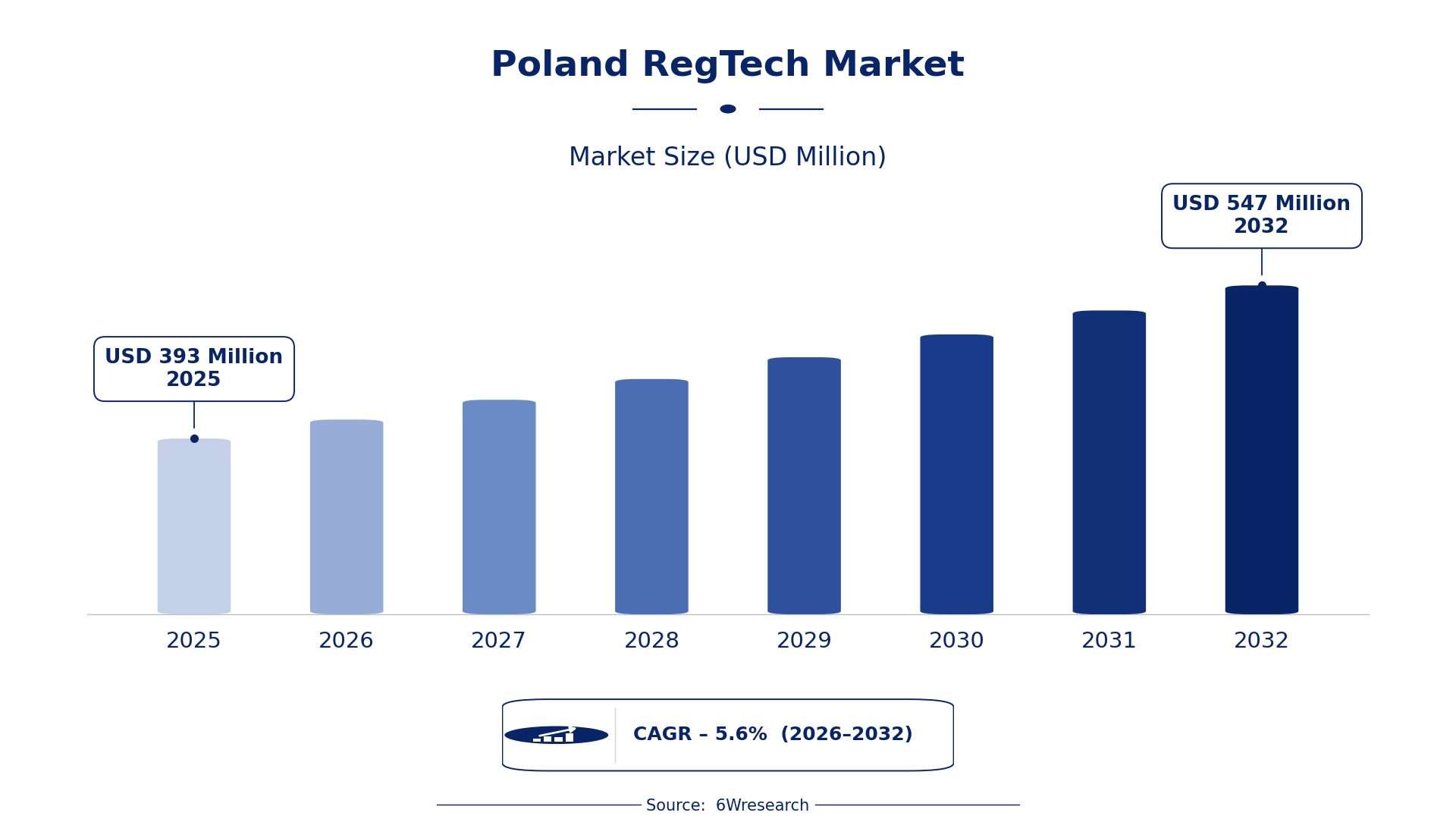
The Poland RegTech Market was estimated at USD 393 Million in 2025 and is projected to reach USD 547 Million by 2032, growing at a CAGR of 5.6% from 2026 to 2032.
Poland RegTech Market Synopsis
The Poland RegTech market has gained momentum due to the escalating regulatory demands within the financial sector. As organizations scramble to enhance compliance and mitigate risks, the adoption of RegTech solutions is becoming a strategic necessity rather than a luxury.
Looking ahead, the market is set to expand further, driven by technological advancements such as artificial intelligence and machine learning. These innovations promise to transform how regulatory processes are managed, making compliance not just easier but also more efficient.
Poland RegTech Market Year-wise Growth Rate and Key Drivers
This graph illustrates the annual growth rates of the Poland RegTech Market from 2021 to 2032, highlighting a steady upward trajectory and projected expansion over the forecast period.
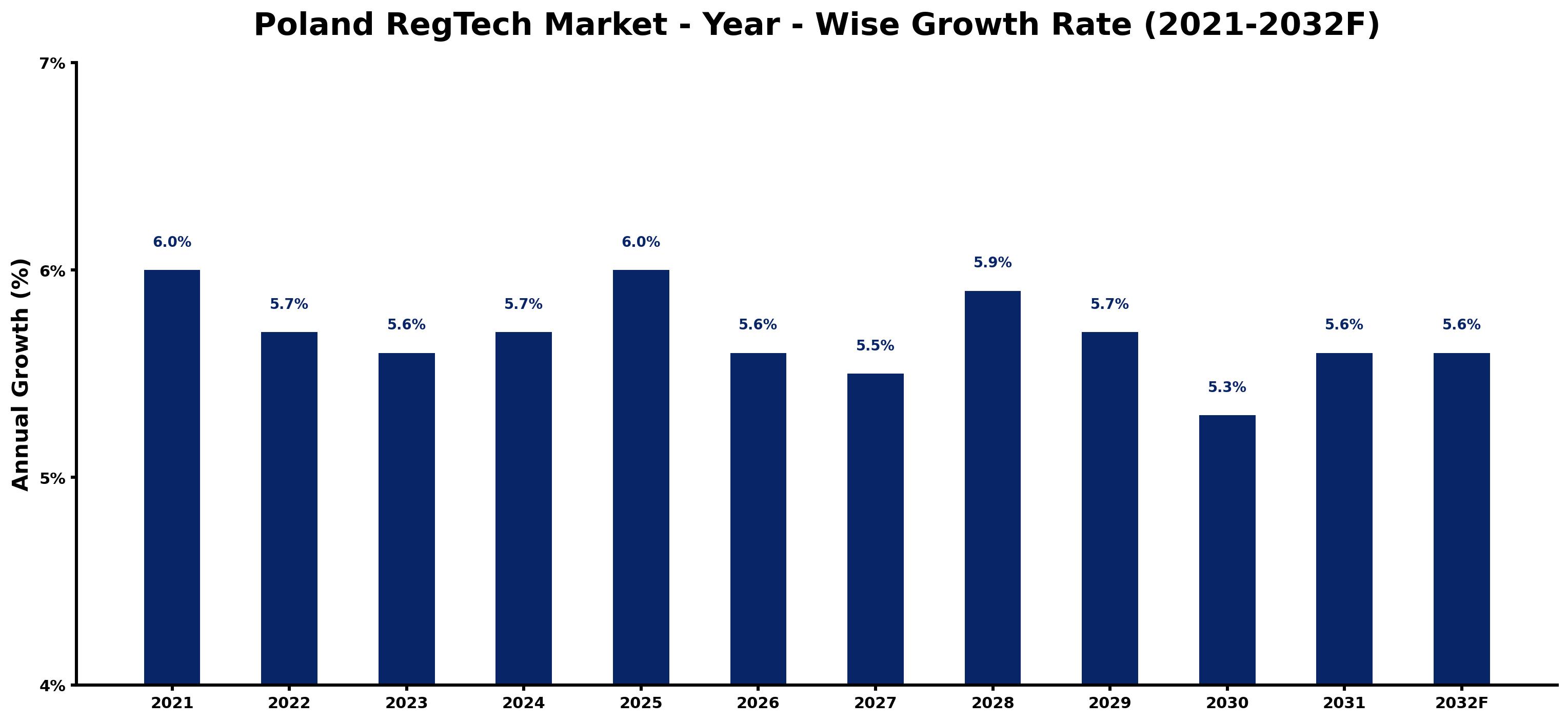
The table below presents the year‑wise growth rates along with the key drivers influencing the market
| Year | Growth Rate | Major Drivers |
| 2021 | 6.0% | Implementation of EU’s 5th Anti-Money Laundering Directive. |
| 2022 | 5.7% | Increased digitalization of financial services post-pandemic. |
| 2023 | 5.6% | Growing emphasis on data protection and GDPR compliance. |
| 2024 | 5.7% | Rise in fintech startups requiring regulatory compliance tools. |
| 2025 | 6.0% | Expanding collaborations between banks and RegTech firms. |
| 2026 | 5.6% | Heightened focus on consumer protection regulations by UOKiK. |
| 2027 | 5.5% | Increased government audits necessitating RegTech solutions. |
| 2028 | 5.9% | Adoption of AI technologies for fraud detection in financing. |
| 2029 | 5.7% | Enhanced KYC regulations driven by EU financial guidelines. |
| 2030 | 5.3% | Rise in e-commerce leading to stricter transaction regulations. |
| 2031 | 5.6% | Investment in cybersecurity measures by financial institutions. |
| 2032 | 5.6% | Implementation of new tax compliance requirements by MF. |
Note: Market size estimations and growth projections presented in this report are based on 6Wresearch's proprietary forecasting methodology, utilizing the latest available industry data, government publications, and primary research inputs.
Poland RegTech Market Key Takeaways
Below are some of the specific key takeaways from the market, including:
- The increasing complexity of regulations is a primary driver of RegTech adoption in Poland.
- Financial institutions are prioritizing data security and privacy in their compliance strategies.
- Artificial intelligence and machine learning are at the forefront of automating compliance processes.
- There is a growing demand for tailored RegTech solutions across various sectors, including healthcare and cybersecurity.
- Government initiatives are fostering an environment conducive to RegTech innovation and adoption.
Evaluation of Restraints in Poland RegTech Market
Several factors are limiting the growth of the Poland RegTech market. The constantly evolving regulatory environment poses a challenge for solutions to remain compliant. on top of that, a general lack of awareness among businesses about the benefits of RegTech hampers widespread adoption. Concerns around data privacy and security further complicate the landscape, as organizations often hesitate to adopt solutions that handle sensitive information. In this competitive market, standing out requires not only innovation but also a deep understanding of these barriers.
Poland RegTech Market Trends
Key trends in the Poland RegTech market include the integration of advanced technologies like AI and machine learning to streamline compliance processes. Organizations are increasingly looking for solutions that offer real-time monitoring and reporting capabilities. Another noteworthy trend is the heightened focus on data security and privacy compliance, as businesses recognize the critical importance of safeguarding sensitive information. The demand for tailored solutions specific to various industries is also on the rise, signaling a shift towards more specialized offerings.
Poland RegTech Market Opportunities
The opportunities within the Poland RegTech market are substantial. As regulatory frameworks continue to tighten, businesses are seeking customized solutions that cater to their specific compliance needs. Expanding into emerging areas such as environmental regulations and sustainability reporting presents a lucrative avenue for growth. Collaborating with regulatory bodies could also provide companies with insights and support needed to innovate effectively. Investment in research and development will be crucial for staying ahead in this rapidly changing market.
Government Initiatives in the Poland RegTech Market
The Polish government is actively supporting the RegTech market through various initiatives aimed at enhancing regulatory compliance and efficiency. Regulatory bodies like the Polish Financial Supervision Authority (KNF) are focused on facilitating the implementation of RegTech solutions, thereby reducing compliance costs for financial institutions. This supportive regulatory posture is essential for fostering innovation and ensuring that organizations can meet their compliance obligations effectively.
- A recently completed initiative by the KNF aimed at streamlining regulatory reporting requirements for financial institutions.
- A current program focused on collaboration between RegTech firms and traditional financial institutions to enhance compliance capabilities.
- A planned regulatory sandbox expected to launch in 2026, aimed at testing innovative RegTech solutions in a controlled environment.
- Ongoing efforts by the government to promote awareness and understanding of RegTech benefits among businesses.
- A recent framework introduced to support startups specializing in compliance technology through grants and mentorship.
Future Insights of the Poland RegTech Market
The future of the Poland RegTech market looks bright, with growth driven by the increasing regulatory demands and technological advancements. Financial institutions are set to ramp up their investments in compliance solutions as they seek to navigate complex regulatory requirements effectively. As AI and machine learning technologies mature, their integration into compliance processes will likely lead to more efficient and cost-effective solutions. The market is on a trajectory towards more comprehensive and specialized offerings, catering to the unique needs of various sectors.
Poland RegTech Market Latest Developments
In the past year, the Poland RegTech market has seen a flurry of activity reflecting its growing importance. Companies are increasingly focusing on innovative solutions that enhance compliance processes and data security. Regulatory bodies are also becoming more proactive in facilitating the adoption of these technologies, signaling a shift towards a more collaborative approach.
- A major technology vendor launched a new AI-driven compliance monitoring tool in early 2025, aimed at automating regulatory reporting.
- An initiative that began in mid-2025 and remains underway is focused on developing a digital infrastructure to support RegTech innovations.
- A planned partnership between financial institutions and RegTech firms is expected to begin in Q3 2026 to enhance compliance capabilities.
- A rollout of a comprehensive training program for financial institutions about the benefits of RegTech is currently ongoing.
- In late 2025, a pilot project was completed that tested a blockchain-based solution for regulatory reporting, yielding promising results.
Poland RegTech Market - Key Attractiveness of the Report
- 10 Years of Market Numbers
- Historical Data Starting from 2022 to 2025
- Base Year: 2025
- Forecast Data until 2032
- Key Performance Indicators Impacting the Market
- Major Upcoming Developments and Projects
Key Highlights of the Report:
- Poland RegTech Market Outlook
- Market Size of Poland RegTech Market, 2025
- Forecast of Poland RegTech Market, 2032
- Historical Data and Forecast of Poland RegTech Revenues & Volume for the Period 2022-2032F
- Poland RegTech Market Trend Evolution
- Poland RegTech Market Drivers and Challenges
- Poland RegTech Price Trends
- Poland RegTech Porter's Five Forces
- Poland RegTech Industry Life Cycle
- Historical Data and Forecast of Poland RegTech Market Revenues & Volume By Component for the Period 2022-2032F
- Historical Data and Forecast of Poland RegTech Market Revenues & Volume By Solutions for the Period 2022-2032F
- Historical Data and Forecast of Poland RegTech Market Revenues & Volume By Services for the Period 2022-2032F
- Historical Data and Forecast of Poland RegTech Market Revenues & Volume By Application for the Period 2022-2032F
- Historical Data and Forecast of Poland RegTech Market Revenues & Volume By Risk & Compliance Management for the Period 2022-2032F
- Historical Data and Forecast of Poland RegTech Market Revenues & Volume By Identity Management for the Period 2022-2032F
- Historical Data and Forecast of Poland RegTech Market Revenues & Volume By Regulatory Reporting for the Period 2022-2032F
- Historical Data and Forecast of Poland RegTech Market Revenues & Volume By AML and Fraud Management for the Period 2022-2032F
- Historical Data and Forecast of Poland RegTech Market Revenues & Volume By Regulatory Intelligence for the Period 2022-2032F
- Historical Data and Forecast of Poland RegTech Market Revenues & Volume By Organization Size for the Period 2022-2032F
- Historical Data and Forecast of Poland RegTech Market Revenues & Volume By SMEs for the Period 2022-2032F
- Historical Data and Forecast of Poland RegTech Market Revenues & Volume By Large Enterprises for the Period 2022-2032F
- Historical Data and Forecast of Poland RegTech Market Revenues & Volume By Deployment Mode for the Period 2022-2032F
- Historical Data and Forecast of Poland RegTech Market Revenues & Volume By On-Premises for the Period 2022-2032F
- Historical Data and Forecast of Poland RegTech Market Revenues & Volume By Cloud for the Period 2022-2032F
- Historical Data and Forecast of Poland RegTech Market Revenues & Volume By Vertical for the Period 2022-2032F
- Historical Data and Forecast of Poland RegTech Market Revenues & Volume By Banking for the Period 2022-2032F
- Historical Data and Forecast of Poland RegTech Market Revenues & Volume By Insurance for the Period 2022-2032F
- Historical Data and Forecast of Poland RegTech Market Revenues & Volume By Non-Financial for the Period 2022-2032F
- Poland RegTech Import Export Trade Statistics
- Market Opportunity Assessment By Component
- Market Opportunity Assessment By Application
- Market Opportunity Assessment By Organization Size
- Market Opportunity Assessment By Deployment Mode
- Market Opportunity Assessment By Vertical
- Poland RegTech Top Companies Market Share
- Poland RegTech Competitive Benchmarking By Technical and Operational Parameters
- Poland RegTech Company Profiles
- Poland RegTech Key Strategic Recommendations






































