Poland Three Wheeler Market Size, Share & Growth Rate
The Poland Three Wheeler Market was estimated at USD 340 Million in 2025 and is projected to reach USD 480 Million by 2032, growing at a CAGR of 5.0% from 2026 to 2032. This growth trajectory is primarily fueled by the increasing demand for agile transportation solutions that cater to last-mile delivery and urban mobility needs. The rising focus on sustainable transportation, coupled with government incentives for electric vehicle adoption, is expected to further propel the market forward.
Poland Three Wheeler Market Year-wise Growth Rate and Key Drivers
This graph highlights how the Poland Three Wheeler Market has steadily grown over the years, supported by major growth factors.
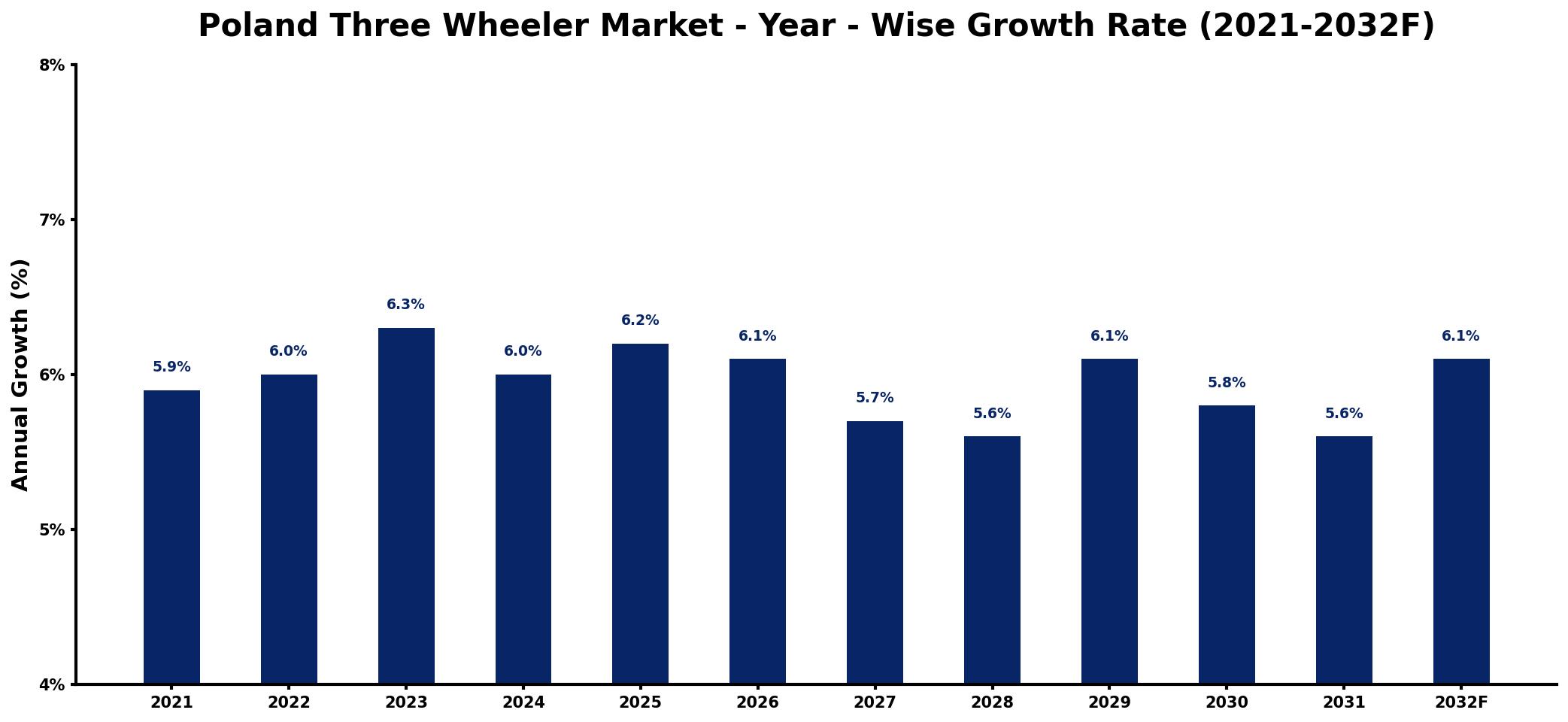
The table below presents the year‑wise growth rates along with the key drivers influencing the market
| Year | Growth Rate | Major Drivers |
| 2021 | 5.9% | Rising urban transportation demand |
| 2022 | 6.0% | Increased investment in infrastructure |
| 2023 | 6.3% | Growing popularity of alternative transport |
| 2024 | 6.0% | Expansion of logistics and delivery |
| 2025 | 6.2% | Emergence of eco-friendly solutions |
| 2026 | 6.1% | Government incentives for local production |
| 2027 | 5.7% | increased overall sector activity |
| 2028 | 5.6% | Growing e-commerce delivery requirements |
| 2029 | 6.1% | Increased focus on last-mile solutions |
| 2030 | 5.8% | Strengthened regional trade partnerships |
| 2031 | 5.6% | increased pharmaceutical industry usage |
| 2032 | 6.1% | Rising consumer preference for convenience |
Note: Market size estimations and growth projections presented in this report are based on 6Wresearch's proprietary forecasting methodology, utilizing the latest available industry data, government publications, and primary research inputs.
Poland Three Wheeler Market Synopsis
The strongest force shaping the Poland Three Wheeler Market today is the shift towards electric mobility. As environmental concerns become more pronounced, both consumers and businesses are gravitating towards electric three-wheelers for their reduced emissions and operational efficiencies. This trend is supported by government policies aimed at promoting greener transportation alternatives.
Moreover, the growing e-commerce sector is significantly driving the need for versatile three-wheelers, especially in urban areas where maneuverability and compactness are key. This dual demand for passenger and cargo transport options is facilitating a robust expansion in the three-wheeler segment, marking a pivotal shift in Poland's automotive landscape.
Poland Three Wheeler Market Key Takeaways
- The increasing urbanization in Poland is creating a favorable environment for three-wheelers, particularly in crowded city areas.
- Electric three-wheelers are gaining traction as businesses and consumers seek eco-friendly and cost-effective transportation solutions.
- Government incentives aimed at reducing carbon emissions are further stimulating market growth.
- Three-wheelers are becoming increasingly recognized for their versatility across various applications, from delivery to recreational use.
- Key manufacturers are investing in innovative designs and battery technology to enhance the product offerings in this market.
Evaluation of Restraints in Poland Three Wheeler Market
Despite its growth potential, the Poland Three Wheeler Market faces several restraints that may impede its progress. Chief among these are regulatory restrictions concerning emissions and safety standards, which can limit product offerings and increase compliance costs for manufacturers. The competitive landscape is also intense, with traditional four-wheeled vehicles and alternative modes of transport, such as ride-sharing services, vying for consumer attention. Moreover, perceptions surrounding three-wheelers as less prestigious compared to cars or motorcycles may impact broader market acceptance and consumer adoption. Addressing these barriers will be essential for unlocking the full potential of the market.
Poland Three Wheeler Market Trends
Several trends are currently reshaping the Poland Three Wheeler Market. Firstly, there is a marked shift toward electric and hybrid models, driven by both environmental consciousness and government incentives. This trend is supported by ongoing advancements in battery technology, resulting in improved performance and range for electric three-wheelers.
Additionally, increasing demand for customizable three-wheelers designed for specific applications is on the rise. Manufacturers are exploring innovative designs that enhance functionality, making three-wheelers attractive options for businesses involved in logistics and delivery services. This evolution towards a more adaptable product lineup signals a promising future for the market.
Poland Three Wheeler Market Opportunities
The Poland Three Wheeler Market offers substantial investment opportunities, particularly in the realm of electric vehicles. With the surge in e-commerce and urban delivery services, three-wheelers are becoming essential for efficient last-mile logistics. Investors are encouraged to explore avenues in manufacturing, distribution, and servicing, especially for electric models that align with the growing sustainability trend.
Furthermore, collaboration with local municipalities for fleet operations presents an attractive business model. As urban areas expand and the demand for cost-effective transportation solutions increases, the potential for growth in this market remains robust.
Government Initiatives in the Poland Three Wheeler Market
Poland's government plays a pivotal role in shaping the Three Wheeler Market through its policies that promote sustainable transportation solutions. Incentives and subsidies for electric three-wheelers are central to these initiatives, aimed at encouraging businesses and consumers to transition towards greener alternatives. Furthermore, regulatory frameworks are being established to enhance safety and quality standards, ensuring the market remains competitive while protecting consumer interests. Additionally, support for research and development in the sector fosters technological advancements that can drive innovation.
Future Insights of the Poland Three Wheeler Market
Looking ahead to 2026-2032, the Poland Three Wheeler Market is set for dynamic growth, propelled by increasing urbanization and an ever-expanding e-commerce sector. As the government continues to prioritize electric vehicle adoption and sustainable practices, electric three-wheelers are expected to dominate the landscape. The combination of favorable policies, evolving consumer preferences, and technological advancements is likely to catalyze significant market expansion, positioning three-wheelers as integral components of Poland's transportation framework.
Poland Three Wheeler Market Latest Developments (2025 - 2026)
Recent industry developments indicate a noticeable pivot towards innovation in electric three-wheelers, with advancements in battery technology enhancing their viability in urban settings. Furthermore, increased interest from various sectors, including logistics and tourism, has spurred collaborations between manufacturers and local businesses to establish more efficient fleet operations. Regulatory updates are also on the horizon, aimed at streamlining the approval processes for new electric models, which may further stimulate market growth.
Poland Three Wheeler Market - Key Attractiveness of the Report
- 10 Years of Market Numbers
- Historical Data Starting from 2022 to 2025
- Base Year: 2025
- Forecast Data until 2032
- Key Performance Indicators Impacting the Market
- Major Upcoming Developments and Projects
Key Highlights of the Report:
- Poland Three Wheeler Market Outlook
- Market Size of Poland Three Wheeler Market, 2025
- Forecast of Poland Three Wheeler Market, 2032
- Historical Data and Forecast of Poland Three Wheeler Revenues & Volume for the Period 2022-2032F
- Poland Three Wheeler Market Trend Evolution
- Poland Three Wheeler Market Drivers and Challenges
- Poland Three Wheeler Price Trends
- Poland Three Wheeler Porter's Five Forces
- Poland Three Wheeler Industry Life Cycle
- Historical Data and Forecast of Poland Three Wheeler Market Revenues & Volume By Fuel Type for the Period 2022-2032F
- Historical Data and Forecast of Poland Three Wheeler Market Revenues & Volume By Petrol/CNG for the Period 2022-2032F
- Historical Data and Forecast of Poland Three Wheeler Market Revenues & Volume By Diesel for the Period 2022-2032F
- Historical Data and Forecast of Poland Three Wheeler Market Revenues & Volume By Electric for the Period 2022-2032F
- Historical Data and Forecast of Poland Three Wheeler Market Revenues & Volume By Vehicle Type for the Period 2022-2032F
- Historical Data and Forecast of Poland Three Wheeler Market Revenues & Volume By Passenger Carrier for the Period 2022-2032F
- Historical Data and Forecast of Poland Three Wheeler Market Revenues & Volume By Load Carrier for the Period 2022-2032F
- Poland Three Wheeler Import Export Trade Statistics
- Market Opportunity Assessment By Fuel Type
- Market Opportunity Assessment By Vehicle Type
- Poland Three Wheeler Top Companies Market Share
- Poland Three Wheeler Competitive Benchmarking By Technical and Operational Parameters
- Poland Three Wheeler Company Profiles
- Poland Three Wheeler Key Strategic Recommendations






































