Portugal Brandy Market Size (2020-2030)
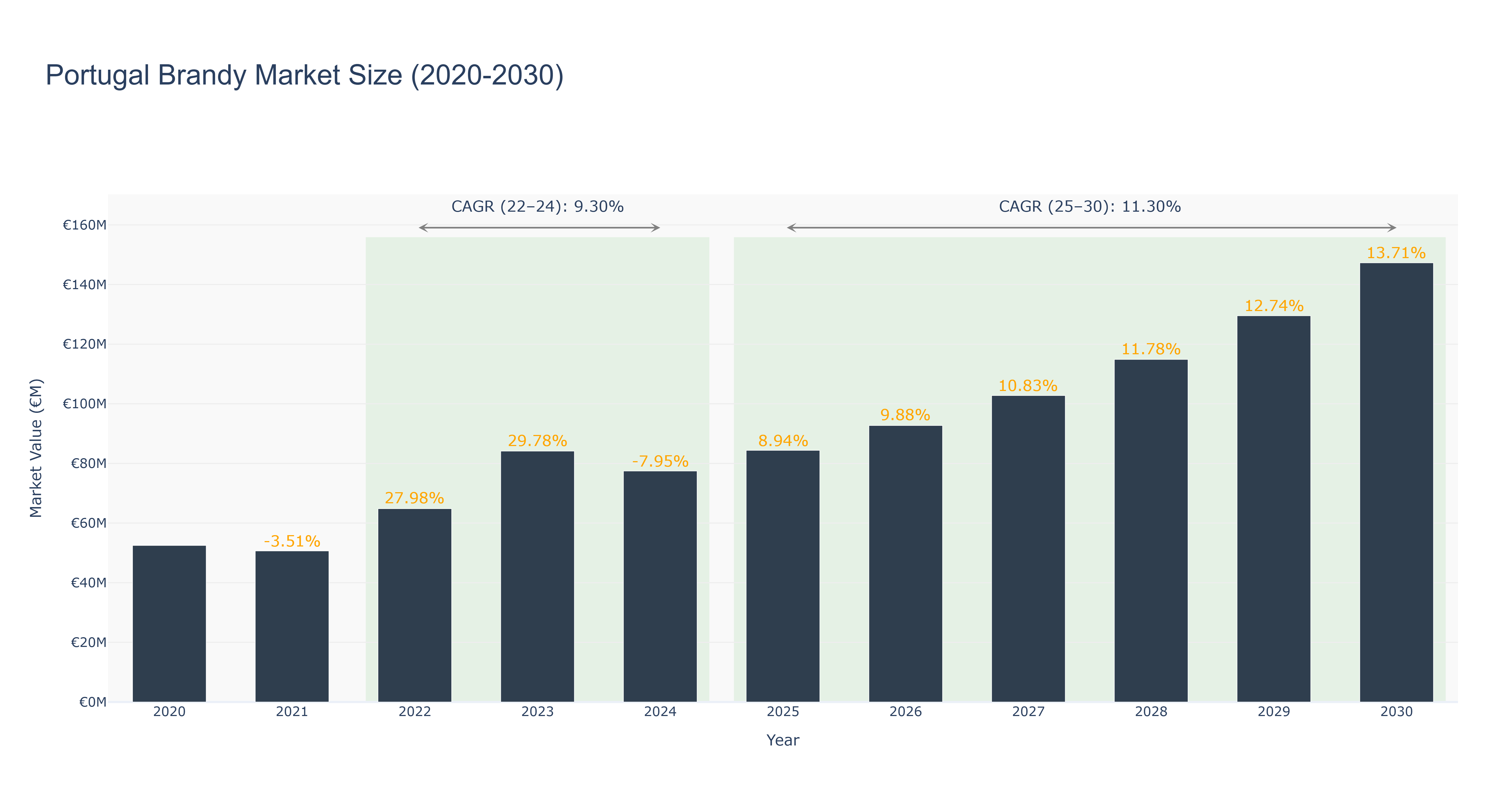
Portugal Brandy Market has shown a fluctuating trend in recent years. The market peaked at €147.27 million in 2030, experiencing steady growth from 2020 to 2025 and a significant increase in the forecasted period from 2025 to 2030, with a CAGR of 11.30%. The market witnessed a decline in 2024 due to a temporary oversupply issue, which was mitigated by strategic marketing efforts and product innovation, leading to the subsequent growth. Industry drivers such as increasing consumer demand for premium spirits and a growing trend towards craft and artisanal products have supported the market's expansion. Looking ahead, Portugal Brandy Market is set to benefit from upcoming government initiatives to promote local distilleries and enhance export opportunities, ensuring sustained growth and competitiveness in the global market.
Portugal Brandy Market: Production & Trade Performance (2019-2025)
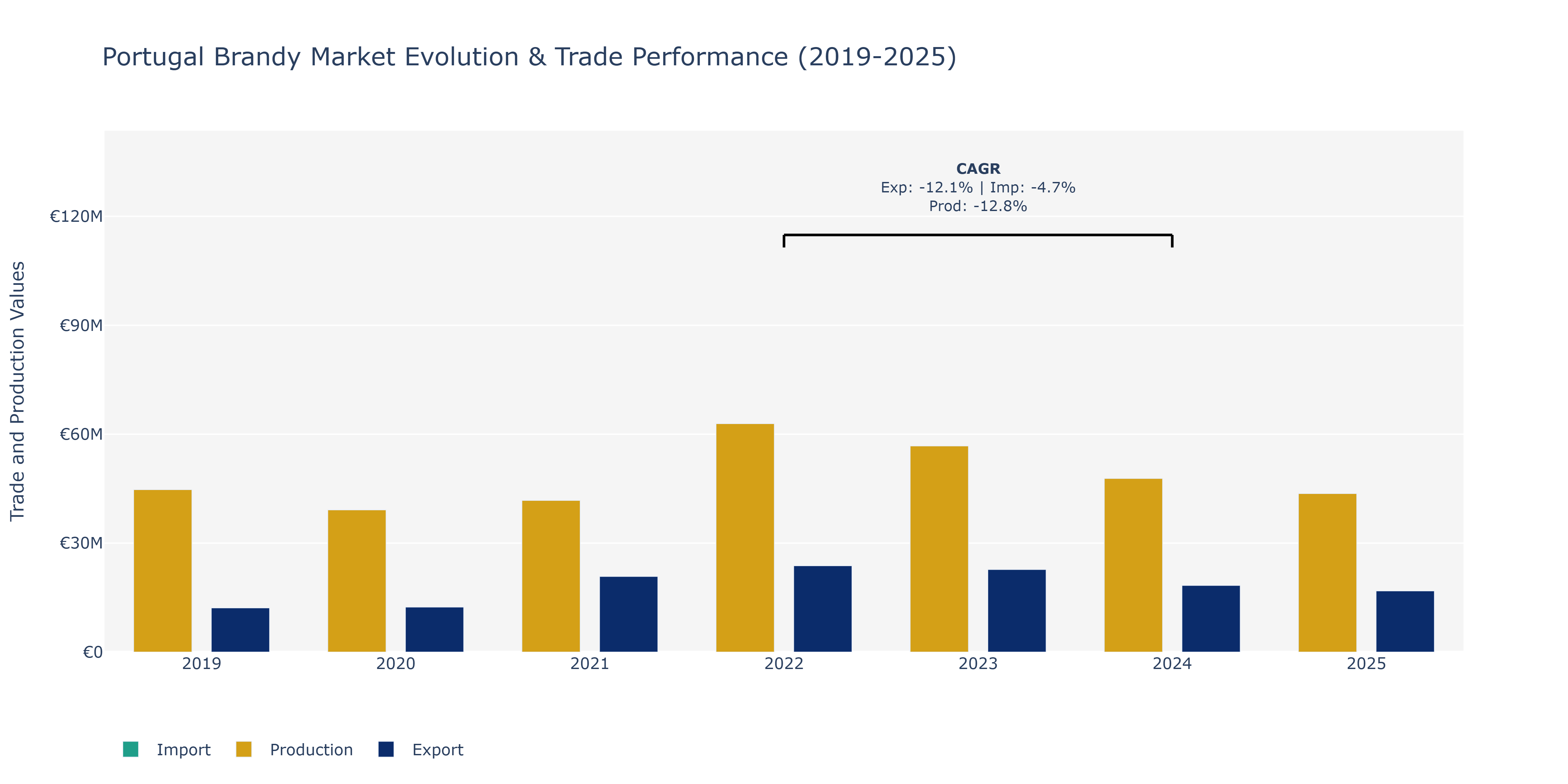
Between 2019 and 2025, the Portugal Brandy Market displayed intriguing dynamics in exports, imports, and production. Exports saw a fluctuation, peaking in 2022 at approximately €23.75 million before declining to around €16.83 million in 2025. Imports followed a similar pattern, hitting a peak in 2023 at nearly €45.82 million and then decreasing to about €29.68 million by 2025. Production levels, on the other hand, peaked in 2022 at approximately €62.89 million and then declined to about €43.63 million by 2025. Factors such as changing consumer preferences, global market conditions, and competition from other spirits could have influenced these trends. For instance, a rise in demand for premium spirits or economic factors affecting discretionary spending could have impacted export and import volumes. Additionally, shifts in production levels could be due to variations in raw material costs or technological advancements in the production process, driving efficiencies and affecting output. These fluctuations underscore the need for market players to stay agile and responsive to evolving market dynamics to maintain a competitive edge in the Portugal Brandy Market.
Key Highlights of the Report:
- Portugal Brandy Market Outlook
- Market Size of Portugal Brandy Market, 2025
- Forecast of Portugal Brandy Market, 2032
- Historical Data and Forecast of Portugal Brandy Revenues & Volume for the Period 2022 - 2032F
- Portugal Brandy Market Trend Evolution
- Portugal Brandy Market Drivers and Challenges
- Portugal Brandy Price Trends
- Portugal Brandy Porter`s Five Forces
- Portugal Brandy Industry Life Cycle
- Historical Data and Forecast of Portugal Brandy Market Revenues & Volume By Type for the Period 2022 - 2032F
- Historical Data and Forecast of Portugal Brandy Market Revenues & Volume By V.S. ("very special") for the Period 2022 - 2032F
- Historical Data and Forecast of Portugal Brandy Market Revenues & Volume By V.S.O.P. ("very superior old pale") for the Period 2022 - 2032F
- Historical Data and Forecast of Portugal Brandy Market Revenues & Volume By XO ("extra old") for the Period 2022 - 2032F
- Historical Data and Forecast of Portugal Brandy Market Revenues & Volume By Hors d`age ("beyond age") for the Period 2022 - 2032F
- Historical Data and Forecast of Portugal Brandy Market Revenues & Volume By Applications for the Period 2022 - 2032F
- Historical Data and Forecast of Portugal Brandy Market Revenues & Volume By Shop & Supermarket for the Period 2022 - 2032F
- Historical Data and Forecast of Portugal Brandy Market Revenues & Volume By Restaurant & Bar & Club for the Period 2022 - 2032F
- Historical Data and Forecast of Portugal Brandy Market Revenues & Volume By Exclusive Store for the Period 2022 - 2032F
- Historical Data and Forecast of Portugal Brandy Market Revenues & Volume By Others for the Period 2022 - 2032F
- Portugal Brandy Import Export Trade Statistics
- Market Opportunity Assessment By Type
- Market Opportunity Assessment By Applications
- Portugal Brandy Top Companies Market Share
- Portugal Brandy Competitive Benchmarking By Technical and Operational Parameters
- Portugal Brandy Company Profiles
- Portugal Brandy Key Strategic Recommendations






































