Portugal Egg Powder Market Size (2020-2030)
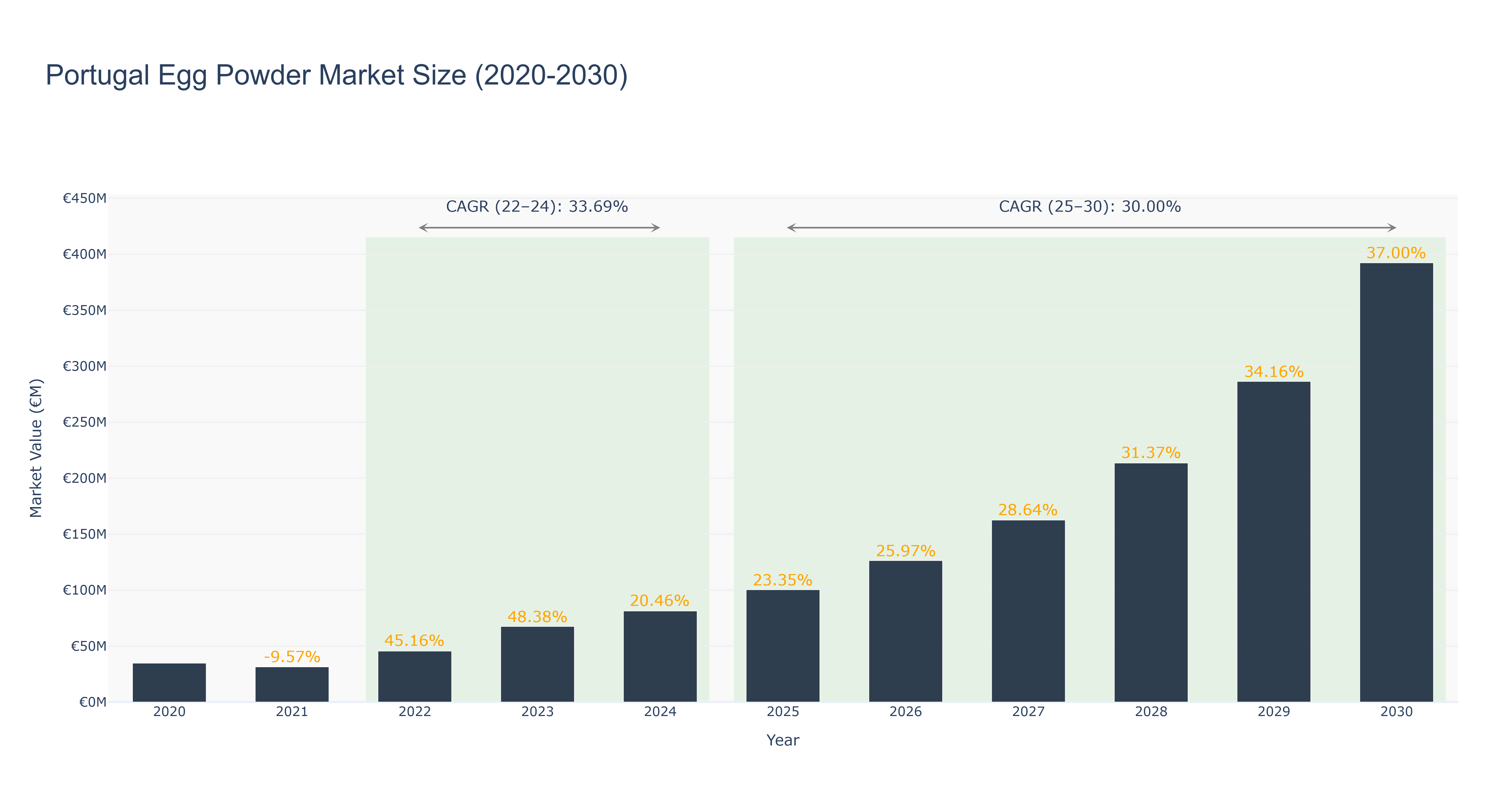
The Portugal Egg Powder Market has demonstrated significant volatility and growth from 2020 to 2024, with the market size peaking at €67.48 million in 2023, representing a remarkable growth rate of 48.38% from the previous year. Following a decline in 2021, the market rebounded with a strong CAGR of 33.69% from 2022 to 2024, driven by increasing demand for convenient and shelf-stable food products, alongside a rise in health-conscious consumption patterns. Looking ahead to the forecasted period from 2025 to 2030, the market is expected to reach €392.33 million, with a projected CAGR of 30.00%. This growth will likely be supported by advancements in food technology and expanding applications of egg powder in the food industry, particularly in bakery and dietary products, catering to evolving consumer preferences. As the market matures, ongoing innovations and strategic partnerships will be critical in sustaining this upward trajectory.
Portugal Egg Powder Market: Production & Trade Performance (2019-2025)
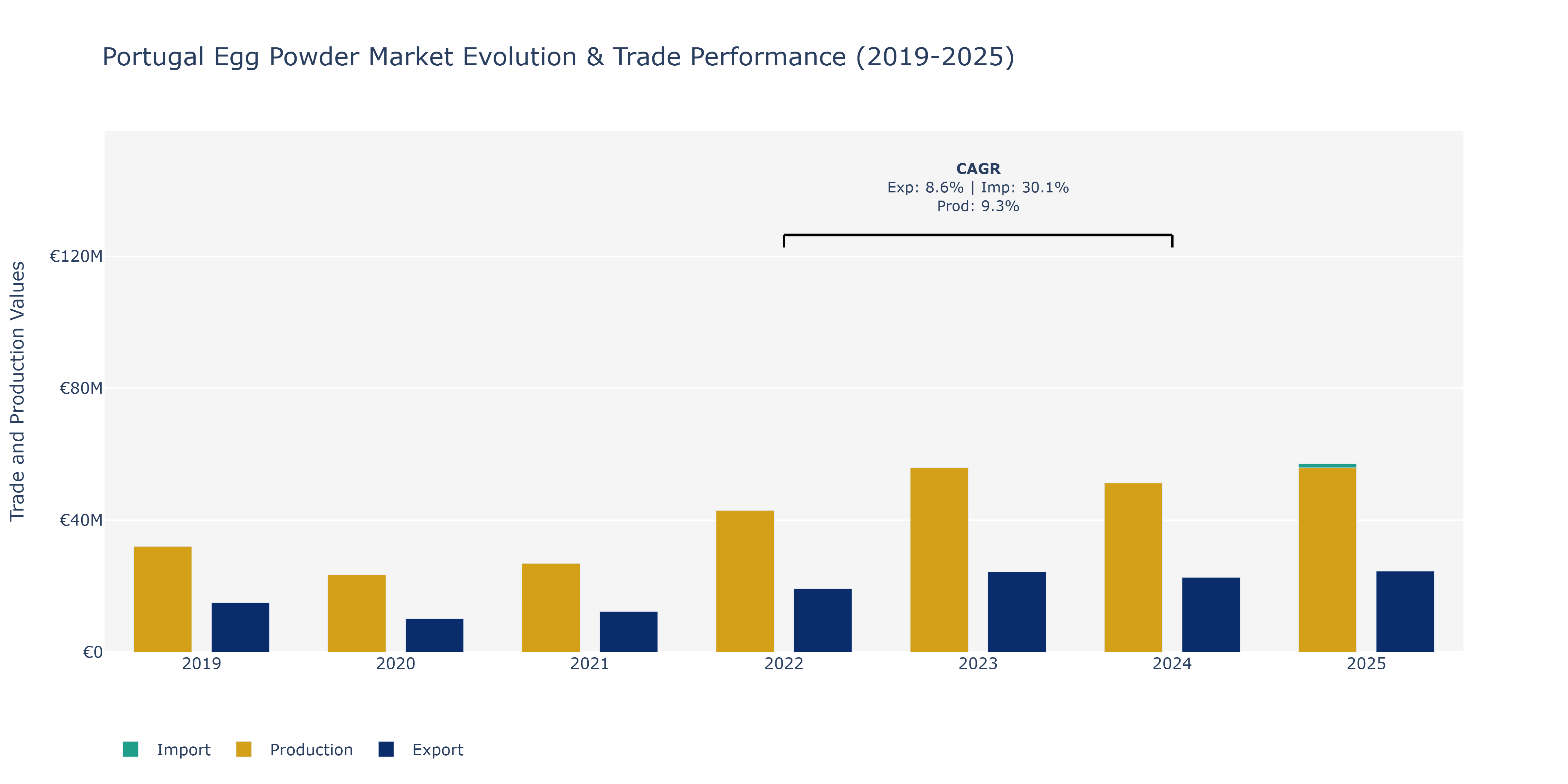
The Portugal Egg Powder Market witnessed fluctuations in Exports, Imports, and Production from 2019 to 2025. In 2019, Exports stood at €14.95 million, dropping to €10.18 million in 2020, before rebounding to €24.55 million in 2025. Imports followed a similar trajectory, decreasing from €19.95 million in 2019 to €12.53 million in 2020, and then rising to €57.08 million in 2025. Production value experienced a decline from €32.05 million in 2019 to €23.40 million in 2020 and gradually recovered to €55.85 million in 2025. The notable peak points were observed in 2025 for Exports and Imports, while Production peaked in 2023. These trends can be attributed to various factors such as changes in consumer preferences towards convenience foods, growing demand for bakery and confectionery products, and advancements in food processing technologies in Portugal. As the global food processing industry continues to evolve, the Portugal Egg Powder Market is poised for further growth in the coming years.
Key Highlights of the Report:
- Portugal Egg Powder Market Outlook
- Market Size of Portugal Egg Powder Market, 2025
- Forecast of Portugal Egg Powder Market, 2032
- Historical Data and Forecast of Portugal Egg Powder Revenues & Volume for the Period 2022 - 2032F
- Portugal Egg Powder Market Trend Evolution
- Portugal Egg Powder Market Drivers and Challenges
- Portugal Egg Powder Price Trends
- Portugal Egg Powder Porter`s Five Forces
- Portugal Egg Powder Industry Life Cycle
- Historical Data and Forecast of Portugal Egg Powder Market Revenues & Volume By Types for the Period 2022 - 2032F
- Historical Data and Forecast of Portugal Egg Powder Market Revenues & Volume By Whole Eggfor the Period 2022 - 2032F
- Historical Data and Forecast of Portugal Egg Powder Market Revenues & Volume By Egg Yolkfor the Period 2022 - 2032F
- Historical Data and Forecast of Portugal Egg Powder Market Revenues & Volume By White Eggfor the Period 2022 - 2032F
- Historical Data and Forecast of Portugal Egg Powder Market Revenues & Volume By End-user for the Period 2022 - 2032F
- Historical Data and Forecast of Portugal Egg Powder Market Revenues & Volume By Bakery for the Period 2022 - 2032F
- Historical Data and Forecast of Portugal Egg Powder Market Revenues & Volume By Sauces, Dressings, and Mixesfor the Period 2022 - 2032F
- Historical Data and Forecast of Portugal Egg Powder Market Revenues & Volume By Others for the Period 2022 - 2032F
- Portugal Egg Powder Import Export Trade Statistics
- Market Opportunity Assessment By Types
- Market Opportunity Assessment By End-user
- Portugal Egg Powder Top Companies Market Share
- Portugal Egg Powder Competitive Benchmarking By Technical and Operational Parameters
- Portugal Egg Powder Company Profiles
- Portugal Egg Powder Key Strategic Recommendations






































