Portugal Packaged Water Market Top 5 Importing Countries and Market Competition (HHI) Analysis
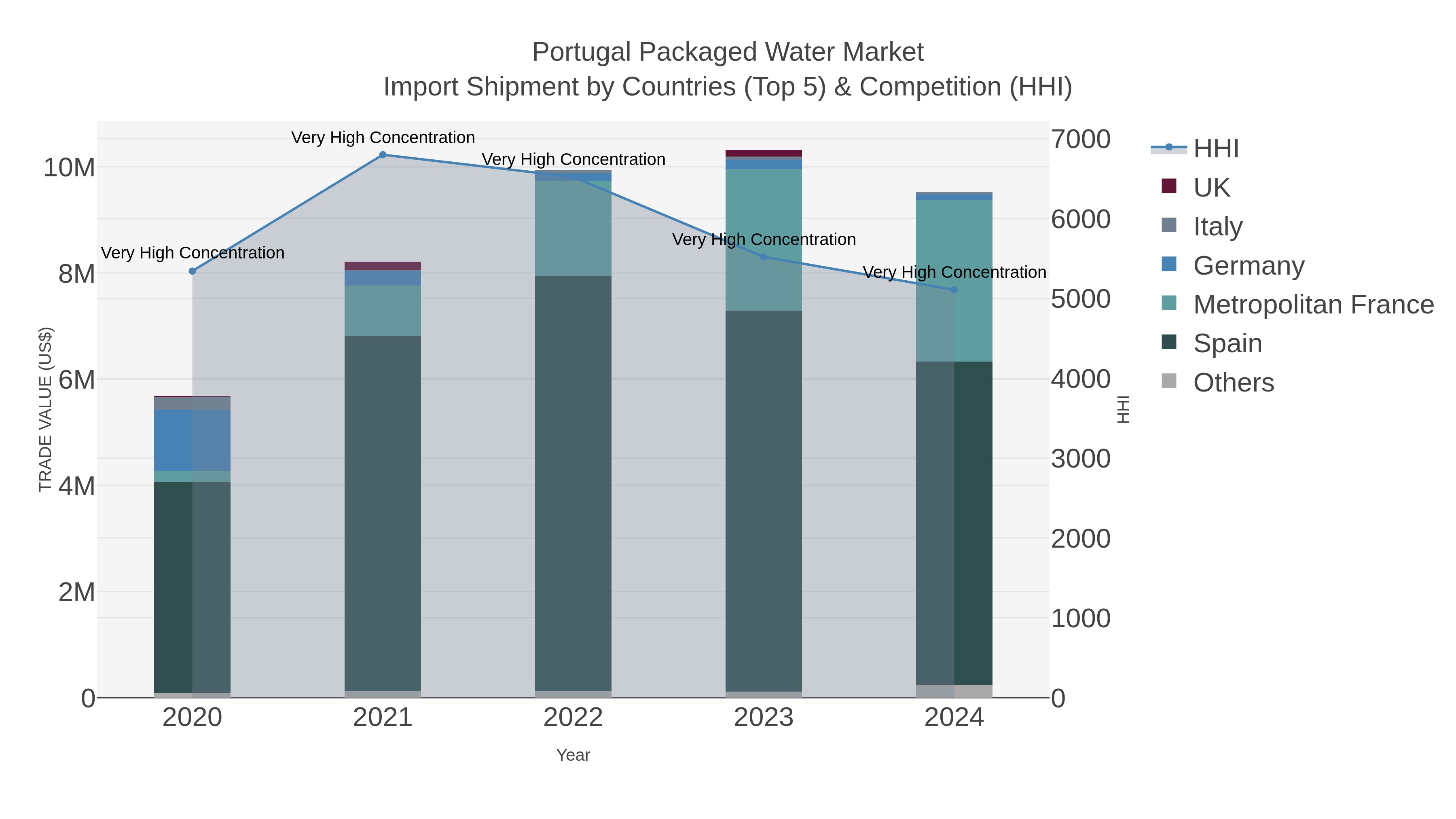
In 2024, Portugal continued to rely on neighboring countries such as Spain, Metropolitan France, and Germany for packaged water imports. The high Herfindahl-Hirschman Index (HHI) indicates a market dominated by a few key players, suggesting limited competition. Despite a strong compound annual growth rate (CAGR) of 13.8% from 2020 to 2024, the negative growth rate in 2024 (-7.61%) raises concerns about potential market challenges or shifts. It will be crucial for stakeholders to closely monitor these trends and adapt strategies accordingly to navigate the evolving market dynamics in the packaged water import sector in Portugal.
Portugal Packaged water Market Overview
The Portugal packaged water market has been experiencing steady growth driven by increasing consumer awareness about the importance of hydration and health. The market is primarily dominated by major players offering a wide range of packaged water products, including still water, sparkling water, flavored water, and functional water. The shift towards healthier beverage options, coupled with the convenience of on-the-go hydration, has fueled the demand for packaged water in Portugal. Environmentally sustainable packaging solutions, such as recycled PET bottles and eco-friendly materials, are gaining traction among consumers, influencing purchasing decisions. Moreover, the focus on product innovation, such as enhanced hydration benefits and unique flavors, is shaping the competitive landscape of the Portugal packaged water market, with companies constantly striving to meet evolving consumer preferences and demands.
Portugal Packaged water Market Trends and Opportunities
The Portugal packaged water market is experiencing a shift towards healthier lifestyle choices, driving the demand for functional and flavored water products. Consumers are increasingly seeking natural, low-sugar, and environmentally friendly options, leading to a rise in the popularity of premium and sustainable packaged water brands. Opportunities exist for companies to innovate with new packaging formats such as eco-friendly materials and convenient on-the-go packaging. Additionally, there is a growing emphasis on transparency and traceability in the supply chain, presenting a chance for brands to differentiate themselves through ethical sourcing practices and transparent labeling. Overall, the Portugal packaged water market is ripe for expansion through product diversification, sustainability initiatives, and catering to evolving consumer preferences.
Portugal Packaged water Market Challenges
In the Portugal Packaged water market, one of the key challenges faced is the increasing competition among brands, leading to price wars and pressure on profit margins. Additionally, the market is saturated, making it difficult for new entrants to establish themselves and compete with established players. Consumer preferences are also evolving, with a growing demand for sustainable packaging and healthier product options, forcing companies to adapt their strategies and product offerings. Furthermore, regulatory requirements around packaging materials and environmental concerns are adding complexity to operations and increasing costs for manufacturers. Overall, companies in the Portugal Packaged water market need to innovate constantly, differentiate their products, and invest in sustainable practices to stay competitive in this challenging environment.
Portugal Packaged water Market Drivers
The Portugal Packaged water market is primarily driven by the increasing health consciousness among consumers, leading to a shift towards healthier beverage options like packaged water. The convenience and portability of packaged water also contribute to its popularity, especially among on-the-go consumers. Additionally, concerns about the quality and safety of tap water in certain regions further boost the demand for packaged water as a reliable and safe drinking option. Changing lifestyles, rising disposable incomes, and a growing preference for hygienic and convenient packaging solutions are key factors driving the growth of the packaged water market in Portugal. In response to these drivers, companies are focusing on product innovation, eco-friendly packaging, and expanding distribution channels to capitalize on the expanding market opportunities.
Portugal Packaged water Market Government Policy
In Portugal, the packaged water market is regulated by several government policies aimed at ensuring the quality and safety of the products. The Portuguese Food and Economic Safety Authority (ASAE) oversees the market, enforcing regulations on labeling, packaging, and advertising of packaged water products. The government has set guidelines for the mineral content, microbiological safety, and hygiene standards of packaged water, which must comply with European Union regulations. Additionally, there are specific requirements for the extraction and bottling of natural mineral water. The government also monitors and sets limits on the use of additives and contaminants in packaged water to safeguard consumer health. Overall, the regulatory framework in Portugal aims to maintain high standards of quality and safety in the packaged water market.
Portugal Packaged water Market Future Outlook
The Portugal packaged water market is poised for steady growth in the coming years, driven by increasing consumer awareness of the importance of hydration, convenience, and health consciousness. The market is expected to benefit from the growing trend towards healthier beverage alternatives, as well as the rising demand for on-the-go hydration solutions. Furthermore, the emphasis on sustainability and eco-friendly packaging is likely to shape the market landscape, with a growing number of consumers seeking environmentally friendly options. Market players are anticipated to innovate and diversify their product offerings to cater to evolving consumer preferences, such as flavored water, functional water, and premium bottled water. Overall, the Portugal packaged water market is expected to witness sustained growth and opportunities for expansion in the foreseeable future.
Key Highlights of the Report:
- Portugal Packaged water Market Outlook
- Market Size of Portugal Packaged water Market, 2025
- Forecast of Portugal Packaged water Market, 2032
- Historical Data and Forecast of Portugal Packaged water Revenues & Volume for the Period 2022- 2032
- Portugal Packaged water Market Trend Evolution
- Portugal Packaged water Market Drivers and Challenges
- Portugal Packaged water Price Trends
- Portugal Packaged water Porter's Five Forces
- Portugal Packaged water Industry Life Cycle
- Historical Data and Forecast of Portugal Packaged water Market Revenues & Volume By Product for the Period 2022- 2032
- Historical Data and Forecast of Portugal Packaged water Market Revenues & Volume By Still for the Period 2022- 2032
- Historical Data and Forecast of Portugal Packaged water Market Revenues & Volume By Carbonated for the Period 2022- 2032
- Historical Data and Forecast of Portugal Packaged water Market Revenues & Volume By Flavored for the Period 2022- 2032
- Historical Data and Forecast of Portugal Packaged water Market Revenues & Volume By Functional for the Period 2022- 2032
- Portugal Packaged water Import Export Trade Statistics
- Market Opportunity Assessment By Product
- Portugal Packaged water Top Companies Market Share
- Portugal Packaged water Competitive Benchmarking By Technical and Operational Parameters
- Portugal Packaged water Company Profiles
- Portugal Packaged water Key Strategic Recommendations






































