Qatar 3D Glasses Market Summary
The qatar 3d glasses market was estimated at USD 367 Million in 2025 and is projected to reach USD 499 Million by 2032, growing at a CAGR of 5.2% from 2026 to 2032.
Qatar 3D Glasses Market Year-wise Growth Rate and Key Drivers
This graph highlights how the Qatar 3D Glasses Market has steadily grown over the past five years, supported by major growth factors.
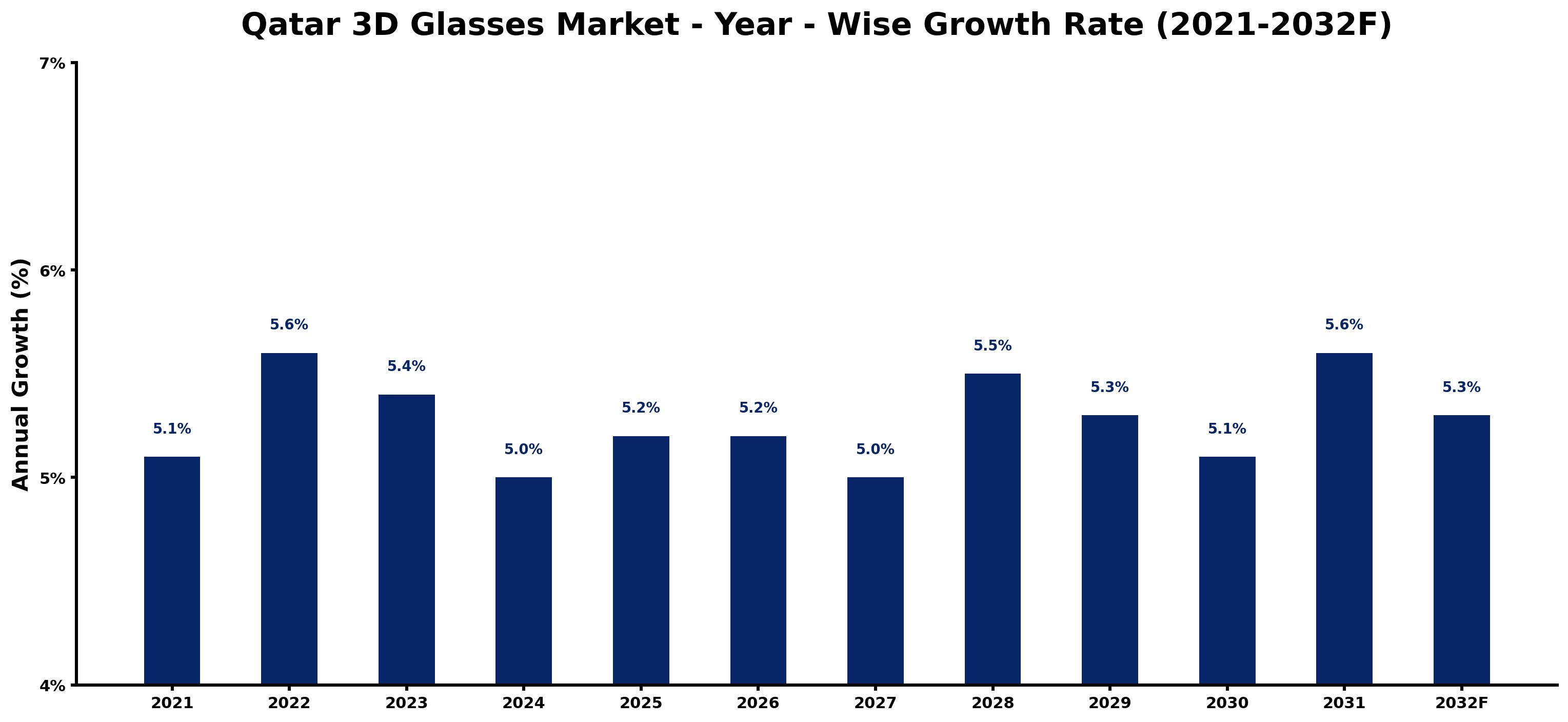
The table below presents the year wise growth rates along with the key drivers influencing the market
| Year | Growth Rate | Major Drivers |
| 2021 | 5.1% | Post-lockdown retail projects emphasized immersive shopping experiences using 3D technology. |
| 2022 | 5.6% | Increased entertainment options prompted local cinemas to embrace advanced 3D viewing technologies. |
| 2023 | 5.4% | Local universities partnered with tech firms to foster innovation in 3D content creation. |
| 2024 | 5.0% | High demand for virtual tourism experiences stimulated investments in 3D visual technology. |
| 2025 | 5.2% | Corporate sectors increasingly utilized 3D glasses for enhanced training and simulation programs. |
| 2026 | 5.2% | The flourishing gaming industry drove the integration of 3D capabilities in new releases. |
| 2027 | 5.0% | Launch of augmented reality applications encouraged consumers to explore 3D visual experiences. |
| 2028 | 5.5% | Collaborations between global brands and local firms enhanced regional product offerings significantly. |
| 2029 | 5.3% | Enhancements in 3D printing technologies opened new avenues for product design and prototyping. |
| 2030 | 5.1% | Ongoing construction projects integrated 3D visualization tools for improved architectural planning. |
| 2031 | 5.6% | Consumer electronics brands diversified product lines with innovative 3D glasses for households. |
| 2032 | 5.3% | Expanded distribution channels enabled wider access to 3D technologies across various sectors. |
Note - Market size estimations and growth projections presented in this report are based on 6Wresearch's advanced forecasting approach, validated with industry datasets as of June 2026.
Qatar 3D Glasses Market Synopsis
The Qatar 3D Glasses Market is projected to reach 5.2% and witness significant growth during the forecast period (2026-2032). The burgeoning movie theater industry in Qatar, combined with an increase in disposable income among consumers, is driving the demand for 3D glasses in the region. Additionally, an augmented interest in diverse television programs and cinematic experiences is further propelling the market. Technological advancements that have led to the development of lightweight and wireless 3D glasses are set to enhance market potential in the coming years.
Qatar 3D Glasses Market Growth Drivers
The primary impetus for growth in the Qatar 3D glasses market is the escalating demand from the movie industry. The success and widespread popularity of films that leverage advanced technology, such as Avatar and Iron Man 2, have encouraged filmmakers to adopt high-quality 3D production techniques. Furthermore, the government's ongoing investments in the entertainment sector promote content creation that utilizes the latest technologies, including augmented reality (AR) and virtual reality (VR). This influx of funding is facilitating a broader adoption of premium 3D products, which, in turn, is expected to enhance growth opportunities within this market segment.
- Increased spending on entertainment, supported by rising disposable incomes, is likely to boost 3D glasses sales.
- The growing influence of visually immersive storytelling in cinema is contributing to the demand for superior 3D experiences.
- Innovations in 3D technology, such as enhanced resolution lenses and improved battery life, are attracting consumers to invest in advanced glasses.
- The increasing number of cinema screens in Qatar provides more venues for 3D content, thereby amplifying market demand.
- Shifts in consumer preferences towards home-viewing experiences are also encouraging the purchase of 3D glasses for personal use.
Qatar 3D Glasses Market Challenges and Restraints
Despite the positive outlook, the Qatar 3D glasses market faces significant challenges that could hinder growth. One of the fundamental challenges includes maintaining cost competitiveness in a sector that is highly reliant on raw materials, particularly polycarbonate plastics, which are integral to 3D glasses manufacturing. Local manufacturers often struggle to compete with imported products due to differences in labor costs and pricing strategies.
- The high cost of raw materials significantly affects profit margins, leading to increased retail prices for consumers.
- Many manufacturers face pressure to balance product quality and affordability, with a focus on retaining market share.
- A lack of established distribution channels could limit the accessibility of premium 3D glasses to wider audiences.
- Regulatory pressures and fluctuating import tariffs can exacerbate challenges associated with imported goods.
- Market trend shifts away from theater attendance toward digital streaming services could also suppress demand.
Qatar 3D Glasses Market Covid-19 Impact
The COVID-19 pandemic had a significant adverse impact on the Qatar 3D glasses market. During this period, cinema operations faced suspension, leading to a sharp decline in demand for 3D glasses. While at-home viewing experiences surged, the limited access to immersive 3D content constrained market growth. Nevertheless, as the entertainment sector began its recovery with the resumption of cinema operations and live events, the demand for 3D glasses witnessed a gradual rebound, particularly with the technological advancements that continued to emerge.
Qatar 3D Glasses Market Government Investment and Initiatives
The Qatari government has made considerable investments in the entertainment and media sector, providing a conducive environment for the growth of the 3D glasses market. Initiatives aimed at improving infrastructure for cinema and entertainment venues are underway, which will likely bolster the demand for advanced viewing technologies, including 3D glasses. The government is also promoting policies that encourage innovation and the adoption of new technologies within the film industry. These policies include tax incentives for businesses investing in entertainment production and technology development, further positioning Qatar as a hub for cutting-edge media experiences.
Qatar 3D Glasses Market Latest Developments (May 2025 - June 2026)
Recent trends in the Qatar 3D glasses market highlight a significant shift towards integrating advanced technology into 3D viewing experiences. Innovations such as augmented reality (AR) have gained traction, leading to greater consumer interest. The period from May 2025 to June 2026 has seen market participants exploring new product designs that capitalize on lightweight and ergonomic features, catering to evolving consumer preferences. Additionally, partnerships between local media companies and international technology providers have emerged, fostering the development of superior 3D content and experiences. This collaborative approach is expected to further enhance the overall market landscape.
Qatar 3D Glasses Market - Key Attractiveness of the Report
- 10 Years of Market Numbers
- Historical Data Starting from 2022 to 2025
- Base Year: 2025
- Forecast Data until 2032
- Key Performance Indicators Impacting the Market
- Major Upcoming Developments and Projects
Key Highlights of the Report:
- Qatar 3D Glasses Market Outlook
- Market Size of Qatar 3D Glasses Market, 2025
- Forecast of Qatar 3D Glasses Market, 2032
- Historical Data and Forecast of Qatar 3D Glasses Revenues & Volume for the Period 2022-2032F
- Qatar 3D Glasses Market Trend Evolution
- Qatar 3D Glasses Market Drivers and Challenges
- Qatar 3D Glasses Price Trends
- Qatar 3D Glasses Porter's Five Forces
- Qatar 3D Glasses Industry Life Cycle
- Historical Data and Forecast of Qatar 3D Glasses Market Revenues & Volume By Product Type for the Period 2022-2032F
- Historical Data and Forecast of Qatar 3D Glasses Market Revenues & Volume By Active shutter for the Period 2022-2032F
- Historical Data and Forecast of Qatar 3D Glasses Market Revenues & Volume By Polarized for the Period 2022-2032F
- Historical Data and Forecast of Qatar 3D Glasses Market Revenues & Volume By Anaglyph for the Period 2022-2032F
- Historical Data and Forecast of Qatar 3D Glasses Market Revenues & Volume By Applications for the Period 2022-2032F
- Historical Data and Forecast of Qatar 3D Glasses Market Revenues & Volume By Media for the Period 2022-2032F
- Historical Data and Forecast of Qatar 3D Glasses Market Revenues & Volume By Cinemas for the Period 2022-2032F
- Qatar 3D Glasses Import Export Trade Statistics
- Market Opportunity Assessment By Product Type
- Market Opportunity Assessment By Applications
- Qatar 3D Glasses Top Companies Market Share
- Qatar 3D Glasses Competitive Benchmarking By Technical and Operational Parameters
- Qatar 3D Glasses Company Profiles
- Qatar 3D Glasses Key Strategic Recommendations






































