Qatar 3D Technology Market Growth Rate
According to 6Wresearch internal database and industry insights, The Qatar 3D Technology Market is projected to experience steady growth over the forecast period 2026–2032, with a CAGR of 5.18%.
Qatar 3D Technology Market Year-wise Growth Rate and Key Drivers
This graph illustrates the annual growth rates of the Qatar 3D Technology Market from 2021 to 2032, highlighting a steady upward trajectory and projected market expansion over the forecast period.
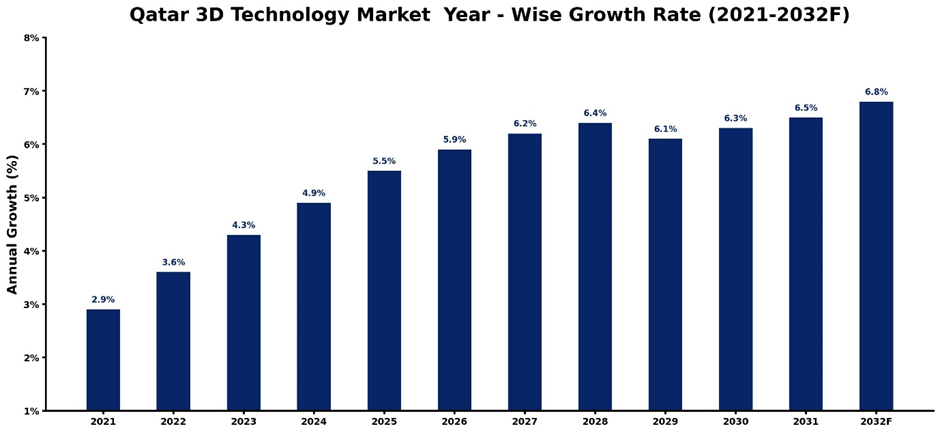
The following table summarizes the historical and forecasted growth rates of the Qatar 3D Technology Market, along with the rationale behind each year’s performance.
| Year | Estimated Growth (%) | Market Rationale |
| 2021 | 2.9 | Early-stage incorporation of 3D printing in construction and prototyping. |
| 2022 | 3.6 | Deployment of 3D scanning technologies for industrial inspection and healthcare diagnostics. |
| 2023 | 4.3 | Allocation of money by private sector in 3D modeling for consumer electronics. |
| 2024 | 4.9 | Rise of 3D display solutions in virtual training sectors. |
| 2025 | 5.5 | To augment 3D printing in smart city projects various government-backed initiatives are implemented. |
| 2026 | 5.9 | For precision diagnostics, there is rising usage of 3D imaging in research centers |
| 2027 | 6.2 | Brader application of 3D printing in aerospace, defense, and industrial prototyping. |
| 2028 | 6.4 | Increase in personalisation in consumer electronics through additive manufacturing. |
| 2029 | 6.1 | Stable growth owing to rising number of R&D programs. |
| 2030 | 6.3 | For reverse engineering in manufacturing, there is rising reliability on 3D scanning. |
| 2031 | 6.5 | Incorporation of 3D technologies into education and engineering programs. |
| 2032 | 6.8 | Mature deployment across multiple industries. |
Topics Covered in the Qatar 3D Technology Market Report
The Qatar 3D Technology Market report thoroughly covers the market by type and application. The report provides an in-depth analysis of market trends, technological advancements, investment opportunities, competitive landscape, regulatory developments, challenges, and key growth drivers shaping the industry. It helps stakeholders understand current market dynamics and formulate strategies aligned with future technological adoption across major end-use sectors.
Qatar 3D Technology Market Highlights
| Report Name | Qatar 3D Technology Market |
| Forecast period | 2026-2032 |
| CAGR | 5.18% |
| Growing Sector | 3D Printing Technology Segment |
Qatar 3D Technology Market Synopsis
The Qatar 3D Technology Market encompasses 3D printing, 3D displays, 3D scanning, 3D imaging, and related innovations. These technologies are highly used for prototyping, medical diagnostics, aerospace component design, and consumer electronics. The Qatar 3D Technology Market Growth is underpinned by government-backed initiatives, private sector investment, and increasing awareness of the efficiency, precision, and customization potential offered by 3D solutions. The market also gets advantage from collaborative research programs which encourages creative innovation in 3D scanning, imaging, and printing applications. These collaborative programmes are between universities, healthcare institutions, and industrial R&D centers.
Evaluation of Growth Drivers in Qatar 3D Technology Market (2026–2032)
Below are some major drivers and their influence on the market dynamics:
| Drivers | Primary Segment Affected | Why It Matters (Evidence) |
| Government Smart City Programs | Construction & Infrastructure | Qatar’s 2030 National Vision promotes advanced 3D technologies for urban planning and large-scale projects. |
| Industrial Digitization | Manufacturing & Automotive | Industries adopt 3D printing and scanning to reduce production timelines and enhance prototyping accuracy. |
| Healthcare Modernization | Hospitals & Clinics | 3D imaging and printing help in enabling patient-specific surgical planning and diagnostic models. |
| Consumer Electronics Expansion | Electronics & Retail | For competitive differentiation, 3D printing encourages personalised rapid prototyping. |
| Aerospace & Defense Investments | Defense Contractors | 3D printing decreases prices for complex aerospace components. |
The Qatar 3D Technology Market is projected to expand at a CAGR of 5.18% during 2026–2032. It is showcasing a rise in deployment across industrial, healthcare, and governmental initiatives and growth is spurred by rising fund allocation in additive manufacturing and government-supported smart city projects. Furthermore, developments in materials, software, and 3D platform integration are augmenting functional efficiency, reducing production timelines, and enabling highly customized solutions. This collectively propel market momentum throughout the forecast period.
Evaluation of Restraints in Qatar 3D Technology Market
Below are some major restraints and their influence on the market dynamics:
| Restraints | Primary Segment Affected | What This Means (Evidence) |
| High Initial Investment | Manufacturing & Healthcare | Price of advanced 3D printers and scanners limits deployment by small enterprises. |
| Skilled Workforce Shortage | R&D & Industrial | Lack of trained personnel slows implementation of sophisticated 3D solutions. |
| Regulatory Complexity | Medical & Aerospace | Compliance with safety can postpone deployment. |
| Limited Awareness | Consumer & Education | Small-scale sectors persists to be hesitant to incorporate new 3D technologies. |
| Material & Technology Constraints | Industrial & Healthcare | Lack of attainability of specialized 3D printing materials can limit application scope. |
Qatar 3D Technology Market Challenges
While the Qatar 3D Technology Industry is growing steadily, deployment challenges such as increased setup costs, skill gaps, and regulatory hurdles could decrease incorporation in smaller industries and startups. Without government or institutional support, and given the regulatory complexities in sectors such as medical, aerospace, and defense, early-stage companies may struggle to scale up. This is postponing approvals, market entry, and broader deployment can get obstructed owing to lack of knowledge of 3D solutions in emerging industries and educational institutions. Lastly, constraints in material availability limit the scope of applications. It is particularly for specialized industrial and healthcare projects.
Qatar 3D Technology Market Trends
The following are key trends that influence the Qatar 3D Technology Market:
- Rise of Hybrid Manufacturing: Incorporation of additive and traditional manufacturing for complicated, cost-friendly production.
- Customization Demand: Consumers are highly getting inclined towards personalized medical devices and consumer products.
- Integration with IoT & AI: For predictive maintenance and surgical planning, smart scanning and imaging solutions are being coupled with AI-driven analytics
- Expansion of 3D Displays: rising deployment in entertainment, simulation, and education sectors.
Investment Opportunities in Qatar 3D Technology Market
Certain possible investment opportunities available in the Qatar 3D Technology Market are listed below:
- Smart City Infrastructure: Opportunities are present in 3D-printed construction and urban modeling.
- Healthcare Solutions: Potential for allocation of funds in patient-specific implants, prosthetics, and preoperative planning.
- Consumer Electronics Customization: Developing market for rapid prototyping and personalized gadget production.
Top 5 Leading Players in Qatar 3D Technology Market
Below is a list of prominent companies dominating the Qatar 3D Technology Market Share:
1. Stratasys
| Company Name | Stratasys |
|---|---|
| Established Year | 1989 |
| Headquarters | Eden Prairie, Minnesota, USA |
| Official Website | Click Here |
Stratasys is a leading global leader in polymer 3D printing, supplying advanced FDM (fused deposition modeling) and PolyJet technologies broadly used across Qatar’s healthcare, aerospace, and engineering sectors.
2. 3D Systems
| Company Name | 3D Systems |
|---|---|
| Established Year | 1986 |
| Headquarters | Rock Hill, South Carolina, USA |
| Official Website | Click Here |
3D Systems is renowned for pioneering stereolithography (SLA) and selective laser sintering (SLS), offering essential hardware, materials, and solutions for industrial, aerospace, and medical-grade manufacturing applications in Qatar.
3. Materialise NV
| Company Name | Materialise NV |
|---|---|
| Established Year | 1990 |
| Headquarters | Leuven, Belgium |
| Official Website | Click Here |
Materialise NV is a world-wide software and 3D printing service provider, delivering certified medical 3D planning software and tailored solutions for hospitals, research centers, and healthcare institutions in Qatar.
4. i3D Qatar
| Company Name | i3D Qatar |
|---|---|
| Established Year | 2015 |
| Headquarters | Doha, Qatar |
| Official Website | NA |
i3D Qatar is a leading localized 3D printing service bureau, giving rapid prototyping, additive manufacturing services, and 3D design support directly within the Qatari market.
5. Proto21 3D Printing LLC
| Company Name | Proto21 3D Printing LLC |
|---|---|
| Established Year | 2013 |
| Headquarters | Dubai, United Arab Emirates |
| Official Website | Click Here |
Proto21 3D Printing LLC, while based in the wider GCC region, is a major regional player providing on-demand 3D printing, scanning, and rapid manufacturing services to enterprises and projects across Qatar.
Government Initiatives Being Implemented in Qatar 3D Technology Market
According to Qatar’s government data, several initiatives have been launched encouraging 3D technology adoption. They include smart city infrastructure projects, 3D-printed public housing prototypes, and hospital partnerships for 3D surgical planning programs. To proliferate adoption, these initiatives cater funding, tax incentives, and collaboration prospects. To further spur deployment, the government is providing funding programs, tax incentives, and technology grants for both startups and established enterprises. For propelling creative improvement in 3D printing and display technologies, public-private partnerships and research collaborations with universities and industrial R&D centers are encouraging adoption and development.
Future Insights of Qatar 3D Technology Market
The Qatar 3D Technology Market is expected to mature across industrial, healthcare, aerospace, and consumer sectors by 2032. Consistent revenue growth will be spurred through deployment of 3D printing for construction, 3D imaging for diagnostics, and scanning for manufacturing quality control. While public-private partnerships will propel innovation and commercial application and these partnerships and collaborative research initiatives are predicted to proliferate technological innovation and facilitate the commercial deployment of advanced 3D solutions. Market will advance further owing to the growth of customised manufacturing, rapid prototyping, and patient-specific medical devices.
Market Segmentation Analysis
This report offers a comprehensive study of the following market segments and their leading categories:
By Type
According to Rishil, Senior Research Analyst, 6Wresearch, 3D Printing dominated the market in 2025 with 42.5% market share, driven by industrial prototyping, aerospace parts production, and construction applications. It is projected to maintain robust growth at a CAGR of 5.9% during 2026–2032. As industries highly deploy additive manufacturing for productivity and price reduction.
By Application
Healthcare was the dominating application segment in 2025. It was accounting for 38.7% Qatar 3D Technology Market Share. It is spurred by deployment of 3D imaging for surgical planning, prosthetics, and patient-specific models. Healthcare applications are predicted to grow at a CAGR of 6.1% through 2032. It is supported by hospital modernization programs and increasing need for personalized medical solutions.
Note: Market size estimations and growth projections presented in this report are based on 6Wresearch’s advanced forecasting approach, validated with industry datasets as of June 2026.
Key Attractiveness of the Report:
- 10 Years of Market Numbers
- Historical Data Starting from 2022 to 2025
- Base Year: 2025
- Forecast Data until 2032
- Key Performance Indicators Impacting the Market
- Major Upcoming Developments and Projects
Key Highlights of the Report:
- Qatar 3D Technology Market Outlook
- Market Size of Qatar 3D Technology Market, 2025
- Forecast of Qatar 3D Technology Market, 2032
- Historical Data and Forecast of Qatar 3D Technology Revenues & Volume for the Period 2022-2032
- Qatar 3D Technology Market Trend Evolution
- Qatar 3D Technology Market Drivers and Challenges
- Qatar 3D Technology Price Trends
- Qatar 3D Technology Porter's Five Forces
- Qatar 3D Technology Industry Life Cycle
- Historical Data and Forecast of Qatar 3D Technology Market Revenues & Volume By Type for the Period 2022-2032
- Historical Data and Forecast of Qatar 3D Technology Market Revenues & Volume By 3D Printing for the Period 2022-2032
- Historical Data and Forecast of Qatar 3D Technology Market Revenues & Volume By 3D Display for the Period 2022-2032
- Historical Data and Forecast of Qatar 3D Technology Market Revenues & Volume By 3D Scanning for the Period 2022-2032
- Historical Data and Forecast of Qatar 3D Technology Market Revenues & Volume By 3D Imaging for the Period 2022-2032
- Historical Data and Forecast of Qatar 3D Technology Market Revenues & Volume By Others for the Period 2021 - 2031
- Historical Data and Forecast of Qatar 3D Technology Market Revenues & Volume By Application for the Period 2022-2032
- Historical Data and Forecast of Qatar 3D Technology Market Revenues & Volume By Healthcare for the Period 2022-2032
- Historical Data and Forecast of Qatar 3D Technology Market Revenues & Volume By Automotive for the Period 2022-2032
- Historical Data and Forecast of Qatar 3D Technology Market Revenues & Volume By Aerospace & Defense for the Period 2022-2032
- Historical Data and Forecast of Qatar 3D Technology Market Revenues & Volume By Consumer Electronics for the Period 2022-2032
- Historical Data and Forecast of Qatar 3D Technology Market Revenues & Volume By Others for the Period 2021 - 2031
- Qatar 3D Technology Import Export Trade Statistics
- Market Opportunity Assessment By Type
- Market Opportunity Assessment By Application
- Qatar 3D Technology Top Companies Market Share
- Qatar 3D Technology Competitive Benchmarking By Technical and Operational Parameters
- Qatar 3D Technology Company Profiles
- Qatar 3D Technology Key Strategic Recommendations
Market Covered
The report offers a comprehensive study of the following Qatar 3D Technology Market segments:
By Type
- 3D Printing
- 3D Display
- 3D Scanning
- 3D Imaging
- Others
By Application
- Healthcare
- Automotive
- Aerospace & Defense
- Consumer Electronics
- Others






































