Qatar 5G Radio Access Network Market Growth Rate
According to 6Wresearch internal databases and industry insights, the Qatar 5G Radio Access Network Market is projected to grow at a moderate compound annual growth rate (CAGR) of 10.6% during the forecast period 2026–2032.
Qatar 5G Radio Access Network Market Year-wise Growth Rate and Key Drivers
This graph illustrates the annual growth rates of the Qatar 5G Radio Access Network Market from 2021 to 2032, highlighting a steady upward trajectory and projected market expansion over the forecast period.
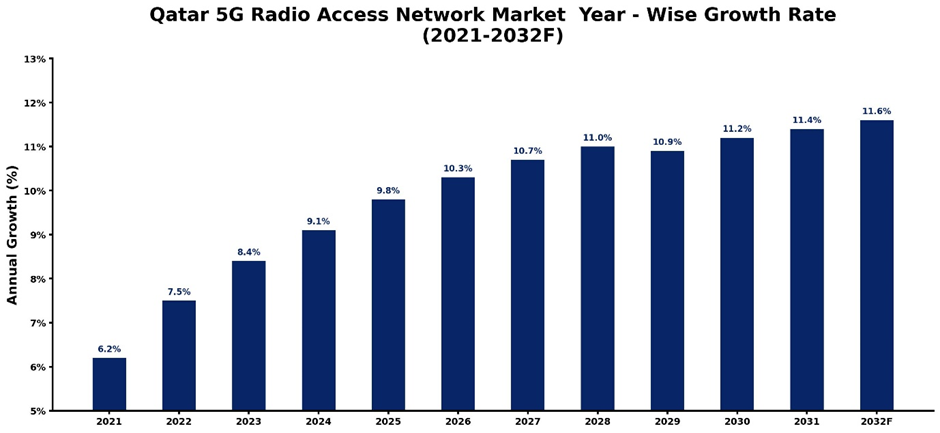
The following table summarizes the historical and forecasted growth rates of the Qatar 5G Radio Access Network Market, along with the rationale behind each year’s performance.
| Year | Estimated Growth (%) | Market Rationale |
| 2021 | 6.2% | Initial 5G NSA expansion focused on urban coverage |
| 2022 | 7.5% | World Cup-driven network densification and capacity upgrades |
| 2023 | 8.4% | Enterprise 5G pilots in oil & gas and logistics |
| 2024 | 9.1% | Early cloud-RAN trials and fiber backhaul expansion |
| 2025 | 9.8% | Transition toward 5G Standalone architecture |
| 2026 | 10.3% | Open RAN testing and multi-vendor integration |
| 2027 | 10.7% | Private 5G scaling in industrial zones |
| 2028 | 11% | mmWave expansion in smart districts |
| 2029 | 10.9% | Optimization phase with AI-based network orchestration |
| 2030 | 11.2% | Expansion of cloud-native telecom core ecosystems |
| 2031 | 11.4% | Advanced virtualization and network slicing maturity |
| 2032 | 11.6% | Pre-6G readiness infrastructure investments |
Topics Covered in the Qatar 5G Radio Access Network Market Report
The report provides an in-depth study of the Qatar 5G Radio Access Network (RAN) Market by RAN type, frequency and deployment type. The report provides a detailed analysis of ongoing market trends, high-growth areas, and market drivers that help stakeholders align strategies based on current and future market dynamics.
Qatar 5G Radio Access Network Market Highlights
| Report Name | Qatar 5G Radio Access Network Market |
| Forecast period | 2026-2032 |
| CAGR | 10.6% |
| Growing Sector | Mobile Networks |
Qatar 5G Radio Access Network Market Synopsis
The Qatar 5G Radio Access Network Market is evolving into a software-controlled connectivity layer rather than a traditional telecom infrastructure segment. Instead of simply expanding coverage, operators are now focused on decoupling hardware and software layers of the radio network. This shift is heavily influenced by Qatar’s push toward industrial automation, smart logistics corridors, and digitally connected energy infrastructure. The market is increasingly defined by compute-heavy RAN nodes, cloud orchestration layers, and AI-based spectrum allocation systems, rather than traditional tower deployment metrics.
Evaluation of Growth Drivers in Qatar 5G Radio Access Network Market (2026–2032)
Below are some major drivers and their influence on the market dynamics:
| Driver | Primary Segment Impacted | Why It Matters (Structural Reason) |
| Telecom cloudification strategy | Cloud-based RAN | Converts fixed infrastructure into scalable software workloads |
| Energy sector digitization | Distributed RAN | Requires ultra-reliable deterministic connectivity |
| National digital infrastructure vision | Open RAN | Pushes diversification away from single-vendor ecosystems |
| Industrial private 5G demand | Virtualized RAN | Enables isolated, high-security network slices |
| Edge computing expansion | Software-defined RAN | Moves processing closer to devices for latency reduction |
The Qatar 5G Radio Access Network Market is projected to witness steady growth at a CAGR of 10.6% between 2026 and 2032. It is reflecting a mature infrastructure transition phase rather than an early-stage expansion cycle. This slower growth trajectory is primarily influenced by the fact that Qatar’s 5G coverage footprint is already relatively advanced, with most urban and high-value industrial zones having achieved significant network densification in the previous deployment phases. Qatar 5G Radio Access Network Market Growth during the forecast period is expected to be driven more by technology refresh cycles and architectural upgrades rather than greenfield network expansion.
Evaluation of Restraints in Qatar 5G Radio Access Network Market
Below are some major restraints and their influence on the market dynamics:
| Restraint | Affected Area | Real Market Impact |
| High dependency on global telecom OEMs | Open RAN | Limits domestic innovation autonomy |
| Network architecture fragmentation risk | Virtualized RAN | Causes integration delays across vendors |
| Power density constraints in urban cells | mmWave | Restricts ultra-high frequency scaling |
| Complex migration from legacy systems | Cloud-based RAN | Slows full virtualization transition |
| Cyber-attack surface expansion | Software-defined RAN | Increases security engineering requirements |
Qatar 5G Radio Access Network Market Challenges
The main challenge for Qatar 5G Radio Access Network Industry is not network expansion but coexistence of multiple RAN generations (legacy LTE, NSA 5G, SA 5G, and Open RAN). This creates layered infrastructure complexity, where operators must maintain performance while simultaneously migrating to cloud-native systems without service disruption. Another critical challenge is the increased reliability on phased migration strategies. It is where telecom operators cannot fully decommission older infrastructure owing to service continuity requirements and this results in prolonged hybrid network operations.
Qatar 5G Radio Access Network Market Trends
Major trends responsible for Qatar 5G Radio Access Network Market Growth includes:
- RAN becomes a software workload: Telecom infrastructure is highly managed like cloud computing environments rather than physical assets and this is enabling faster deployment cycles.
- Private 5G overtakes public innovation pace: Enterprises, especially in the energy sector, are adopting faster than consumer deployments and this is proliferating industrial-grade network transformation.
- Spectrum becomes dynamically allocated: Fixed frequency usage is replaced by AI-based adaptive spectrum sharing and this augments spectral efficiency.
- Infrastructure compression trend: Fewer but more powerful base stations replace traditional dense tower networks, and this lowers operational costs while improving coverage efficiency.
Investment Opportunities of Qatar 5G Radio Access Network Market
- Below are the investment opportunities available in Qatar 5G Radio Access Network Market:
- RAN virtualization platforms: High opportunity in software-defined telecom orchestration layers and this enables scalable and vendor-agnostic network management.
- Industrial private 5G ecosystems: Oil & gas and logistics sectors require mission-critical connectivity and this supports real-time automation and operational safety systems.
- AI-based telecom optimization engines: Growing need for self-healing and predictive RAN systems and this augments network dependability.
Top 5 Leading Players in the Qatar 5G Radio Access Network Market
Below is a list of prominent companies dominating the Qatar 5G Radio Access Network Market Share:
1. Huawei Technologies
| Company Name | Huawei Technologies |
|---|---|
| Established Year | 1987 |
| Headquarters | Shenzhen, China |
| Official Website | Click Here |
Huawei maintains a robust presence in the Middle East 5G infrastructure ecosystem, offering AI-driven and highly scalable Radio Access Network solutions, including advanced 5G Active Antenna Units (AAU) and integrated Massive MIMO systems.
2. Ericsson
| Company Name | Ericsson |
|---|---|
| Established Year | 1876 |
| Headquarters | Stockholm, Sweden |
| Official Website | Click Here |
Ericsson is a leading supplier of the Ericsson Radio System portfolio, providing highly efficient Massive MIMO radios and Cloud RAN solutions. The company supports Qatar’s transition toward 5G Standalone architecture with energy-efficient and software-defined network technologies.
3. Nokia
| Company Name | Nokia |
|---|---|
| Established Year | 1865 |
| Headquarters | Espoo, Finland |
| Official Website | Click Here |
Nokia is actively involved in augmenting Qatar’s 5G infrastructure through its AirScale Radio Access platform and advanced 5G Standalone Core capabilities.
4. ZTE Corporation
| Company Name | ZTE Corporation |
|---|---|
| Established Year | 1985 |
| Headquarters | Shenzhen, China |
| Official Website | Click Here |
ZTE contributes majorly to Qatar’s 5G foundation with its Uni-RAN architecture and Active Antenna solutions.
5. Samsung Electronics
| Company Name | Samsung Electronics |
|---|---|
| Established Year | 1969 |
| Headquarters | Seoul, South Korea |
| Official Website | Click Here |
Samsung is a major innovator in Virtualized RAN (vRAN) and Open RAN technologies, increasingly integrated into Qatar’s 5G ecosystem.
Government Initiatives in Qatar 5G Radio Access Network Market
According to Qatar’s government data, they have positioned 5G RAN development as a major pillar of its national digital transformation strategy rather than a standalone telecom upgrade and major initiatives include the Qatar National Vision 2030. It actively prioritizes building a distinctive, knowledge-based economy where advanced connectivity infrastructure encourages sectors such as energy automation, smart transportation, and digital public services. Under this framework, telecom operators are supported to bolster deployment of 5G Standalone (SA) infrastructure and fiber-integrated radio access systems.
Future Insights of the Qatar 5G Radio Access Network Market
The future of Qatar 5G Radio Access Network Market will be defined by a shift from coverage-centric deployment to intelligence-driven network operation. By 2032, RAN infrastructure is predicted to function more like a distributed cloud computing system, where base stations functions as programmable nodes capable of dynamically allocating compute, storage, and spectrum resources centred on real-time demand. A major future direction is the rise of industrial-grade private 5G networks, particularly in the LNG, petrochemical, and logistics sectors, where deterministic latency and network isolation will become critical operational requirements.
Market Segmentation Analysis
The report offers a comprehensive study of the following market segments and their leading categories:
By RAN Type – Market Dominated by Distributed RAN, Open RAN Set for Rapid Expansion
According to Bhawna Singh, Assistant Manager, 6Wresearch, By RAN type, Distributed RAN secured a dominant 41.20% of the Qatar 5G Radio Access Network Market Share in 2025, supported by its strong macro coverage efficiency, proven deployment stability, and continued reliance on existing 4G/5G hybrid infrastructure across urban and industrial zones. Its widespread use across nationwide mobile networks has made it the backbone of Qatar’s current radio access architecture.
Conversely, Open RAN is projected to register the fastest growth with a CAGR of 14.40% during 2026–2032, driven by increasing operator demand for vendor-neutral architectures, cost optimization in network expansion, and growing adoption of disaggregated software-defined network functions enabling flexible deployment and faster innovation cycles.
By Frequency – Sub-6 GHz Leads Market, mmWave Shows Rapid Expansion
By frequency, Sub-6 GHz held the dominant 53.60% share of the Qatar 5G Radio Access Network market in 2025. It is mainly primarily owing to its superior coverage range and suitability for nationwide mobile broadband deployment and will continues to serve as the foundational spectrum layer for large-scale 5G connectivity across Qatar. mmWave frequency bands are predicted to expand at a CAGR of 15.10% during 2026–2032 and it is accelerated by increasing demand for ultra-high-speed data transmission and capacity-intensive applications in smart city zones.
By Deployment Type – Hybrid Deployment Dominates, Cloud-Based RAN Shows Rapid Growth
By deployment type, Hybrid RAN deployment accounted for 46.80% of the Qatar 5G Radio Access Network market in 2025. It is encouraged by its ability to balance legacy infrastructure with next-generation cloud-native systems. It helps in making sure functional continuity during ongoing network transformation phases and Cloud-based RAN is accounted to witness the fastest expansion at a CAGR of 15.60% during 2026–2032. It is spurred by bolstering telecom cloud migration and increasing adoption of virtualization technologies.
Note: Market size estimations and growth projections presented in this report are based on 6Wresearch’s advanced forecasting approach, validated with industry datasets as of June 2026.
Key Attractiveness of the Report:
- 10 Years of Market Numbers
- Historical Data Starting from 2022 to 2025
- Base Year: 2025
- Forecast Data until 2032
- Key Performance Indicators Impacting the Market
- Major Upcoming Developments and Projects
Key Highlights of the Report:
- Qatar 5G Radio Access Network Market Outlook
- Market Size of Qatar 5G Radio Access Network Market, 2025
- Forecast of Qatar 5G Radio Access Network Market, 2032
- Historical Data and Forecast of Qatar 5G Radio Access Network Revenues & Volume for the Period 2022-2032
- Qatar 5G Radio Access Network Market Trend Evolution
- Qatar 5G Radio Access Network Market Drivers and Challenges
- Qatar 5G Radio Access Network Price Trends
- Qatar 5G Radio Access Network Porter's Five Forces
- Qatar 5G Radio Access Network Industry Life Cycle
- Historical Data and Forecast of Qatar 5G Radio Access Network Market Revenues & Volume By RAN Type for the Period 2022-2032
- Historical Data and Forecast of Qatar 5G Radio Access Network Market Revenues & Volume By Centralized RAN for the Period 2022-2032
- Historical Data and Forecast of Qatar 5G Radio Access Network Market Revenues & Volume By Open RAN for the Period 2022-2032
- Historical Data and Forecast of Qatar 5G Radio Access Network Market Revenues & Volume By Virtualized RAN for the Period 2022-2032
- Historical Data and Forecast of Qatar 5G Radio Access Network Market Revenues & Volume By Distributed RAN for the Period 2022-2032
- Historical Data and Forecast of Qatar 5G Radio Access Network Market Revenues & Volume By Frequency for the Period 2022-2032
- Historical Data and Forecast of Qatar 5G Radio Access Network Market Revenues & Volume By Sub-6 GHz for the Period 2022-2032
- Historical Data and Forecast of Qatar 5G Radio Access Network Market Revenues & Volume By mmWave for the Period 2022-2032
- Historical Data and Forecast of Qatar 5G Radio Access Network Market Revenues & Volume By 26-39 GHz for the Period 2022-2032
- Historical Data and Forecast of Qatar 5G Radio Access Network Market Revenues & Volume By Above 39 GHz for the Period 2022-2032
- Historical Data and Forecast of Qatar 5G Radio Access Network Market Revenues & Volume By Deployment Type for the Period 2022-2032
- Historical Data and Forecast of Qatar 5G Radio Access Network Market Revenues & Volume By Cloud-based for the Period 2022-2032
- Historical Data and Forecast of Qatar 5G Radio Access Network Market Revenues & Volume By Hybrid for the Period 2022-2032
- Historical Data and Forecast of Qatar 5G Radio Access Network Market Revenues & Volume By Software-defined for the Period 2022-2032
- Historical Data and Forecast of Qatar 5G Radio Access Network Market Revenues & Volume By On-Premise for the Period 2022-2032
- Qatar 5G Radio Access Network Import Export Trade Statistics
- Market Opportunity Assessment By RAN Type
- Market Opportunity Assessment By Frequency
- Market Opportunity Assessment By Deployment Type
- Qatar 5G Radio Access Network Top Companies Market Share
- Qatar 5G Radio Access Network Competitive Benchmarking By Technical and Operational Parameters
- Qatar 5G Radio Access Network Company Profiles
- Qatar 5G Radio Access Network Key Strategic Recommendations
Market Covered
The report offers a comprehensive study of the following Qatar 5G Radio Access Network Market segments:
By RAN Type
- Centralized RAN
- Open RAN
- Virtualized RAN
- Distributed RAN
By Frequency
- Sub-6 GHz
- mmWave
- 26–39 GHz
- Above 39 GHz
By Deployment Type
- Cloud-based
- Hybrid
- Software-defined
- On-Premise






































