Qatar Active Phased Array Radar Market Growth Rate
According to 6Wresearch internal databases and industry insights, the Qatar Active Phased Array Radar Market is estimated to expand at a compound annual growth rate (CAGR) of 5.86% during 2026–2032.
Qatar Active Phased Array Radar Market Year-wise Growth Rate and Key Drivers(2022-2032)
This graph illustrates the annual growth rates of the Qatar Active Phased Array Radar Market from 2022 to 2032, highlighting a steady upward trajectory and projected market expansion over the forecast period.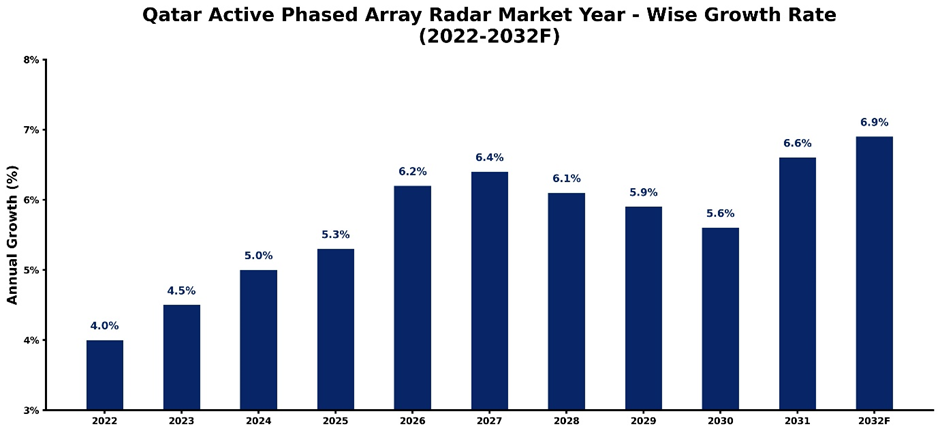 The following table summarizes the historical and forecasted growth rates of the Qatar Active Phased Array Radar Market along with the rationale behind each year’s performance.
| Year | Estimated Growth (%) | Market Rationale |
| 2022 | 4% | Greater attention to integrated surveillance and protection of strategic assets supported radar demand. |
| 2023 | 4.5% | Increasing requirements for modern airspace monitoring and low-altitude threat detection strengthened procurement activity. |
| 2024 | 5% | Counter-UAS requirements and digital radar modernization became more prominent in defense planning. |
| 2025 | 5.3% | Demand benefited from continued investment in advanced surveillance and electronically controlled radar architectures. |
| 2026 | 6.2% | New radar programs and counter-drone initiatives provide a stronger near-term procurement base. |
| 2027 | 6.4% | System deployment, integration, training and associated support requirements are expected to sustain market activity. |
| 2028 | 6.1% | Expansion of networked surveillance and multi-target tracking capabilities supports continued adoption. |
| 2029 | 5.9% | Software upgrades, sensor fusion and lifecycle modernization increasingly influence purchasing decisions. |
| 2030 | 5.6% | Growth becomes more measured as major modernization programs move toward mature deployment stages. |
| 2031 | 6.6% | Replacement cycles and incremental capacity additions maintain steady demand. |
| 2032 | 6.9% | Market expansion remains positive, led by upgrades, sustainment and advanced counter-UAS applications. |
Topics Covered in the Qatar Active Phased Array Radar Market Report
The Qatar Active Phased Array Radar Market Report provides a comprehensive analysis based on type and end user. It offers detailed insights into key industry trends, growth drivers, emerging opportunities, competitive developments, and high-growth segments. The report presents an objective assessment of current dynamics and future prospects, enabling stakeholders to make informed business decisions and develop effective strategies aligned with the evolving industry landscape.
Qatar Active Phased Array Radar Market Highlights
| Report Name | Qatar Active Phased Array Radar Market |
| Forecast period | 2026-2032 |
| CAGR | 5.86% |
| Growing Sector | Digital Radar |
Qatar Active Phased Array Radar Market Synopsis
The Qatar Active Phased Array Radar Market is expected to record consistent expansion during 2026–2032, reflecting Qatar’s continuing requirement for modern airspace-monitoring and defense capabilities. Active phased array radar is an electronically controlled sensing system that rapidly directs radar energy across different areas to identify, locate and follow multiple airborne objects with high responsiveness. Qatar’s market is expected to remain strongly oriented toward military and defense applications, particularly digital radar for early warning, airspace surveillance, counter-UAS detection and coordinated air-defense operations. Over the forecast period, demand is likely to favor radar systems offering faster processing, multi-target handling, network connectivity and greater adaptability to changing aerial threats.
Evaluation of Growth Drivers in Qatar Active Phased Array Radar Market (2026–2032)
Below are some major drivers and their influence on the market dynamics:
| Drivers | Primary Segment Affected | Why It Matters (Evidence) |
| Airspace surveillance modernization | Military & Defense | Qatar's security requirements favor radar systems capable of maintaining a continuous and detailed picture of national airspace. |
| Counter-UAS deployment | Military & Defense | Small drones create detection challenges for conventional surveillance, increasing demand for high-resolution radar sensing. |
| Digital radar adoption | Digital Radar | Digital architectures provide greater flexibility in beam management, signal processing and integration with command-and-control systems. |
| Defense localization | Military & Defense | Qatar is encouraging domestic capability development through international partnerships, technology transfer and local industrial participation. |
| Lifecycle modernization | Military & Defense | Advanced radar procurement generates continuing requirements for maintenance, software updates, training, spares and technical services. |
The Qatar Active Phased Array Radar Market is projected to grow at a compound annual growth rate (CAGR) of 5.86% from 2026 to 2032, with the strongest momentum expected from digital radar and defense applications. Growth is likely to be sustained by the need to improve detection of low-altitude and unmanned threats, connect radar feeds with command systems and improve the responsiveness of national surveillance networks. The planned development and potential localization of Omega360 systems, including a proposed radar factory and competence center, provides an additional example of Qatar's movement toward domestically supported advanced sensing capabilities.
Evaluation of Restraints in Qatar Active Phased Array Radar Market
Below are some major restraints and their influence on market dynamics:
| Restraints | Primary Segment Affected | What This Means |
| High system acquisition costs | Digital Radar | AESA systems require sophisticated transmit/receive modules, processors, cooling, power systems and integration infrastructure. |
| Limited domestic technology depth | Digital Radar | Qatar is developing local capabilities but remains dependent on international suppliers for several highly specialized radar technologies. |
| Small addressable market | Military & Defense | Qatar's geographic size limits the number of large-scale radar installations compared with major defense markets. |
| Complex system integration | Military & Defense | New radar assets must operate alongside existing command, communications and air-defense infrastructure. |
| Extended procurement timelines | Military & Defense | Defense radar programs often require qualification, testing, training and acceptance before reaching full operational deployment. |
Qatar Active Phased Array Radar Market Challenges
The Qatar Active Phased Array Radar Industry goes through numerous constraints such as balancing advanced radar performance with procurement efficiency and long-term sustainment. AESA systems need substantial technical expertise, specialized components and sophisticated software integration and qatar's relatively small domestic demand base also makes large-scale indigenous production economically difficult without international collaborations. Consequently, the market is likely to favor selective localization, joint ventures, technical centers and domestic maintenance capabilities rather than complete self-sufficiency. This approach is consistent with Qatar's wider defense-industrial strategy, which emphasizes partnerships, knowledge transfer and development of local capabilities.
Qatar Active Phased Array Radar Market Trends
Important trends shaping the Qatar Active Phased Array Radar Market Growth are detailed below:
- Multi-mission radar platforms: Systems capable of supporting air surveillance, target tracking and counter-UAS missions can provide more operational value than single-purpose equipment.
- Local sustainment is becoming increasingly important from a commercial standpoint: Qatar's industrial policy is promoting local assembly, maintenance and technical support, provides opportunities beyond the initial sale of radar equipment.
- Radar systems are moving toward networked operation: Rather than operating as isolated sensors, modern radar assets are increasingly expected to exchange information with command-and-control, air-defense and other surveillance systems.
Investment Opportunities in the Qatar Active Phased Array Radar Market
Potential investment opportunities in the Qatar Active Phased Array Radar Market include the following:
- Counter-UAS Radar Systems: High-resolution short-range radar is an attractive opportunity as drones require persistent detection and tracking that can complement electro-optical and electronic sensors.
- Local radar repair centers: Opportunities for calibration, repair, component replacement, software support and operator training open up for investment in Qatar’s localization drive.
- Digital AESA modernization: Suppliers with scalable digital architectures can benefit from Qatar's requirement to improve surveillance performance without continuously replacing complete defense networks.
Top Players in Qatar Active Phased Array Radar Market
Below are some companies influencing the Qatar Active Phased Array Radar Market:
1. Thales
| Company Name | Thales |
|---|---|
| Established Year | 2000 |
| Headquarters | Paris, France |
| Official Website | Click Here |
Thales is a leading international defense-electronics and radar supplier with technologies covering air surveillance, ground-based defense, naval sensing and command systems.
2. Leonardo
| Company Name | Leonardo |
|---|---|
| Established Year | 1948 |
| Headquarters | Rome, Italy |
| Official Website | Click Here |
Leonardo craetes radar, electronic systems and integrated defense solutions for land, naval and airborne applications. Its radar portfolio includes electronically scanned technologies and multi-mission surveillance systems.
3. RTX / Raytheon
| Company Name | RTX / Raytheon |
|---|---|
| Established Year | 2020 |
| Headquarters | Arlington, Virginia, United States |
| Official Website | Click Here |
RTX, through Raytheon, gives advanced radar, sensors and integrated air-defense technologies. Its portfolio includes AESA radar systems for airborne and ground applications, along with broader command-and-control and missile-defense capabilities.
4. Saab
| Company Name | Saab |
|---|---|
| Established Year | 1937 |
| Headquarters | Stockholm, Sweden |
| Official Website | Click Here |
Saab craetes electronically scanned radar systems for air surveillance, ground-based air defense and multi-domain monitoring.
Government Initiatives Being Implemented in the Qatar Active Phased Array Radar Market
According to Qatar’s government data, their approach to advanced radar development is closely connected with its broader defense-industry localization strategy. Barzan Holdings, founded in 2016, is owned by Qatar’s Ministry of Defense and has been tasked with enhancing military capabilities, whilst also promoting local industrial development, international partnerships, research and knowledge transfer. One particularly relevant example is the 2024 Fincantieri-Barzan Holdings Omega360 agreement, which established cooperation around a national counter-drone radar program. The proposed arrangement included potential localization of production in Qatar, a planned supply of 40 radar units and development of a local competence center for assembly and maintenance.
Future Insights of the Qatar Active Phased Array Radar Market
The Qatar Active Phased Array Radar Market is expected to maintain a moderate upward trajectory through 2032, with growth increasingly shifting from basic equipment procurement toward advanced digital sensing, counter-UAS detection, software enhancement and lifecycle services. Military applications will remain the core revenue source because Qatar's radar requirements are primarily associated with national airspace protection and defense surveillance. Over the longer term, domestic assembly and maintenance capabilities could increase the participation of Qatari entities in radar value chains, although high-end semiconductor, antenna and signal-processing technologies are likely to remain dependent on international suppliers.
Market Segmentation Analysis
This report presents a detailed analysis of the market segments along with their leading categories.
By Type – Digital Radar Segment Dominates Due to Advanced Signal Processing and Flexible Beam Management
According to Sumit Sagar, Senior Research Analyst, 6Wresearch, By type, the Digital Radar segment is estimated to dominate the Qatar Active Phased Array Radar Market, accounting for approximately 72.4% market share in 2025 and projected to expand at a CAGR of 6.18% during 2026–2032. Digital systems are gaining preference because of their adaptable signal processing, rapid electronic beam steering, multi-target tracking and compatibility with integrated air-surveillance networks.
By End User – Military & Defense Segment Leads Due to National Airspace Protection Requirements
By end user, the Military & Defense segment is projected to hold the leading position, representing approximately 81.65% Qatar Active Phased Array Radar Market Share in 2025 and advancing at a CAGR of 6.2% during 2026–2032. The segment remains dominant as Qatar continues to prioritize airspace monitoring, early warning, counter-UAS detection and modernization of integrated defense surveillance capabilities.
Note: Market size estimations and growth projections presented in this report are based on 6Wresearch's proprietary forecasting methodology, utilizing the latest available industry data, government publications, and primary research inputs.
Key Attractiveness of the Report:
- 10 Years of Market Numbers
- Historical Data Starting from 2022 to 2025
- Base Year: 2025
- Forecast Data until 2032
- Key Performance Indicators Impacting the Market
- Major Upcoming Developments and Project
Key Highlights of the Report:
- Qatar Active Phased Array Radar Market Outlook
- Market Size of Qatar Active Phased Array Radar Market, 2025
- Forecast of Qatar Active Phased Array Radar Market, 2032
- Historical Data and Forecast of Qatar Active Phased Array Radar Revenues & Volume for the Period 2022-2032
- Qatar Active Phased Array Radar Market Trend Evolution
- Qatar Active Phased Array Radar Market Drivers and Challenges
- Qatar Active Phased Array Radar Price Trends
- Qatar Active Phased Array Radar Porter's Five Forces
- Qatar Active Phased Array Radar Industry Life Cycle
- Historical Data and Forecast of Qatar Active Phased Array Radar Market Revenues & Volume By Type for the Period 2022-2032
- Historical Data and Forecast of Qatar Active Phased Array Radar Market Revenues & Volume By Analog Radar for the Period 2022-2032
- Historical Data and Forecast of Qatar Active Phased Array Radar Market Revenues & Volume By Digital Radar for the Period 2022-2032
- Historical Data and Forecast of Qatar Active Phased Array Radar Market Revenues & Volume By End User for the Period 2022-2032
- Historical Data and Forecast of Qatar Active Phased Array Radar Market Revenues & Volume By Military & Defense for the Period 2022-2032
- Historical Data and Forecast of Qatar Active Phased Array Radar Market Revenues & Volume By Aerospace for the Period 2022-2032
- Historical Data and Forecast of Qatar Active Phased Array Radar Market Revenues & Volume By Automotive for the Period 2022-2032
- Historical Data and Forecast of Qatar Active Phased Array Radar Market Revenues & Volume By Civil Aviation for the Period 2022-2032
- Qatar Active Phased Array Radar Import Export Trade Statistics
- Market Opportunity Assessment By Type
- Market Opportunity Assessment By End User
- Qatar Active Phased Array Radar Top Companies Market Share
- Qatar Active Phased Array Radar Competitive Benchmarking By Technical and Operational Parameters
- Qatar Active Phased Array Radar Company Profiles
- Qatar Active Phased Array Radar Key Strategic Recommendations
Market Covered
The report offers an extensive study of the following market segments:
By Type
- Analog Radar
- Digital Radar
By End User
- Military & Defense
- Aerospace
- Automotive
- Civil Aviation






































