Qatar Active Space Debris Removal Market Size, Share & Growth Rate
The Qatar Active Space Debris Removal Market was estimated at USD 442 Million in 2025 and is projected to reach USD 606 Million by 2032, growing at a CAGR of 4.6% from 2026 to 2032. This robust growth trajectory is driven by Qatar's escalating investment in satellite technologies and an increasing awareness of the potential risks posed by space debris. As Qatar positions itself as an emerging player in space exploration, the need for sustainable practices, including proactive debris management, has become paramount.
Qatar Active Space Debris Removal Market Year-wise Growth Rate and Key Drivers
This graph highlights how the Qatar Active Space Debris Removal Market has steadily grown over the years, supported by major growth factors.
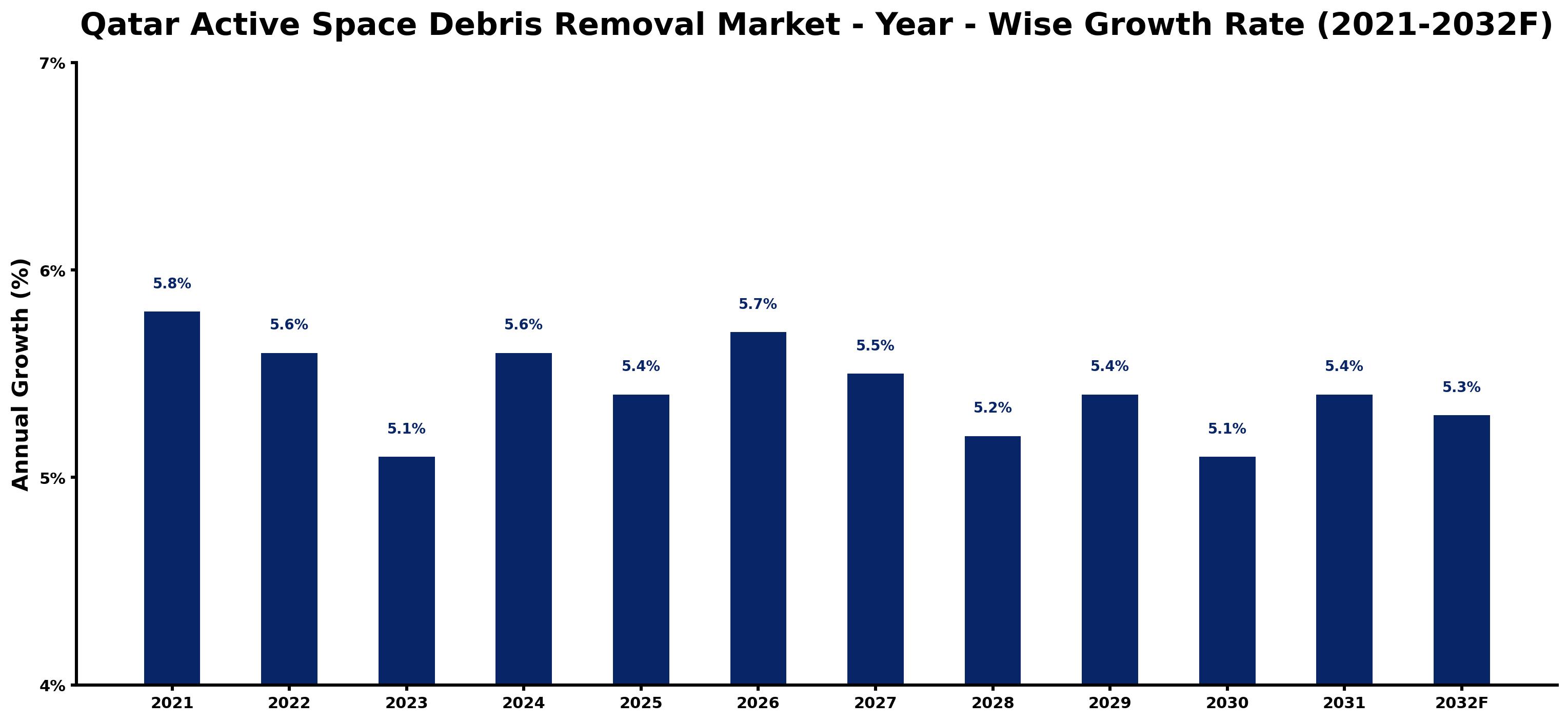
The table below presents the year‑wise growth rates along with the key drivers influencing the market
| Year | Growth Rate | Major Drivers |
| 2021 | 5.8% | Increasing adoption of advanced technologies |
| 2022 | 5.6% | Expansion of commercial construction activities |
| 2023 | 5.1% | Government infrastructure modernization initiatives |
| 2024 | 5.6% | Increasing industrial automation investments |
| 2025 | 5.4% | Increasing adoption of advanced technologies |
| 2026 | 5.7% | Increasing smart city development projects |
| 2027 | 5.5% | Increasing industrial infrastructure investments |
| 2028 | 5.2% | Increasing industrial infrastructure investments |
| 2029 | 5.4% | Expansion of manufacturing activities |
| 2030 | 5.1% | Rising electricity demand across industries |
| 2031 | 5.4% | Expansion of manufacturing activities |
| 2032 | 5.3% | Increasing industrial automation investments |
Note - Market size estimations and growth projections presented in this report are based on 6Wresearch's advanced forecasting approach, validated with industry datasets as of June 2026.
Qatar Active Space Debris Removal Market Synopsis
In recent years, Qatar has witnessed an upsurge in space-related activities, propelling the demand for active space debris removal solutions. As satellite launches continue to rise, the urgency to mitigate space debris issues has been met with a strategic response from both public and private sectors. Looking ahead, the focus on developing sophisticated technologies for debris removal is expected to intensify as global collaboration strengthens.
The current momentum reflects a growing recognition within Qatar of the importance of space sustainability. This proactive stance marks a shift from traditional passive approaches to a more engaged methodology in addressing the debris challenge. The commitment to advancing capabilities in space debris management will serve as a crucial factor in Qatar's long-term aspirations in the aerospace domain.
Qatar Active Space Debris Removal Market Key Takeaways
- The Qatar active space debris removal market is poised for significant growth driven by national investments in space initiatives.
- Technological advancements and international collaborations are key factors shaping market dynamics.
- Awareness of space sustainability and debris mitigation is increasingly influencing policy and operational strategies.
- Challenges related to technology development and international regulations continue to impact market players.
- The market presents multiple opportunities for innovation and strategic partnerships to address pressing debris issues.
Evaluation of Restraints in Qatar Active Space Debris Removal Market
The active space debris removal market in Qatar faces several constraints that could impede its growth. The complexity of deploying effective debris removal technologies necessitates a high level of expertise, substantial investment, and ongoing research. Moreover, navigating the intricate landscape of international regulations and space governance poses challenges for Qatari entities eager to engage in debris removal missions. These factors can lead to delays and increased operational costs, which must be addressed to ensure a viable market future.
Qatar Active Space Debris Removal Market Trends
Emerging trends in the Qatar active space debris removal market highlight an increased focus on innovative technology solutions, such as robotic arms and net capture systems. Furthermore, there is a noticeable shift toward collaborative international efforts, with countries joining forces to address the growing space debris challenge. The demand for environmentally friendly debris management solutions is also gaining traction, pushing for sustainable practices in space operations.
Qatar Active Space Debris Removal Market Opportunities
Investment opportunities in the Qatar active space debris removal market are ripe for exploration. As the nation ramps up its space initiatives, sectors focusing on research and development of debris removal technologies stand to benefit significantly. Additionally, partnerships with international space agencies and private entities can foster knowledge transfer and technology sharing, enhancing Qatar's capabilities in this vital area.
Government Initiatives in the Qatar Active Space Debris Removal Market
The Qatari government has increasingly recognized the necessity of sustainable space practices, including active debris removal. Public spending is being directed toward satellite projects and related technologies, aimed at fortifying the nation's role in the global space community. Programs promoting research into space sustainability and the mitigation of debris risks are pivotal to Qatar's overarching strategy in its burgeoning space sector.
Future Insights of the Qatar Active Space Debris Removal Market
From 2026 to 2032, the Qatar active space debris removal market is expected to evolve with a strong emphasis on developing advanced debris management technologies. The integration of international collaboration in addressing space debris is anticipated to bolster the market's growth. As awareness around space sustainability continues to rise, Qatari initiatives will likely pivot towards innovative solutions, ensuring that the nation not only participates but thrives in the global space domain.
Qatar Active Space Debris Removal Market Latest Developments (May 2025 - June 2026)
Recent developments in Qatar's active space debris removal market indicate a progressive approach towards enhancing capabilities and partnerships. Efforts to engage in international collaborations are intensifying, with discussions around joint missions and technology transfers gaining momentum. The focus on public-private partnerships is expected to stimulate advancements in debris removal technology and foster an environment conducive to innovative solutions.
Qatar Active Space Debris Removal Market - Key Attractiveness of the Report
- 10 Years of Market Numbers
- Historical Data Starting from 2022 to 2025
- Base Year: 2025
- Forecast Data until 2032
- Key Performance Indicators Impacting the Market
- Major Upcoming Developments and Projects
Key Highlights of the Report:
- Qatar Active Space Debris Removal Market Outlook
- Market Size of Qatar Active Space Debris Removal Market, 2025
- Forecast of Qatar Active Space Debris Removal Market, 2032
- Historical Data and Forecast of Qatar Active Space Debris Removal Revenues & Volume for the Period 2022-2032F
- Qatar Active Space Debris Removal Market Trend Evolution
- Qatar Active Space Debris Removal Market Drivers and Challenges
- Qatar Active Space Debris Removal Price Trends
- Qatar Active Space Debris Removal Porter's Five Forces
- Qatar Active Space Debris Removal Industry Life Cycle
- Historical Data and Forecast of Qatar Active Space Debris Removal Market Revenues & Volume By Debris Size for the Period 2022-2032F
- Historical Data and Forecast of Qatar Active Space Debris Removal Market Revenues & Volume By Between 1 mm and 1 cm for the Period 2022-2032F
- Historical Data and Forecast of Qatar Active Space Debris Removal Market Revenues & Volume By Between 1 cm to 10 cm for the Period 2022-2032F
- Historical Data and Forecast of Qatar Active Space Debris Removal Market Revenues & Volume By More than 10 cm for the Period 2022-2032F
- Historical Data and Forecast of Qatar Active Space Debris Removal Market Revenues & Volume By End-users for the Period 2022-2032F
- Historical Data and Forecast of Qatar Active Space Debris Removal Market Revenues & Volume By Commercial for the Period 2022-2032F
- Historical Data and Forecast of Qatar Active Space Debris Removal Market Revenues & Volume By Defense for the Period 2022-2032F
- Qatar Active Space Debris Removal Import Export Trade Statistics
- Market Opportunity Assessment By Debris Size
- Market Opportunity Assessment By End-users
- Qatar Active Space Debris Removal Top Companies Market Share
- Qatar Active Space Debris Removal Competitive Benchmarking By Technical and Operational Parameters
- Qatar Active Space Debris Removal Company Profiles
- Qatar Active Space Debris Removal Key Strategic Recommendations






































