Qatar Aerobridge Market Growth Rate
According to 6Wresearch internal databases and industry insights, the Qatar Aerobridge Market is estimated to register a compound annual growth rate (CAGR) of approximately 5.8% during 2026–2032.
Qatar Aerobridge Market Year-wise Growth Rate and Key Drivers (2022–2032)
This graph illustrates the annual growth rates of the Qatar Aerobridge Market from 2022 to 2032, highlighting a steady upward trajectory and projected market expansion over the forecast period.
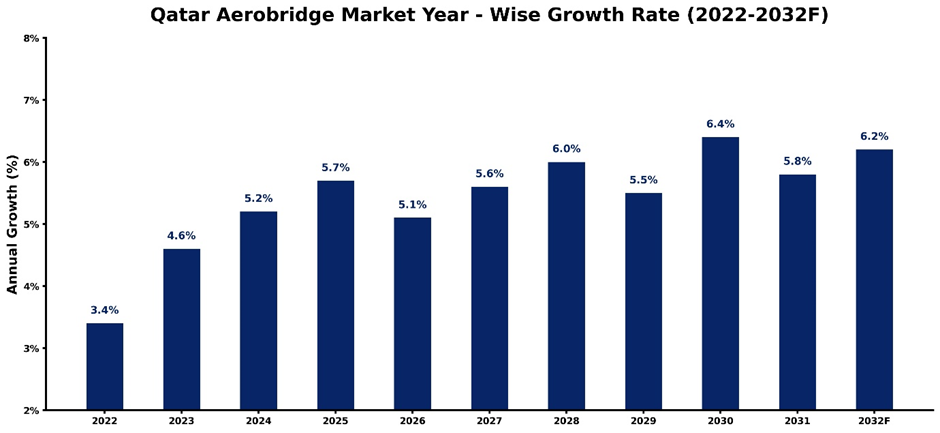
The following table presents the estimated annual growth rates of the market for each year, along with the key factors influencing market performance during the respective period. The values are intended to highlight year-wise drivers rather than provide a direct comparison between individual years.
| Year | Estimated Growth (%) | Market Rationale |
| 2022 | 3.4% | Airport infrastructure expansion and preparation for elevated passenger throughput supported aerobridge demand. |
| 2023 | 4.6% | Recovery in international aviation activity increased utilization of contact gates and boarding infrastructure. |
| 2024 | 5.2% | Rising passenger traffic and continued airport modernization strengthened demand for passenger boarding systems. |
| 2025 | 5.7% | Completion of Hamad International Airport's Concourse D and E expansion increased gate capacity and strengthened the requirement for advanced passenger-access infrastructure. |
| 2026 | 5.1% | Airport capacity utilization and replacement requirements are expected to support continued aerobridge procurement and modernization. |
| 2027 | 5.6% | Greater adoption of automated docking, digital monitoring and integrated gate-management technologies should stimulate market development. |
| 2028 | 6% | Increasing international connectivity and tourism activity are expected to raise demand for high-cycle boarding infrastructure. |
| 2029 | 5.5% | Airport operators are likely to prioritize energy-efficient, reliable and technologically upgraded boarding bridges. |
| 2030 | 6.4% | Qatar's tourism and economic-diversification objectives are expected to sustain aviation infrastructure investment. |
| 2031 | 5.8% | Replacement cycles and modernization of existing passenger boarding infrastructure should support steady demand. |
| 2032 | 6.2% | Wider deployment of automated and digitally monitored aerobridges is expected as airports pursue higher operational efficiency. |
Topics Covered in the Qatar Aerobridge Market Report
The Qatar Aerobridge Market Report provides a comprehensive analysis based on type, operation mode and end user. It offers detailed insights into key industry trends, growth drivers, emerging opportunities, competitive developments, and high-growth segments. The report presents an objective assessment of current dynamics and future prospects, enabling stakeholders to make informed business decisions and develop effective strategies aligned with the evolving industry landscape.
Qatar Aerobridge Market Highlights
| Report Name | Qatar Aerobridge Market |
| Forecast period | 2026-2032 |
| CAGR | 5.8% |
| Growing Sector | Airports |
Qatar Aerobridge Market Synopsis
The Qatar Aerobridge Market is predicted to maintain a positive growth trajectory through 2032. Aerobridges provide controlled, weather-protected and efficient passenger access between airport terminals and aircraft, making them particularly important at high-throughput international airports. The completion of Hamad International Airport's latest expansion has materially strengthened the addressable infrastructure base of Aerobridge. The project increased annual capacity to more than 65 million passengers, expanded terminal space to approximately 845,000 square metres and increased boarding gates to 62.
Evaluation of Growth Drivers in Qatar Aerobridge Market (2026–2032)
Below are some major drivers and their influence on market dynamics:
| Drivers | Primary Segment Affected | Why It Matters (Evidence) |
| Expansion of airport passenger capacity | Airports | Hamad International Airport's completed expansion increased annual capacity to more than 65 million passengers and added 17 boarding gates, creating a larger infrastructure base for passenger boarding systems. |
| Increasing international connectivity | Airports / Airlines | Qatar's hub-and-spoke aviation model creates sustained requirements for efficient aircraft turnaround and passenger boarding infrastructure. |
| Airport modernization and automation | Automatic Aerobridges | New airport infrastructure highly incorporates automated boarding and smart operational technologies. |
| Replacement of aging boarding infrastructure | Fixed Aerobridges | Existing bridges require periodic refurbishment, component replacement and modernization to maintain operational reliability and safety. |
| Growth in tourism and international visitation | Airports / Airlines | Qatar Tourism targets six million visitors annually by 2030, supporting longer-term passenger-processing and airport-infrastructure requirements. |
| Need for efficient aircraft turnaround | Automatic Aerobridges | Faster and more predictable aircraft boarding can support gate utilization and reduce dependence on remote-bus operations. |
The Qatar Aerobridge Market is projected to grow at a compound annual growth rate (CAGR) of approximately 5.8% during 2026–2032. Growth of the industry is expected to be driven by airport modernization, rising passenger throughput, gate expansion, replacement of older passenger boarding bridges and increased adoption of automated airport systems. In addition, increasing emphasis on faster aircraft turnaround, improved passenger accessibility, enhanced gate utilization and integration of aerobridges with smart airport infrastructure is expected to support demand.
Evaluation of Restraints in Qatar Aerobridge Market
Below are some major restraints and their influence on market dynamics:
| Restraints | Primary Segment Affected | What This Means (Evidence) |
| High capital expenditure | Fixed / Automatic Aerobridges | Aerobridge systems require substantial expenditure for structural equipment, electrical systems, controls, installation and integration with terminal infrastructure. |
| Limited number of major airport projects | Airports | Qatar has a concentrated aviation infrastructure base, meaning large procurement opportunities can be project-driven rather than distributed across numerous airports. |
| Complex installation requirements | Fixed Aerobridges | Installation need coordination with terminal structures, aircraft stand layouts, electrical systems, ground-support infrastructure and airport operations. |
| Specialized maintenance requirements | Automatic Aerobridges | Automated drives, sensors, control systems and safety mechanisms need trained maintenance personnel and scheduled servicing. |
| Dependence on imported technology | All Segments | Advanced passenger boarding bridge systems typically comprise of international equipment manufacturers and specialized components. |
| Long replacement cycles | Fixed Aerobridges | Aerobridges are long-life infrastructure assets, limiting recurring annual demand once leading airport expansion projects are completed. |
Qatar Aerobridge Market Challenges
The Qatar Aerobridge Industry encounters various challenges associated with high procurement costs, complex airport integration, long asset lifecycles and specialized maintenance requirements. Aerobridge projects must be coordinated with terminal architecture, aircraft stand geometry, passenger-flow systems, electrical infrastructure and aircraft compatibility requirements. The market is also relatively concentrated as Qatar's aviation infrastructure is dominated by major international airport operations. As a result, market growth can be influenced significantly by the timing of major airport expansion, refurbishment and replacement contracts rather than by a large number of smaller installations.
Qatar Aerobridge Market Trends
Key developments impacting the Qatar Aerobridge Market Growth are highlighted below:
- Shift toward lifecycle-cost optimization: Airport operators are highly assessing aerobridges based on reliability, maintenance requirements, energy consumption, downtime and total lifecycle cost instead of acquisition price alone.
- Demand for high-throughput boarding infrastructure: Qatar's position as an international aviation hub increases the importance of productive passenger movement and aircraft turnaround, particularly at high-utilization contact gates.
- Modernization of existing aerobridges: Following leading capacity additions, the market is predicted to gradually transition from pure capacity growth toward maintenance, refurbishment and controls modernization.
Investment Opportunities in the Qatar Aerobridge Market
Promising investment avenues in the Qatar Aerobridge Market presented below:
- Integrated gate solutions: Companies capable of merging aerobridges with visual docking guidance, ground power, pre-conditioned air and gate-management systems can address larger airport infrastructure contracts.
- Maintenance and lifecycle services: Long-term operation and maintenance agreements can cater recurring revenue after installation, particularly as the installed base of passenger boarding bridges growth.
- Energy-efficient airport equipment: Aerobridges incorporating efficient lighting, smart controls and incorporation with airport energy-management systems may gain rising preference as airports pursue sustainability targets.
Top Players in Qatar Aerobridge Market
A list of leading companies operating in the Qatar Aerobridge Market is presented below:
1. CIMC Tianda Holdings Co., Ltd.
|
Company Name |
CIMC Tianda Holdings Co., Ltd. |
|---|---|
|
Established Year |
1988 |
|
Headquarters |
Shenzhen, Guangdong, China |
|
Official Website |
CIMC Tianda Holdings Co., Ltd. is a major global supplier of airport and logistics equipment, fire and rescue equipment.
2. TK Airport Solutions S.A.
|
Company Name |
TK Airport Solutions S.A. |
|---|---|
|
Established Year |
2018 |
|
Headquarters |
Mieres, Asturias, Spain |
|
Official Website |
TK Airport Solutions S.A. is an airport equipment company specializing in passenger boarding bridges and related airport access equipment.
3. Oshkosh Corporation (Oshkosh AeroTech)
|
Company Name |
Oshkosh Corporation (Oshkosh AeroTech) |
|---|---|
|
Established Year |
1917 |
|
Headquarters |
Oshkosh, Wisconsin, USA |
|
Official Website |
Oshkosh Corporation is a major manufacturer of specialty vehicles and equipment. Through Oshkosh AeroTech, the company provides aviation support solutions and equipment for airports. Oshkosh Corporation acquired AeroTech from JBT Corporation in August 2023.
4. ShinMaywa Industries, Ltd.
|
Company Name |
ShinMaywa Industries, Ltd. |
|---|---|
|
Established Year |
1949 |
|
Headquarters |
Takarazuka, Hyogo, Japan |
|
Official Website |
ShinMaywa Industries, Ltd. is a diversified Japanese engineering and manufacturing company with businesses covering special-purpose vehicles, parking systems, industrial machinery, environmental systems, and aircraft.
Government Initiatives being implemented in the Qatar Aerobridge Market
According to Qatar’s government data, The completion of Concourses D and E in March 2025 increased HIA's annual passenger capacity to more than 65 million and added 17 boarding gates, taking the total to 62. The project also incorporated automated boarding systems and smart technologies. Airport Automation and Passenger-Experience Development expansion has incorporated automated boarding and smart passenger-processing systems. They have the objective of decreasing waiting times and augmenting functional efficiency. Such development favors aerobridges equipped for greater automation and digital integration.
Future Insights of the Qatar Aerobridge Market
The Qatar Aerobridge Market is expected to sustain moderate growth through 2032, with demand concentrated around major international airport infrastructure. Following the completion of the latest HIA expansion, future market development is expected to become increasingly associated with replacement, modernization, automation and lifecycle-service requirements rather than large-scale greenfield capacity additions alone. Automatic aerobridges are expected to gain share as airport operators prioritize controlled docking, operational consistency and integration with smart airport systems. Fixed aerobridges are expected to remain the dominant configuration as they are suited to permanent terminal-gate infrastructure.
Market Segmentation Analysis
This report presents a detailed analysis of the market segments along with their leading categories.
By Type – Fixed Aerobridges Dominate, While Movable Aerobridges Register Strong Growth
According to Sumit Sagar, Senior Research Analyst, 6Wresearch, By type, Fixed Aerobridges accounted for approximately 68.42% of Qatar Aerobridge Market Share in 2025, supported by permanent contact-gate infrastructure at major airport terminals.
Meanwhile, Movable Aerobridges are estimated to increase at a CAGR of 6.43% over 2026-2032, owing to flexible gate configurations and functional adaptability.
By Operation Mode – Manual Aerobridges Dominate, While Automatic Systems Record Faster Expansion
By operation mode, the Manual Aerobridges segment accounted the highest market share of 57.36% in 2025, owing to the established installed base.
At the same time, The Automatic Aerobridges market is anticipated to grow at a CAGR of 7.18% during 2026 - 2032 driven by development in airport and automated docking needs.
By End User – Airports Lead, While Airlines Show Higher Growth Potential
By End users, airports, accounted for a 72.64% market share in 2025, owing to the concentration of procurement in airport infrastructure projects.
In parallel, Airlines are expected to register a CAGR of approximately 6.21% during 2026–2032, supported by increasing emphasis on efficient gate utilization and passenger turnaround.
Note: Market size estimations and growth projections presented in this report are based on 6Wresearch's proprietary forecasting methodology, utilizing the latest available industry data, government publications, and primary research inputs.
Key Attractiveness of the Report:
- 10 Years of Market Numbers
- Historical Data Starting from 2022 to 2025
- Base Year: 2025
- Forecast Data until 2032
- Key Performance Indicators Impacting the Market
- Major Upcoming Developments and Projects
Key Highlights of the Report:
- Qatar Aerobridge Market Outlook
- Market Size of Qatar Aerobridge Market, 2025
- Forecast of Qatar Aerobridge Market, 2032
- Historical Data and Forecast of Qatar Aerobridge Revenues & Volume for the Period 2022-2032
- Qatar Aerobridge Market Trend Evolution
- Qatar Aerobridge Market Drivers and Challenges
- Qatar Aerobridge Price Trends
- Qatar Aerobridge Porter's Five Forces
- Qatar Aerobridge Industry Life Cycle
- Historical Data and Forecast of Qatar Aerobridge Market Revenues & Volume By Type for the Period 2022-2032
- Historical Data and Forecast of Qatar Aerobridge Market Revenues & Volume By Fixed Aerobridges for the Period 2022-2032
- Historical Data and Forecast of Qatar Aerobridge Market Revenues & Volume By Movable Aerobridges for the Period 2022-2032
- Historical Data and Forecast of Qatar Aerobridge Market Revenues & Volume By Others for the Period 2022-2032
- Historical Data and Forecast of Qatar Aerobridge Market Revenues & Volume By Operation Mode for the Period 2022-2032
- Historical Data and Forecast of Qatar Aerobridge Market Revenues & Volume By Manual for the Period 2022-2032
- Historical Data and Forecast of Qatar Aerobridge Market Revenues & Volume By Automatic for the Period 2022-2032
- Historical Data and Forecast of Qatar Aerobridge Market Revenues & Volume By Others for the Period 2022-2032
- Historical Data and Forecast of Qatar Aerobridge Market Revenues & Volume By End User for the Period 2022-2032
- Historical Data and Forecast of Qatar Aerobridge Market Revenues & Volume By Airports for the Period 2022-2032
- Historical Data and Forecast of Qatar Aerobridge Market Revenues & Volume By Airlines for the Period 2022-2032
- Historical Data and Forecast of Qatar Aerobridge Market Revenues & Volume By Others for the Period 2022-2032
- Qatar Aerobridge Import Export Trade Statistics
- Market Opportunity Assessment By Type
- Market Opportunity Assessment By Operation Mode
- Market Opportunity Assessment By End User
- Qatar Aerobridge Top Companies Market Share
- Qatar Aerobridge Competitive Benchmarking By Technical and Operational Parameters
- Qatar Aerobridge Company Profiles
- Qatar Aerobridge Key Strategic Recommendations
Market Covered
The report offers an extensive study of the following market segments:
By Type
- Fixed Aerobridges
- Movable Aerobridges
- Others
By Operation Mode
- Manual
- Automatic
- Others
By End User
- Airports
- Airlines
- Others






































