Qatar Baby Prams and Strollers Market Size, Share & Growth Rate
The Qatar Baby Prams and Strollers Market was estimated at USD 421 Million in 2025 and is projected to reach USD 581 Million by 2032, growing at a CAGR of 4.7% from 2026 to 2032. This growth trajectory is propelled by the rising trend of nuclear families and increasing disposable incomes among parents, which has made high-quality baby transportation products a priority. Additionally, the government's encouragement of family-oriented policies further solidifies a favorable market climate, leading to sustained demand.
Qatar Baby Prams and Strollers Market Year-wise Growth Rate and Key Drivers
This graph highlights how the Qatar Baby Prams and Strollers Market has steadily grown over the years, supported by major growth factors.
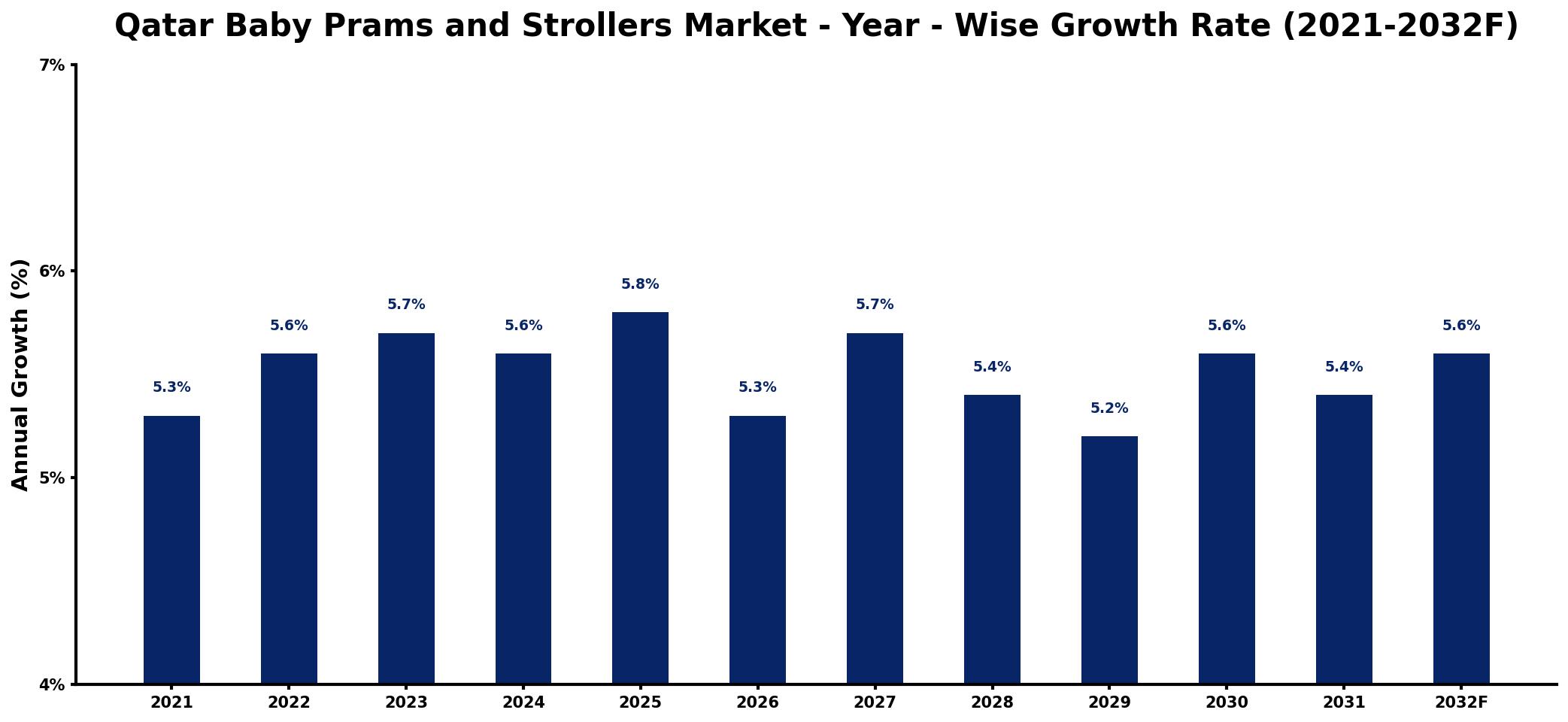
The table below presents the year‑wise growth rates along with the key drivers influencing the market
| Year | Growth Rate | Major Drivers |
| 2021 | 5.3% | Rising birth rates driving demand |
| 2022 | 5.6% | Increased disposable income trends |
| 2023 | 5.7% | Growing focus on child safety |
| 2024 | 5.6% | Expansion of retail distribution channels |
| 2025 | 5.8% | Emerging eco-friendly product preferences |
| 2026 | 5.3% | Technological advancements in design |
| 2027 | 5.7% | Increase in urban living spaces |
| 2028 | 5.4% | Growing demand for multifunctional products |
| 2029 | 5.2% | Rise in online shopping popularity |
| 2030 | 5.6% | Enhanced marketing strategies adopted |
| 2031 | 5.4% | Investment in innovative product features |
| 2032 | 5.6% | Strengthened consumer awareness campaigns |
Note: Market size estimations and growth projections presented in this report are based on 6Wresearch's proprietary forecasting methodology, utilizing the latest available industry data, government publications, and primary research inputs.
Qatar Baby Prams and Strollers Market Synopsis
The baby prams and strollers market in Qatar is flourishing, fueled by a burgeoning population of young families and a significant expatriate community. As parents become increasingly discerning about their childcare choices, high-quality options offering safety, comfort, and durability are in high demand.
With a cosmopolitan society that places a premium on family-centric lifestyles, the market is experiencing a robust evolution. Local and international brands are competing to meet the diverse needs of parents, underscoring a landscape ripe for innovation.
Qatar Baby Prams and Strollers Market Key Takeaways
- The market is driven by the increasing emphasis on safety, comfort, and high-quality materials.
- Government support for family-friendly initiatives is likely to enhance market dynamics.
- Expatriate families are a crucial demographic influencing product trends and purchasing behavior.
- Parents are investing in baby products that not only provide mobility but also contribute to their child's early development.
- The shift toward online retail has become a significant avenue for market growth post-pandemic.
Evaluation of Restraints in Qatar Baby Prams and Strollers Market
Despite the promising growth trajectory, the Qatar baby prams and strollers market grapples with some inherent challenges. A primary concern is the country's relatively low birth rate, which may limit the long-term customer base. This necessitates targeted marketing strategies, particularly aimed at the expatriate populations that contribute to the market. Furthermore, the increasing focus on stringent safety and quality standards requires manufacturers to invest heavily in compliance, which can be a barrier for new entrants trying to establish themselves in this competitive landscape.
Qatar Baby Prams and Strollers Market Trends
A notable trend shaping the Qatar baby prams and strollers market is the growing preference for multi-functional products. Parents are gravitating towards strollers that combine the features of prams, car seats, and travel systems, prioritizing versatility to match their busy lifestyles. Additionally, eco-friendly materials and sustainable manufacturing practices are gaining traction as consumers become more environmentally conscious. Technology integration, such as smart features that enhance convenience and safety, is also emerging as a significant trend in consumer preferences.
Qatar Baby Prams and Strollers Market Opportunities
The market presents a wealth of opportunities for growth and investment, particularly in the areas of innovation and e-commerce. Companies that prioritize the development of high-quality, multifunctional products that meet the demands of modern parents are well-positioned to capture market share. Additionally, as the trend towards online shopping continues, businesses that enhance their digital presence and optimize customer experience will likely see significant benefits. Engaging with expatriate communities through targeted marketing and product offerings could also unlock new revenue streams.
Government Initiatives in the Qatar Baby Prams and Strollers Market
The Qatari government has undertaken various initiatives to promote family-friendly policies, which have a direct impact on the baby prams and strollers market. Efforts to enhance public amenities for families, along with regulations supporting child safety in consumer products, contribute positively to market dynamics. Public spending aimed at improving health and wellness for young families is expected to further reinforce market demand.
Future Insights of the Qatar Baby Prams and Strollers Market
Looking ahead to 2026-2032, the Qatar baby prams and strollers market is set to experience sustained growth driven by an evolving demographic landscape and increasing consumer expectations. With a robust emphasis on safety and innovation, manufacturers will likely focus on enhancing product offerings to cater to the discerning tastes of parents. The ongoing development of family-oriented infrastructure and policies will further support this upward trend, suggesting a bright future for industry stakeholders.
Qatar Baby Prams and Strollers Market Latest Developments (2025 - 2026)
In recent months, the market has seen a surge in product launches focused on multifunctional and technology-enhanced baby transport solutions. Retailers are also increasingly investing in enhancing their online sales channels to align with shifting consumer behaviors post-pandemic. Initiatives promoting safety standards and quality assurance are being adopted more widely, indicating an industry-wide commitment to consumer trust and satisfaction.
Qatar Baby Prams and Strollers Market - Key Attractiveness of the Report
- 10 Years of Market Numbers
- Historical Data Starting from 2022 to 2025
- Base Year: 2025
- Forecast Data until 2032
- Key Performance Indicators Impacting the Market
- Major Upcoming Developments and Projects
Key Highlights of the Report:
- Qatar Baby Prams and Strollers Market Outlook
- Market Size of Qatar Baby Prams and Strollers Market, 2025
- Forecast of Qatar Baby Prams and Strollers Market, 2032
- Historical Data and Forecast of Qatar Baby Prams and Strollers Revenues & Volume for the Period 2022-2032F
- Qatar Baby Prams and Strollers Market Trend Evolution
- Qatar Baby Prams and Strollers Market Drivers and Challenges
- Qatar Baby Prams and Strollers Price Trends
- Qatar Baby Prams and Strollers Porter's Five Forces
- Qatar Baby Prams and Strollers Industry Life Cycle
- Historical Data and Forecast of Qatar Baby Prams and Strollers Market Revenues & Volume By Product Type for the Period 2022-2032F
- Historical Data and Forecast of Qatar Baby Prams and Strollers Market Revenues & Volume By Lightweight Strollers for the Period 2022-2032F
- Historical Data and Forecast of Qatar Baby Prams and Strollers Market Revenues & Volume By Jogging Strollers for the Period 2022-2032F
- Historical Data and Forecast of Qatar Baby Prams and Strollers Market Revenues & Volume By Standard Strollers for the Period 2022-2032F
- Historical Data and Forecast of Qatar Baby Prams and Strollers Market Revenues & Volume By Double / Triple Strollers for the Period 2022-2032F
- Historical Data and Forecast of Qatar Baby Prams and Strollers Market Revenues & Volume By Multi-Optional System Strollers for the Period 2022-2032F
- Historical Data and Forecast of Qatar Baby Prams and Strollers Market Revenues & Volume By Age for the Period 2022-2032F
- Historical Data and Forecast of Qatar Baby Prams and Strollers Market Revenues & Volume By 0 - 6 months for the Period 2022-2032F
- Historical Data and Forecast of Qatar Baby Prams and Strollers Market Revenues & Volume By 6 - 12 months for the Period 2022-2032F
- Historical Data and Forecast of Qatar Baby Prams and Strollers Market Revenues & Volume By 12 - 36 months for the Period 2022-2032F
- Historical Data and Forecast of Qatar Baby Prams and Strollers Market Revenues & Volume By Sales Channel for the Period 2022-2032F
- Historical Data and Forecast of Qatar Baby Prams and Strollers Market Revenues & Volume By BaBoutiques for the Period 2022-2032F
- Historical Data and Forecast of Qatar Baby Prams and Strollers Market Revenues & Volume By Specialty Stores for the Period 2022-2032F
- Historical Data and Forecast of Qatar Baby Prams and Strollers Market Revenues & Volume By Modern Trade for the Period 2022-2032F
- Historical Data and Forecast of Qatar Baby Prams and Strollers Market Revenues & Volume By Departmental Stores for the Period 2022-2032F
- Historical Data and Forecast of Qatar Baby Prams and Strollers Market Revenues & Volume By Mono-brand Stores for the Period 2022-2032F
- Historical Data and Forecast of Qatar Baby Prams and Strollers Market Revenues & Volume By Online retailers for the Period 2022-2032F
- Historical Data and Forecast of Qatar Baby Prams and Strollers Market Revenues & Volume By Other Sales Channel for the Period 2022-2032F
- Qatar Baby Prams and Strollers Import Export Trade Statistics
- Market Opportunity Assessment By Product Type
- Market Opportunity Assessment By Age
- Market Opportunity Assessment By Sales Channel
- Qatar Baby Prams and Strollers Top Companies Market Share
- Qatar Baby Prams and Strollers Competitive Benchmarking By Technical and Operational Parameters
- Qatar Baby Prams and Strollers Company Profiles
- Qatar Baby Prams and Strollers Key Strategic Recommendations






































