Qatar Beef And Veal Market Size, Share & Growth Rate
The Qatar Beef And Veal Market was estimated at USD 204 Million in 2025 and is projected to reach USD 279 Million by 2032, growing at a CAGR of 4.6% from 2026 to 2032. This growth trajectory is primarily fueled by an increasing demand for premium meat products, a reflection of the changing dietary preferences and cultural dynamics within the nation. As Qatar continues to develop as a global economic hub, the influx of diverse populations seeking quality beef and veal options is significant, alongside rising disposable incomes that empower consumers to invest in higher-quality food products.
Qatar Beef And Veal Market Year-wise Growth Rate and Key Drivers
This graph highlights how the Qatar Beef And Veal Market has steadily grown over the years, supported by major growth factors.
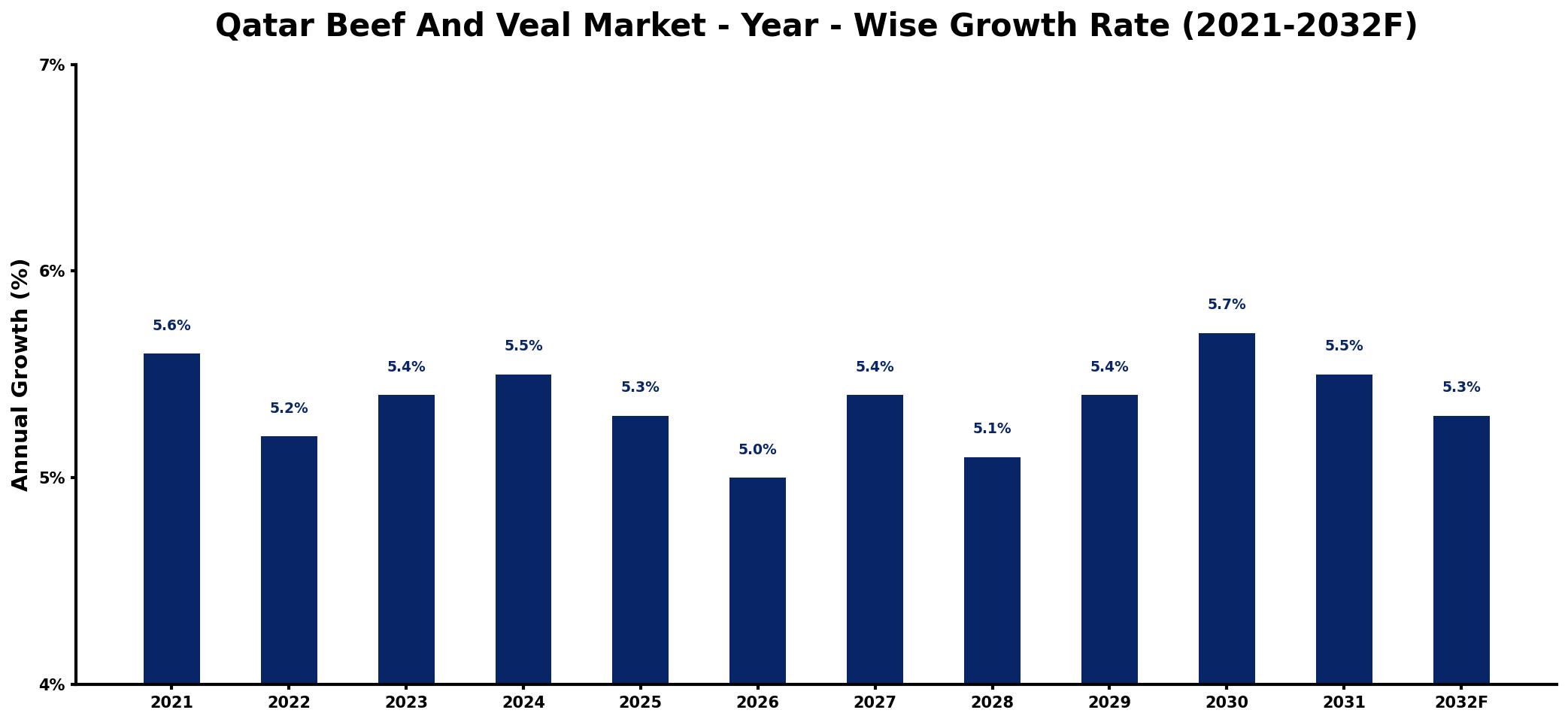
The table below presents the year‑wise growth rates along with the key drivers influencing the market
| Year | Growth Rate | Major Drivers |
| 2021 | 5.6% | Increased consumer health consciousness |
| 2022 | 5.2% | Growing popularity of premium products |
| 2023 | 5.4% | Expansion of local farming initiatives |
| 2024 | 5.5% | Rising disposable income levels |
| 2025 | 5.3% | Enhanced distribution network efficiency |
| 2026 | 5.0% | Increased tourism boosting demand |
| 2027 | 5.4% | Adoption of sustainable practices |
| 2028 | 5.1% | Growing preference for organic options |
| 2029 | 5.4% | Investment in food processing technology |
| 2030 | 5.7% | Strengthened export market opportunities |
| 2031 | 5.5% | Development of value-added products |
| 2032 | 5.3% | Emergence of innovative retail formats |
Note: Market size estimations and growth projections presented in this report are based on 6Wresearch's proprietary forecasting methodology, utilizing the latest available industry data, government publications, and primary research inputs.
Qatar Beef And Veal Market Synopsis
The most compelling force currently shaping the Qatar Beef And Veal Market is the growing consumer preference for high-quality meat products. This trend aligns with a national focus on food security and self-sufficiency, prompting increased investments in domestic livestock production. The expanding population base further amplifies this demand, establishing a robust market environment.
Additionally, the hospitality sector's growth, particularly in response to booming tourism, is significantly influencing the demand for beef and veal. As Qatar positions itself as a premier destination for international visitors, the culinary diversity and quality of meat offerings are pivotal in meeting the expectations of a global audience.
Qatar Beef And Veal Market Key Takeaways
- The market is experiencing consistent growth driven by a rise in disposable income and consumer demand for premium meat.
- Food security initiatives by the government are encouraging domestic livestock production and supply chain resilience.
- The hospitality industry plays a crucial role in the increasing demand for high-quality beef and veal products.
- Consumer trends are leaning towards home-cooked meals, driven in part by the impact of the COVID-19 pandemic.
- The market maintains an outlook of positive growth amid challenges related to import dependency.
Evaluation of Restraints in Qatar Beef And Veal Market
Despite its growth potential, the Qatar Beef And Veal Market grapples with challenges related to its reliance on imports. With domestic production capacity still limited, maintaining a steady supply of quality beef and veal products often hinges on external sources. This dependency can lead to vulnerabilities, particularly in times of geopolitical instability or global disruptions. Additionally, balancing quality standards while keeping prices affordable poses ongoing concerns, as fluctuating import costs can impact consumer accessibility.
Qatar Beef And Veal Market Trends
Current trends indicate a marked shift toward sustainability and ethical sourcing in the beef and veal sector. Consumers are increasingly informed and concerned about the provenance of their food, leading to heightened demand for traceable and responsibly sourced products. Technological advancements in meat processing and distribution are also gaining traction, enhancing product quality and supply chain efficiency. As health-conscious dining becomes more prevalent, there is a growing interest in leaner cuts and alternative meat options that cater to diverse dietary needs.
Qatar Beef And Veal Market Opportunities
The future of the Qatar Beef And Veal Market presents numerous opportunities for growth and investment. Strategic partnerships within the agricultural sector can bolster local production capabilities, reducing import dependency and enhancing self-sufficiency. Additionally, as the tourism industry continues to flourish, there is substantial potential for catering services and high-end dining establishments to drive premium meat consumption. Investing in innovative processing technologies and sustainable farming practices will also position businesses favorably in a competitive landscape.
Government Initiatives in the Qatar Beef And Veal Market
The Qatari government is actively pursuing policies aimed at enhancing food security and promoting self-sufficiency in livestock production. Initiatives include financial incentives for local farmers and investments in agricultural infrastructure, aimed at bolstering domestic meat production. Additionally, programs focused on enhancing food traceability and safety standards are in place, ensuring that consumers have access to high-quality beef and veal products. These efforts underscore the governments commitment to securing a stable and sustainable supply chain.
Future Insights of the Qatar Beef And Veal Market
Looking ahead to 2026-2032, the Qatar Beef And Veal Market is poised for continued growth, driven by demographic trends and changing consumer preferences. As the population expands and incomes rise, the appetite for premium meat products will strengthen. Enhanced local production capabilities, coupled with ongoing government support, will mitigate import vulnerabilities and solidify market stability. Embracing sustainability will be vital, as consumers increasingly seek ethically sourced and environmentally friendly options.
Qatar Beef And Veal Market Latest Developments (2025 - 2026)
Recent developments in the Qatar Beef And Veal Market have seen a rise in strategic partnerships aimed at improving local production efficiencies. Ongoing governmental initiatives to enhance food security and support local farmers are gaining momentum, with several projects aimed at modernizing livestock management practices. Meanwhile, the retail sector has observed a shift towards premium meat products, indicating a growing consumer trend favoring quality over quantity.
Qatar Beef And Veal Market - Key Attractiveness of the Report
- 10 Years of Market Numbers
- Historical Data Starting from 2022 to 2025
- Base Year: 2025
- Forecast Data until 2032
- Key Performance Indicators Impacting the Market
- Major Upcoming Developments and Projects
Key Highlights of the Report:
- Qatar Beef And Veal Market Outlook
- Market Size of Qatar Beef And Veal Market, 2025
- Forecast of Qatar Beef And Veal Market, 2032
- Historical Data and Forecast of Qatar Beef And Veal Revenues & Volume for the Period 2022-2032F
- Qatar Beef And Veal Market Trend Evolution
- Qatar Beef And Veal Market Drivers and Challenges
- Qatar Beef And Veal Price Trends
- Qatar Beef And Veal Porter's Five Forces
- Qatar Beef And Veal Industry Life Cycle
- Historical Data and Forecast of Qatar Beef And Veal Market Revenues & Volume By Type for the Period 2022-2032F
- Historical Data and Forecast of Qatar Beef And Veal Market Revenues & Volume By Beef for the Period 2022-2032F
- Historical Data and Forecast of Qatar Beef And Veal Market Revenues & Volume By Veal for the Period 2022-2032F
- Historical Data and Forecast of Qatar Beef And Veal Market Revenues & Volume By Distribution Channel for the Period 2022-2032F
- Historical Data and Forecast of Qatar Beef And Veal Market Revenues & Volume By Supermarkets for the Period 2022-2032F
- Historical Data and Forecast of Qatar Beef And Veal Market Revenues & Volume By Convenient Store for the Period 2022-2032F
- Historical Data and Forecast of Qatar Beef And Veal Market Revenues & Volume By Speciality Stores for the Period 2022-2032F
- Historical Data and Forecast of Qatar Beef And Veal Market Revenues & Volume By Online Retail for the Period 2022-2032F
- Qatar Beef And Veal Import Export Trade Statistics
- Market Opportunity Assessment By Type
- Market Opportunity Assessment By Distribution Channel
- Qatar Beef And Veal Top Companies Market Share
- Qatar Beef And Veal Competitive Benchmarking By Technical and Operational Parameters
- Qatar Beef And Veal Company Profiles
- Qatar Beef And Veal Key Strategic Recommendations






































