Qatar Casting Equipment Market Size, Share & Growth Rate
The Qatar Casting Equipment Market was estimated at USD 1098 Million in 2025 and is projected to reach USD 1575 Million by 2032, growing at a CAGR of 5.3% from 2026 to 2032. This growth is spurred by robust advancements in the industrial and construction sectors, as Qatar's economy diversifies away from hydrocarbon dependency. A surging demand for high-quality metal components further fuels investments in innovative casting technologies.
Qatar Casting Equipment Market Year-wise Growth Rate and Key Drivers
This graph highlights how the Qatar Casting Equipment Market has steadily grown over the years, supported by major growth factors.
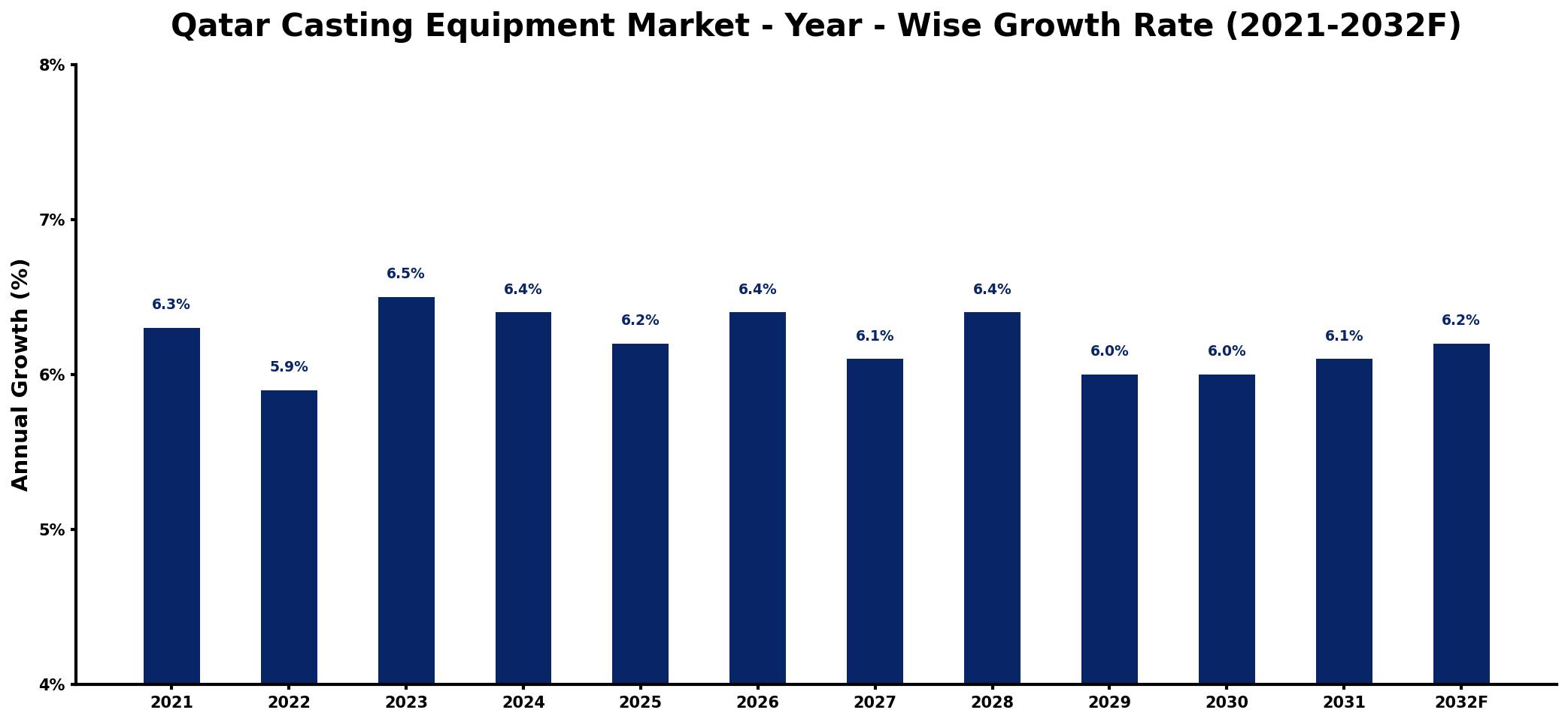
The table below presents the year‑wise growth rates along with the key drivers influencing the market
| Year | Growth Rate | Major Drivers |
| 2021 | 6.3% | Rising construction project investments |
| 2022 | 5.9% | Increased automotive manufacturing activities |
| 2023 | 6.5% | Growing demand for energy sector |
| 2024 | 6.4% | Expansion in aerospace applications |
| 2025 | 6.2% | Surge in consumer goods production |
| 2026 | 6.4% | Technological advancements in manufacturing |
| 2027 | 6.1% | Growth in renewable energy projects |
| 2028 | 6.4% | Boost in export opportunities abroad |
| 2029 | 6.0% | Rising infrastructure development initiatives |
| 2030 | 6.0% | Increased focus on sustainability practices |
| 2031 | 6.1% | Expansion of local manufacturing capabilities |
| 2032 | 6.2% | Growing investment in research innovations |
Note: Market size estimations and growth projections presented in this report are based on 6Wresearch's proprietary forecasting methodology, utilizing the latest available industry data, government publications, and primary research inputs.
Qatar Casting Equipment Market Synopsis
The casting equipment market in Qatar has experienced consistent growth, showcasing resilience amidst the challenges posed by recent global events. Looking ahead, the market is set to evolve further, driven by both technological advancements and an increased focus on meeting stringent quality standards.
As industries adapt to new market dynamics, the need for efficient and sophisticated casting solutions becomes ever more critical. With ongoing infrastructure projects and a push for economic diversification, the Qatar Casting Equipment Market is well-positioned for continued expansion.
Qatar Casting Equipment Market Key Takeaways
- Steady growth projected in a diversifying economic landscape driven by construction and industrial demands.
- Strong emphasis on innovative casting technologies and automation enhances production efficiency.
- Key players are prioritizing R&D to stay competitive and meet the evolving industry standards.
- Infrastructure investment by the government is a significant catalyst for increased demand for casting equipment.
- Increased reliance on advanced materials is shaping the future of the casting equipment market.
Evaluation of Restraints in Qatar Casting Equipment Market
Despite promising growth prospects, the Qatar Casting Equipment Market faces several restraints. One notable challenge is the rapid pace of technological change, compelling manufacturers to invest heavily in R&D to keep up. Competing casting methods, such as 3D printing, also pose a risk by offering alternative solutions that could diminish demand for traditional equipment. Additionally, the financial burden of importing specialized machinery can deter potential investments, while ensuring a skilled labor force to operate new technologies remains an ongoing hurdle.
Qatar Casting Equipment Market Trends
Current trends in the Qatar Casting Equipment Market highlight a growing shift towards automation and digitalization in manufacturing processes. Companies are integrating smart technology solutions, including IoT and AI, to enhance productivity and streamline operations. Additionally, sustainable practices and eco-friendly materials are gaining traction, reflecting a broader global trend toward greener manufacturing. This paradigm shift not only meets regulatory demands but also caters to increasing customer preferences for sustainable products.
Qatar Casting Equipment Market Opportunities
The Qatar Casting Equipment Market presents lucrative opportunities for growth and investment. With the government's ongoing commitment to infrastructure development, businesses can capitalize on projects requiring high-quality casting solutions. Furthermore, as industries seek to adopt cutting-edge technologies, partnerships with innovative firms specializing in automation and material science can foster collaborative growth. The increasing focus on sustainability also opens doors for companies developing eco-friendly casting methods and materials.
Government Initiatives in the Qatar Casting Equipment Market
The Qatari government is actively promoting industrial growth through various initiatives aimed at enhancing the manufacturing sector. Policies encouraging foreign investment, infrastructure spending, and technological innovation are central to this strategy. Moreover, special economic zones have been established to attract and support manufacturing enterprises, thereby laying a solid foundation for the casting equipment market. These measures not only aim to diversify the economy but also enhance the country's competitiveness on a global scale.
Future Insights of the Qatar Casting Equipment Market
From 2026 to 2032, the Qatar Casting Equipment Market is expected to witness transformative growth. As the industrial sector continues to evolve, businesses will increasingly prioritize efficient, automated casting solutions capable of meeting stringent international standards. The sustained focus on infrastructure and construction will drive demand, while technological advancements in materials and processes will redefine the operational landscape. With these developments, the market is likely to reach new heights in terms of capacity and innovation.
Qatar Casting Equipment Market Latest Developments (2025 - 2026)
Recently, the Qatar casting equipment sector has been witnessing a notable shift towards digitalization, with manufacturers exploring smart technologies to enhance production capabilities. Concurrently, there has been a renewed emphasis on training and development programs aimed at equipping the workforce with skills necessary for operating advanced casting technologies. This focus on human capital, combined with strategic collaborations aimed at research and innovation, is shaping the direction of the industry.
Qatar Casting Equipment Market - Key Attractiveness of the Report
- 10 Years of Market Numbers
- Historical Data Starting from 2022 to 2025
- Base Year: 2025
- Forecast Data until 2032
- Key Performance Indicators Impacting the Market
- Major Upcoming Developments and Projects
Key Highlights of the Report:
- Qatar Casting Equipment Market Outlook
- Market Size of Qatar Casting Equipment Market, 2025
- Forecast of Qatar Casting Equipment Market, 2032
- Historical Data and Forecast of Qatar Casting Equipment Revenues & Volume for the Period 2022-2032F
- Qatar Casting Equipment Market Trend Evolution
- Qatar Casting Equipment Market Drivers and Challenges
- Qatar Casting Equipment Price Trends
- Qatar Casting Equipment Porter's Five Forces
- Qatar Casting Equipment Industry Life Cycle
- Historical Data and Forecast of Qatar Casting Equipment Market Revenues & Volume By Casting type for the Period 2022-2032F
- Historical Data and Forecast of Qatar Casting Equipment Market Revenues & Volume By Expendable mold casting for the Period 2022-2032F
- Historical Data and Forecast of Qatar Casting Equipment Market Revenues & Volume By Non Expendable mold casting for the Period 2022-2032F
- Historical Data and Forecast of Qatar Casting Equipment Market Revenues & Volume By End-user for the Period 2022-2032F
- Historical Data and Forecast of Qatar Casting Equipment Market Revenues & Volume By Automotive for the Period 2022-2032F
- Historical Data and Forecast of Qatar Casting Equipment Market Revenues & Volume By Aerospace for the Period 2022-2032F
- Historical Data and Forecast of Qatar Casting Equipment Market Revenues & Volume By Defense for the Period 2022-2032F
- Historical Data and Forecast of Qatar Casting Equipment Market Revenues & Volume By Pump & Valve for the Period 2022-2032F
- Historical Data and Forecast of Qatar Casting Equipment Market Revenues & Volume By Energy & Power generation for the Period 2022-2032F
- Historical Data and Forecast of Qatar Casting Equipment Market Revenues & Volume By Others for the Period 2022-2032F
- Historical Data and Forecast of Qatar Casting Equipment Market Revenues & Volume By Machine Type for the Period 2022-2032F
- Historical Data and Forecast of Qatar Casting Equipment Market Revenues & Volume By Vertical machine for the Period 2022-2032F
- Historical Data and Forecast of Qatar Casting Equipment Market Revenues & Volume By Horizontal machine for the Period 2022-2032F
- Historical Data and Forecast of Qatar Casting Equipment Market Revenues & Volume By Distribution Channel for the Period 2022-2032F
- Historical Data and Forecast of Qatar Casting Equipment Market Revenues & Volume By Online for the Period 2022-2032F
- Historical Data and Forecast of Qatar Casting Equipment Market Revenues & Volume By Offline for the Period 2022-2032F
- Qatar Casting Equipment Import Export Trade Statistics
- Market Opportunity Assessment By Casting type
- Market Opportunity Assessment By End-user
- Market Opportunity Assessment By Machine Type
- Market Opportunity Assessment By Distribution Channel
- Qatar Casting Equipment Top Companies Market Share
- Qatar Casting Equipment Competitive Benchmarking By Technical and Operational Parameters
- Qatar Casting Equipment Company Profiles
- Qatar Casting Equipment Key Strategic Recommendations






































