Qatar Cellulose Acetate Fiber Market Size, Share & Growth Rate
The Qatar Cellulose Acetate Fiber Market was estimated at USD 948 Million in 2025 and is projected to reach USD 1360 Million by 2032, growing at a CAGR of 5.3% from 2026 to 2032. This growth trajectory is primarily driven by a heightened consumer preference for sustainable textiles, as well as ongoing expansions within the textile and apparel sector in Qatar. Additionally, technological advancements in production processes have enhanced the quality and cost-effectiveness of cellulose acetate fibers, further encouraging their adoption across various applications.
Qatar Cellulose Acetate Fiber Market Year-wise Growth Rate and Key Drivers
This graph highlights how the Qatar Cellulose Acetate Fiber Market has steadily grown over the years, supported by major growth factors.
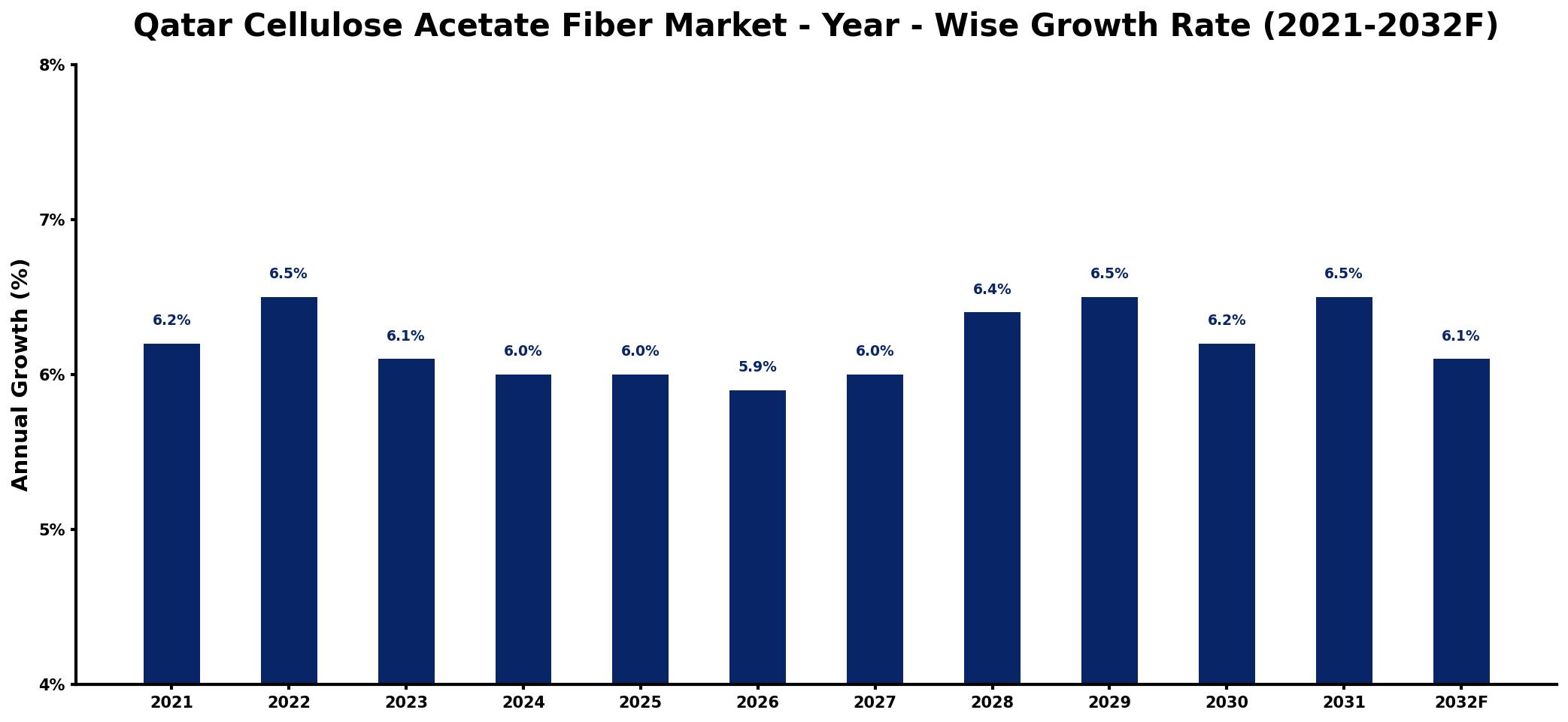
The table below presents the year‑wise growth rates along with the key drivers influencing the market
| Year | Growth Rate | Major Drivers |
| 2021 | 6.2% | Rising demand in textile industry |
| 2022 | 6.5% | Increased investments in manufacturing |
| 2023 | 6.1% | Growing consumer awareness sustainability |
| 2024 | 6.0% | Expansion in packaging applications |
| 2025 | 6.0% | Emerging markets driving consumption |
| 2026 | 5.9% | Technological advancements in production |
| 2027 | 6.0% | Growth in automotive sector usage |
| 2028 | 6.4% | Higher export opportunities developing |
| 2029 | 6.5% | Innovations in product formulations |
| 2030 | 6.2% | Strengthening supply chain networks |
| 2031 | 6.5% | Increased focus on eco-friendly solutions |
| 2032 | 6.1% | Rising popularity in home textiles |
Note: Market size estimations and growth projections presented in this report are based on 6Wresearch's proprietary forecasting methodology, utilizing the latest available industry data, government publications, and primary research inputs.
Qatar Cellulose Acetate Fiber Market Synopsis
In recent years, there has been a noticeable shift in consumer behavior towards sustainable and comfortable clothing, propelling the demand for cellulose acetate fibers. This semi-synthetic fiber, known for its softness and moisture absorption, has carved out a niche for itself in the textiles market of Qatar.
The growing awareness surrounding eco-friendly manufacturing processes and sustainable fashion practices is influencing the textile industry's landscape. As domestic manufacturers recognize the benefits of incorporating cellulose acetate fibers, the market is seeing a diversification of product offerings that appeal to environmentally-conscious consumers.
Qatar Cellulose Acetate Fiber Market Key Takeaways
- The market is experiencing growth due to rising consumer demand for sustainable textiles.
- Technological advancements are enhancing the production efficiency and quality of cellulose acetate fibers.
- Expanding applications in clothing, home textiles, and industrial products are driving market adoption.
- Challenges related to raw material sourcing remain a critical concern for market players.
- Post-pandemic recovery is prompting cautious optimism among industry stakeholders.
Evaluation of Restraints in Qatar Cellulose Acetate Fiber Market
Despite its promising growth potential, the Qatar Cellulose Acetate Fiber Market is faced with notable challenges that may hinder its expansion. A significant concern is the dependence on imported raw materials, which poses risks related to supply chain disruptions and price volatility in international markets. Furthermore, while the shift towards sustainability is evident, the production processes involved in cellulose acetate fiber manufacturing can be energy-intensive and chemical-dependent, sparking debates regarding their overall environmental impact. These factors compel industry players to navigate complex landscapes as they strive for growth.
Qatar Cellulose Acetate Fiber Market Trends
The trend of sustainable fashion is reshaping the Qatar Cellulose Acetate Fiber Market, leading to increased demand for biodegradable and eco-friendly fibers. There is also a burgeoning interest in natural and organic products, encouraging manufacturers to innovate in production methods that align with these values. Furthermore, collaborations among designers and manufacturers are emerging, combining aesthetics with eco-consciousness, and showcasing cellulose acetate fibers in both fashion-forward and practical applications. Such trends are likely to accelerate consumer acceptance and market penetration.
Qatar Cellulose Acetate Fiber Market Opportunities
Opportunities within the Qatar Cellulose Acetate Fiber Market are becoming increasingly apparent, particularly in the realms of innovation and investment. As consumer demand for sustainable textiles continues to rise, market players can capitalize on the development of new products that incorporate cellulose acetate fibers in various applications beyond apparel, including home textiles and biodegradable plastics. Additionally, investment in local raw material sourcing could mitigate supply chain risks and enhance the sustainability profile of cellulose acetate fibers produced in Qatar, creating a more resilient market structure.
Government Initiatives in the Qatar Cellulose Acetate Fiber Market
The Qatari government has recognized the importance of sustainable practices within the textile industry and is encouraging initiatives aimed at promoting eco-friendly materials, including cellulose acetate fibers. Policies aimed at bolstering local manufacturing capabilities and reducing reliance on imports are being explored, alongside public spending in research and development for sustainable textiles. Such initiatives reflect a commitment to sustainability and innovation, contributing positively to the market landscape.
Future Insights of the Qatar Cellulose Acetate Fiber Market
Looking ahead, the Qatar Cellulose Acetate Fiber Market is poised for significant transformations by 2032. Increased consumer awareness of sustainability will likely fuel further demand, as well as the expansion of production facilities locally. Moreover, the integration of advanced technologies in manufacturing processes is expected to improve efficiency and product quality. These developments will create a robust framework for growth, enabling the market to position itself competitively within the broader textile industry.
Qatar Cellulose Acetate Fiber Market Latest Developments (2025 - 2026)
The market is currently witnessing a shift towards innovative applications of cellulose acetate fibers, as stakeholders explore new avenues in both textile and non-textile sectors. Collaborative projects are emerging between manufacturers and researchers to develop biodegradable alternatives that cater to environmental concerns. Furthermore, the industry is focusing on enhancing the transparency of supply chains and production methods, which aligns with global sustainability goals. Such developments signal a positive momentum in the market's recovery and expansion phase.
Qatar Cellulose Acetate Fiber Market - Key Attractiveness of the Report
- 10 Years of Market Numbers
- Historical Data Starting from 2022 to 2025
- Base Year: 2025
- Forecast Data until 2032
- Key Performance Indicators Impacting the Market
- Major Upcoming Developments and Projects
Key Highlights of the Report:
- Qatar Cellulose Acetate Fiber Market Outlook
- Market Size of Qatar Cellulose Acetate Fiber Market, 2025
- Forecast of Qatar Cellulose Acetate Fiber Market, 2032
- Historical Data and Forecast of Qatar Cellulose Acetate Fiber Revenues & Volume for the Period 2022-2032F
- Qatar Cellulose Acetate Fiber Market Trend Evolution
- Qatar Cellulose Acetate Fiber Market Drivers and Challenges
- Qatar Cellulose Acetate Fiber Price Trends
- Qatar Cellulose Acetate Fiber Porter's Five Forces
- Qatar Cellulose Acetate Fiber Industry Life Cycle
- Historical Data and Forecast of Qatar Cellulose Acetate Fiber Market Revenues & Volume By Type for the Period 2022-2032F
- Historical Data and Forecast of Qatar Cellulose Acetate Fiber Market Revenues & Volume By Plastic for the Period 2022-2032F
- Historical Data and Forecast of Qatar Cellulose Acetate Fiber Market Revenues & Volume By Fiber for the Period 2022-2032F
- Historical Data and Forecast of Qatar Cellulose Acetate Fiber Market Revenues & Volume By Application for the Period 2022-2032F
- Historical Data and Forecast of Qatar Cellulose Acetate Fiber Market Revenues & Volume By Photographic Films for the Period 2022-2032F
- Historical Data and Forecast of Qatar Cellulose Acetate Fiber Market Revenues & Volume By Cigarette Filters for the Period 2022-2032F
- Historical Data and Forecast of Qatar Cellulose Acetate Fiber Market Revenues & Volume By Tapes & Labels for the Period 2022-2032F
- Historical Data and Forecast of Qatar Cellulose Acetate Fiber Market Revenues & Volume By Textiles & Apparel for the Period 2022-2032F
- Qatar Cellulose Acetate Fiber Import Export Trade Statistics
- Market Opportunity Assessment By Type
- Market Opportunity Assessment By Application
- Qatar Cellulose Acetate Fiber Top Companies Market Share
- Qatar Cellulose Acetate Fiber Competitive Benchmarking By Technical and Operational Parameters
- Qatar Cellulose Acetate Fiber Company Profiles
- Qatar Cellulose Acetate Fiber Key Strategic Recommendations






































