Mexico Cellulose Acetate Fiber Market Size, Share & Growth Rate
The Mexico Cellulose Acetate Fiber Market was estimated at USD 211 Million in 2025 and is projected to reach USD 245 Million by 2032, growing at a CAGR of 2.2% from 2026 to 2032. This steady growth trajectory is largely driven by a shift in consumer preferences towards sustainable and biodegradable materials, particularly in the textile and automotive industries. As manufacturers increasingly adopt eco-friendly practices, the demand for cellulose acetate fiber continues to rise, positioning it as a leading alternative to traditional synthetic fibers.
Mexico Cellulose Acetate Fiber Market Year-wise Growth Rate and Key Drivers
This graph highlights how the Mexico Cellulose Acetate Fiber Market has steadily grown over the years, supported by major growth factors.
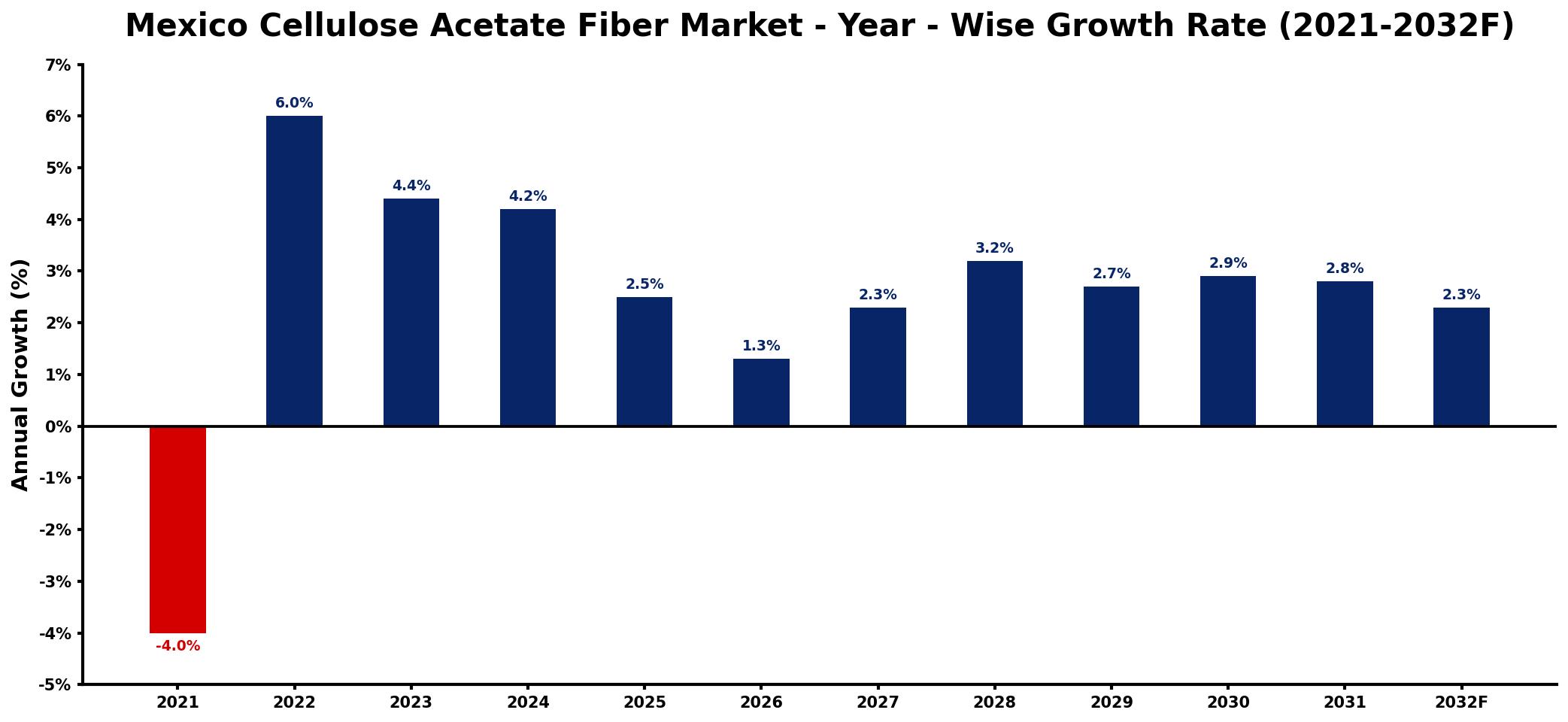
The table below presents the year‑wise growth rates along with the key drivers influencing the market
| Year | Growth Rate | Major Drivers |
| 2021 | -4.0% | decreased demand from textile industry |
| 2022 | 6.0% | rising demand for sustainable materials |
| 2023 | 4.4% | increased investments in production capacity |
| 2024 | 4.2% | expansion of fashion industry trends |
| 2025 | 2.5% | growth in eco-friendly product lines |
| 2026 | 1.3% | emerging applications in automotive sector |
| 2027 | 2.3% | increased use in home textiles |
| 2028 | 3.2% | growing downstream application demand |
| 2029 | 2.7% | rising consumer awareness on sustainability |
| 2030 | 2.9% | increased collaboration with fashion brands |
| 2031 | 2.8% | growing demand from packaging industry |
| 2032 | 2.3% | expanding applications in medical textiles |
Note: Market size estimations and growth projections presented in this report are based on 6Wresearch's proprietary forecasting methodology, utilizing the latest available industry data, government publications, and primary research inputs.
Mexico Cellulose Acetate Fiber Market Synopsis
Sustainability is the most significant force shaping the Mexico Cellulose Acetate Fiber Market today. As eco-conscious consumers seek out products that align with their values, industries are responding by integrating cellulose acetate fiber into their offerings. This growing awareness of environmental concerns enhances the market's prospects and sets the stage for innovation.
In the textile sector, manufacturers are increasingly leveraging the properties of cellulose acetate fiber to create garments that not only meet aesthetic demands but also prioritize environmental impact. The automotive industry is also recognizing the benefits of cellulose acetate fiber for its interior components, further amplifying the market's growth potential.
Mexico Cellulose Acetate Fiber Market Key Takeaways
- The market is driven by increasing consumer demand for sustainable and biodegradable fibers.
- Key industries adopting cellulose acetate fiber include textiles, automotive, and healthcare.
- Government initiatives are promoting the growth of domestic production and innovation in the sector.
- Competition from alternative synthetic fibers presents both challenges and opportunities for market players.
- Investment in technology is essential for enhancing product quality and sustainability.
Evaluation of Restraints in Mexico Cellulose Acetate Fiber Market
Despite its growth potential, the Mexico Cellulose Acetate Fiber Market faces several restraints that could hinder its progress. One significant challenge is the stiff competition from alternative synthetic fibers that offer lower production costs and well-established supply chains. Additionally, fluctuations in raw material prices may impact the stability and profitability of cellulose acetate fiber manufacturers. The need for continuous investment in research and technology is crucial to keep pace with consumer expectations while ensuring adherence to environmental regulations. Furthermore, the general lack of consumer awareness regarding the benefits of cellulose acetate fibers can limit market penetration and create hurdles for brand differentiation.
Mexico Cellulose Acetate Fiber Market Trends
Current trends in the Mexico Cellulose Acetate Fiber Market reflect a strong movement towards sustainability, with manufacturers focused on developing innovative products that enhance performance properties. The push for responsible consumption and ethical production practices is reshaping the textile landscape, as consumers increasingly seek out materials that align with their values. Moreover, advancements in processing technologies are enhancing the functionality of cellulose acetate fibers, making them more appealing across diverse applications.
Mexico Cellulose Acetate Fiber Market Opportunities
The potential for growth within the Mexico Cellulose Acetate Fiber Market is substantial, particularly as the demand for eco-friendly textiles rises. Investment opportunities abound in the development of new cellulose acetate fiber products tailored for various applications, from high-fashion garments to durable automotive interiors. Furthermore, the strategic location of Mexico positions it well for exports, allowing investors to capitalize on demand in both North and South American markets. The alignment with government policies aimed at fostering sustainable practices adds an additional layer of opportunity for stakeholders in this sector.
Government Initiatives in the Mexico Cellulose Acetate Fiber Market
The Mexican government has implemented several initiatives to bolster the cellulose acetate fiber industry, including tariff reductions on raw material imports and machinery, thereby promoting local production. Environmental regulations are in place to ensure that manufacturing practices adhere to sustainable standards. Furthermore, financial incentives and subsidies are available to encourage research and development, facilitating innovation within the industry. These governmental measures create a conducive environment for growth, attracting both domestic and foreign investments.
Future Insights of the Mexico Cellulose Acetate Fiber Market
Looking ahead to 2026-2032, the Mexico Cellulose Acetate Fiber Market is poised for sustained growth. As consumer awareness surrounding environmental issues continues to escalate, industries will increasingly seek biodegradable materials to meet their production needs. Innovations in technology and processing will enhance the utility of cellulose acetate fiber, expanding its applications beyond textiles. The ongoing commitment from both the private sector and government to sustainable practices will further solidify the market's trajectory, positioning cellulose acetate fiber as a cornerstone of eco-friendly production across various industries.
Mexico Cellulose Acetate Fiber Market Latest Developments (2025 - 2026)
Recent developments in the Mexico Cellulose Acetate Fiber Market indicate a trend towards greater collaboration between manufacturers and research institutions, aimed at improving product quality and performance. Innovative technologies are being explored to enhance the biodegradability and versatility of cellulose acetate fibers, making them more appealing to manufacturers. Additionally, companies are increasingly participating in sustainability initiatives to align their operations with eco-friendly practices, further indicating a shift towards a greener market landscape.
Mexico Cellulose Acetate Fiber Market - Key Attractiveness of the Report
- 10 Years of Market Numbers
- Historical Data Starting from 2022 to 2025
- Base Year: 2025
- Forecast Data until 2032
- Key Performance Indicators Impacting the Market
- Major Upcoming Developments and Projects
Key Highlights of the Report:
- Mexico Cellulose Acetate Fiber Market Outlook
- Market Size of Mexico Cellulose Acetate Fiber Market, 2025
- Forecast of Mexico Cellulose Acetate Fiber Market, 2032
- Historical Data and Forecast of Mexico Cellulose Acetate Fiber Revenues & Volume for the Period 2022-2032F
- Mexico Cellulose Acetate Fiber Market Trend Evolution
- Mexico Cellulose Acetate Fiber Market Drivers and Challenges
- Mexico Cellulose Acetate Fiber Price Trends
- Mexico Cellulose Acetate Fiber Porter's Five Forces
- Mexico Cellulose Acetate Fiber Industry Life Cycle
- Historical Data and Forecast of Mexico Cellulose Acetate Fiber Market Revenues & Volume By Type for the Period 2022-2032F
- Historical Data and Forecast of Mexico Cellulose Acetate Fiber Market Revenues & Volume By Plastic for the Period 2022-2032F
- Historical Data and Forecast of Mexico Cellulose Acetate Fiber Market Revenues & Volume By Fiber for the Period 2022-2032F
- Historical Data and Forecast of Mexico Cellulose Acetate Fiber Market Revenues & Volume By Application for the Period 2022-2032F
- Historical Data and Forecast of Mexico Cellulose Acetate Fiber Market Revenues & Volume By Photographic Films for the Period 2022-2032F
- Historical Data and Forecast of Mexico Cellulose Acetate Fiber Market Revenues & Volume By Cigarette Filters for the Period 2022-2032F
- Historical Data and Forecast of Mexico Cellulose Acetate Fiber Market Revenues & Volume By Tapes & Labels for the Period 2022-2032F
- Historical Data and Forecast of Mexico Cellulose Acetate Fiber Market Revenues & Volume By Textiles & Apparel for the Period 2022-2032F
- Mexico Cellulose Acetate Fiber Import Export Trade Statistics
- Market Opportunity Assessment By Type
- Market Opportunity Assessment By Application
- Mexico Cellulose Acetate Fiber Top Companies Market Share
- Mexico Cellulose Acetate Fiber Competitive Benchmarking By Technical and Operational Parameters
- Mexico Cellulose Acetate Fiber Company Profiles
- Mexico Cellulose Acetate Fiber Key Strategic Recommendations






































