Venezuela Cellulose Acetate Fiber Market Size, Share & Growth Rate
The Venezuela Cellulose Acetate Fiber Market was estimated at USD 231 Million in 2025 and is projected to reach USD 312 Million by 2032, growing at a CAGR of 4.4% from 2026 to 2032. This growth trajectory is primarily driven by the increasing consumer demand for sustainable and biodegradable textile alternatives. As the textile industry pivots towards eco-friendly materials, cellulose acetate fibers present a compelling solution, appealing to both manufacturers and environmentally conscious consumers.
Venezuela Cellulose Acetate Fiber Market Year-wise Growth Rate and Key Drivers
This graph highlights how the Venezuela Cellulose Acetate Fiber Market has steadily grown over the years, supported by major growth factors.
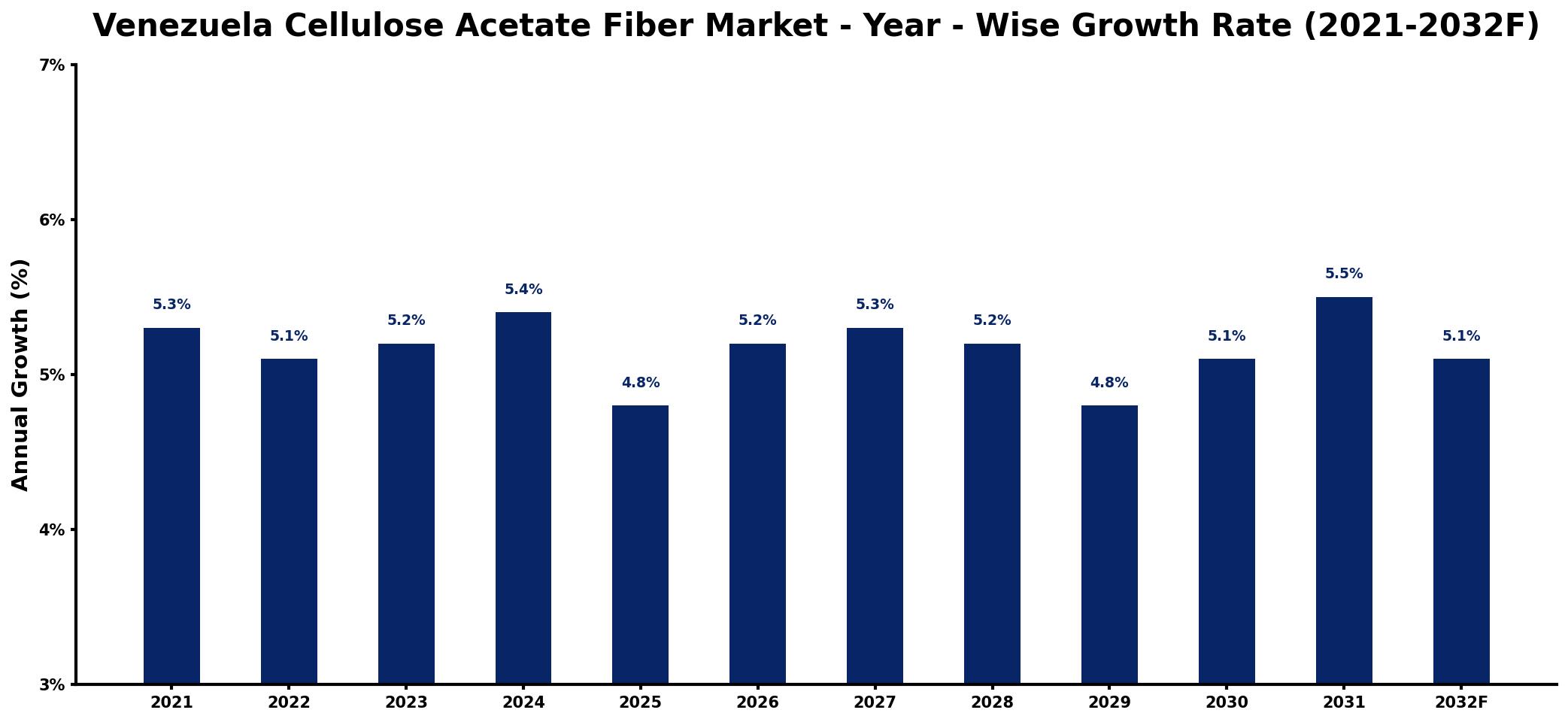
The table below presents the year‑wise growth rates along with the key drivers influencing the market
| Year | Growth Rate | Major Drivers |
| 2021 | 5.3% | Rising demand for sustainable materials |
| 2022 | 5.1% | Growing textile manufacturing investments |
| 2023 | 5.2% | Increased consumer preference for eco-friendly |
| 2024 | 5.4% | Expansion of fashion industry trends |
| 2025 | 4.8% | Emerging markets increasing production capacity |
| 2026 | 5.2% | Technological advancements in production |
| 2027 | 5.3% | Higher export opportunities in region |
| 2028 | 5.2% | Strengthening local supply chain networks |
| 2029 | 4.8% | Diversification of product applications |
| 2030 | 5.1% | Enhanced research and development initiatives |
| 2031 | 5.5% | Adoption of innovative manufacturing processes |
| 2032 | 5.1% | Rising awareness of sustainable practices |
Note: Market size estimations and growth projections presented in this report are based on 6Wresearch's proprietary forecasting methodology, utilizing the latest available industry data, government publications, and primary research inputs.
Venezuela Cellulose Acetate Fiber Market Synopsis
The strongest force currently shaping the Venezuela Cellulose Acetate Fiber Market is the rising awareness of environmental sustainability. Consumers are increasingly gravitating towards materials that minimize ecological impact, prompting manufacturers to innovate and adapt their product offerings accordingly.
As a result, companies within this market are not only focusing on cellulose acetate fibers' natural attributes but are also investing in sustainable production processes. The challenge of aligning with global sustainability trends has galvanized efforts to enhance product quality while addressing the pressing need for eco-friendly materials in the textile sector.
Venezuela Cellulose Acetate Fiber Market Key Takeaways
- The market is expected to grow at a CAGR of 4.4% between 2026 and 2032.
- Increased consumer demand for sustainable textiles is driving product innovation.
- Environmental concerns surrounding synthetic fibers are reshaping consumer preferences.
- Venezuela's cellulose acetate fiber market is pivotal in supporting local production and self-sufficiency.
- Investment opportunities are notable in manufacturing and R&D for new applications.
Evaluation of Restraints in Venezuela Cellulose Acetate Fiber Market
Despite the growth potential, the Venezuela Cellulose Acetate Fiber Market faces significant restraints. Political and economic instability creates volatility in production costs, hampering effective pricing strategies for manufacturers. Furthermore, limited access to modern technology and skilled labor reduces the overall efficiency and competitiveness of the sector. Coupled with fluctuating raw material availability, these factors present formidable challenges for sustainable market growth.
Venezuela Cellulose Acetate Fiber Market Trends
Current trends in the Venezuela Cellulose Acetate Fiber Market indicate a strong shift toward products that feature sustainable attributes. Manufacturers are actively exploring innovative blends that enhance performance while maintaining biodegradability. The popularity of activewear and athleisure segments has further propelled the demand for high-quality cellulose acetate fibers, reflecting changing consumer preferences.
Moreover, the rise of the circular economy is influencing market practices, with companies beginning to investigate recycling and upcycling methods for cellulose acetate fibers. This trend aligns with global sustainability goals and offers a promising avenue for future innovations within the industry.
Venezuela Cellulose Acetate Fiber Market Opportunities
The opportunities for growth in the Venezuela Cellulose Acetate Fiber Market are significant. As consumer demand for eco-friendly materials escalates, cellulose acetate fibers position themselves as viable alternatives to traditional synthetic fibers. Investors can explore avenues in local manufacturing facilities to bolster production capabilities and foster R&D for novel applications within textiles and beyond. Additionally, engaging in partnerships with local textile companies could facilitate the integration of cellulose acetate fibers into diverse product lines, promoting wider market acceptance.
Government Initiatives in the Venezuela Cellulose Acetate Fiber Market
Government policies in Venezuela are centered around bolstering domestic cellulose acetate fiber production while minimizing imports. These measures include tariffs and subsidies aimed at protecting local manufacturers and encouraging self-sufficiency. Moreover, quality standards and regulations emphasize sustainability and fair competition within the industry, reflecting the government's broader economic development objectives amidst ongoing challenges.
Future Insights of the Venezuela Cellulose Acetate Fiber Market
Looking ahead to the period from 2026 to 2032, the Venezuela Cellulose Acetate Fiber Market faces a mix of challenges and opportunities. While ongoing political and economic instability may continue to affect production and distribution, improvements in the local economic landscape could unlock significant growth potential. As demand for biodegradable textiles remains strong, companies focusing on sustainable practices may be well-positioned to capitalize on the market's evolution and increase their competitive advantage.
Venezuela Cellulose Acetate Fiber Market Latest Developments (2025 - 2026)
Recent developments in the Venezuela Cellulose Acetate Fiber Market indicate a noticeable trend toward enhanced product innovation, driven by a focus on sustainability. Companies are increasingly investing in R&D to develop new applications and improve the performance of cellulose acetate fibers. Additionally, there is a marked interest in establishing collaborative efforts within the industry, fostering a more integrated approach to tackle the challenges posed by market volatility.
Venezuela Cellulose Acetate Fiber Market - Key Attractiveness of the Report
- 10 Years of Market Numbers
- Historical Data Starting from 2022 to 2025
- Base Year: 2025
- Forecast Data until 2032
- Key Performance Indicators Impacting the Market
- Major Upcoming Developments and Projects
Key Highlights of the Report:
- Venezuela Cellulose Acetate Fiber Market Outlook
- Market Size of Venezuela Cellulose Acetate Fiber Market, 2025
- Forecast of Venezuela Cellulose Acetate Fiber Market, 2032
- Historical Data and Forecast of Venezuela Cellulose Acetate Fiber Revenues & Volume for the Period 2022-2032F
- Venezuela Cellulose Acetate Fiber Market Trend Evolution
- Venezuela Cellulose Acetate Fiber Market Drivers and Challenges
- Venezuela Cellulose Acetate Fiber Price Trends
- Venezuela Cellulose Acetate Fiber Porter's Five Forces
- Venezuela Cellulose Acetate Fiber Industry Life Cycle
- Historical Data and Forecast of Venezuela Cellulose Acetate Fiber Market Revenues & Volume By Type for the Period 2022-2032F
- Historical Data and Forecast of Venezuela Cellulose Acetate Fiber Market Revenues & Volume By Plastic for the Period 2022-2032F
- Historical Data and Forecast of Venezuela Cellulose Acetate Fiber Market Revenues & Volume By Fiber for the Period 2022-2032F
- Historical Data and Forecast of Venezuela Cellulose Acetate Fiber Market Revenues & Volume By Application for the Period 2022-2032F
- Historical Data and Forecast of Venezuela Cellulose Acetate Fiber Market Revenues & Volume By Photographic Films for the Period 2022-2032F
- Historical Data and Forecast of Venezuela Cellulose Acetate Fiber Market Revenues & Volume By Cigarette Filters for the Period 2022-2032F
- Historical Data and Forecast of Venezuela Cellulose Acetate Fiber Market Revenues & Volume By Tapes & Labels for the Period 2022-2032F
- Historical Data and Forecast of Venezuela Cellulose Acetate Fiber Market Revenues & Volume By Textiles & Apparel for the Period 2022-2032F
- Venezuela Cellulose Acetate Fiber Import Export Trade Statistics
- Market Opportunity Assessment By Type
- Market Opportunity Assessment By Application
- Venezuela Cellulose Acetate Fiber Top Companies Market Share
- Venezuela Cellulose Acetate Fiber Competitive Benchmarking By Technical and Operational Parameters
- Venezuela Cellulose Acetate Fiber Company Profiles
- Venezuela Cellulose Acetate Fiber Key Strategic Recommendations






































