France Cellulose Acetate Fiber Market Top 5 Importing Countries and Market Competition (HHI) Analysis
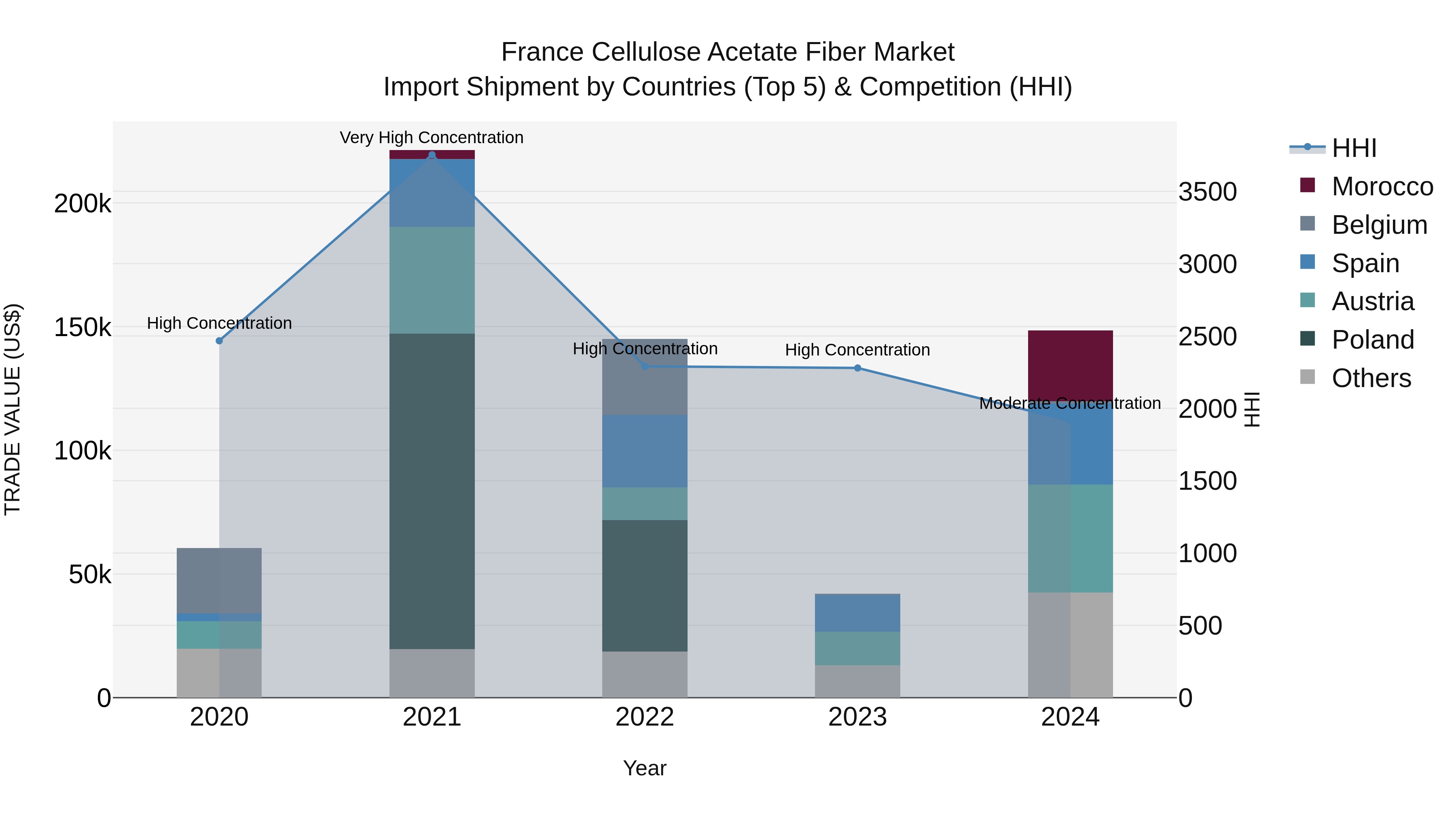
France`s cellulose acetate fiber import market is witnessing significant growth, with a remarkable CAGR of 25.15% from 2020 to 2024. In 2024, top exporting countries include Austria, Spain, Morocco, Germany, and Portugal. The market concentration, as measured by the HHI, shifted from high to moderate in 2024, indicating a more balanced competitive landscape. The impressive growth rate of 253.06% from 2023 to 2024 suggests a surge in demand for cellulose acetate fiber in France, presenting opportunities for both domestic and international suppliers.
France Cellulose Acetate Fiber Market Overview
The France Cellulose Acetate Fiber Market is experiencing steady growth driven by the increasing demand for sustainable and eco-friendly textile materials. Cellulose acetate fibers, derived from wood pulp, offer properties such as softness, breathability, and biodegradability, making them a popular choice in the textile industry. The market is witnessing a shift towards sustainable fashion practices, with consumers increasingly opting for products that are environmentally friendly. Key players in the France Cellulose Acetate Fiber Market are focusing on product innovation, technological advancements, and strategic partnerships to expand their market presence. The growing trend of sustainable fashion, coupled with the superior properties of cellulose acetate fibers, is expected to drive further growth in the France Cellulose Acetate Fiber Market in the coming years.
France Cellulose Acetate Fiber Market Trends
The France Cellulose Acetate Fiber market is currently witnessing a growing demand for sustainable and eco-friendly textile fibers. Consumers are increasingly seeking products that are derived from natural sources and have a lower environmental impact. Cellulose acetate fiber, being a biodegradable and renewable material, is gaining popularity among manufacturers and consumers alike. Additionally, there is a rising trend of incorporating cellulose acetate fibers in the production of high-quality textiles and clothing, as it offers a luxurious feel and drapes well. The market is also seeing innovations in the development of cellulose acetate fibers with enhanced properties such as improved moisture absorption and breathability, further driving the growth of the market in France.
France Cellulose Acetate Fiber Market Challenges
In the France Cellulose Acetate Fiber Market, one of the key challenges is the increasing competition from alternative synthetic fibers and sustainable materials. The rising demand for eco-friendly and biodegradable products has led to a shift away from cellulose acetate fibers, which are derived from wood pulp. Additionally, fluctuations in raw material prices and availability can impact the overall cost and supply chain of cellulose acetate fibers, posing challenges for manufacturers and suppliers in the market. Furthermore, stringent regulations regarding environmental sustainability and waste management in France also add complexity to the production and disposal processes of cellulose acetate fibers, requiring companies to invest in sustainable practices and technology to remain competitive in the market.
France Cellulose Acetate Fiber Market Investment Opportunities
The France Cellulose Acetate Fiber Market offers promising investment opportunities due to the growing demand for sustainable and eco-friendly textile materials. With increasing awareness towards environmental conservation and the shift towards sustainable fashion, there is a rising preference for cellulose acetate fibers as they are derived from natural sources such as wood pulp. This trend is driving the demand for cellulose acetate fibers in various applications including apparel, textiles, and nonwoven products. Additionally, the versatility of cellulose acetate fibers in terms of dyeing, printing, and blending with other materials makes them a favorable choice for manufacturers. Investors can capitalize on this market by investing in companies involved in the production, distribution, and innovation of cellulose acetate fibers to meet the evolving needs of the textile industry in France.
France Cellulose Acetate Fiber Market Government Policy
In France, the government has implemented various policies to regulate and support the cellulose acetate fiber market. These policies focus on promoting sustainability and innovation in the industry through initiatives such as the Circular Economy Roadmap and the Energy Transition Law. Additionally, the government has introduced regulations to ensure the safety and quality of cellulose acetate fiber products, aligning with EU standards and directives. Furthermore, there are financial incentives and subsidies available to encourage research and development in the sector, fostering competitiveness and growth. Overall, the government`s policies aim to drive the transition towards a more sustainable and environmentally friendly cellulose acetate fiber market in France.
France Cellulose Acetate Fiber Market Future Outlook
The France Cellulose Acetate Fiber Market is expected to witness steady growth in the coming years due to the increasing demand for sustainable and eco-friendly fibers in various industries such as textiles, apparel, and home furnishings. With a growing emphasis on reducing carbon footprint and promoting environmental sustainability, cellulose acetate fibers are gaining popularity as a biodegradable alternative to conventional synthetic fibers. Additionally, the rising awareness among consumers regarding the environmental impact of their purchasing decisions is driving the adoption of cellulose acetate fibers in the French market. As a result, manufacturers are likely to invest in research and development to enhance the properties and applications of cellulose acetate fibers, further fueling the market growth in the future.
Key Highlights of the Report:
- France Cellulose Acetate Fiber Market Outlook
- Market Size of France Cellulose Acetate Fiber Market, 2024
- Forecast of France Cellulose Acetate Fiber Market, 2031
- Historical Data and Forecast of France Cellulose Acetate Fiber Revenues & Volume for the Period 2021 - 2031
- France Cellulose Acetate Fiber Market Trend Evolution
- France Cellulose Acetate Fiber Market Drivers and Challenges
- France Cellulose Acetate Fiber Price Trends
- France Cellulose Acetate Fiber Porter's Five Forces
- France Cellulose Acetate Fiber Industry Life Cycle
- Historical Data and Forecast of France Cellulose Acetate Fiber Market Revenues & Volume By Type for the Period 2021 - 2031
- Historical Data and Forecast of France Cellulose Acetate Fiber Market Revenues & Volume By Plastic for the Period 2021 - 2031
- Historical Data and Forecast of France Cellulose Acetate Fiber Market Revenues & Volume By Fiber for the Period 2021 - 2031
- Historical Data and Forecast of France Cellulose Acetate Fiber Market Revenues & Volume By Application for the Period 2021 - 2031
- Historical Data and Forecast of France Cellulose Acetate Fiber Market Revenues & Volume By Photographic Films for the Period 2021 - 2031
- Historical Data and Forecast of France Cellulose Acetate Fiber Market Revenues & Volume By Cigarette Filters for the Period 2021 - 2031
- Historical Data and Forecast of France Cellulose Acetate Fiber Market Revenues & Volume By Tapes & Labels for the Period 2021 - 2031
- Historical Data and Forecast of France Cellulose Acetate Fiber Market Revenues & Volume By Textiles & Apparel for the Period 2021 - 2031
- France Cellulose Acetate Fiber Import Export Trade Statistics
- Market Opportunity Assessment By Type
- Market Opportunity Assessment By Application
- France Cellulose Acetate Fiber Top Companies Market Share
- France Cellulose Acetate Fiber Competitive Benchmarking By Technical and Operational Parameters
- France Cellulose Acetate Fiber Company Profiles
- France Cellulose Acetate Fiber Key Strategic Recommendations






































