Iraq Cellulose Acetate Fiber Market Size, Share & Growth Rate
The Iraq Cellulose Acetate Fiber Market was estimated at USD 483 Million in 2025 and is projected to reach USD 683 Million by 2032, growing at a CAGR of 5.1% from 2026 to 2032. This growth trajectory is supported by an increasing demand from the textile industry, which recognizes the advantages of cellulose acetate fiber in apparel and home textiles. Furthermore, rising consumer consciousness regarding sustainability and the eco-friendly characteristics of cellulose acetate are also integral to driving market expansion.
Iraq Cellulose Acetate Fiber Market Year-wise Growth Rate and Key Drivers
This graph highlights how the Iraq Cellulose Acetate Fiber Market has steadily grown over the years, supported by major growth factors.
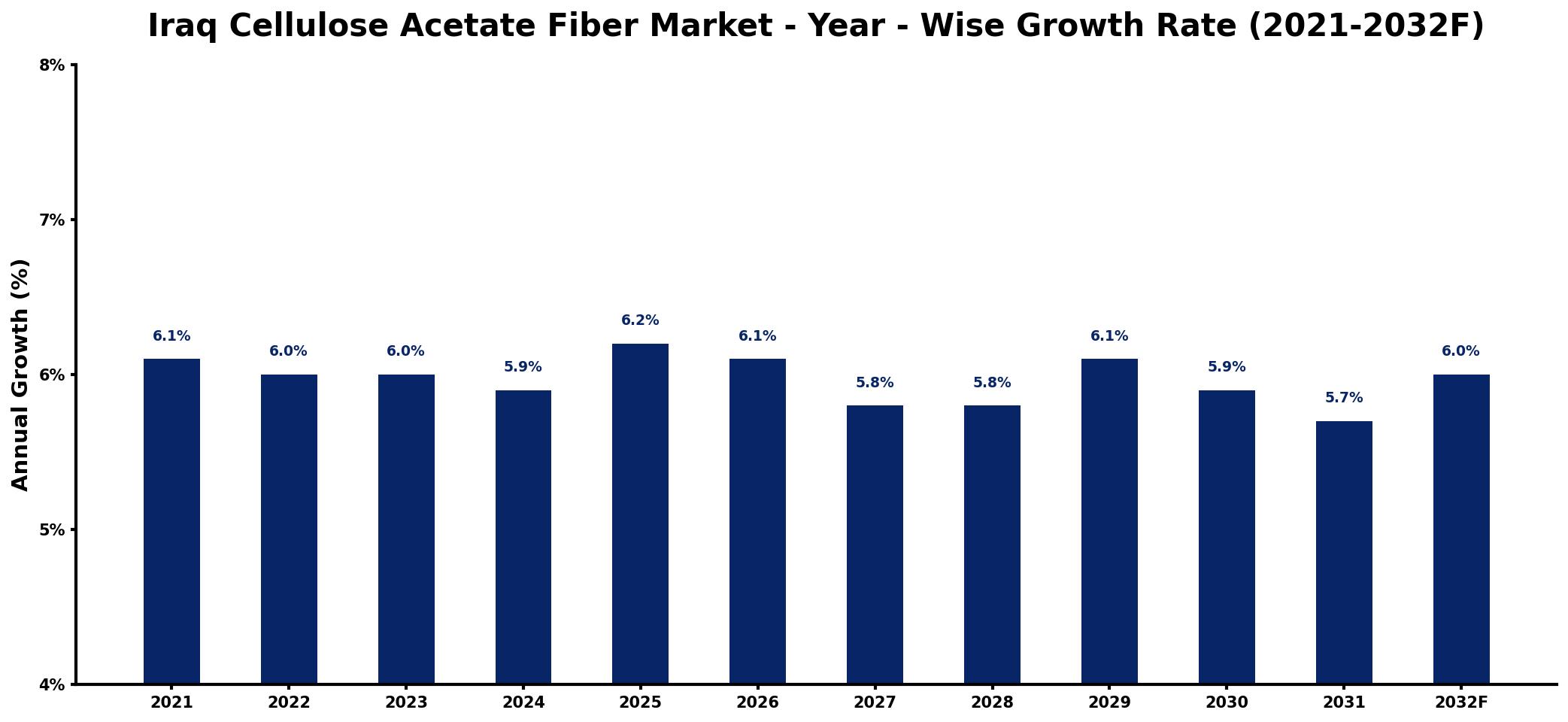
The table below presents the year‑wise growth rates along with the key drivers influencing the market
| Year | Growth Rate | Major Drivers |
| 2021 | 6.1% | Rising demand from textile industry |
| 2022 | 6.0% | Increased investment in manufacturing |
| 2023 | 6.0% | Growth in fashion and apparel |
| 2024 | 5.9% | Expansion of packaging sector |
| 2025 | 6.2% | Surge in automotive applications |
| 2026 | 6.1% | Emergence of sustainable materials |
| 2027 | 5.8% | Shifts in consumer preferences |
| 2028 | 5.8% | Innovations in production technologies |
| 2029 | 6.1% | rising infrastructure development spending |
| 2030 | 5.9% | Demand from medical applications |
| 2031 | 5.7% | Supply chain consolidation trends |
| 2032 | 6.0% | Increased focus on eco-friendly solutions |
Note: Market size estimations and growth projections presented in this report are based on 6Wresearch's proprietary forecasting methodology, utilizing the latest available industry data, government publications, and primary research inputs.
Iraq Cellulose Acetate Fiber Market Synopsis
The Iraq Cellulose Acetate Fiber Market has gained significant momentum in recent years, primarily fueled by a robust demand for eco-friendly materials. However, as competition intensifies and raw material costs fluctuate, the market must adapt to ensure consistent growth moving forward.
As we look ahead, the focus on sustainable production methods and the growing inclination towards ethical sourcing will shape the future landscape of the Iraq Cellulose Acetate Fiber Market. This momentum, combined with advancements in manufacturing technologies, promises to foster a more resilient industry environment.
Iraq Cellulose Acetate Fiber Market Key Takeaways
- The market is projected to expand significantly, driven by increasing demand for sustainable textile materials.
- Cellulose acetate fiber is favored for its biodegradable nature and renewable sourcing, particularly in Iraq's textile sector.
- Government initiatives are geared towards supporting local production and reducing dependence on imports.
- Consumers are increasingly aware of the environmental impact of their purchasing decisions, driving demand for eco-friendly products.
- Strategic investments in domestic production are essential to counterbalance challenges like fluctuating raw material prices.
Evaluation of Restraints in Iraq Cellulose Acetate Fiber Market
Despite the promising growth potential, the Iraq Cellulose Acetate Fiber Market faces several significant restraints. The limited domestic production capacity poses a challenge, compelling the industry to depend heavily on imports for raw materials. This dependency leaves the market vulnerable to global price fluctuations and supply chain disruptions. Additionally, the economic and political instability in Iraq may deter investment and hinder market development. Educating consumers about the advantages of cellulose acetate fibers will be crucial in overcoming these hurdles and unlocking the market's full potential.
Iraq Cellulose Acetate Fiber Market Trends
A noticeable trend in the Iraq Cellulose Acetate Fiber Market is the increasing preference for sustainable and eco-friendly materials. With growing consumer demand for environmentally responsible products, manufacturers are innovating in production techniques to improve the quality and functionality of cellulose acetate fibers. Furthermore, there is a palpable shift towards ethical sourcing practices within the textile industry, which aligns with the rising consumer interest in transparency and sustainability. These trends are catalyzing a transformation in how fibers are produced and marketed in Iraq.
Iraq Cellulose Acetate Fiber Market Opportunities
There are compelling investment opportunities within the Iraq Cellulose Acetate Fiber Market, particularly due to the increasing demand for sustainable textile materials. The country's rich agricultural resources can be leveraged for sourcing raw materials, paving the way for companies that aim to capitalize on this growing market. Additionally, the government's commitment to enhancing local industries offers an encouraging backdrop for investments focused on cellulose acetate fiber production and distribution.
Government Initiatives in the Iraq Cellulose Acetate Fiber Market
The Iraqi government has initiated various policies aimed at promoting domestic production of cellulose acetate fibers and reducing reliance on imports. These initiatives include subsidies and tax incentives for local manufacturers, as well as support for infrastructure development to bolster production capacity. Regulatory measures are also in place to ensure that quality standards are upheld and to encourage sustainable manufacturing practices. Such efforts reflect the governments intent to stimulate growth in this sector and enhance the overall competitiveness of local producers.
Future Insights of the Iraq Cellulose Acetate Fiber Market
Looking ahead to 2026-2032, the Iraq Cellulose Acetate Fiber Market is expected to maintain a positive growth trajectory. The increasing focus on sustainable fashion and eco-conscious consumer behavior are anticipated to drive demand further for cellulose acetate fibers, which are recognized for their renewable and biodegradable properties. Enhanced manufacturing technologies and processes are likely to evolve, improving product offerings and expanding market reach. As disposable incomes rise, consumers will increasingly favor durable and comfortable clothing, ultimately bolstering the cellulose acetate fiber sector in Iraq.
Iraq Cellulose Acetate Fiber Market Latest Developments (2025 - 2026)
Recent developments in the Iraq Cellulose Acetate Fiber Market indicate a shift towards greater collaboration between industry stakeholders to enhance production capabilities. Manufacturers are exploring partnerships to improve raw material sourcing and distribution networks, driven by the need for quality and sustainability. Additionally, there has been a focus on increasing consumer awareness regarding the environmental benefits of cellulose acetate fibers through targeted marketing campaigns. These initiatives reflect an industry moving towards enhanced sustainability practices and innovation.
Iraq Cellulose Acetate Fiber Market - Key Attractiveness of the Report
- 10 Years of Market Numbers
- Historical Data Starting from 2022 to 2025
- Base Year: 2025
- Forecast Data until 2032
- Key Performance Indicators Impacting the Market
- Major Upcoming Developments and Projects
Key Highlights of the Report:
- Iraq Cellulose Acetate Fiber Market Outlook
- Market Size of Iraq Cellulose Acetate Fiber Market, 2025
- Forecast of Iraq Cellulose Acetate Fiber Market, 2032
- Historical Data and Forecast of Iraq Cellulose Acetate Fiber Revenues & Volume for the Period 2022-2032F
- Iraq Cellulose Acetate Fiber Market Trend Evolution
- Iraq Cellulose Acetate Fiber Market Drivers and Challenges
- Iraq Cellulose Acetate Fiber Price Trends
- Iraq Cellulose Acetate Fiber Porter's Five Forces
- Iraq Cellulose Acetate Fiber Industry Life Cycle
- Historical Data and Forecast of Iraq Cellulose Acetate Fiber Market Revenues & Volume By Type for the Period 2022-2032F
- Historical Data and Forecast of Iraq Cellulose Acetate Fiber Market Revenues & Volume By Plastic for the Period 2022-2032F
- Historical Data and Forecast of Iraq Cellulose Acetate Fiber Market Revenues & Volume By Fiber for the Period 2022-2032F
- Historical Data and Forecast of Iraq Cellulose Acetate Fiber Market Revenues & Volume By Application for the Period 2022-2032F
- Historical Data and Forecast of Iraq Cellulose Acetate Fiber Market Revenues & Volume By Photographic Films for the Period 2022-2032F
- Historical Data and Forecast of Iraq Cellulose Acetate Fiber Market Revenues & Volume By Cigarette Filters for the Period 2022-2032F
- Historical Data and Forecast of Iraq Cellulose Acetate Fiber Market Revenues & Volume By Tapes & Labels for the Period 2022-2032F
- Historical Data and Forecast of Iraq Cellulose Acetate Fiber Market Revenues & Volume By Textiles & Apparel for the Period 2022-2032F
- Iraq Cellulose Acetate Fiber Import Export Trade Statistics
- Market Opportunity Assessment By Type
- Market Opportunity Assessment By Application
- Iraq Cellulose Acetate Fiber Top Companies Market Share
- Iraq Cellulose Acetate Fiber Competitive Benchmarking By Technical and Operational Parameters
- Iraq Cellulose Acetate Fiber Company Profiles
- Iraq Cellulose Acetate Fiber Key Strategic Recommendations






































