Qatar Cement and Concrete Market Summary
The qatar cement and concrete market was estimated at USD 293 Million in 2025 and is projected to reach USD 407 Million by 2032, growing at a CAGR of 5.6% from 2026 to 2032.
Qatar Cement and Concrete Market Year-wise Growth Rate and Key Drivers
This graph highlights how the Qatar Cement and Concrete Market has steadily grown over the past five years, supported by major growth factors.
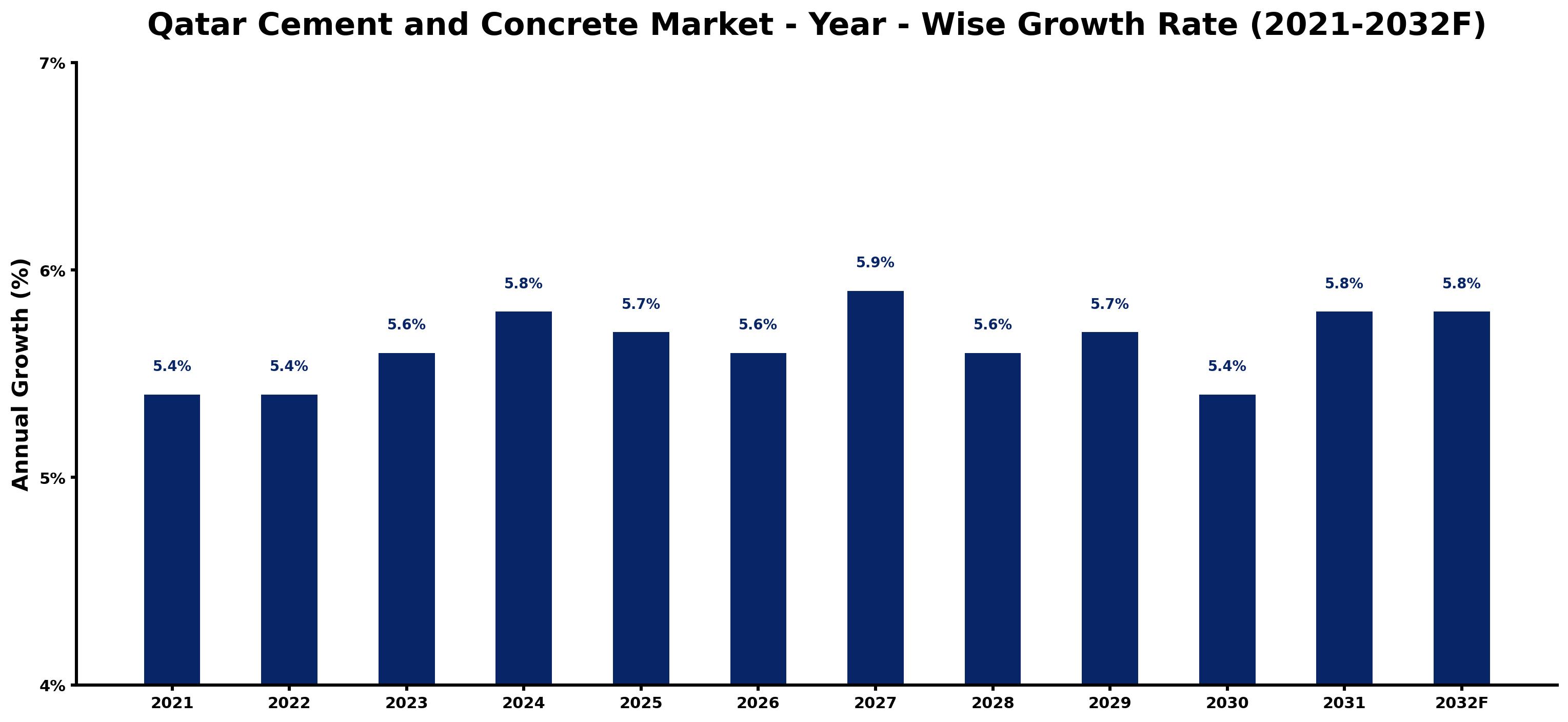
The table below presents the year wise growth rates along with the key drivers influencing the market
| Year | Growth Rate | Major Drivers |
| 2021 | 5.4% | Post-lockdown retail projects stimulated demand for commercial construction materials in Qatar. |
| 2022 | 5.4% | Local manufacturers focused on sustainable practices, enhancing product quality and market presence. |
| 2023 | 5.6% | Infrastructure investments elevated concrete usage, supporting Qatar's rapid urban development goals. |
| 2024 | 5.8% | Increased regional collaboration within the GCC strengthened material supply chains and competitiveness. |
| 2025 | 5.7% | Large-scale events, like the World Cup, created temporary spikes in construction activities. |
| 2026 | 5.6% | Adoption of smart building technologies induced changes in concrete formulation and design efficiency. |
| 2027 | 5.9% | Water scarcity led to innovations in water-efficient concrete production methods and technologies. |
| 2028 | 5.6% | Rising local population prompted more residential projects, increasing demand for cement products. |
| 2029 | 5.7% | Public-private partnerships flourished, facilitating ambitious infrastructure projects across the nation. |
| 2030 | 5.4% | Sustainability trends triggered an interest in alternative materials, influencing traditional cement usage. |
| 2031 | 5.8% | Emerging technologies in construction, like 3D printing, began reshaping concrete applications and costs. |
| 2032 | 5.8% | Economic diversification strategies emphasized urban development, maintaining a robust cement market presence. |
Note - Market size estimations and growth projections presented in this report are based on 6Wresearch's advanced forecasting approach, validated with industry datasets as of June 2026.
Qatar Cement and Concrete Market Synopsis
The Qatar Cement and Concrete Market is projected to reach 5.6% and witness significant growth during the forecast period (2026-2032). The steady expansion of this market has been fueled by a myriad of factors, including substantial infrastructure development initiatives, rapid urbanization, and an expanding construction sector.
Qatar Cement and Concrete Market Growth Drivers
Several key drivers are shaping the dynamics of the Qatar Cement and Concrete Market. Firstly, the significant investment in infrastructure projects, including the construction of stadiums, roads, bridges, and public facilities, has heightened the demand for cement and concrete products. This investment was particularly pronounced as the country geared up for the 2022 FIFA World Cup, which served as a catalyst for numerous construction activities.
- The construction sector in Qatar is witnessing a surge due to ongoing urbanization, leading to an increased need for residential and commercial properties.
- Government-led initiatives aimed at modernizing infrastructure are essential in meeting the demands of a growing population and urban centers.
- Economic growth in Qatar has led to enhanced spending power, which directly translates to increased construction demands and a corresponding rise in cement and concrete consumption.
- Advancements in construction technology and practices have allowed for more efficient production processes, positively impacting the market landscape.
- Qatar's strategic location and proximity to raw material sources enable effective supply chain management for cement and concrete production.
Qatar Cement and Concrete Market Challenges and Restraints
Despite the growth potential, the Qatar Cement and Concrete Market faces several challenges. The extreme climate, characterized by high temperatures and humidity, poses significant hurdles for concrete production and construction activities. Special formulations and curing techniques are essential to ensure the durability and strength of concrete structures.
- The reliance on cement imports may lead to price volatility, as global market dynamics can affect availability and cost.
- Environmental issues related to cement production present a challenge, as the industry is known for its substantial carbon footprint.
- Increased regulatory scrutiny regarding sustainable construction practices is pushing stakeholders to adopt greener technologies.
- Supply chain disruptions, particularly in the context of global events and market fluctuations, can impact material availability and project timelines.
- Labor shortages, exacerbated by various socio-economic factors, could hinder ongoing and upcoming construction projects.
Qatar Cement and Concrete Market Government Investment and Initiatives
The Qatari government has demonstrated a strong commitment to enhancing the cement and concrete market through strategic investments and initiatives. Public spending directed towards infrastructure development is critical to maintaining the momentum of the construction sector. Major national development plans, such as Qatar National Vision 2030, emphasize the importance of infrastructure modernization and expansion.
- Government initiatives focus on improving public facilities and transportation networks, significantly impacting the demand for construction materials.
- Investment in sustainable building practices is being promoted, encouraging the use of eco-friendly materials and technologies.
- Financial incentives are offered to projects that adhere to sustainability standards, thus fostering a greener construction environment.
- Collaboration with international partners on infrastructure projects is essential for knowledge transfer and innovation in construction practices.
- Regulations aimed at enhancing the efficiency of construction processes are being implemented, further driving the demand for modern cement and concrete solutions.
Qatar Cement and Concrete Market Latest Developments (May 2025 - June 2026)
In the period between May 2025 and June 2026, the Qatar Cement and Concrete Market saw several developments that set the stage for future growth. Ongoing projects that began in the lead-up to the FIFA World Cup continued to be a focal point, impacting construction timelines and material demand. The government's commitment to infrastructure investments remained strong, with new initiatives being introduced to enhance existing facilities and accommodate growing urban populations.
- Regulatory changes aimed at enhancing environmental sustainability were introduced, prompting the industry to adapt to stricter standards.
- The market witnessed an increase in research and development efforts to innovate concrete formulations suitable for Qatar's climatic conditions.
- Technology advancements in construction methodologies were adopted, allowing for more efficient project completion and resource utilization.
- Collaborative projects between the government and private sector aimed at reinforcing public infrastructure gained momentum, driving cement and concrete consumption.
- Supply chain dynamics continued to evolve, with stakeholders seeking to mitigate risks associated with imported materials and fluctuating prices.
Qatar Cement and Concrete Market - Key Attractiveness of the Report
- 10 Years of Market Numbers
- Historical Data Starting from 2022 to 2025
- Base Year: 2025
- Forecast Data until 2032
- Key Performance Indicators Impacting the Market
- Major Upcoming Developments and Projects
Key Highlights of the Report:
- Qatar Cement and Concrete Market Outlook
- Market Size of Qatar Cement and Concrete Market, 2025
- Forecast of Qatar Cement and Concrete Market, 2032
- Historical Data and Forecast of Qatar Cement and Concrete Revenues & Volume for the Period 2022-2032F
- Qatar Cement and Concrete Market Trend Evolution
- Qatar Cement and Concrete Market Drivers and Challenges
- Qatar Cement and Concrete Price Trends
- Qatar Cement and Concrete Porter's Five Forces
- Qatar Cement and Concrete Industry Life Cycle
- Historical Data and Forecast of Qatar Cement and Concrete Market Revenues & Volume By Type for the Period 2022-2032F
- Historical Data and Forecast of Qatar Cement and Concrete Market Revenues & Volume By Cement for the Period 2022-2032F
- Historical Data and Forecast of Qatar Cement and Concrete Market Revenues & Volume By Ready-Mix Concrete for the Period 2022-2032F
- Historical Data and Forecast of Qatar Cement and Concrete Market Revenues & Volume By Concrete PipeBrickand Block for the Period 2022-2032F
- Historical Data and Forecast of Qatar Cement and Concrete Market Revenues & Volume By Others for the Period 2022-2032F
- Historical Data and Forecast of Qatar Cement and Concrete Market Revenues & Volume By Applications for the Period 2022-2032F
- Historical Data and Forecast of Qatar Cement and Concrete Market Revenues & Volume By Residential for the Period 2022-2032F
- Historical Data and Forecast of Qatar Cement and Concrete Market Revenues & Volume By Nonresidential for the Period 2022-2032F
- Qatar Cement and Concrete Import Export Trade Statistics
- Market Opportunity Assessment By Type
- Market Opportunity Assessment By Applications
- Qatar Cement and Concrete Top Companies Market Share
- Qatar Cement and Concrete Competitive Benchmarking By Technical and Operational Parameters
- Qatar Cement and Concrete Company Profiles
- Qatar Cement and Concrete Key Strategic Recommendations






































