Qatar Chlorofluorocarbon Market Size, Share & Growth Rate
The Qatar Chlorofluorocarbon Market was estimated at USD 1390 Million in 2025 and is projected to reach USD 2021 Million by 2032, growing at a CAGR of 5.5% from 2026 to 2032. This growth trajectory is primarily driven by a consistent push towards compliance with international environmental regulations, notably the Montreal Protocol, alongside an ongoing transition to alternative refrigerants. Furthermore, the gradual rebound in demand post-COVID-19 is shaping an optimistic outlook for the market.
Qatar Chlorofluorocarbon Market Year-wise Growth Rate and Key Drivers
This graph highlights how the Qatar Chlorofluorocarbon Market has steadily grown over the years, supported by major growth factors.
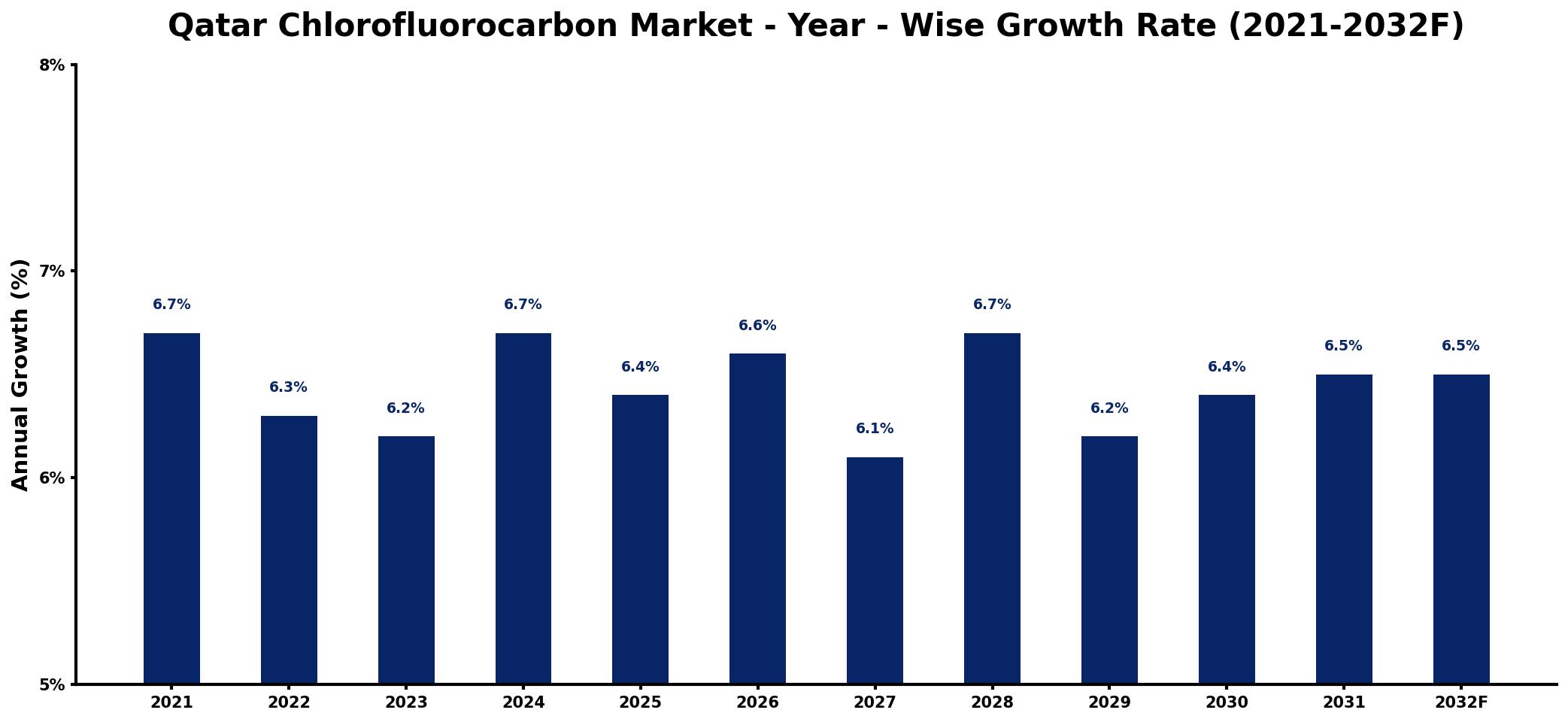
The table below presents the year‑wise growth rates along with the key drivers influencing the market
| Year | Growth Rate | Major Drivers |
| 2021 | 6.7% | Increased demand from refrigeration sector |
| 2022 | 6.3% | Growth in HVAC installation projects |
| 2023 | 6.2% | Rising investments in renewable technology |
| 2024 | 6.7% | Expansion of industrial manufacturing activities |
| 2025 | 6.4% | Surge in construction and infrastructure |
| 2026 | 6.6% | Growing automotive industry requirements |
| 2027 | 6.1% | Demand from commercial cooling applications |
| 2028 | 6.7% | Increased focus on energy efficiency |
| 2029 | 6.2% | stronger distribution network expansion |
| 2030 | 6.4% | Rising consumer electronics production |
| 2031 | 6.5% | enhanced product quality standards |
| 2032 | 6.5% | Increased urbanization driving demand |
Note: Market size estimations and growth projections presented in this report are based on 6Wresearch's proprietary forecasting methodology, utilizing the latest available industry data, government publications, and primary research inputs.
Qatar Chlorofluorocarbon Market Synopsis
The recent momentum in the Qatar chlorofluorocarbon market is rooted in the countrys commitment to international environmental standards, yet the future landscape appears constrained. As industries pivot towards greener alternatives, the traditional CFC market is expected to decline consistently.
Despite experiencing a temporary rebound, the market must contend with stringent regulations aimed at reducing CFC usage. The transformation towards more sustainable refrigerants and the significant R&D investment needed for innovation reflect the dual nature of challenge and opportunity within this sector.
Qatar Chlorofluorocarbon Market Key Takeaways
- The market is transitioning from CFCs to more environmentally friendly refrigerants, aligning with global standards.
- Investment in R&D is crucial for developing sustainable alternatives to CFCs in the region.
- Demand for chlorofluorocarbons is expected to decline as compliance with international agreements strengthens.
- The impact of the COVID-19 pandemic has been mitigated, allowing for a gradual demand recovery.
- Qatar's strategic partnerships and investments could influence the pace of market transformation.
Evaluation of Restraints in Qatar Chlorofluorocarbon Market
The chlorofluorocarbon market in Qatar is significantly restrained by global initiatives aimed at phasing out these compounds. As Qatar adheres to the Montreal Protocol, compliance requires industries to not only halt the use of CFCs but also invest heavily in alternative technologies and refrigerants. This transition presents logistical challenges, including the need for retraining skilled labor and reworking supply chains that have historically relied on CFCs. Furthermore, the rising costs associated with research and development pose a significant barrier for market participants looking to innovate and pivot towards greener alternatives.
Qatar Chlorofluorocarbon Market Trends
Current trends within the Qatar chlorofluorocarbon market reveal a decisive shift towards eco-friendly refrigerants, including hydrochlorofluorocarbons (HCFCs) and hydrofluorocarbons (HFCs). Companies are increasingly investing in technologies that reduce their carbon footprints. Additionally, there is a heightened focus on sustainability across various sectors, stimulating demand for compliant and innovative refrigerant solutions. The adoption of stringent environmental policies continues to drive the industrys evolution, fostering a landscape characterized by both challenges and opportunities.
Qatar Chlorofluorocarbon Market Opportunities
Opportunities abound in the Qatar chlorofluorocarbon market for businesses willing to innovate and adapt. With increasing regulatory pressure, companies can capitalize on the demand for sustainable refrigerants. Investments in research that yield viable alternatives to CFCs are likely to yield substantial returns. Furthermore, collaborations with governmental bodies and international organizations can enhance research initiatives, paving the way for development projects that align with Qatar's environmental goals.
Government Initiatives in the Qatar Chlorofluorocarbon Market
The Qatari government has committed to a range of initiatives aimed at enhancing environmental sustainability within the chlorofluorocarbon market. Public spending on research and development, alongside regulatory frameworks that support the transition to alternative refrigerants, are critical. These initiatives include strict adherence to international agreements, as well as incentives for companies to adopt more sustainable practices. The governments proactive stance not only ensures compliance but also fosters a climate conducive to innovation and investment.
Future Insights of the Qatar Chlorofluorocarbon Market
Looking ahead to 2026-2032, the Qatar chlorofluorocarbon market is expected to face ongoing pressures from international regulations while simultaneously adapting to a demand landscape increasingly centered on sustainability. The transition towards alternative refrigerants will shape the market, necessitating continuous investment in innovative technologies. Despite the challenging environment, the potential for growth through eco-friendly initiatives presents a compelling narrative for stakeholders in this evolving market.
Qatar Chlorofluorocarbon Market Latest Developments (2025 - 2026)
Recent developments in the Qatar chlorofluorocarbon market have highlighted a focus on compliance with environmental standards. Companies are beginning to implement strategies that emphasize innovation in refrigerant technology, aiming to replace traditional CFCs with more sustainable options. Industry stakeholders are also exploring partnerships to enhance R&D capabilities, fostering a collaborative approach towards achieving environmental compliance. Overall, the sector is witnessing a shift that embraces sustainability as a core principle.
Qatar Chlorofluorocarbon Market - Key Attractiveness of the Report
- 10 Years of Market Numbers
- Historical Data Starting from 2022 to 2025
- Base Year: 2025
- Forecast Data until 2032
- Key Performance Indicators Impacting the Market
- Major Upcoming Developments and Projects
Key Highlights of the Report:
- Qatar Chlorofluorocarbon Market Outlook
- Market Size of Qatar Chlorofluorocarbon Market, 2025
- Forecast of Qatar Chlorofluorocarbon Market, 2032
- Historical Data and Forecast of Qatar Chlorofluorocarbon Revenues & Volume for the Period 2022-2032F
- Qatar Chlorofluorocarbon Market Trend Evolution
- Qatar Chlorofluorocarbon Market Drivers and Challenges
- Qatar Chlorofluorocarbon Price Trends
- Qatar Chlorofluorocarbon Porter's Five Forces
- Qatar Chlorofluorocarbon Industry Life Cycle
- Historical Data and Forecast of Qatar Chlorofluorocarbon Market Revenues & Volume By Type for the Period 2022-2032F
- Historical Data and Forecast of Qatar Chlorofluorocarbon Market Revenues & Volume By CFC-11 for the Period 2022-2032F
- Historical Data and Forecast of Qatar Chlorofluorocarbon Market Revenues & Volume By CFC-12 for the Period 2022-2032F
- Historical Data and Forecast of Qatar Chlorofluorocarbon Market Revenues & Volume By CFC-113 for the Period 2022-2032F
- Historical Data and Forecast of Qatar Chlorofluorocarbon Market Revenues & Volume By CFC-114 for the Period 2022-2032F
- Historical Data and Forecast of Qatar Chlorofluorocarbon Market Revenues & Volume By CFC-115 for the Period 2022-2032F
- Historical Data and Forecast of Qatar Chlorofluorocarbon Market Revenues & Volume By Others for the Period 2022-2032F
- Historical Data and Forecast of Qatar Chlorofluorocarbon Market Revenues & Volume By Application for the Period 2022-2032F
- Historical Data and Forecast of Qatar Chlorofluorocarbon Market Revenues & Volume By Aerosol Propellants for the Period 2022-2032F
- Historical Data and Forecast of Qatar Chlorofluorocarbon Market Revenues & Volume By Blowing Agent for the Period 2022-2032F
- Historical Data and Forecast of Qatar Chlorofluorocarbon Market Revenues & Volume By Refrigerants for the Period 2022-2032F
- Historical Data and Forecast of Qatar Chlorofluorocarbon Market Revenues & Volume By Others for the Period 2022-2032F
- Qatar Chlorofluorocarbon Import Export Trade Statistics
- Market Opportunity Assessment By Type
- Market Opportunity Assessment By Application
- Qatar Chlorofluorocarbon Top Companies Market Share
- Qatar Chlorofluorocarbon Competitive Benchmarking By Technical and Operational Parameters
- Qatar Chlorofluorocarbon Company Profiles
- Qatar Chlorofluorocarbon Key Strategic Recommendations






































