Qatar Cloud Applications Market Size & Growth Rate (2026-2032)
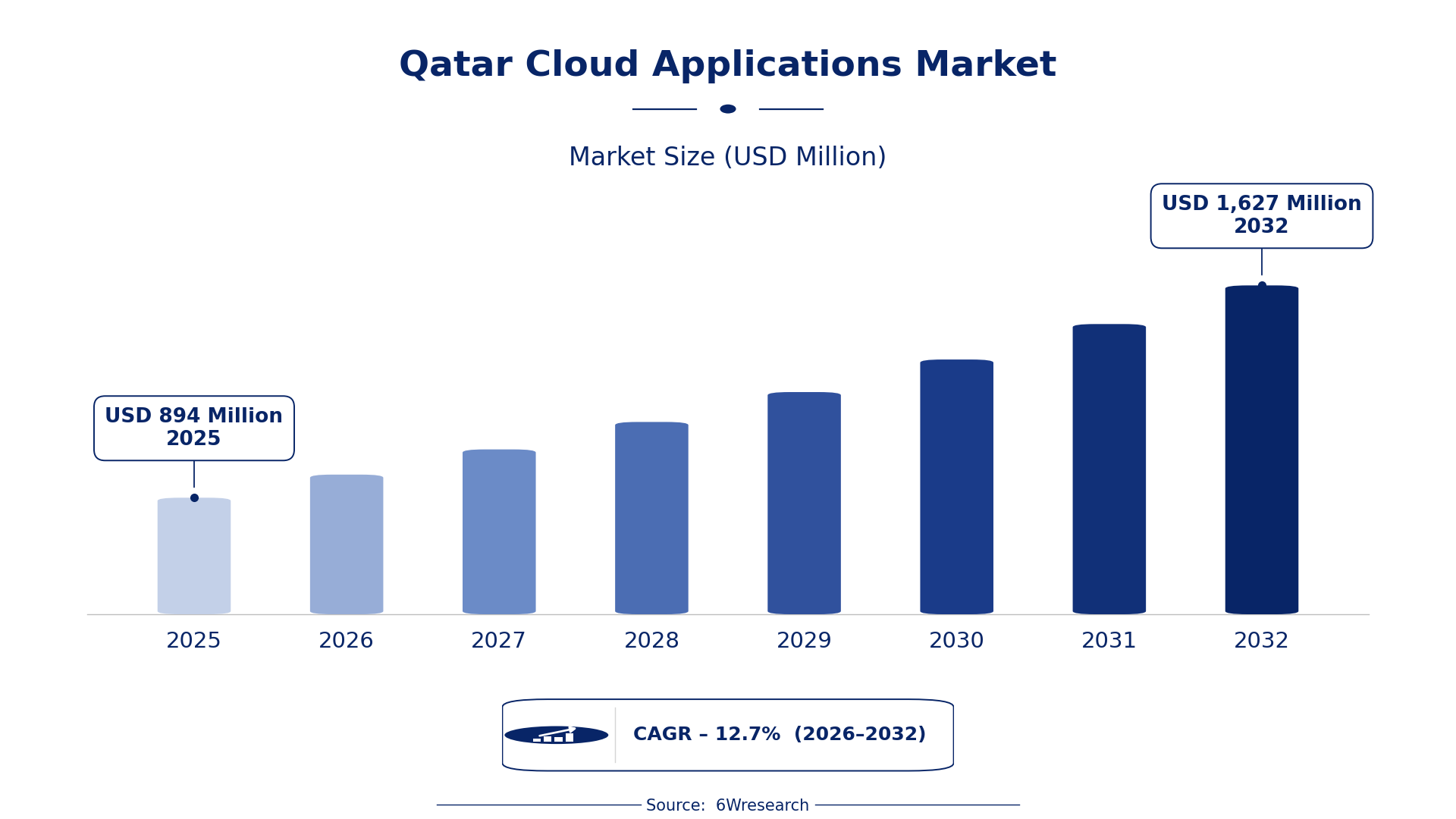
The Qatar Cloud Applications Market was estimated at USD 894 Million in 2025 and is projected to reach USD 1627 Million by 2032, growing at a CAGR of 12.7% from 2026 to 2032.
Qatar Cloud Applications Market Synopsis
The shift to cloud applications in Qatar is not merely a trend but a strategic pivot for organizations seeking efficiency and adaptability. Companies across various sectors are increasingly prioritizing cloud-based solutions to enhance operational performance, reflecting a broader commitment to digital transformation.
As businesses recognize the myriad advantages of cloud applications—such as improved accessibility, scalability, and cost savings—the market is evolving rapidly. From customer relationship management to enterprise resource planning, the diverse applications available are catering to specific industry needs, fostering innovation and collaboration.
Qatar Cloud Applications Market Year-wise Growth Rate and Key Drivers
This graph illustrates the annual growth rates of the Qatar Cloud Applications Market from 2021 to 2032, highlighting a steady upward trajectory and projected expansion over the forecast period.
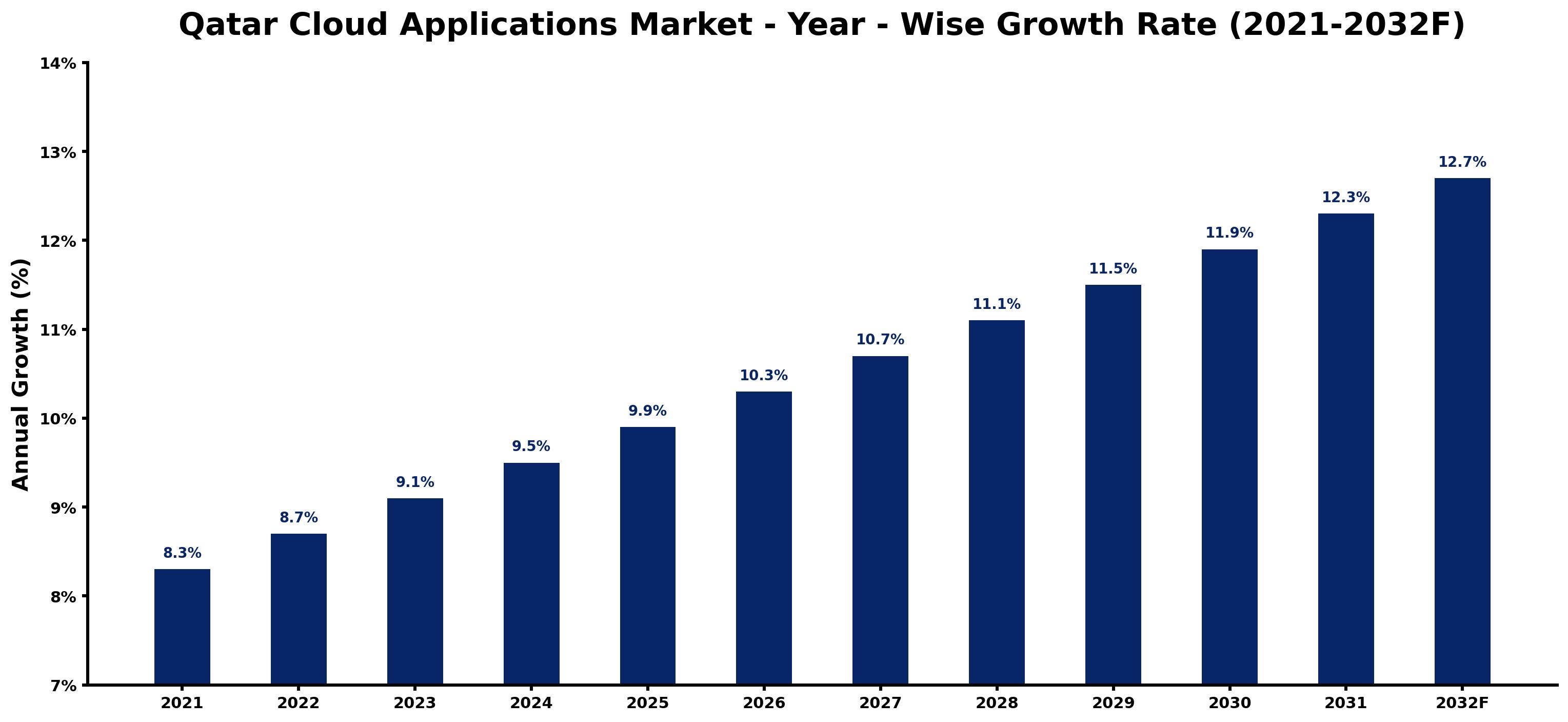
The table below presents the year‑wise growth rates along with the key drivers influencing the market
| Year | Growth Rate | Major Drivers |
| 2021 | 8.3% | Qatar National Vision 2030 promotes digital economy growth. |
| 2022 | 8.7% | Rising adoption of cloud solutions by SMEs in Qatar. |
| 2023 | 9.1% | Increased government focus on smart city cloud integration. |
| 2024 | 9.5% | Investments in local data centers enhance cloud accessibility. |
| 2025 | 9.9% | Boost in fintech adoption driving cloud service demands. |
| 2026 | 10.3% | Education sector's shift to cloud-based learning platforms. |
| 2027 | 10.7% | Enhanced cybersecurity regulations necessitating cloud compliance solutions. |
| 2028 | 11.1% | Telecom advancements improving cloud connectivity options in Qatar. |
| 2029 | 11.5% | Public sector digitalization initiatives fueling cloud application needs. |
| 2030 | 11.9% | Healthcare sector cloud usage for patient data management. |
| 2031 | 12.3% | Increased IoT deployments requiring robust cloud infrastructures. |
| 2032 | 12.7% | Rising consumer demand for scalable e-commerce cloud solutions. |
Note: Market size estimations and growth projections presented in this report are based on 6Wresearch's proprietary forecasting methodology, utilizing the latest available industry data, government publications, and primary research inputs.
Qatar Cloud Applications Market Key Takeaways
Below are some of the specific key takeaways from the market, including:
- The market is set to grow significantly, driven by the increasing need for flexibility and remote access to applications.
- Cloud solutions are facilitating digital transformation across various industries, enhancing operational efficiency.
- Integration challenges with legacy systems pose obstacles to full adoption of cloud applications.
- The COVID-19 pandemic has accelerated the transition to cloud technologies, reshaping business operations.
- Local and international players are diversifying their offerings to meet the unique demands of the Qatari market.
Evaluation of Restraints in Qatar Cloud Applications Market
Despite the promising growth trajectory, several restraints hinder the Qatar Cloud Applications Market. A primary concern is the integration of cloud solutions with existing legacy systems, which often leads to complex and costly transitions. Many organizations in Qatar are still heavily reliant on traditional software, making the shift to cloud applications a challenging endeavor. Additionally, concerns around data security and compliance with local regulations further complicate adoption. Without addressing these integration and security issues, the potential benefits of cloud applications may remain underutilized.
Qatar Cloud Applications Market Trends
A noticeable trend is the increased focus on industry-specific cloud solutions, as organizations seek applications tailored to their unique operational needs. This customization enhances user experience and ensures better alignment with business objectives. on top of that, the rise of artificial intelligence and machine learning within cloud applications is transforming how businesses analyze data and make informed decisions.
Another trend is the growing demand for collaborative tools that support remote work. As organizations in Qatar adapt to new work environments, cloud applications that facilitate teamwork and communication are becoming essential. This shift towards enhanced collaboration tools is indicative of a broader cultural change in how work is conducted, emphasizing flexibility and connectivity.
Qatar Cloud Applications Market Opportunities
The Qatar Cloud Applications Market presents numerous opportunities for growth and investment. As more businesses recognize the need for digital solutions, there is a rising demand for cloud applications that support analytics and business intelligence. Investing in these areas can yield substantial returns, particularly as companies seek to harness data for strategic decision-making. Additionally, the ongoing public sector digitization initiatives open avenues for cloud providers to partner with government entities, further expanding the market's reach.
Government Initiatives in the Qatar Cloud Applications Market
Government policy in Qatar is actively shaping the cloud applications market, focusing on enhancing the nation’s digital infrastructure. With a clear commitment to digital transformation, the government is prioritizing initiatives that foster innovation and support businesses in adopting cloud technologies. This proactive approach is crucial for creating an environment conducive to growth in the cloud applications sector.
- A national digital infrastructure upgrade programme now in its rollout phase aims to enhance connectivity and cloud service accessibility.
- A regulatory framework introduced in 2025 mandates data protection measures for cloud applications, improving security and consumer trust.
- Current initiatives focus on developing public-private partnerships to drive cloud adoption in key sectors, including healthcare and finance.
- Upcoming initiatives are expected to promote training and skill development in cloud technologies, addressing workforce needs.
Future Insights of the Qatar Cloud Applications Market
Looking ahead to 2026-2032, the Qatar Cloud Applications Market is positioned for substantial growth. As businesses continue to embrace digital transformation, the demand for innovative cloud solutions will rise. Companies that invest in emerging technologies, such as artificial intelligence and machine learning, will likely have a competitive edge. on top of that, as regulatory frameworks mature, organizations will gain increased confidence in transitioning to cloud environments, driving market expansion.
Qatar Cloud Applications Market Latest Developments
In the past year, the Qatar Cloud Applications Market has witnessed a surge in activity, with organizations rapidly adopting cloud solutions to enhance business resilience. The COVID-19 pandemic acted as a catalyst, prompting many businesses to seek flexible and scalable cloud options. As a result, both local and international providers are stepping up their offerings to meet the growing demand.
- A major technology vendor launched a new cloud-based CRM platform in Q2 2025, targeting businesses looking for enhanced customer engagement solutions.
- An initiative that began in early 2025 and remains underway focuses on integrating cloud applications into public sector operations, streamlining service delivery.
- In mid-2025, a regional operator announced plans for a cloud services expansion to support the burgeoning demand from SMEs in Qatar.
- Upcoming in late 2026, a collaborative project between local enterprises aims to create a shared cloud infrastructure to promote resource optimization.
Qatar Cloud Applications Market - Key Attractiveness of the Report
- 10 Years of Market Numbers
- Historical Data Starting from 2022 to 2025
- Base Year: 2025
- Forecast Data until 2032
- Key Performance Indicators Impacting the Market
- Major Upcoming Developments and Projects
Key Highlights of the Report:
- Qatar Cloud Applications Market Outlook
- Market Size of Qatar Cloud Applications Market, 2025
- Forecast of Qatar Cloud Applications Market, 2032
- Historical Data and Forecast of Qatar Cloud Applications Revenues & Volume for the Period 2022-2032F
- Qatar Cloud Applications Market Trend Evolution
- Qatar Cloud Applications Market Drivers and Challenges
- Qatar Cloud Applications Price Trends
- Qatar Cloud Applications Porter's Five Forces
- Qatar Cloud Applications Industry Life Cycle
- Historical Data and Forecast of Qatar Cloud Applications Market Revenues & Volume By Application for the Period 2022-2032F
- Historical Data and Forecast of Qatar Cloud Applications Market Revenues & Volume By ERP for the Period 2022-2032F
- Historical Data and Forecast of Qatar Cloud Applications Market Revenues & Volume By CRM for the Period 2022-2032F
- Historical Data and Forecast of Qatar Cloud Applications Market Revenues & Volume By HCM for the Period 2022-2032F
- Historical Data and Forecast of Qatar Cloud Applications Market Revenues & Volume By SCM for the Period 2022-2032F
- Historical Data and Forecast of Qatar Cloud Applications Market Revenues & Volume By Content Management for the Period 2022-2032F
- Historical Data and Forecast of Qatar Cloud Applications Market Revenues & Volume By BI for the Period 2022-2032F
- Historical Data and Forecast of Qatar Cloud Applications Market Revenues & Volume By Analytics for the Period 2022-2032F
- Historical Data and Forecast of Qatar Cloud Applications Market Revenues & Volume By Vertical for the Period 2022-2032F
- Historical Data and Forecast of Qatar Cloud Applications Market Revenues & Volume By Banking, Financial Services, and Insurance (BFSI) for the Period 2022-2032F
- Historical Data and Forecast of Qatar Cloud Applications Market Revenues & Volume By Energy and Utilities for the Period 2022-2032F
- Historical Data and Forecast of Qatar Cloud Applications Market Revenues & Volume By Government and Public Sector for the Period 2022-2032F
- Historical Data and Forecast of Qatar Cloud Applications Market Revenues & Volume By Healthcare and Life Sciences for the Period 2022-2032F
- Historical Data and Forecast of Qatar Cloud Applications Market Revenues & Volume By Manufacturing for the Period 2022-2032F
- Historical Data and Forecast of Qatar Cloud Applications Market Revenues & Volume By Retail and Consumer Goods for the Period 2022-2032F
- Historical Data and Forecast of Qatar Cloud Applications Market Revenues & Volume By Telecommunications for the Period 2022-2032F
- Historical Data and Forecast of Qatar Cloud Applications Market Revenues & Volume By Transportation and Logistics for the Period 2022-2032F
- Historical Data and Forecast of Qatar Cloud Applications Market Revenues & Volume By Organization Size for the Period 2022-2032F
- Historical Data and Forecast of Qatar Cloud Applications Market Revenues & Volume By Small and Medium-sized Enterprises (SMEs) for the Period 2022-2032F
- Historical Data and Forecast of Qatar Cloud Applications Market Revenues & Volume By Large Enterprises for the Period 2022-2032F
- Qatar Cloud Applications Import Export Trade Statistics
- Market Opportunity Assessment By Application
- Market Opportunity Assessment By Vertical
- Market Opportunity Assessment By Organization Size
- Qatar Cloud Applications Top Companies Market Share
- Qatar Cloud Applications Competitive Benchmarking By Technical and Operational Parameters
- Qatar Cloud Applications Company Profiles
- Qatar Cloud Applications Key Strategic Recommendations






































