Qatar Cloud POS Market Size & Growth Rate (2026-2032)
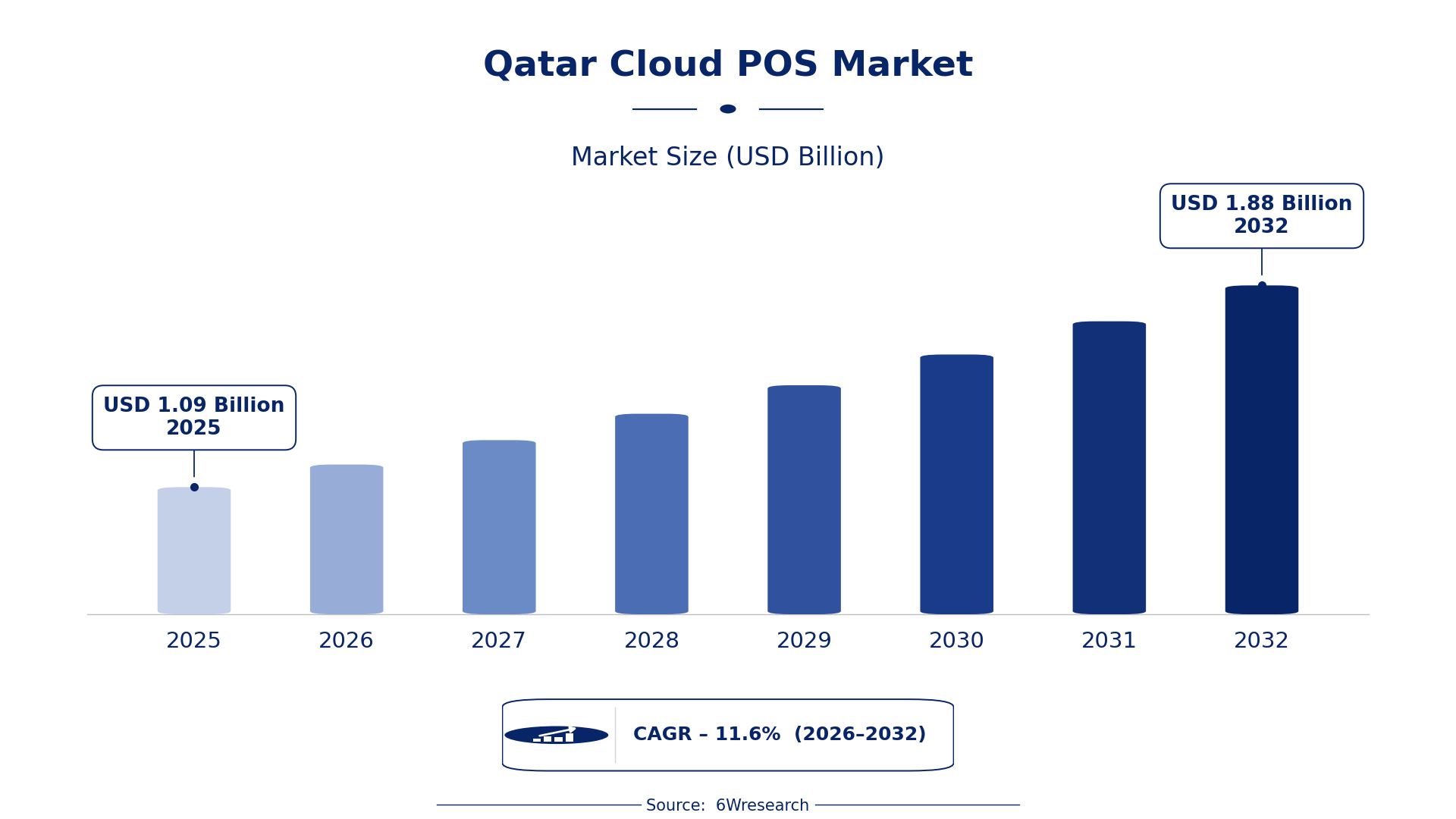
The Qatar Cloud POS Market was estimated at USD 1095 Million in 2025 and is projected to reach USD 1877 Million by 2032, growing at a CAGR of 11.6% from 2026 to 2032.
Qatar Cloud POS Market Synopsis
The Qatar Cloud Point of Sale (POS) Market is undergoing a transformative shift, moving away from traditional systems to more advanced cloud-based solutions. This transition is driven by businesses recognizing the need for greater flexibility and real-time data access, particularly in retail and hospitality sectors, where customer experience is paramount.
Looking ahead, the market is expected to thrive as companies increasingly seek centralized data management and enhanced operational efficiency. The demand for integrated solutions that combine inventory management with various payment options will be a key factor in shaping market dynamics in the coming years.
Qatar Cloud POS Market Year-wise Growth Rate and Key Drivers
This graph illustrates the annual growth rates of the Qatar Cloud POS Market from 2021 to 2032, highlighting a steady upward trajectory and projected expansion over the forecast period.
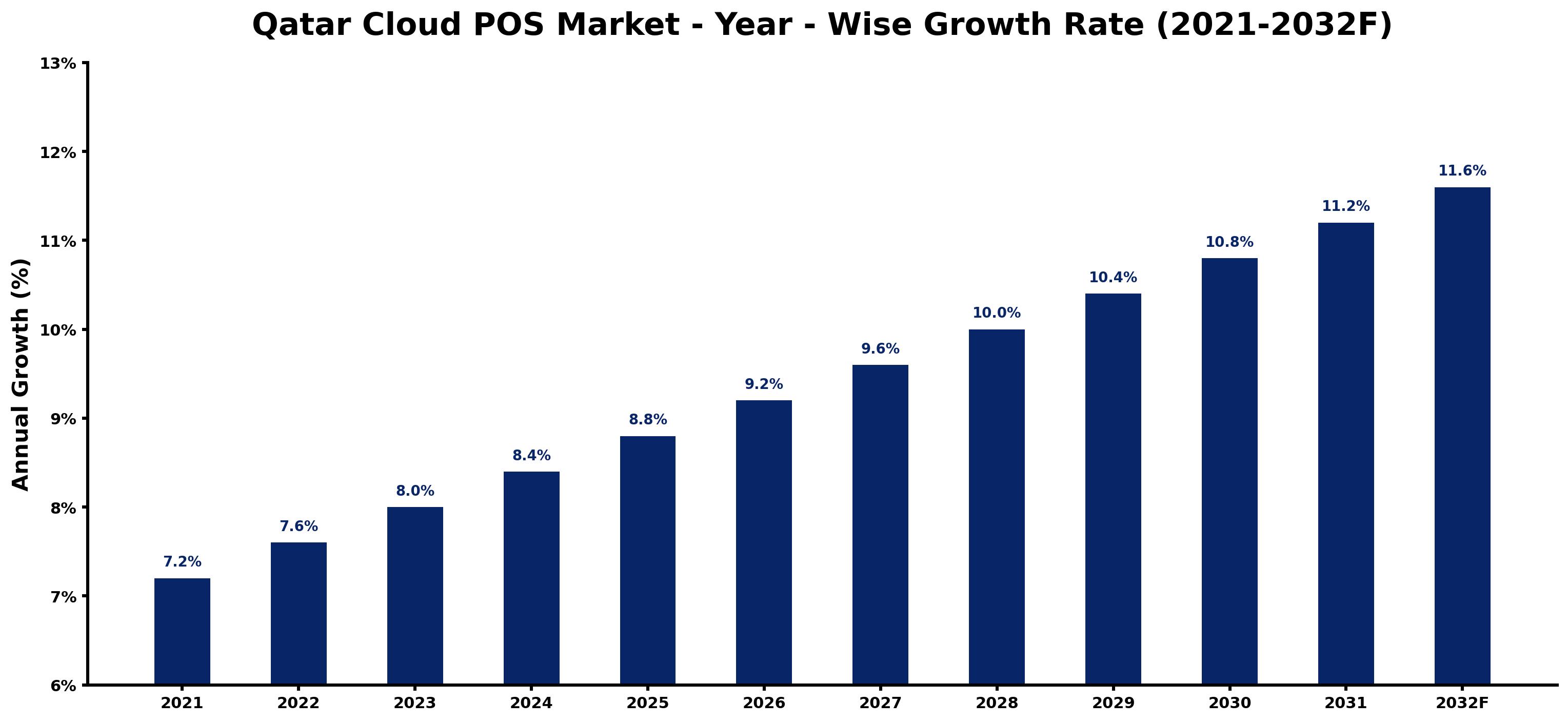
The table below presents the year‑wise growth rates along with the key drivers influencing the market
| Year | Growth Rate | Major Drivers |
| 2021 | 7.2% | Qatar Central Bank's digital payment regulatory framework enhancements. |
| 2022 | 7.6% | Government incentives boosting adoption of digital payment solutions. |
| 2023 | 8.0% | Increased smartphone penetration enhancing cloud POS usage. |
| 2024 | 8.4% | Tourism recovery driving demand for agile payment systems. |
| 2025 | 8.8% | Growing preference for integrated retail management solutions. |
| 2026 | 9.2% | Corporate tax reforms encouraging small business digitalization. |
| 2027 | 9.6% | Local entrepreneurs seeking innovative customer engagement tools. |
| 2028 | 10.0% | Focus on sustainable retail practices fostering cloud platforms. |
| 2029 | 10.4% | Increased investment in fintech startups enhancing competition. |
| 2030 | 10.8% | Qatar's Digital Economy Strategy encouraging cloud technologies adoption. |
| 2031 | 11.2% | Rapid urbanization in Lusail driving advanced retail technologies. |
| 2032 | 11.6% | Cultural shift towards digital experiences in retail environment. |
Note: Market size estimations and growth projections presented in this report are based on 6Wresearch's proprietary forecasting methodology, utilizing the latest available industry data, government publications, and primary research inputs.
Qatar Cloud POS Market Key Takeaways
Below are some of the specific key takeaways from the market, including:
- The shift towards cloud-based solutions is primarily driven by the need for agility and real-time data access.
- Businesses are focusing on enhancing customer experiences through personalized services and streamlined operations.
- Data security and reliability concerns remain significant challenges for the industry.
- The COVID-19 pandemic has accelerated the adoption of contactless and online transaction solutions.
- Growth in the market is supported by increasing digitalization across various sectors.
Evaluation of Restraints in Qatar Cloud POS Market
Despite the promising growth trajectory, the Qatar Cloud POS Market faces notable restraints, particularly surrounding data security. As businesses handle sensitive customer information, the risk of security breaches looms large. Companies must invest heavily in cybersecurity measures to protect their systems and gain customer trust. Additionally, the reliability of cloud services can be a concern, as system downtimes can disrupt operations and lead to loss of revenue.
Qatar Cloud POS Market Trends
Several key trends are shaping the Qatar Cloud POS Market. The integration of artificial intelligence and machine learning into POS systems is on the rise, enabling businesses to analyze customer behavior and optimize inventory management. There’s also a growing emphasis on mobile payment solutions, driven by consumer preference for contactless transactions. on top of that, the increasing collaboration between POS providers and e-commerce platforms is enhancing the capabilities of cloud solutions.
Qatar Cloud POS Market Opportunities
The market presents substantial growth opportunities, particularly for providers who can offer tailored solutions to niche sectors. With the surge in e-commerce, there’s an urgent need for integrated systems that support both online and in-store transactions. Additionally, as more businesses look to enhance operational efficiencies, there’s a significant opportunity for cloud POS solutions that facilitate seamless integration with other business applications, thereby improving overall performance.
Government Initiatives in the Qatar Cloud POS Market
Government policies in Qatar are increasingly focusing on digital transformation, which directly impacts the Cloud POS Market. The regulatory environment is evolving to support the integration of advanced technologies in business processes. Initiatives aimed at enhancing digital infrastructure are vital for fostering innovation in the POS sector, encouraging businesses to adopt cloud-based solutions.
- A national digital infrastructure upgrade programme now in its rollout phase aims to enhance connectivity and support cloud services.
- A regulatory framework introduced in 2025 mandating billing transparency is expected to improve consumer trust in digital transactions.
- Ongoing initiatives to promote cybersecurity measures are crucial for businesses adopting cloud solutions.
- A planned public-private initiative expected to expand access to digital payment systems by 2028 is set to boost cloud POS adoption.
Future Insights of the Qatar Cloud POS Market
Looking towards 2026-2032, the Qatar Cloud POS Market is anticipated to witness substantial growth, driven by technological advancements and shifting consumer preferences. As businesses increasingly prioritize digitalization, the demand for efficient, scalable cloud solutions will rise. Enhanced data analytics capabilities and improved customer engagement tools are likely to become key differentiators in the competitive landscape.
Qatar Cloud POS Market Latest Developments
Recent activity in the Qatar Cloud POS Market reflects a strong momentum towards modernization and innovation. Companies are actively pursuing partnerships and technology rollouts to enhance their service offerings. The focus remains on providing solutions that meet the changing needs of businesses in the retail and hospitality sectors.
- A leading regional operator launched a new cloud POS solution in early 2025, designed to streamline operations for small and medium-sized enterprises.
- Ongoing collaboration between a major technology vendor and local businesses is currently underway, focusing on integrating AI capabilities into existing POS systems.
- A service upgrade announced in Q1 2025 aims to improve system reliability and enhance security features across all cloud solutions.
- Upcoming in mid-2026 is a planned expansion of cloud POS services to include advanced inventory management features, tailored to the needs of the hospitality industry.
Qatar Cloud POS Market - Key Attractiveness of the Report
- 10 Years of Market Numbers
- Historical Data Starting from 2022 to 2025
- Base Year: 2025
- Forecast Data until 2032
- Key Performance Indicators Impacting the Market
- Major Upcoming Developments and Projects
Key Highlights of the Report:
- Qatar Cloud POS Market Outlook
- Market Size of Qatar Cloud POS Market, 2025
- Forecast of Qatar Cloud POS Market, 2032
- Historical Data and Forecast of Qatar Cloud POS Revenues & Volume for the Period 2022-2032F
- Qatar Cloud POS Market Trend Evolution
- Qatar Cloud POS Market Drivers and Challenges
- Qatar Cloud POS Price Trends
- Qatar Cloud POS Porter's Five Forces
- Qatar Cloud POS Industry Life Cycle
- Historical Data and Forecast of Qatar Cloud POS Market Revenues & Volume By Application Areas for the Period 2022-2032F
- Historical Data and Forecast of Qatar Cloud POS Market Revenues & Volume By Retail and Consumer Goods for the Period 2022-2032F
- Historical Data and Forecast of Qatar Cloud POS Market Revenues & Volume By Travel and Hospitality for the Period 2022-2032F
- Historical Data and Forecast of Qatar Cloud POS Market Revenues & Volume By Media and Entertainment for the Period 2022-2032F
- Historical Data and Forecast of Qatar Cloud POS Market Revenues & Volume By Transport and Logistics for the Period 2022-2032F
- Historical Data and Forecast of Qatar Cloud POS Market Revenues & Volume By Healthcare for the Period 2022-2032F
- Historical Data and Forecast of Qatar Cloud POS Market Revenues & Volume By Component for the Period 2022-2032F
- Historical Data and Forecast of Qatar Cloud POS Market Revenues & Volume By Solution for the Period 2022-2032F
- Historical Data and Forecast of Qatar Cloud POS Market Revenues & Volume By Services for the Period 2022-2032F
- Historical Data and Forecast of Qatar Cloud POS Market Revenues & Volume By Service for the Period 2022-2032F
- Historical Data and Forecast of Qatar Cloud POS Market Revenues & Volume By Training, Consulting, and Integration for the Period 2022-2032F
- Historical Data and Forecast of Qatar Cloud POS Market Revenues & Volume By Support and Maintenance for the Period 2022-2032F
- Historical Data and Forecast of Qatar Cloud POS Market Revenues & Volume By Organization Size for the Period 2022-2032F
- Historical Data and Forecast of Qatar Cloud POS Market Revenues & Volume By SMEs for the Period 2022-2032F
- Historical Data and Forecast of Qatar Cloud POS Market Revenues & Volume By Large Enterprises for the Period 2022-2032F
- Qatar Cloud POS Import Export Trade Statistics
- Market Opportunity Assessment By Application Areas
- Market Opportunity Assessment By Component
- Market Opportunity Assessment By Service
- Market Opportunity Assessment By Organization Size
- Qatar Cloud POS Top Companies Market Share
- Qatar Cloud POS Competitive Benchmarking By Technical and Operational Parameters
- Qatar Cloud POS Company Profiles
- Qatar Cloud POS Key Strategic Recommendations






































