Peru Cloud POS Market Size & Growth Rate (2026-2032)
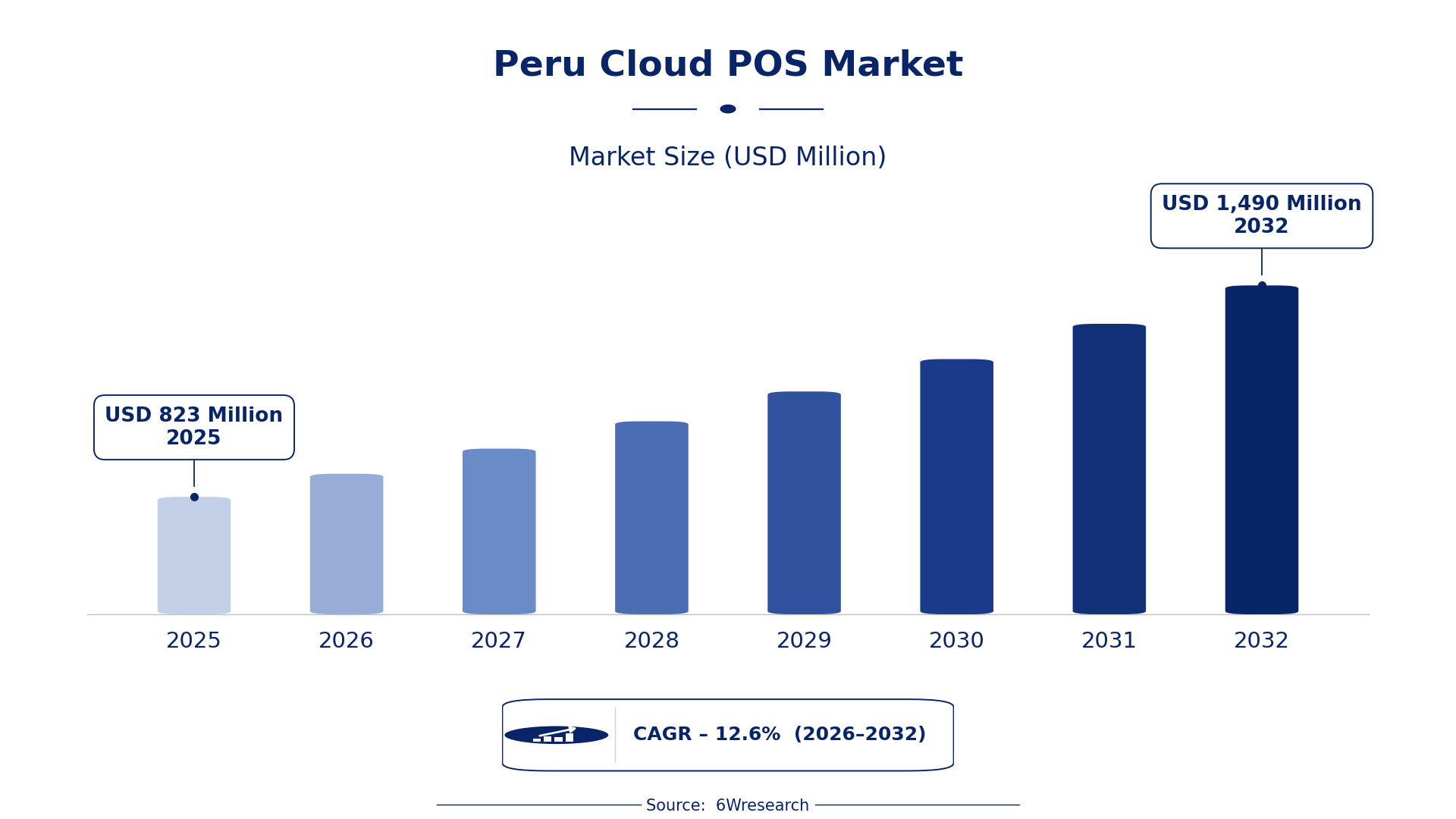
The Peru Cloud POS Market was estimated at USD 823 Million in 2025 and is projected to reach USD 1490 Million by 2032, growing at a CAGR of 12.6% from 2026 to 2032.
Peru Cloud POS Market Synopsis
The Peru Cloud POS market is in a dynamic phase, characterized by increasing adoption rates among small and medium-sized enterprises, particularly within the retail and hospitality sectors. These businesses are gravitating towards cloud-based solutions for their cost efficiency and scalability, thereby transforming traditional operations.
The shift towards digitalization is not just a trend; it’s a necessity driven by the rise of e-commerce and a demand for real-time data analytics. As government initiatives further support this transition, the market is set to expand, offering modern solutions tailored to contemporary business needs.
Peru Cloud POS Market Year-wise Growth Rate and Key Drivers
This graph illustrates the annual growth rates of the Peru Cloud POS Market from 2021 to 2032, highlighting a steady upward trajectory and projected expansion over the forecast period.
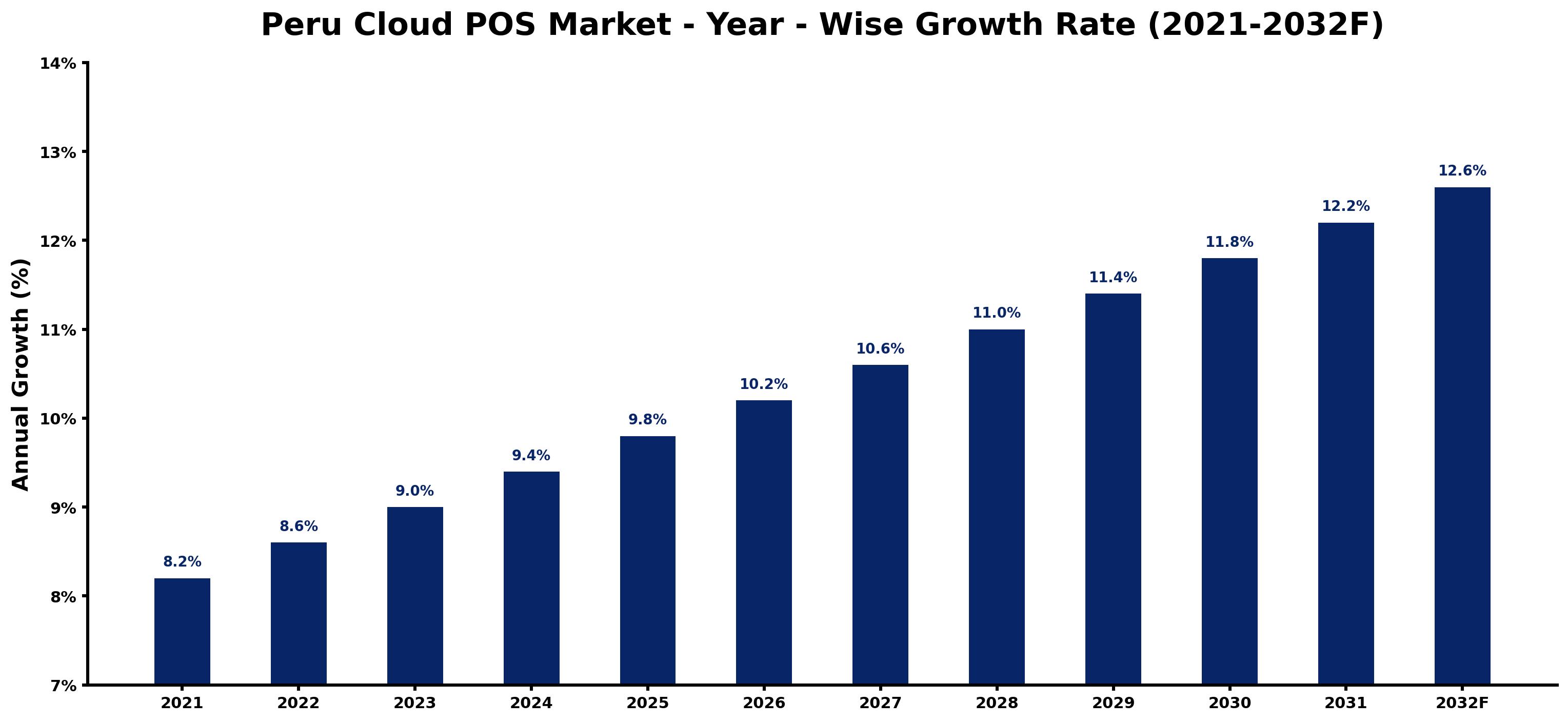
The table below presents the year‑wise growth rates along with the key drivers influencing the market
| Year | Growth Rate | Major Drivers |
| 2021 | 8.2% | Peruvian SMEs adopting digital payment solutions rapidly. |
| 2022 | 8.6% | Government incentives promoting electronic invoicing initiatives. |
| 2023 | 9.0% | Tech startups enhancing POS software functionality and support. |
| 2024 | 9.4% | Growing tourism sector demanding modern payment processing systems. |
| 2025 | 9.8% | Increased smartphone penetration aiding mobile POS deployment. |
| 2026 | 10.2% | Local fintech innovation driving competitive pricing for services. |
| 2027 | 10.6% | Finance ministry regulations boosting cloud service providers. |
| 2028 | 11.0% | Expanding e-commerce sector requiring integrated POS solutions. |
| 2029 | 11.4% | Rising focus on sustainability in retail operations. |
| 2030 | 11.8% | Consumers favoring seamless online-to-offline shopping experiences. |
| 2031 | 12.2% | Government programs fostering entrepreneurship in digital technology. |
| 2032 | 12.6% | Enhanced cybersecurity measures encouraging cloud service adoption. |
Note: Market size estimations and growth projections presented in this report are based on 6Wresearch's proprietary forecasting methodology, utilizing the latest available industry data, government publications, and primary research inputs.
Peru Cloud POS Market Key Takeaways
Below are some of the specific key takeaways from the market, including:
- The shift to cloud-based POS solutions is led by small and medium-sized businesses seeking flexibility and cost savings.
- Real-time data analytics and inventory management features are becoming critical for competitive advantage.
- Government policies encouraging digitalization are positively influencing market growth.
- Emerging trends include mobile POS integration and a focus on data security to protect consumer information.
- Market players are differentiating themselves through user-friendly interfaces and robust customer support.
Evaluation of Restraints in Peru Cloud POS Market
Despite the growth potential, several challenges hinder the market's full development. A lack of awareness about cloud solutions among smaller businesses remains a significant barrier, coupled with persistent concerns regarding data security and privacy. Many businesses still cling to traditional POS systems, creating a resistance to change.
on top of that, inadequate internet infrastructure in certain regions of Peru poses connectivity challenges, which can disrupt cloud POS operations. Transition costs from conventional systems to cloud-based solutions also deter some enterprises, especially those with limited budgets. Educating businesses about the benefits of cloud technology is essential for overcoming these hurdles.
Peru Cloud POS Market Trends
Key trends are shaping the Peru Cloud POS market. The integration of mobile POS capabilities is at the forefront, reflecting a shift toward convenience and flexibility. Companies increasingly prioritize omnichannel retailing to provide seamless customer experiences across various platforms.
Data security is gaining heightened attention as businesses seek to protect sensitive information in an increasingly digital world. The demand for innovative features such as loyalty programs and customer relationship management tools is also on the rise, driving further interest in cloud POS systems.
Peru Cloud POS Market Opportunities
The landscape presents numerous opportunities for growth and investment. With the increasing number of small and medium-sized enterprises seeking to digitize operations, there’s a significant market waiting to be tapped. Tailored solutions that cater to specific sectors, like restaurants and retail boutiques, can help vendors carve out niche markets.
Additionally, companies that can offer customizable features and exceptional customer support are likely to stand out. As businesses become more aware of the advantages of cloud technology, the market will likely see an influx of demand for innovative POS solutions.
Government Initiatives in the Peru Cloud POS Market
Government policies play a crucial role in shaping the Peru Cloud POS market. The Peruvian government is actively promoting the adoption of cloud-based solutions through various initiatives aimed at enhancing digital infrastructure and ensuring data security. These efforts are crucial for fostering a competitive and efficient retail environment.
- A recently completed initiative introduced tax incentives for businesses transitioning to cloud POS systems to encourage adoption.
- A current program is underway to improve internet infrastructure across rural areas, facilitating better connectivity for cloud-based operations.
- Upcoming legislation aims to establish regulations focused on data security and privacy for businesses utilizing cloud technology.
- A planned public-private partnership is expected to enhance support services for small businesses looking to implement cloud POS solutions by 2027.
Future Insights of the Peru Cloud POS Market
Looking ahead to 2026-2032, the Peru Cloud POS market is set for substantial growth. The shift toward advanced POS solutions will be driven by increasing demand for enhanced customer experiences and operational efficiencies. As digital payments become more prevalent and businesses seek real-time insights, the necessity for cloud POS systems will rise.
Investments in technology and infrastructure will be vital as companies strive to remain competitive. Vendors that adapt quickly to the evolving needs of businesses will likely capture a significant share of this expanding market.
Peru Cloud POS Market Latest Developments
Recent activity in the Peru Cloud POS market shows a strong trend towards innovation and adaptation. Over the last year, key players have been focusing on expanding their offerings to meet the growing demands of businesses seeking efficient and user-friendly solutions.
- A major technology vendor launched a new cloud POS solution in early 2025, featuring enhanced mobile payment integration and advanced analytics capabilities.
- An initiative that began in mid-2025 is currently underway to provide training for small businesses on the benefits and usage of cloud POS systems.
- In Q4 2025, a regional operator announced plans for a nationwide rollout of a specialized cloud POS system designed for the hospitality sector, aiming for completion by mid-2026.
- A product upgrade is expected in late 2025, focusing on improved user interface and data security features in response to market feedback.
Peru Cloud POS Market - Key Attractiveness of the Report
- 10 Years of Market Numbers
- Historical Data Starting from 2022 to 2025
- Base Year: 2025
- Forecast Data until 2032
- Key Performance Indicators Impacting the Market
- Major Upcoming Developments and Projects
There’s a growing demand for customized solutions tailored to specific sectors like retail and hospitality. Vendors can also capitalize on the increasing trend of businesses digitizing their operations.
Key Highlights of the Report:
- Peru Cloud POS Market Outlook
- Market Size of Peru Cloud POS Market, 2025
- Forecast of Peru Cloud POS Market, 2032
- Historical Data and Forecast of Peru Cloud POS Revenues & Volume for the Period 2022-2032F
- Peru Cloud POS Market Trend Evolution
- Peru Cloud POS Market Drivers and Challenges
- Peru Cloud POS Price Trends
- Peru Cloud POS Porter's Five Forces
- Peru Cloud POS Industry Life Cycle
- Historical Data and Forecast of Peru Cloud POS Market Revenues & Volume By Application Areas for the Period 2022-2032F
- Historical Data and Forecast of Peru Cloud POS Market Revenues & Volume By Retail and Consumer Goods for the Period 2022-2032F
- Historical Data and Forecast of Peru Cloud POS Market Revenues & Volume By Travel and Hospitality for the Period 2022-2032F
- Historical Data and Forecast of Peru Cloud POS Market Revenues & Volume By Media and Entertainment for the Period 2022-2032F
- Historical Data and Forecast of Peru Cloud POS Market Revenues & Volume By Transport and Logistics for the Period 2022-2032F
- Historical Data and Forecast of Peru Cloud POS Market Revenues & Volume By Healthcare for the Period 2022-2032F
- Historical Data and Forecast of Peru Cloud POS Market Revenues & Volume By Component for the Period 2022-2032F
- Historical Data and Forecast of Peru Cloud POS Market Revenues & Volume By Solution for the Period 2022-2032F
- Historical Data and Forecast of Peru Cloud POS Market Revenues & Volume By Services for the Period 2022-2032F
- Historical Data and Forecast of Peru Cloud POS Market Revenues & Volume By Service for the Period 2022-2032F
- Historical Data and Forecast of Peru Cloud POS Market Revenues & Volume By Training, Consulting, and Integration for the Period 2022-2032F
- Historical Data and Forecast of Peru Cloud POS Market Revenues & Volume By Support and Maintenance for the Period 2022-2032F
- Historical Data and Forecast of Peru Cloud POS Market Revenues & Volume By Organization Size for the Period 2022-2032F
- Historical Data and Forecast of Peru Cloud POS Market Revenues & Volume By SMEs for the Period 2022-2032F
- Historical Data and Forecast of Peru Cloud POS Market Revenues & Volume By Large Enterprises for the Period 2022-2032F
- Peru Cloud POS Import Export Trade Statistics
- Market Opportunity Assessment By Application Areas
- Market Opportunity Assessment By Component
- Market Opportunity Assessment By Service
- Market Opportunity Assessment By Organization Size
- Peru Cloud POS Top Companies Market Share
- Peru Cloud POS Competitive Benchmarking By Technical and Operational Parameters
- Peru Cloud POS Company Profiles
- Peru Cloud POS Key Strategic Recommendations






































