Qatar Commercial vehicles Market Summary
The qatar commercial vehicles market was estimated at USD 289 Million in 2025 and is projected to reach USD 403 Million by 2032, growing at a CAGR of 5.9% from 2026 to 2032.
Qatar Commercial vehicles Market Year-wise Growth Rate and Key Drivers
This graph highlights how the Qatar Commercial vehicles Market has steadily grown over the past five years, supported by major growth factors.
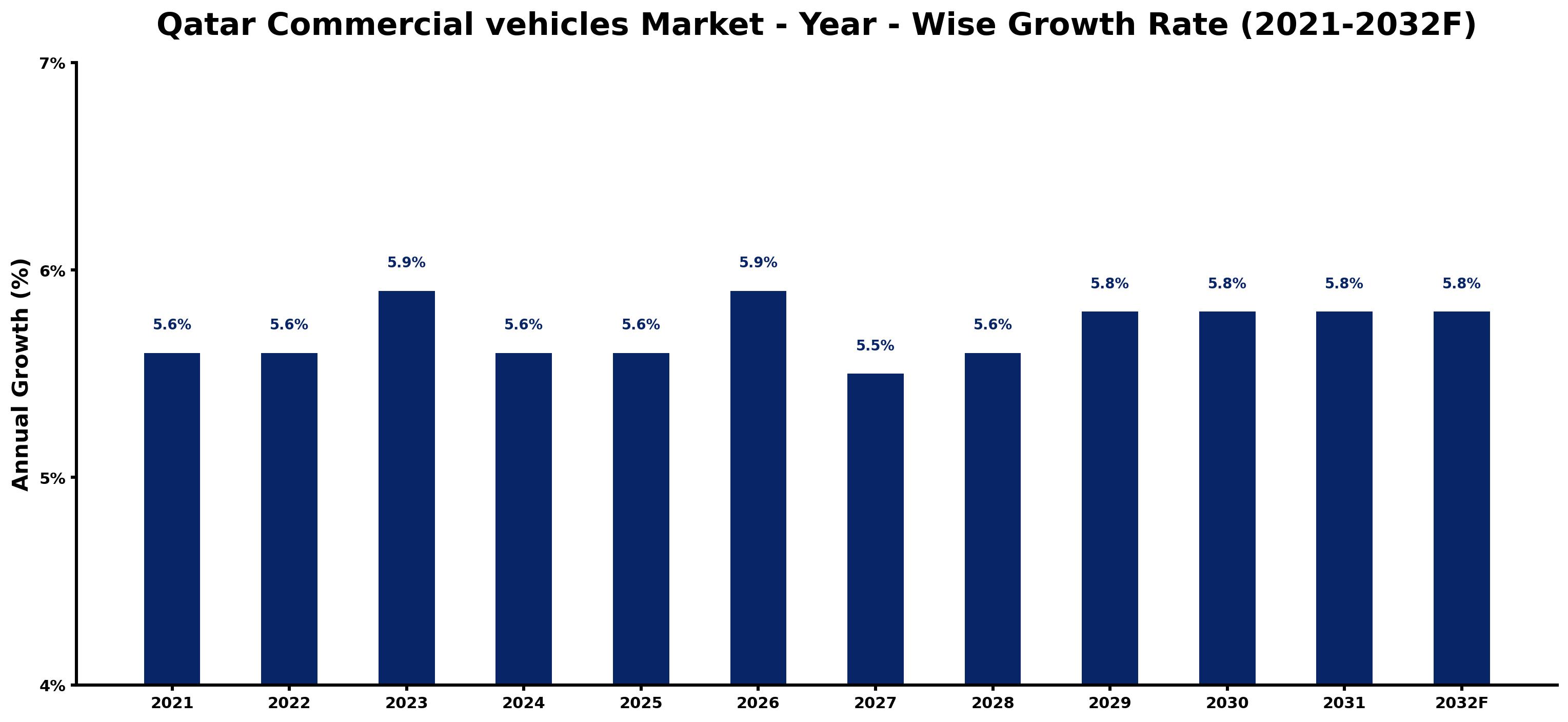
The table below presents the year wise growth rates along with the key drivers influencing the market
| Year | Growth Rate | Major Drivers |
| 2021 | 5.6% | Post-lockdown infrastructure investments spurred demand for commercial vehicles across sectors. |
| 2022 | 5.6% | Expansion of logistics networks in Qatar increased the need for reliable transport solutions. |
| 2023 | 5.9% | Rising urbanization fueled interest in commercial vehicle fleets for last-mile deliveries. |
| 2024 | 5.6% | Local manufacturers began producing specialized vehicles tailored to the region's climate requirements. |
| 2025 | 5.6% | Trade agreements with neighboring countries strengthened cross-border commercial vehicle sales. |
| 2026 | 5.9% | Tourism revival drove up demand for transport solutions in the hospitality sector. |
| 2027 | 5.5% | Sustainability initiatives prompted the introduction of electric commercial vehicles in fleets. |
| 2028 | 5.6% | Technological upgrades in fleet management systems enhanced operational efficiency for businesses. |
| 2029 | 5.8% | Public-private partnerships expanded infrastructure projects, increasing vehicle demand for construction. |
| 2030 | 5.8% | Integration of smart technologies in commercial vehicles attracted new market entrants. |
| 2031 | 5.8% | Economic diversification strategies created new industries requiring expanded commercial transport solutions. |
| 2032 | 5.8% | Regional climate challenges prompted investments in durable vehicles suited for harsh environments. |
Note - Market size estimations and growth projections presented in this report are based on 6Wresearch's advanced forecasting approach, validated with industry datasets as of June 2026.
Qatar Commercial vehicles Market Synopsis
The Qatar Commercial vehicles Market is projected to reach 5.9% and witness significant growth during the forecast period (2026-2032). The market dynamics are actively shaped by a series of influential factors, including robust infrastructure development initiatives, increasing public expenditure on construction, and a steadily expanding population. These components are vital drivers for the demand for various commercial vehicles such as medium-duty trucks, light-duty trucks, buses, and vans. As Qatar's government intensifies its focus on major road network expansions, the commercial vehicles market is anticipated to experience a surge in demand.
Qatar Commercial vehicles Market Growth Drivers
The growth of the Qatar commercial vehicles market is underpinned by several pivotal factors:
- Infrastructure Development: The ongoing and upcoming infrastructure projects, particularly related to transportation, are expected to significantly boost the demand for commercial vehicles. Enhanced road networks facilitate improved logistics and distribution, which in turn necessitates a greater number of commercial vehicles.
- Government Spending: Increased public spending on construction and urban development projects has a direct impact on the commercial vehicles market, leading to a greater requirement for various types of commercial vehicles to support these initiatives.
- Population Growth: With a rising population, there is a commensurate increase in demand for transportation services, thus enhancing the need for buses and vans, crucial for public transport.
- Oil Revenue Utilization: Qatar's robust oil production levels are generating significant revenue, which allows for substantial investment in transport infrastructure, further stimulating the market for commercial vehicles.
- Major Events: Preparations for significant events, such as the FIFA World Cup 2022, have resulted in heightened demand for commercial vehicles, providing lucrative opportunities for manufacturers.
Qatar Commercial vehicles Market Challenges and Restraints
Despite the promising outlook for the Qatar commercial vehicles market, certain challenges remain that could impede growth:
- Economic Fluctuations: Volatility in oil prices could potentially affect government spending levels, influencing the demand dynamics within the commercial vehicle sector.
- Import Dependency: The market's reliance on imported vehicles and parts may pose risks related to supply chain disruptions, leading to potential delays in project timelines.
- Regulatory Framework: Adherence to evolving regulations and standards regarding environmental impacts of commercial vehicles can create barriers for manufacturers, necessitating ongoing compliance efforts.
- Competition from Alternatives: The rise of alternative transportation solutions and technologies, including electric vehicles, could affect traditional commercial vehicle sales as consumer preferences evolve.
- Skilled Labor Shortage: The need for skilled workforce in vehicle maintenance and operation can hinder the effective utilization of the commercial vehicle fleet, impacting overall productivity.
Qatar Commercial vehicles Market Government Investment and Initiatives
The Qatari government has made significant commitments to enhance the commercial vehicles market through various investment initiatives:
- Infrastructure Investment: The government has prioritized infrastructure development as part of its National Vision 2030, aiming to create a sustainable and efficient transport system.
- Public Works Projects: Large-scale public works projects are underway, attracting both local and international investments, which increase the need for commercial vehicles to support construction efforts.
- Road Expansion Schemes: Major road and highway expansion projects are planned to improve connectivity, necessitating a substantial increase in commercial vehicle availability.
- Public Transport Enhancement: Investments in public transport infrastructure, such as bus rapid transit systems, aim to enhance mobility, directly impacting the demand for buses and vans.
- Policy Support: The government is providing incentives for the adoption of advanced vehicle technologies and greener options, aligning with global sustainability trends.
Qatar Commercial vehicles Market Latest Developments (May 2025 - June 2026)
In recent months, the Qatar commercial vehicles market has seen several notable developments that underscore its evolving landscape:
- Project Rollouts: Multiple infrastructure projects have been initiated or are in the planning phase, leading to an increased demand for construction-related commercial vehicles.
- Technological Advancements: Manufacturers are focusing on integrating advanced technology into commercial vehicles, enhancing efficiency and performance to meet market needs.
- Public Transport Initiatives: Significant enhancements in public transport systems have been undertaken, fostering growth in the bus and van segments of the commercial vehicle market.
- Collaborative Efforts: Partnerships between government and private sector entities are becoming increasingly common, aimed at leveraging resources and expertise for transport infrastructure projects.
- Sustainability Focus: There is a rising emphasis on the development of eco-friendly commercial vehicle options in response to global environmental concerns, driving innovation within the market.
Qatar Commercial vehicles Market - Key Attractiveness of the Report
- 10 Years of Market Numbers
- Historical Data Starting from 2022 to 2025
- Base Year: 2025
- Forecast Data until 2032
- Key Performance Indicators Impacting the Market
- Major Upcoming Developments and Projects
- What factors are driving the Qatar commercial vehicles market growth?
- How does government policy affect the commercial vehicles market?
- What are the main challenges faced by the commercial vehicles market in Qatar?
- What role do major events play in the commercial vehicles market demand?
Key Highlights of the Report:
- Qatar Commercial vehicles Market Outlook
- Market Size of Qatar Commercial vehicles Market, 2025
- Forecast of Qatar Commercial vehicles Market, 2032F
- Historical Data and Forecast of Qatar Commercial vehicles Revenues & Volume for the Period 2022-2032F
- Qatar Commercial vehicles Market Trend Evolution
- Qatar Commercial vehicles Market Drivers and Challenges
- Qatar Commercial vehicles Price Trends
- Qatar Commercial vehicles Porter's Five Forces
- Qatar Commercial vehicles Industry Life Cycle
- Historical Data and Forecast of Qatar Commercial vehicles Market Revenues & Volume By Product for the Period 2022-2032F
- Historical Data and Forecast of Qatar Commercial vehicles Market Revenues & Volume By Light Commercial Vehicles (LCVs) for the Period 2022-2032F
- Historical Data and Forecast of Qatar Commercial vehicles Market Revenues & Volume By Heavy Trucks for the Period 2022-2032F
- Historical Data and Forecast of Qatar Commercial vehicles Market Revenues & Volume By Buses & Coaches for the Period 2022-2032F
- Historical Data and Forecast of Qatar Commercial vehicles Market Revenues & Volume By End-Users for the Period 2022-2032F
- Historical Data and Forecast of Qatar Commercial vehicles Market Revenues & Volume By Industrial for the Period 2022-2032F
- Historical Data and Forecast of Qatar Commercial vehicles Market Revenues & Volume By Mining & Construction for the Period 2022-2032F
- Historical Data and Forecast of Qatar Commercial vehicles Market Revenues & Volume By Logistics for the Period 2022-2032F
- Historical Data and Forecast of Qatar Commercial vehicles Market Revenues & Volume By Passenger Transportation for the Period 2022-2032F
- Historical Data and Forecast of Qatar Commercial vehicles Market Revenues & Volume By Others for the Period 2022-2032F
- Qatar Commercial vehicles Import Export Trade Statistics
- Market Opportunity Assessment By Product
- Market Opportunity Assessment By End-Users
- Qatar Commercial vehicles Top Companies Market Share
- Qatar Commercial vehicles Competitive Benchmarking By Technical and Operational Parameters
- Qatar Commercial vehicles Company Profiles
- Qatar Commercial vehicles Key Strategic Recommendations






































