Qatar Computer Software Market Size, Share & Growth Rate
The Qatar Computer Software Market was estimated at USD 183 Million in 2025 and is projected to reach USD 259 Million by 2032, growing at a CAGR of 5.1% from 2026 to 2032. This growth trajectory is largely propelled by the ongoing digital transformation initiatives led by both the government and private sectors. Enhanced cybersecurity needs, coupled with the rising demand for cloud computing and data analytics solutions, are among the key factors driving software investment across various industries in Qatar.
Qatar Computer Software Market Year-wise Growth Rate and Key Drivers
This graph highlights how the Qatar Computer Software Market has steadily grown over the years, supported by major growth factors.
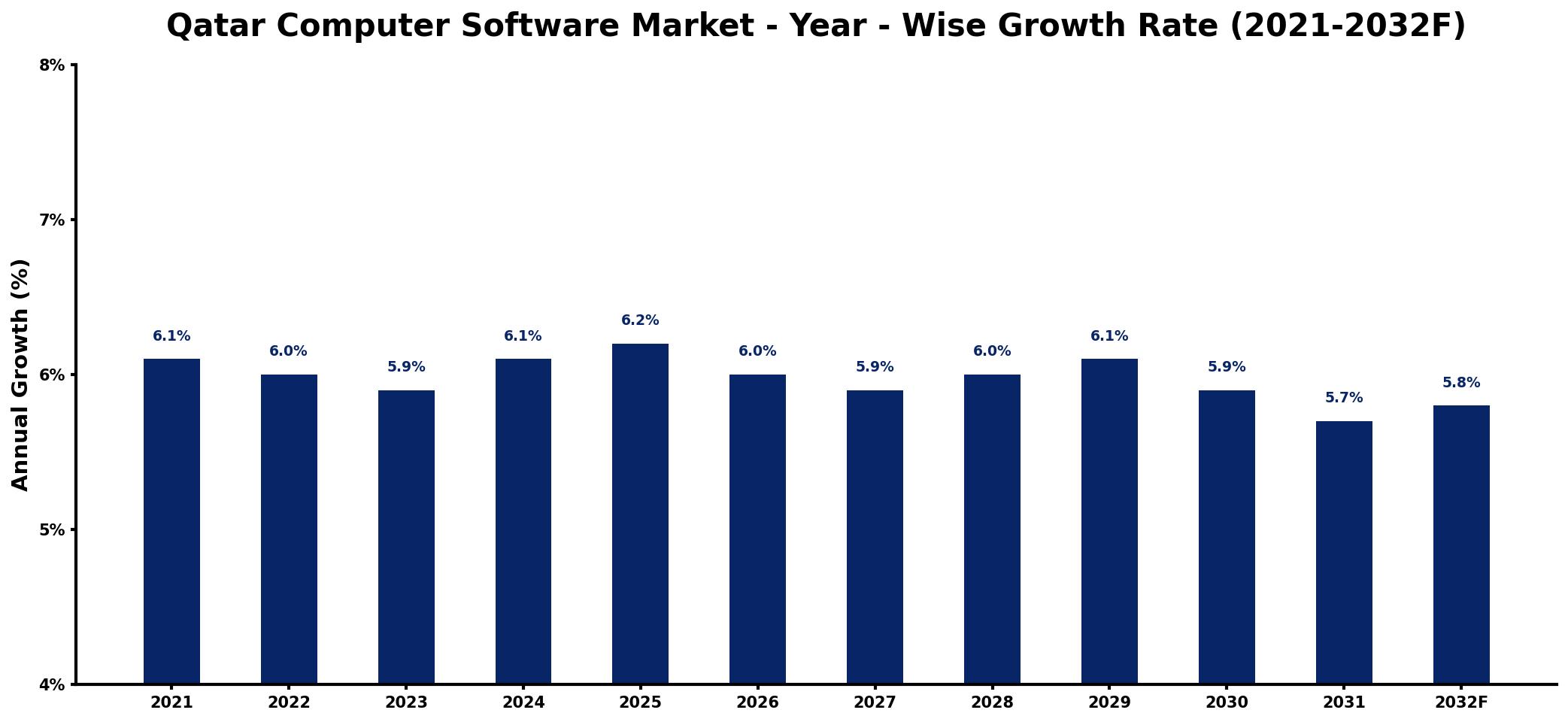
The table below presents the year‑wise growth rates along with the key drivers influencing the market
| Year | Growth Rate | Major Drivers |
| 2021 | 6.1% | Rising demand for digital solutions |
| 2022 | 6.0% | Increased investment in technology infrastructure |
| 2023 | 5.9% | Growing adoption of cloud services |
| 2024 | 6.1% | Expansion of mobile app development |
| 2025 | 6.2% | Surge in cybersecurity requirements |
| 2026 | 6.0% | Higher demand for data analytics |
| 2027 | 5.9% | Emergence of artificial intelligence applications |
| 2028 | 6.0% | Strengthening of e-commerce platforms |
| 2029 | 6.1% | Boost in remote working tools |
| 2030 | 5.9% | Growing interest in automation technologies |
| 2031 | 5.7% | Shift towards sustainable tech solutions |
| 2032 | 5.8% | Increase in digital transformation initiatives |
Note: Market size estimations and growth projections presented in this report are based on 6Wresearch's proprietary forecasting methodology, utilizing the latest available industry data, government publications, and primary research inputs.
Qatar Computer Software Market Synopsis
The computer software market in Qatar is currently experiencing remarkable expansion, spurred by the nation's strategic commitment to embracing digital solutions. As businesses increasingly adopt technology to optimize processes and improve customer experiences, the demand for innovative software solutions has intensified.
In this climate of rapid technological advancement, sectors such as cybersecurity, software development, and cloud services are at the forefront of growth. The integration of digital platforms into everyday operations signals a robust shift that positions Qatar as a prominent player in the regional technology landscape.
Qatar Computer Software Market Key Takeaways
- The market is on a strong growth trajectory, projected to reach USD 259 Million by 2032.
- Increased government and private sector investments in digital solutions are enhancing operational efficiencies.
- Cybersecurity and cloud computing are emerging as critical areas of focus for businesses.
- The pandemic has accelerated the digital transformation efforts across industries in Qatar.
- Strategic investments in technology infrastructure are attracting software vendors and developers to the region.
Evaluation of Restraints in Qatar Computer Software Market
Despite the markets dynamic growth, certain limitations persist that could affect its trajectory. Cybersecurity remains a paramount concern, as increasing digitization exposes organizations to heightened risks of cyber threats. This necessitates ongoing investments in robust cybersecurity measures to protect sensitive data and build customer trust. Additionally, the prevalence of software piracy continues to challenge revenue generation for legitimate software vendors. Economic fluctuations may further impact the procurement budgets of businesses and governmental entities, adding another layer of complexity to the market landscape.
Qatar Computer Software Market Trends
Emerging trends in the Qatar Computer Software Market are shaping the future of technology adoption in the region. The rise of artificial intelligence and machine learning applications is increasingly transforming business processes, leading to better decision-making and operational efficiencies. Additionally, the growing emphasis on remote work and virtual collaboration tools post-COVID-19 is driving demand for integrated software solutions. Enterprises are seeking adaptable, scalable software products that not only enhance productivity but also ensure data security and regulatory compliance.
Qatar Computer Software Market Opportunities
As the Qatar Computer Software Market continues to mature, numerous growth opportunities emerge. Companies focusing on cybersecurity solutions stand to benefit significantly, given the country's increasing awareness of digital threats. Moreover, the acceleration of cloud-based service adoption presents a lucrative avenue for software providers. Investment in custom software development tailored to industry-specific needs can further enhance competitiveness, while the growth of e-commerce and digital services offers a vast playground for innovative software applications.
Government Initiatives in the Qatar Computer Software Market
The Qatari government is playing a pivotal role in shaping the computer software market through various initiatives aimed at boosting digital transformation. Investments in technology infrastructure, support for innovation hubs, and incentives for tech startups illustrate the governments commitment to fostering a vibrant technology ecosystem. Programs encouraging collaboration between public and private sectors are designed to facilitate the development and adoption of advanced software solutions across different industries.
Future Insights of the Qatar Computer Software Market
Looking ahead to 2026-2032, the Qatar Computer Software Market is poised for continued growth as digital transformation becomes an ingrained aspect of business strategy. The emphasis on AI and data analytics is expected to accelerate, enabling organizations to harness data for strategic advantages. Furthermore, as cybersecurity threats evolve, the demand for comprehensive security solutions will likely surge, creating a robust market for innovative software providers.
Qatar Computer Software Market Latest Developments (2025 - 2026)
Recent developments within the Qatar Computer Software Market indicate a clear direction towards increased investment in advanced software solutions. Businesses are prioritizing the integration of AI-driven technologies to enhance operational efficiencies. Additionally, there is a growing emphasis on collaborative platforms and cybersecurity measures to safeguard digital assets. The ongoing push for modernization across public services suggests that software providers will continue to find new opportunities for growth in the coming months.
Qatar Computer Software Market - Key Attractiveness of the Report
- 10 Years of Market Numbers
- Historical Data Starting from 2022 to 2025
- Base Year: 2025
- Forecast Data until 2032
- Key Performance Indicators Impacting the Market
- Major Upcoming Developments and Projects
Key Highlights of the Report:
- Qatar Computer Software Market Outlook
- Market Size of Qatar Computer Software Market, 2025
- Forecast of Qatar Computer Software Market, 2032
- Historical Data and Forecast of Qatar Computer Software Revenues & Volume for the Period 2022-2032F
- Qatar Computer Software Market Trend Evolution
- Qatar Computer Software Market Drivers and Challenges
- Qatar Computer Software Price Trends
- Qatar Computer Software Porter's Five Forces
- Qatar Computer Software Industry Life Cycle
- Historical Data and Forecast of Qatar Computer Software Market Revenues & Volume By Type for the Period 2022-2032F
- Historical Data and Forecast of Qatar Computer Software Market Revenues & Volume By Operating Systems & Productivity Software Publishing for the Period 2022-2032F
- Historical Data and Forecast of Qatar Computer Software Market Revenues & Volume By Database, Storage & Backup Software Publishing for the Period 2022-2032F
- Historical Data and Forecast of Qatar Computer Software Market Revenues & Volume By Business Analytics & Enterprise Software for the Period 2022-2032F
- Historical Data and Forecast of Qatar Computer Software Market Revenues & Volume By Video Game Software for the Period 2022-2032F
- Historical Data and Forecast of Qatar Computer Software Market Revenues & Volume By Design for the Period 2022-2032F
- Historical Data and Forecast of Qatar Computer Software Market Revenues & Volume By Editing & Rendering Software for the Period 2022-2032F
- Historical Data and Forecast of Qatar Computer Software Market Revenues & Volume By Application for the Period 2022-2032F
- Historical Data and Forecast of Qatar Computer Software Market Revenues & Volume By Personal for the Period 2022-2032F
- Historical Data and Forecast of Qatar Computer Software Market Revenues & Volume By Business/Commercial for the Period 2022-2032F
- Historical Data and Forecast of Qatar Computer Software Market Revenues & Volume By Industrial for the Period 2022-2032F
- Historical Data and Forecast of Qatar Computer Software Market Revenues & Volume By Industry Verticals for the Period 2022-2032F
- Historical Data and Forecast of Qatar Computer Software Market Revenues & Volume By BFSI for the Period 2022-2032F
- Historical Data and Forecast of Qatar Computer Software Market Revenues & Volume By Media & Entertainment for the Period 2022-2032F
- Historical Data and Forecast of Qatar Computer Software Market Revenues & Volume By IT & Telecommunications for the Period 2022-2032F
- Historical Data and Forecast of Qatar Computer Software Market Revenues & Volume By Energy & Utilities for the Period 2022-2032F
- Historical Data and Forecast of Qatar Computer Software Market Revenues & Volume By Government & Public Sector for the Period 2022-2032F
- Historical Data and Forecast of Qatar Computer Software Market Revenues & Volume By Retail & Consumer Goods for the Period 2022-2032F
- Historical Data and Forecast of Qatar Computer Software Market Revenues & Volume By Manufacturing for the Period 2022-2032F
- Historical Data and Forecast of Qatar Computer Software Market Revenues & Volume By Others for the Period 2022-2032F
- Qatar Computer Software Import Export Trade Statistics
- Market Opportunity Assessment By Type
- Market Opportunity Assessment By Application
- Market Opportunity Assessment By Industry Verticals
- Qatar Computer Software Top Companies Market Share
- Qatar Computer Software Competitive Benchmarking By Technical and Operational Parameters
- Qatar Computer Software Company Profiles
- Qatar Computer Software Key Strategic Recommendations






































