Qatar Concrete Aggregate Market Size, Share & Growth Rate
The Qatar Concrete Aggregate Market was estimated at USD 1163 Million in 2025 and is projected to reach USD 1687 Million by 2032, growing at a CAGR of 5.5% from 2026 to 2032. This upward trajectory is primarily driven by the robust demand arising from large-scale infrastructure projects, ongoing urbanization, and significant government investments aimed at bolstering the construction sector. As Qatar gears up for various international events and continues to prioritize sustainable development, the need for high-quality concrete aggregates is anticipated to rise sharply.
Qatar Concrete Aggregate Market Year-wise Growth Rate and Key Drivers
This graph highlights how the Qatar Concrete Aggregate Market has steadily grown over the years, supported by major growth factors.
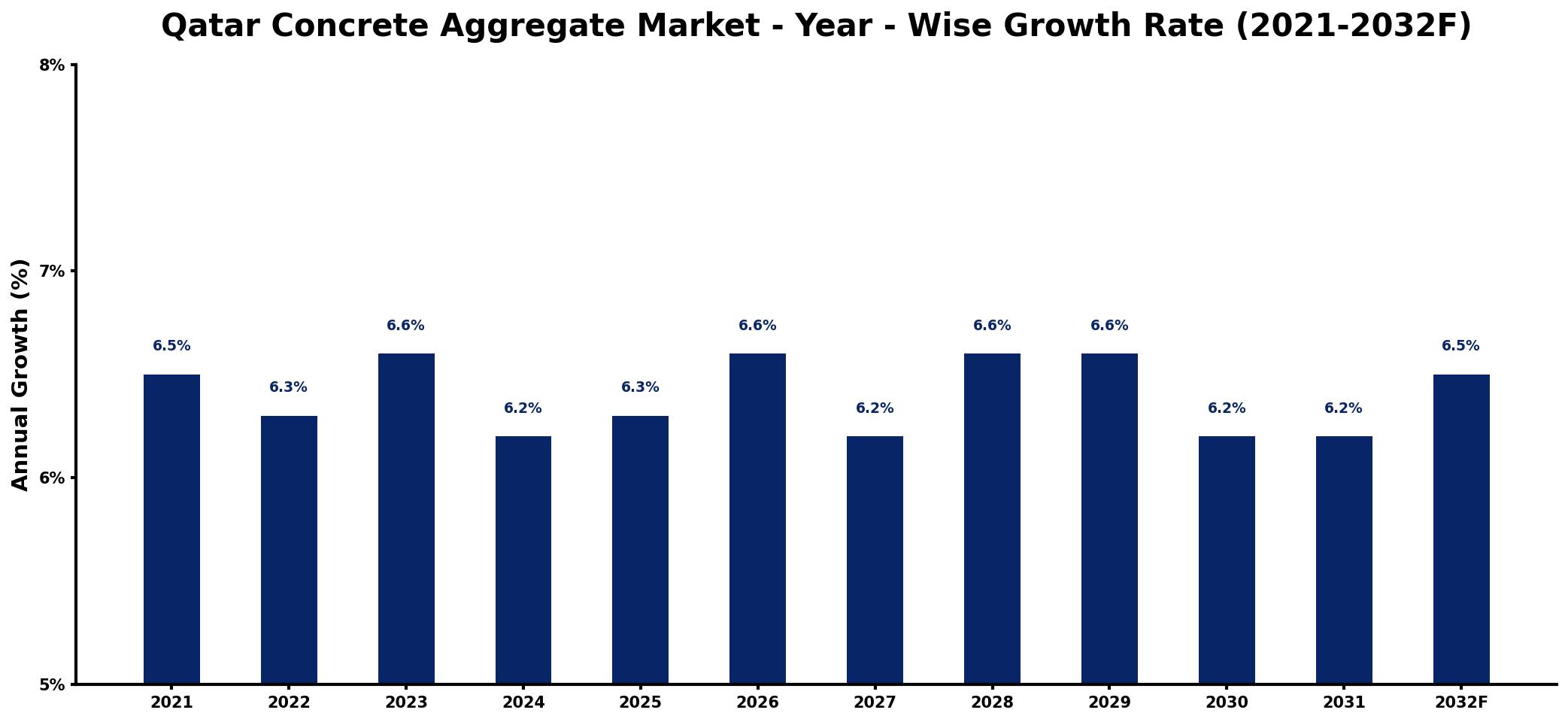
The table below presents the year‑wise growth rates along with the key drivers influencing the market
| Year | Growth Rate | Major Drivers |
| 2021 | 6.5% | Infrastructure investments increase significantly |
| 2022 | 6.3% | Construction sector demand rises consistently |
| 2023 | 6.6% | Real estate projects expand rapidly |
| 2024 | 6.2% | Government initiatives boost infrastructure development |
| 2025 | 6.3% | Urbanization trends drive material demand |
| 2026 | 6.6% | Sustainable building practices gain traction |
| 2027 | 6.2% | Public-private partnerships enhance projects |
| 2028 | 6.6% | Technological advancements improve efficiency |
| 2029 | 6.6% | International events stimulate local construction |
| 2030 | 6.2% | Regulatory frameworks support industry growth |
| 2031 | 6.2% | Rising population fuels housing demand |
| 2032 | 6.5% | Economic diversification enhances market opportunities |
Note: Market size estimations and growth projections presented in this report are based on 6Wresearch's proprietary forecasting methodology, utilizing the latest available industry data, government publications, and primary research inputs.
Qatar Concrete Aggregate Market Synopsis
In recent years, the Qatar Concrete Aggregate Market has witnessed significant momentum, propelled by the construction industry's relentless growth. However, as the nation enters a new phase of urbanization and infrastructure enhancement, the market is set to expand even further, driven by an increasing number of projects and environmental considerations.
Looking ahead, the demand for concrete aggregates is positioned to strengthen, thanks to an evolving construction landscape focused on quality and sustainability. The current emphasis on eco-friendly materials will likely influence supply strategies, ensuring that producers can meet both market needs and regulatory standards.
Qatar Concrete Aggregate Market Key Takeaways
- Growing infrastructure projects fuel robust demand for concrete aggregates in Qatar.
- Government initiatives are significantly bolstering investments in housing and transportation sectors.
- Focus on sustainability and eco-friendly aggregate solutions is gaining traction.
- Market players face challenges in maintaining high-quality supply amid increasing competition.
- The rebound from COVID-19 is expected to further stimulate market growth.
Evaluation of Restraints in Qatar Concrete Aggregate Market
Despite the promising growth trajectory, several constraints are impeding the full potential of the Qatar Concrete Aggregate Market. One of the most significant challenges is the consistent supply of high-quality aggregates, which is crucial for meeting the stringent demands of construction projects. Moreover, environmental regulations around quarrying and extraction processes pose hurdles for suppliers. This is compounded by the competitive nature of the market, where resource allocation and strategic positioning are vital for success. The need for continuous compliance with regulatory standards further adds complexity to the operational landscape.
Qatar Concrete Aggregate Market Trends
Several trends are currently shaping the demand and technology landscape within the Qatar Concrete Aggregate Market. There is a notable shift towards the use of recycled and eco-friendly aggregates, driven by both consumer demand for sustainable options and government regulations promoting environmental responsibility. Additionally, the integration of advanced technologies in extraction and processing is enhancing operational efficiency and product quality. The increasing use of prefabricated materials in construction also indicates a potential change in how aggregates are sourced and utilized.
Qatar Concrete Aggregate Market Opportunities
Growth opportunities within the Qatar Concrete Aggregate Market are abundant, particularly in the realm of sustainable construction practices. Suppliers that can innovate in producing eco-friendly aggregates are likely to capture significant market share. Furthermore, the ongoing urbanization and infrastructure projects, including housing and transportation systems, present substantial opportunities for investment and collaboration. Companies focusing on technological advancements to enhance the quality and efficiency of aggregate production will be well-positioned to thrive in this evolving market.
Government Initiatives in the Qatar Concrete Aggregate Market
The Qatari government is actively promoting initiatives that support the concrete aggregate market through significant public spending on infrastructure and urban development projects. Policies aimed at enhancing sustainability in construction are also being implemented, which encourage the adoption of eco-friendly materials. Additionally, the government's Vision 2030 plan prioritizes infrastructure development, creating a favorable environment for businesses operating in the concrete aggregate sector.
Future Insights of the Qatar Concrete Aggregate Market
Looking ahead to the 2026-2032 period, the Qatar Concrete Aggregate Market is expected to maintain its growth momentum. Driven by ongoing infrastructure projects and the governments commitment to urban development, the demand for concrete aggregates will likely surge. The increasing emphasis on sustainability will catalyze a transformation in sourcing and production methods, resulting in a market that is not only lucrative but also aligned with global environmental standards.
Qatar Concrete Aggregate Market Latest Developments (2025 - 2026)
Recent developments in the Qatar Concrete Aggregate Market reflect a dynamic shift towards greater sustainability and innovation. Companies are beginning to invest in advanced processing technologies, aimed at enhancing product quality while minimizing environmental impacts. The construction industry continues to adapt post-pandemic, with a strong focus on resilient infrastructure projects that prioritize eco-friendly materials. Moreover, discussions around regulatory frameworks are gaining traction as stakeholders work towards sustainable growth in the sector.
Qatar Concrete Aggregate Market - Key Attractiveness of the Report
- 10 Years of Market Numbers
- Historical Data Starting from 2022 to 2025
- Base Year: 2025
- Forecast Data until 2032
- Key Performance Indicators Impacting the Market
- Major Upcoming Developments and Projects
Key Highlights of the Report:
- Qatar Concrete Aggregate Market Outlook
- Market Size of Qatar Concrete Aggregate Market, 2025
- Forecast of Qatar Concrete Aggregate Market, 2032
- Historical Data and Forecast of Qatar Concrete Aggregate Revenues & Volume for the Period 2022-2032F
- Qatar Concrete Aggregate Market Trend Evolution
- Qatar Concrete Aggregate Market Drivers and Challenges
- Qatar Concrete Aggregate Price Trends
- Qatar Concrete Aggregate Porter's Five Forces
- Qatar Concrete Aggregate Industry Life Cycle
- Historical Data and Forecast of Qatar Concrete Aggregate Market Revenues & Volume By Production for the Period 2022-2032F
- Historical Data and Forecast of Qatar Concrete Aggregate Market Revenues & Volume By Natural for the Period 2022-2032F
- Historical Data and Forecast of Qatar Concrete Aggregate Market Revenues & Volume By Artificial for the Period 2022-2032F
- Historical Data and Forecast of Qatar Concrete Aggregate Market Revenues & Volume By Processed for the Period 2022-2032F
- Historical Data and Forecast of Qatar Concrete Aggregate Market Revenues & Volume By Glass Ceramics for the Period 2022-2032F
- Historical Data and Forecast of Qatar Concrete Aggregate Market Revenues & Volume By Manufactured Marbles for the Period 2022-2032F
- Historical Data and Forecast of Qatar Concrete Aggregate Market Revenues & Volume By Bulk Density for the Period 2022-2032F
- Historical Data and Forecast of Qatar Concrete Aggregate Market Revenues & Volume By ASTM C33 for the Period 2022-2032F
- Historical Data and Forecast of Qatar Concrete Aggregate Market Revenues & Volume By mechanical properties for the Period 2022-2032F
- Historical Data and Forecast of Qatar Concrete Aggregate Market Revenues & Volume By Abrasive power for the Period 2022-2032F
- Historical Data and Forecast of Qatar Concrete Aggregate Market Revenues & Volume By Particle Size for the Period 2022-2032F
- Historical Data and Forecast of Qatar Concrete Aggregate Market Revenues & Volume By Fine Aggregates for the Period 2022-2032F
- Historical Data and Forecast of Qatar Concrete Aggregate Market Revenues & Volume By Coarse Aggregate for the Period 2022-2032F
- Qatar Concrete Aggregate Import Export Trade Statistics
- Market Opportunity Assessment By Production
- Market Opportunity Assessment By Bulk Density
- Market Opportunity Assessment By mechanical properties
- Market Opportunity Assessment By Particle Size
- Qatar Concrete Aggregate Top Companies Market Share
- Qatar Concrete Aggregate Competitive Benchmarking By Technical and Operational Parameters
- Qatar Concrete Aggregate Company Profiles
- Qatar Concrete Aggregate Key Strategic Recommendations






































