Qatar Corticosteroid Market Size, Share & Growth Rate
The Qatar Corticosteroid Market was estimated at USD 1139 Million in 2025 and is projected to reach USD 1644 Million by 2032, growing at a CAGR of 5.4% from 2026 to 2032. This growth trajectory is primarily influenced by the increasing prevalence of inflammatory and autoimmune disorders, which have led to a higher demand for corticosteroids as effective treatment options. Furthermore, the aging population and rising health awareness regarding skin and inflammatory conditions are propelling the market forward, alongside advancements in drug formulation technologies.
Qatar Corticosteroid Market Year-wise Growth Rate and Key Drivers
This graph highlights how the Qatar Corticosteroid Market has steadily grown over the years, supported by major growth factors.
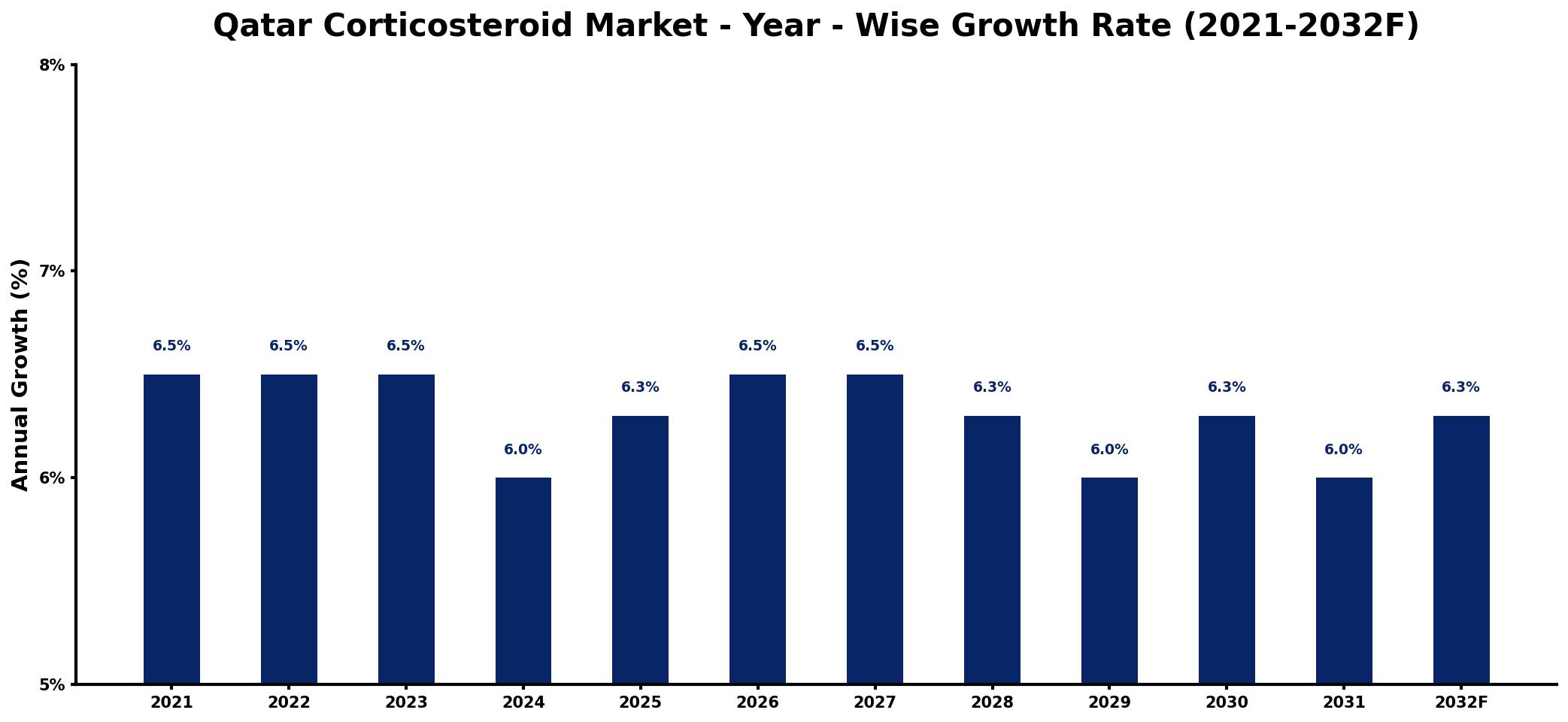
The table below presents the year‑wise growth rates along with the key drivers influencing the market
| Year | Growth Rate | Major Drivers |
| 2021 | 6.5% | Rising prevalence of chronic conditions |
| 2022 | 6.5% | Increased healthcare expenditure growth |
| 2023 | 6.5% | Expansion of healthcare infrastructure |
| 2024 | 6.0% | Growing demand for specialized treatments |
| 2025 | 6.3% | Technological advancements in therapies |
| 2026 | 6.5% | Increase in patient awareness campaigns |
| 2027 | 6.5% | Higher investments in research initiatives |
| 2028 | 6.3% | Emergence of innovative treatment options |
| 2029 | 6.0% | Strengthening distribution network capabilities |
| 2030 | 6.3% | Collaboration between healthcare stakeholders |
| 2031 | 6.0% | Enhanced regulatory support for therapies |
| 2032 | 6.3% | Wider access to healthcare services |
Note: Market size estimations and growth projections presented in this report are based on 6Wresearch's proprietary forecasting methodology, utilizing the latest available industry data, government publications, and primary research inputs.
Qatar Corticosteroid Market Synopsis
The corticosteroid market in Qatar is on an upward trend, marked by a robust demand for anti-inflammatory treatments driven by a heightened awareness of health issues among the population. Recent years have shown a surge in prescribing these medications for both dermatological and autoimmune conditions, positioning the market favorably.
Looking ahead, the market is expected to continue its growth trajectory, bolstered by new drug delivery systems and an increase in local pharmaceutical manufacturing capabilities. This shift not only enhances accessibility but also supports the competitive landscape, ensuring a diverse range of corticosteroid products are available to meet evolving healthcare needs.
Qatar Corticosteroid Market Key Takeaways
- The market is experiencing steady growth driven by the rising incidence of inflammatory and autoimmune disorders.
- Increasing healthcare access and awareness around skin health are enhancing the demand for corticosteroids.
- Advancements in drug delivery mechanisms are expanding the applications of corticosteroids beyond traditional uses.
- Key players in the market are focused on research and development to innovate new formulations.
- The aging population in Qatar is likely to contribute to sustained market growth as more individuals seek treatment for chronic conditions.
Evaluation of Restraints in Qatar Corticosteroid Market
Despite the positive outlook, the Qatar corticosteroid market faces several restraints. One significant concern is the potential side effects associated with prolonged use of corticosteroids, which may lead to increased regulatory scrutiny and a shift in prescribing practices. Additionally, the demand for affordable healthcare options poses challenges, particularly in relation to insurance coverage for these treatments. These factors could hinder market expansion and may necessitate strategies that emphasize patient safety and cost-effectiveness.
Qatar Corticosteroid Market Trends
Current trends in the Qatar corticosteroid market include a notable shift towards personalized medicine, where treatments are tailored to individual patient profiles, enhancing therapeutic outcomes. Furthermore, the adoption of advanced drug formulations, such as extended-release systems, is gaining traction, allowing for less frequent dosing and improved patient compliance. Theres also an increasing focus on non-systemic corticosteroid options, addressing concerns regarding side effects while providing effective anti-inflammatory solutions.
Qatar Corticosteroid Market Opportunities
As the market evolves, significant growth opportunities lie in the development of novel corticosteroid formulations aimed at treating complex conditions such as psoriasis and rheumatoid arthritis. Additionally, expanding distribution networks and enhancing online pharmacy access could increase market penetration and consumer reach. Public health campaigns focusing on awareness about inflammatory and autoimmune disorders can further stimulate demand and encourage preventive healthcare approaches.
Government Initiatives in the Qatar Corticosteroid Market
The Qatari government continues to invest in healthcare infrastructure, providing a supportive environment for the growth of the corticosteroid market. Initiatives aimed at improving healthcare access and promoting public health awareness play a crucial role in driving market dynamics. Additionally, policies that facilitate the importation and local production of pharmaceuticals create a more competitive market landscape and can lead to more affordable treatment options for patients.
Future Insights of the Qatar Corticosteroid Market
In the coming years, the Qatar corticosteroid market is poised for significant expansion. The combination of an aging population, increasing healthcare access, and ongoing research and development efforts will likely fuel this growth. As healthcare providers and patients become more informed about the benefits and risks of corticosteroids, the market is expected to stabilize and evolve to meet emerging healthcare needs effectively.
Qatar Corticosteroid Market Latest Developments (2025 - 2026)
Recent developments in the Qatar corticosteroid market highlight ongoing collaborations between public health institutions and private pharmaceutical companies, aimed at enhancing research capabilities and drug accessibility. There is a growing emphasis on the development of next-generation corticosteroids that promise improved efficacy and reduced side effects. Additionally, advancements in telemedicine are facilitating consultations and prescriptions, increasing patient engagement in treatment plans.
Qatar Corticosteroid Market - Key Attractiveness of the Report
- 10 Years of Market Numbers
- Historical Data Starting from 2022 to 2025
- Base Year: 2025
- Forecast Data until 2032
- Key Performance Indicators Impacting the Market
- Major Upcoming Developments and Projects
Key Highlights of the Report:
- Qatar Corticosteroid Market Outlook
- Market Size of Qatar Corticosteroid Market, 2025
- Forecast of Qatar Corticosteroid Market, 2032
- Historical Data and Forecast of Qatar Corticosteroid Revenues & Volume for the Period 2022-2032F
- Qatar Corticosteroid Market Trend Evolution
- Qatar Corticosteroid Market Drivers and Challenges
- Qatar Corticosteroid Price Trends
- Qatar Corticosteroid Porter's Five Forces
- Qatar Corticosteroid Industry Life Cycle
- Historical Data and Forecast of Qatar Corticosteroid Market Revenues & Volume By Product for the Period 2022-2032F
- Historical Data and Forecast of Qatar Corticosteroid Market Revenues & Volume By Glucocorticoids for the Period 2022-2032F
- Historical Data and Forecast of Qatar Corticosteroid Market Revenues & Volume By Mineralocorticoids for the Period 2022-2032F
- Historical Data and Forecast of Qatar Corticosteroid Market Revenues & Volume By Administration for the Period 2022-2032F
- Historical Data and Forecast of Qatar Corticosteroid Market Revenues & Volume By Topical Steroids for the Period 2022-2032F
- Historical Data and Forecast of Qatar Corticosteroid Market Revenues & Volume By Inhaled Steroids for the Period 2022-2032F
- Historical Data and Forecast of Qatar Corticosteroid Market Revenues & Volume By Oral Forms for the Period 2022-2032F
- Historical Data and Forecast of Qatar Corticosteroid Market Revenues & Volume By Systemic Forms for the Period 2022-2032F
- Historical Data and Forecast of Qatar Corticosteroid Market Revenues & Volume By Others for the Period 2022-2032F
- Historical Data and Forecast of Qatar Corticosteroid Market Revenues & Volume By Application for the Period 2022-2032F
- Historical Data and Forecast of Qatar Corticosteroid Market Revenues & Volume By Rheumatology Indications for the Period 2022-2032F
- Historical Data and Forecast of Qatar Corticosteroid Market Revenues & Volume By Skin Allergies for the Period 2022-2032F
- Historical Data and Forecast of Qatar Corticosteroid Market Revenues & Volume By Endocrinology for the Period 2022-2032F
- Historical Data and Forecast of Qatar Corticosteroid Market Revenues & Volume By Gastroenterology for the Period 2022-2032F
- Historical Data and Forecast of Qatar Corticosteroid Market Revenues & Volume By Acute Respiratory Diseases for the Period 2022-2032F
- Historical Data and Forecast of Qatar Corticosteroid Market Revenues & Volume By Others for the Period 2022-2032F
- Qatar Corticosteroid Import Export Trade Statistics
- Market Opportunity Assessment By Product
- Market Opportunity Assessment By Administration
- Market Opportunity Assessment By Application
- Qatar Corticosteroid Top Companies Market Share
- Qatar Corticosteroid Competitive Benchmarking By Technical and Operational Parameters
- Qatar Corticosteroid Company Profiles
- Qatar Corticosteroid Key Strategic Recommendations






































