Qatar Crystal Lighting Market Summary
The qatar crystal lighting market was estimated at USD 463 Million in 2025 and is projected to reach USD 636 Million by 2032, growing at a CAGR of 5.2% from 2026 to 2032.
Qatar Crystal Lighting Market Year-wise Growth Rate and Key Drivers
This graph highlights how the Qatar Crystal Lighting Market has steadily grown over the past five years, supported by major growth factors.
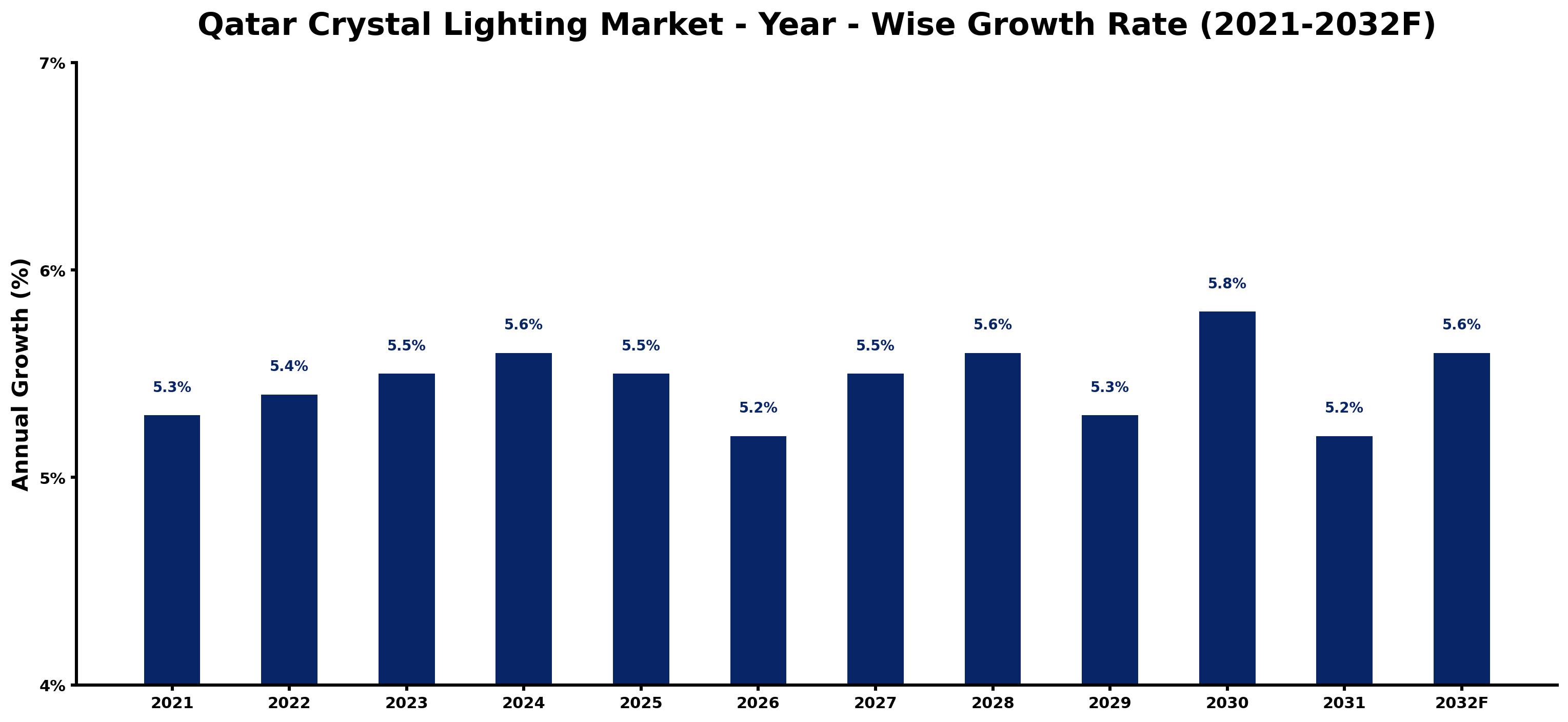
The table below presents the year wise growth rates along with the key drivers influencing the market
| Year | Growth Rate | Major Drivers |
| 2021 | 5.3% | Post-lockdown retail projects stimulated increased investment in illuminated displays. |
| 2022 | 5.4% | High-profile events showcased Qatar's capability for innovative lighting design solutions. |
| 2023 | 5.5% | Construction projects for World Cup facilities heightened demand for specialized lighting fixtures. |
| 2024 | 5.6% | Hospitality sector expansion intensified the need for aesthetically pleasing lighting designs. |
| 2025 | 5.5% | Emerging preferences for energy-efficient solutions began reshaping product offerings significantly. |
| 2026 | 5.2% | Urban development projects required advanced lighting systems for safety and ambiance. |
| 2027 | 5.5% | Luxury residential projects incorporated smart lighting technologies to enhance living experiences. |
| 2028 | 5.6% | Corporate sustainability goals prompted investments in eco-friendly lighting technologies. |
| 2029 | 5.3% | Cultural events drove interest in traditional designs paired with modern technologies. |
| 2030 | 5.8% | International collaborations introduced new lighting technologies to the local market. |
| 2031 | 5.2% | Enhanced consumer awareness of design trends shifted preferences towards customizable options. |
| 2032 | 5.6% | Technological integration with IoT created innovative lighting solutions for smart cities. |
Note - Market size estimations and growth projections presented in this report are based on 6Wresearch's advanced forecasting approach, validated with industry datasets as of June 2026.
Qatar Crystal Lighting Market Synopsis
The Qatar Crystal Lighting Market is projected to reach 5.2% and witness significant growth during the forecast period (2026-2032). This anticipated expansion is a result of multiple converging factors including a marked increase in demand for energy-efficient lighting solutions, rising disposable income among consumers, and proactive government initiatives aimed at promoting the adoption of LED lighting technologies. Additionally, numerous vendors are focusing on delivering advanced crystal lighting products equipped with automated features designed to enhance user experiences, further stimulating market growth.
Qatar Crystal Lighting Market Growth Drivers
Several key dynamics are contributing to the robust growth of the Qatar Crystal Lighting Market. Firstly, the increasing awareness regarding the cost savings associated with energy-efficient lighting solutions has led both residential and commercial sectors to favor crystal lighting over traditional options. Secondly, the sustained rise in construction activities across various sectors has significantly escalated the demand for decorative lighting fixtures, which are witnessing a shift towards modernized designs. Furthermore, the influx of disposable income among consumers is enabling a greater appreciation for high-quality, aesthetically pleasing lighting options. This trend has paved the way for innovative products, meeting evolving consumer preferences.
Qatar Crystal Lighting Market Investment Opportunities
The Qatar Crystal Lighting Market presents a plethora of investment opportunities driven by several factors. Investments in research and development (R&D) activities are fostering innovation within the market, allowing suppliers to introduce cutting-edge products at competitive prices. Moreover, the overall economic growth of Qatar is encouraging both local and international players to explore partnerships and collaborations aimed at enhancing product offerings. The ongoing efforts to diversify the economy beyond oil and gas are also creating new avenues for growth within the lighting sector, inviting increased public and private investment. Additionally, infrastructure development projects in Qatar are likely to further bolster demand for advanced lighting solutions.
Qatar Crystal Lighting Market Government Investment and Initiatives
The government of Qatar has been actively investing in initiatives that stimulate the growth of the lighting sector, particularly through policies that favor energy efficiency and sustainability. Public spending in infrastructure development incorporates modern lighting solutions, including crystal lighting, to enhance urban aesthetics while adhering to stringent energy conservation guidelines. Various governmental regulations are in place to promote LED adoption, which is integral to reducing the overall energy footprint. Furthermore, local authorities are launching campaigns to educate consumers about the long-term benefits of energy-efficient lighting, thereby fostering a supportive environment for market growth.
Qatar Crystal Lighting Market Trends and Opportunities
Several trends are emerging in the Qatar Crystal Lighting Market, creating diverse opportunities for stakeholders. The shift towards automated and smart lighting solutions is gaining momentum, as consumers are increasingly prioritizing convenience and advanced functionalities. Enhanced user experience is becoming a selling point, with integrated technologies that offer personalized lighting settings. Additionally, the trend towards sustainability is influencing purchasing decisions, as environmentally-conscious consumers gravitate towards energy-efficient products. Furthermore, the increasing incorporation of aesthetic appeal in lighting designs is set to transform the market landscape, inviting innovative offerings that cater to this evolving demand.
Qatar Crystal Lighting Market Latest Developments (May 2025 - June 2026)
Recent developments in the Qatar Crystal Lighting Market reflect a growing focus on sustainability and technological advancement. Manufacturers are investing in R&D to enhance the features of crystal lighting fixtures, aligning with consumer demand for energy-efficient solutions. Legislative measures introduced during this period have further reinforced the drive towards LED technology, with an emphasis on reducing energy consumption in public and industrial lighting. Additionally, collaborations between manufacturers and construction companies have become more common, facilitating the integration of sophisticated crystal lighting solutions in new construction projects. Overall, these developments indicate a dynamic shift towards modernized lighting solutions that prioritize energy efficiency and consumer satisfaction.
Qatar Crystal Lighting Market - Key Attractiveness of the Report
- 10 Years of Market Numbers
- Historical Data Starting from 2022 to 2025
- Base Year: 2025
- Forecast Data until 2032
- Key Performance Indicators Impacting the Market
- Major Upcoming Developments and Projects
Key Highlights of the Report:
- Qatar Crystal Lighting Market Outlook
- Market Size of Qatar Crystal Lighting Market, 2025
- Forecast of Qatar Crystal Lighting Market, 2032F
- Historical Data and Forecast of Qatar Crystal Lighting Revenues & Volume for the Period 2022-2032F
- Qatar Crystal Lighting Market Trend Evolution
- Qatar Crystal Lighting Market Drivers and Challenges
- Qatar Crystal Lighting Price Trends
- Qatar Crystal Lighting Porter's Five Forces
- Qatar Crystal Lighting Industry Life Cycle
- Historical Data and Forecast of Qatar Crystal Lighting Market Revenues & Volume By Product Type for the Period 2022-2032F
- Historical Data and Forecast of Qatar Crystal Lighting Market Revenues & Volume By Ceiling Crystal Lights for the Period 2022-2032F
- Historical Data and Forecast of Qatar Crystal Lighting Market Revenues & Volume By Crystal Chandeliers for the Period 2022-2032F
- Historical Data and Forecast of Qatar Crystal Lighting Market Revenues & Volume By Others for the Period 2022-2032F
- Historical Data and Forecast of Qatar Crystal Lighting Market Revenues & Volume By Applications for the Period 2022-2032F
- Historical Data and Forecast of Qatar Crystal Lighting Market Revenues & Volume By Commercial for the Period 2022-2032F
- Historical Data and Forecast of Qatar Crystal Lighting Market Revenues & Volume By Designer for the Period 2022-2032F
- Historical Data and Forecast of Qatar Crystal Lighting Market Revenues & Volume By Superior Residential for the Period 2022-2032F
- Qatar Crystal Lighting Import Export Trade Statistics
- Market Opportunity Assessment By Product Type
- Market Opportunity Assessment By Applications
- Qatar Crystal Lighting Top Companies Market Share
- Qatar Crystal Lighting Competitive Benchmarking By Technical and Operational Parameters
- Qatar Crystal Lighting Company Profiles
- Qatar Crystal Lighting Key Strategic Recommendations






































