Qatar Cybersecurity Market Growth Rate
According to 6Wresearch internal databases and industry insights, the Qatar Cybersecurity Market is projected to grow at a CAGR of 9.97% during the forecast period 2026–2032.
Qatar Cybersecurity Market Year-wise Growth Rate and Key Drivers (2022-2032)
This graph illustrates the annual growth trajectory of the Qatar Academic Medical Centers Market from 2022 to 2032, highlighting a steady upward trajectory and projected market expansion over the forecast period.
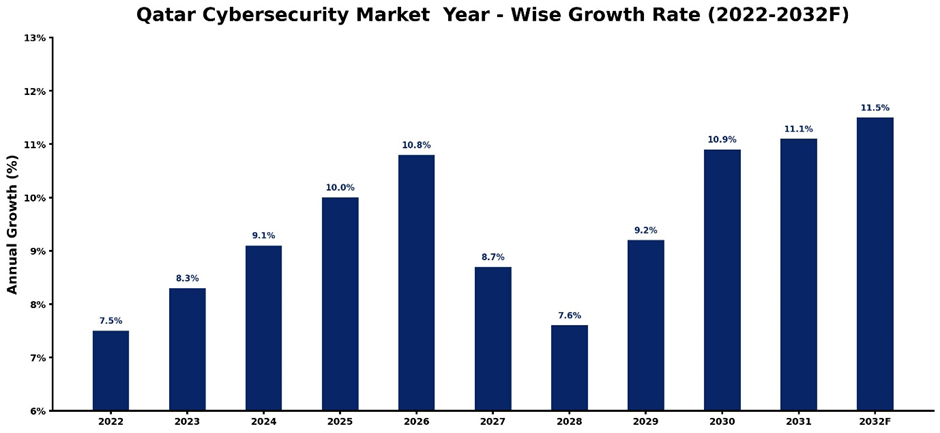 The following table summarizes the historical and forecasted growth rates of the Qatar Cybersecurity Market, along with the rationale behind each year’s performance.
| Year | Estimated Growth (%) | Market Rationale |
| 2022 | 7.5% | Expansion of e-government platforms and telecom modernization |
| 2023 | 8.3% | Rising ransomware threats and compliance requirements |
| 2024 | 9.1% | Increased cloud migration across enterprises |
| 2025 | 10% | Strong demand from BFSI and government digital ecosystems |
| 2026 | 10.8% | National cybersecurity framework strengthening |
| 2027 | 8.7% | Surge in managed security services adoption |
| 2028 | 7.6% | AI-driven threat detection integration |
| 2029 | 9.2% | Market consolidation and enterprise optimization |
| 2030 | 10.9% | Expansion of smart city cybersecurity infrastructure |
| 2031 | 11.1% | Advanced identity governance deployment |
| 2032 | 11.5% | Mature cybersecurity ecosystem with zero-trust adoption |
Topics Covered in the Qatar Cybersecurity Market Report
The Qatar Cybersecurity Market Industry report covers the market by security type, deployment model, and end-user industry. The report provides a detailed analysis of ongoing market trends, high-growth investment areas, and key market drivers that will help stakeholders align strategies with evolving digital risk landscapes and national cybersecurity priorities.
Qatar Cybersecurity Market Highlights
| Report Name | Qatar Cybersecurity Market |
| Forecast period | 2026-2032 |
| CAGR | 9.97% |
| Growing Sector | AI-driven Threat Intelligence |
Qatar Cybersecurity Market Synopsis
The Qatar Cybersecurity Market represents a rapidly evolving digital protection ecosystem. It is crafted to safeguard national infrastructure, enterprise systems, and consumer data from increasing cyber threats, and cybersecurity solutions comprise network protection, cloud security platforms, identity access management systems, data encryption tools, and infrastructure defense mechanisms deployed across public and private sectors. With Qatar proliferating its transition toward a diversified digital economy under national modernization programs, cybersecurity has become a foundational investment area.
Evaluation of Growth Drivers in Qatar Cybersecurity Market (2026–2032)
Below are some major drivers and their influence on the market dynamics:
| Drivers | Primary Segment Affected | Why This Matters (Evidence) |
| National digital transformation programs | Government & Defense | Increase in e-government services is raising attack surface |
| Cloud migration acceleration | Cloud Security | Enterprises transitioning workloads to hybrid cloud environments |
| Rising cybercrime sophistication | Network Security | The requirement is increasing for real-time intrusion detection systems |
| Regulatory compliance enforcement | BFSI & Healthcare | Solidified data protection mandates |
| Expansion of smart city infrastructure | Infrastructure Protection | Rising IoT endpoints require security layers |
The Qatar Cybersecurity Market is projected to grow at a CAGR of 9.97% from 2026–2032, driven primarily by aggressive digital transformation initiatives across government and enterprise ecosystems. Rising reliability on cloud infrastructure is majorly proliferating the demand for advanced cybersecurity solutions. They include identity access management, network monitoring, and AI-enabled threat intelligence platforms and also, the growing adoption of zero-trust security frameworks and automated threat detection systems is reshaping enterprise security architectures across key industries.
Evaluation of Restraints in Qatar Cybersecurity Market
Below are some major restraints and their influence on the market dynamics:
| Restraints | Primary Segment Affected | What This Means (Evidence) |
| High implementation costs | SMEs & Enterprises | Limits adoption of advanced cybersecurity solutions |
| Skilled workforce shortage | Managed Security Services | Restricts operational scalability |
| Complex integration with legacy systems | Government & Enterprises | Delays modernization efforts |
| Dependence on foreign vendors | National Security Infrastructure | Creates strategic dependency risks |
| Rapidly evolving threats | All segments | Continuous investment pressure |
Qatar Cybersecurity Market Challenges
The Qatar Cybersecurity Industry faces several structural and operational challenges, primarily centered around skill shortages, integration complexity, and escalating threat sophistication. One of the key challenges is the shortage of highly specialized cybersecurity professionals capable of managing advanced AI-driven security platforms. The swift evolution of ransomware, phishing, and state-sponsored attacks further raises the cost of defense. This is forcing organizations to persistently upgrade infrastructure, thereby straining budgets and operational efficiency and many enterprises in Qatar still operate on legacy IT systems that are difficult to integrate with modern cloud-native and zero-trust security architectures.
Qatar Cybersecurity Market Trends
Top trends boosting the Qatar cybersecurity market growth includes:
- Zero Trust Architecture Adoption: Organizations are shifting toward identity-first security models to reduce internal and external breach risks.
- AI and Machine Learning in Threat Detection: Increasing deployment of predictive analytics for real-time cyber threat identification.
- Cloud-native Security Platforms: Rising preference for integrated security tools designed specifically for hybrid and multi-cloud environments.
- Managed Security Services Expansion: Enterprises outsourcing cybersecurity operations to specialized providers for cost efficiency.
Investment Opportunities in the Qatar Cybersecurity Market
Below are the major growth-linked investment opportunities shaping the Qatar Cybersecurity Market:
- Managed Security Service Providers (MSSPs): Expanding outsourcing trend among SMEs and government-linked enterprises is an essential investment
- opportunity.Identity and Access Management Systems: Increasing adoption in BFSI and government sectors for secure authentication and is extremely crucial
- prospect.Critical Infrastructure Security: Rising investments in protecting energy, transportation, and smart city infrastructure are present.
Top 5 Leading Players in Qatar Cybersecurity Market
Below are some of the leading companies in the Qatar Cybersecurity Market:
1. Malomatia
| Company Name | Malomatia |
|---|---|
| Established Year | 2007 |
| Headquarters | Doha, Qatar |
| Official Website | Click Here |
Malomatia is a Qatar-based digital services provider specializing in cybersecurity, governance, and SOC operations.
2. MEEZA
| Company Name | MEEZA |
|---|---|
| Established Year | 2008 |
| Headquarters | Doha, Qatar |
| Official Website | Click Here |
MEEZA delivers secure managed IT and data center services with strong focus on cybersecurity and 24/7 infrastructure protection.
3. Help AG (e& enterprise cybersecurity)
| Company Name | Help AG (e& enterprise cybersecurity) |
|---|---|
| Established Year | 2004 |
| Headquarters | Dubai, UAE (Qatar operations present) |
| Official Website | Click Here |
Help AG gives advanced managed security services including threat intelligence and MDR solutions across Qatar.
4. Palo Alto Networks
| Company Name | Palo Alto Networks |
|---|---|
| Established Year | 2005 |
| Headquarters | Santa Clara, United States |
| Official Website | Click Here |
Palo Alto Networks provides next-generation cybersecurity platforms including firewalls and cloud security solutions.
5. Fortinet
| Company Name | Fortinet |
|---|---|
| Established Year | 2000 |
| Headquarters | Sunnyvale, United States |
| Official Website | Click Here |
Fortinet provides incorporated cybersecurity solutions including network protection and automated threat defense.
Government Initiatives in the Qatar Cybersecurity Market
According to Qatar’s government data, they have implemented several national-level cybersecurity initiatives. This is to solidify digital resilience and protect critical infrastructure and the National Cyber Security Strategy concentrates on building a secure digital ecosystem via regulatory frameworks, incident response capabilities, and public-private partnerships. The National Cyber Security Agency (NCSA) plays a major role in monitoring threats, enforcing compliance standards, and coordinating national cyber defense operations and Qatar’s Smart Qatar (TASMU) initiative incorporates cybersecurity into smart city infrastructure. This helps in ensuring secure deployment of IoT and AI-based systems.
Future Insights of the Qatar Cybersecurity Market
The Qatar Cybersecurity Market is expected to progress and will emerge into a highly integrated and intelligence-driven ecosystem by 2032. The deployment of AI-powered autonomous security systems and rising focus on critical infrastructure protection will define the next growth phase. Additionally, increasing geopolitical cyber risks and cloud dependency will persist to push enterprises toward advanced security investments, making cybersecurity a core pillar of Qatar’s digital economy. Going forward, cybersecurity will highly shift from reactive defense mechanisms to proactive and predictive security models.
Market Segmentation Analysis
The report offers a comprehensive study of the following market segments and their leading categories:
By Security Type – Network Security Dominates, Cloud Security Witnesses Fastest Expansion
According to Vasudha, Senior Research Analyst, 6Wresearch, Network Security secured a dominant 28.60% of the Qatar Cybersecurity Market Share in 2025, driven by the increasing need to protect enterprise connectivity layers, prevent intrusion attempts, and secure high-volume data traffic across government and telecom infrastructures. Conversely, Cloud Security is projected to grow at a strong CAGR of 13.20% during 2026–2032, fueled by rapid cloud migration across BFSI, public sector platforms, and enterprises adopting hybrid IT environments requiring scalable, real-time protection frameworks.
By Deployment – Cloud Deployment Leads Market, On-Premise Shows Stable Growth
By deployment model, cloud-based cybersecurity solutions accounted for 58.90% of the Qatar Cybersecurity Market revenue in 2025. It is encouraged by their scalability and seamless integration with digital government platforms and also, enterprise SaaS ecosystems and on-premises cybersecurity solutions are expected to expand at a CAGR of 8.40% through 2032. It is spurred by the need from government, defense, and critical infrastructure operators.
By End-User – Government & Defense Leads Market, IT & Telecom Exhibits Fastest Growth
By end-user segmentation, Government & Defense held a dominant 32.15% share of the Qatar Cybersecurity Market in 2025. It is promoted by national cybersecurity mandates and large-scale digital transformation initiatives under smart governance programs and also, IT & Telecommunications is projected to register the fastest CAGR of 12.10% during 2026–2032. It is proliferated by 5G rollout and rising demand for advanced network security and managed security services across digital service providers.
Note: Market size estimations and growth projections presented in this report are based on 6Wresearch’s advanced forecasting approach, validated with industry datasets as of June 2026.
Key Attractiveness of the Report:
- 10 Years of Market Numbers
- Historical Data Starting from 2022 to 2025
- Base Year: 2025
- Forecast Data until 2032
- Key Performance Indicators Impacting the Market
- Major Upcoming Developments and Projects
Key Highlights of the Report:
- Qatar Cybersecurity Market Outlook
- Market Size of Qatar Cybersecurity Market, 2025
- Forecast of Qatar Cybersecurity Market, 2032
- Historical Data and Forecast of Qatar Cybersecurity Revenues & Volume for the Period 2022-2032
- Qatar Cybersecurity Market Trend Evolution
- Qatar Cybersecurity Market Drivers and Challenges
- Qatar Cybersecurity Price Trends
- Qatar Cybersecurity Porter's Five Forces
- Qatar Cybersecurity Industry Life Cycle
- Historical Data and Forecast of Qatar Cybersecurity Market Revenues & Volume By Security Type for the Period 2022-2032
- Historical Data and Forecast of Qatar Cybersecurity Market Revenues & Volume By Cloud Security for the Period 2022-2032
- Historical Data and Forecast of Qatar Cybersecurity Market Revenues & Volume By Data Security for the Period 2022-2032
- Historical Data and Forecast of Qatar Cybersecurity Market Revenues & Volume By Identity Access Management for the Period 2022-2032
- Historical Data and Forecast of Qatar Cybersecurity Market Revenues & Volume By Network Security for the Period 2022-2032
- Historical Data and Forecast of Qatar Cybersecurity Market Revenues & Volume By Consumer Security for the Period 2022-2032
- Historical Data and Forecast of Qatar Cybersecurity Market Revenues & Volume By Infrastructure Protection for the Period 2022-2032
- Historical Data and Forecast of Qatar Cybersecurity Market Revenues & Volume By Others for the Period 2022-2032
- Historical Data and Forecast of Qatar Cybersecurity Market Revenues & Volume By Deployment for the Period 2022-2032
- Historical Data and Forecast of Qatar Cybersecurity Market Revenues & Volume By Cloud for the Period 2022-2032
- Historical Data and Forecast of Qatar Cybersecurity Market Revenues & Volume By On-Premise for the Period 2022-2032
- Historical Data and Forecast of Qatar Cybersecurity Market Revenues & Volume By End-User for the Period 2022-2032
- Historical Data and Forecast of Qatar Cybersecurity Market Revenues & Volume By BFSI for the Period 2022-2032
- Historical Data and Forecast of Qatar Cybersecurity Market Revenues & Volume By Healthcare for the Period 2022-2032
- Historical Data and Forecast of Qatar Cybersecurity Market Revenues & Volume By Manufacturing for the Period 2022-2032
- Historical Data and Forecast of Qatar Cybersecurity Market Revenues & Volume By Government and Defense for the Period 2022-2032
- Historical Data and Forecast of Qatar Cybersecurity Market Revenues & Volume By IT and Telecommunication for the Period 2022-2032
- Historical Data and Forecast of Qatar Cybersecurity Market Revenues & Volume By Others for the Period 2022-2032
- Qatar Cybersecurity Import Export Trade Statistics
- Market Opportunity Assessment By Security Type
- Market Opportunity Assessment By Deployment
- Market Opportunity Assessment By End-User
- Qatar Cybersecurity Top Companies Market Share
- Qatar Cybersecurity Competitive Benchmarking By Technical and Operational Parameters
- Qatar Cybersecurity Company Profiles
- Qatar Cybersecurity Key Strategic Recommendations
Market Covered
The report offers an extensive study of the following market segments:
By Security Type
- Network Security
- Cloud Security
- Identity Access Management
- Data Security
- Consumer Security
- Infrastructure Protection
- Others
By Deployment
- Cloud
- On-Premise
By End-User
- BFSI
- Healthcare
- Manufacturing
- Government & Defense
- IT & Telecommunications
- Others






































