Qatar Data Classification Market Size & Growth Rate (2026-2032)
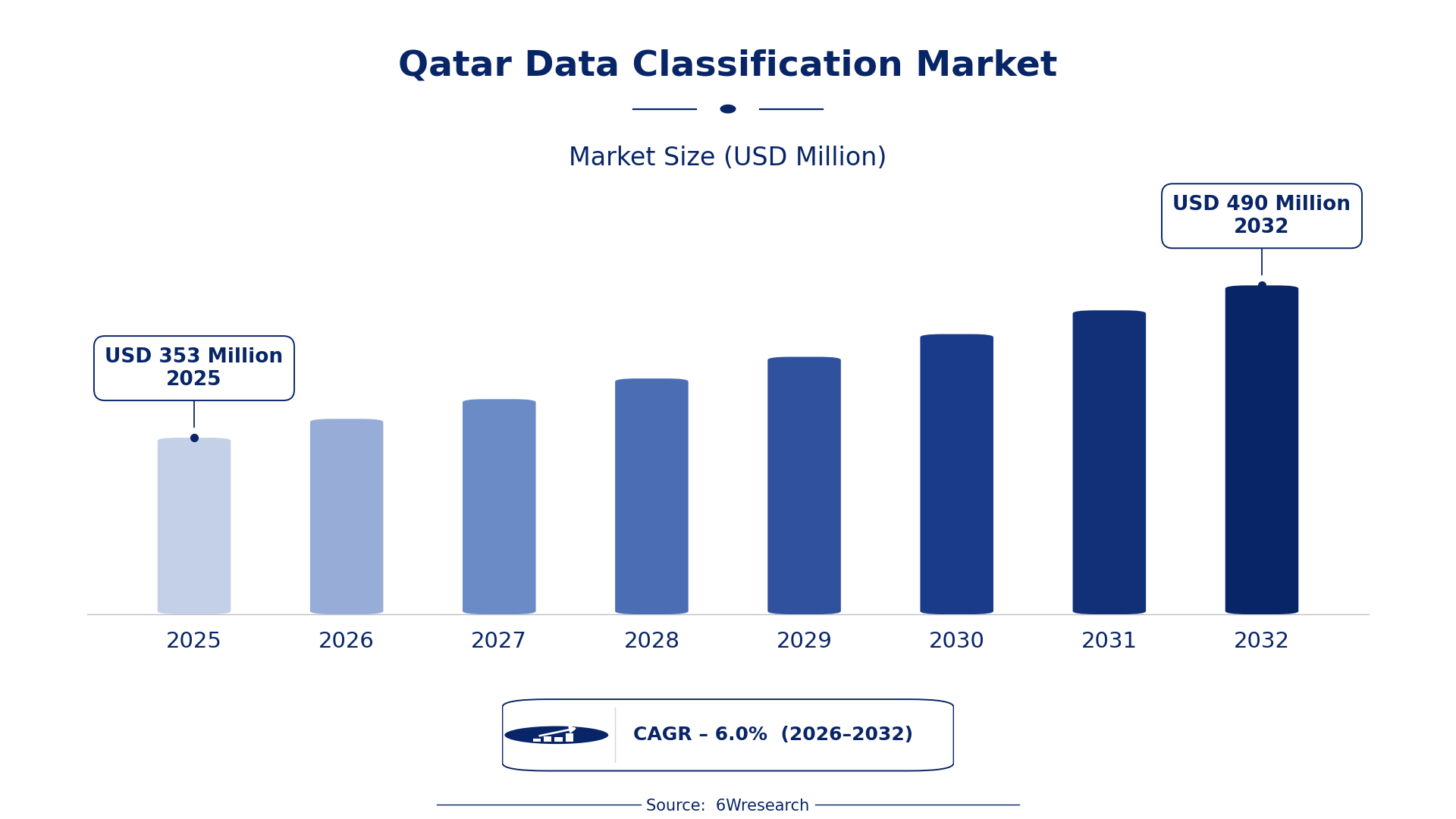
The Qatar Data Classification Market was estimated at USD 353 Million in 2025 and is projected to reach USD 490 Million by 2032, growing at a CAGR of 6.0% from 2026 to 2032.
Qatar Data Classification Market Synopsis
The primary force driving the Qatar Data Classification Market is the increasing emphasis on data protection regulations and compliance. As organizations become more aware of the risks associated with data breaches, they are adopting classification solutions to safeguard sensitive information. This push is underscored by a growing public consciousness regarding data privacy, particularly in a market that is digitalizing rapidly.
The rapid growth of data generation across various sectors, coupled with the pressing need for effective management of sensitive information, further fuels market demand. Organizations in Qatar are increasingly seeking automated solutions that leverage AI and machine learning, enabling more precise data categorization. This trend not only enhances data security but also streamlines compliance with evolving regulatory demands.
Qatar Data Classification Market Year-wise Growth Rate and Key Drivers
This graph illustrates the annual growth rates of the Qatar Data Classification Market from 2021 to 2032, highlighting a steady upward trajectory and projected expansion over the forecast period.
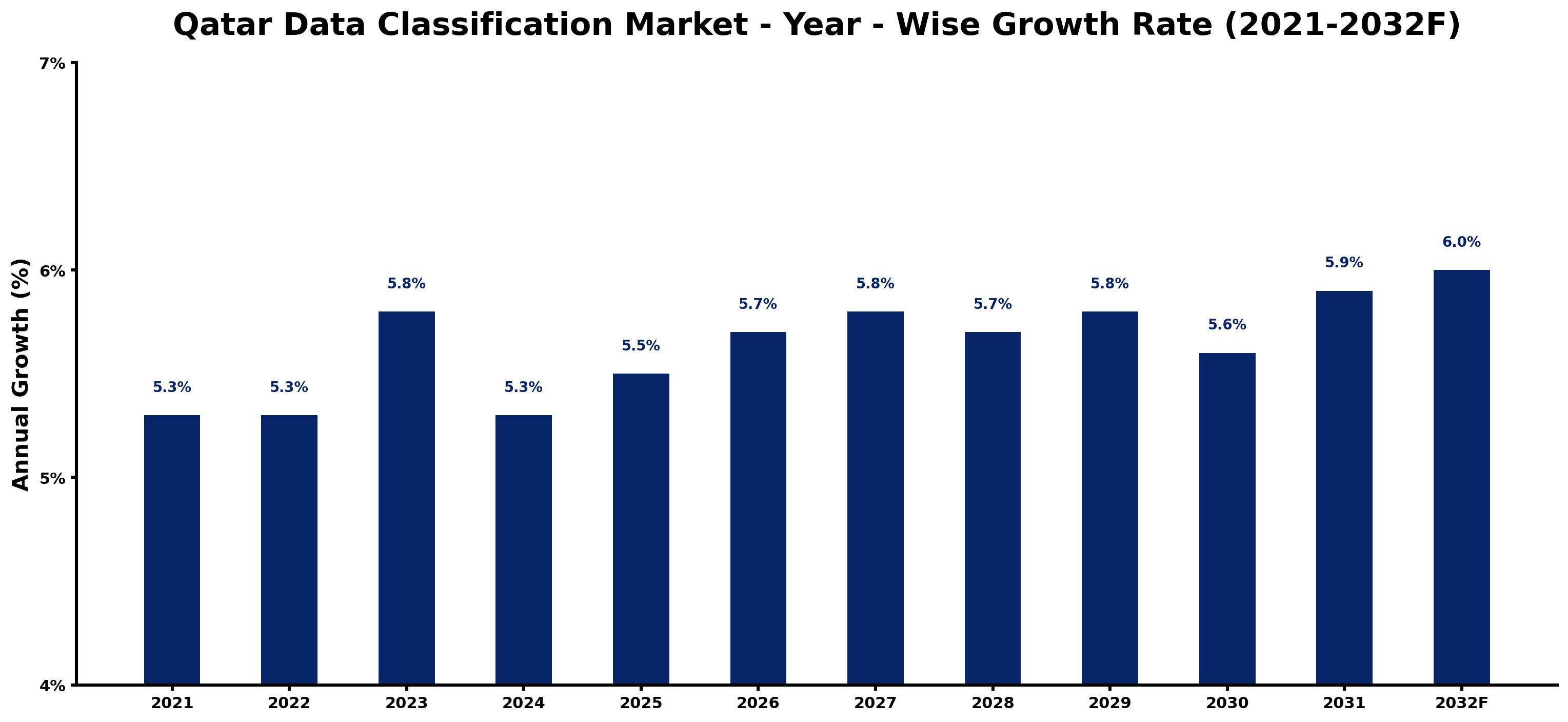
The table below presents the year‑wise growth rates along with the key drivers influencing the market
| Year | Growth Rate | Major Drivers |
| 2021 | 5.3% | Qatar National Vision 2030 enhancing data governance framework. |
| 2022 | 5.3% | Implementation of local data protection regulations mandates compliance. |
| 2023 | 5.8% | Increased adoption of artificial intelligence in data management. |
| 2024 | 5.3% | Growing emphasis on cybersecurity from the Qatar Central Bank. |
| 2025 | 5.5% | Surge in demand for analytics in local financial services. |
| 2026 | 5.7% | Launch of new digital platforms by Qatari government. |
| 2027 | 5.8% | Investment in local tech talent for data classification skills. |
| 2028 | 5.7% | Collaboration with international firms for advanced data solutions. |
| 2029 | 5.8% | Heightened focus on smart city initiatives driving data integration. |
| 2030 | 5.6% | Local enterprises prioritizing data quality for competitive advantage. |
| 2031 | 5.9% | Data-driven decision making gaining traction across sectors. |
| 2032 | 6.0% | Increased federal funding for technological innovation in data. |
Note: Market size estimations and growth projections presented in this report are based on 6Wresearch's proprietary forecasting methodology, utilizing the latest available industry data, government publications, and primary research inputs.
Qatar Data Classification Market Key Takeaways
Below are some of the specific key takeaways from the market, including:
- The market is driven by regulatory compliance and heightened awareness of data privacy risks.
- Automated data classification tools are becoming increasingly popular among organizations.
- The need for robust data security frameworks is critical as digital transformation accelerates.
- Organizations face challenges in keeping pace with the volume and variety of data requiring classification.
- Recent shifts towards remote work have amplified the importance of effective data classification measures.
Evaluation of Restraints in Qatar Data Classification Market
While the Qatar Data Classification Market is poised for growth, it encounters several limitations that could impede progress. A major hurdle is the sheer volume and diversity of data generated daily, making classification a complex task. Organizations often struggle with integrating classification tools into existing workflows, leading to inefficiencies. on top of that, there is a pressing need for enhanced user education regarding data handling practices, which is frequently overlooked. As regulatory scrutiny increases, any failure to address these issues could lead to costly compliance setbacks.
Qatar Data Classification Market Trends
Current trends in the Qatar Data Classification Market reveal a significant shift towards automation. Organizations are increasingly employing AI-driven solutions to facilitate real-time data classification, improving accuracy and efficiency. Another noteworthy trend is the focus on user-friendly classification interfaces that empower employees to manage data more effectively. Additionally, collaborations between tech providers and organizations are on the rise, aiming to enhance the capabilities of data classification solutions.
Qatar Data Classification Market Opportunities
The market presents numerous growth opportunities, particularly for firms investing in advanced classification solutions tailored to specific industry needs. With the rising concern over data privacy, there is a strong demand for compliance-focused tools that can adapt to regulatory changes. on top of that, as businesses continue to expand their digital footprints, the need for integrated solutions that encompass data classification, security, and management will be paramount. The opportunity for public-private partnerships also exists, aiming to create a more secure data environment across sectors.
Government Initiatives in the Qatar Data Classification Market
The government of Qatar is actively shaping the Data Classification Market through various initiatives that prioritize data security and privacy. Regulatory frameworks are being established to enhance compliance among organizations while promoting best practices in data management. This strategic focus is crucial in a rapidly digitizing economy, ensuring that sensitive data is adequately classified and protected.
- A regulatory framework introduced in 2025 mandates organizations to implement data classification protocols to ensure compliance with data privacy laws.
- Current initiatives include a national digital security program aimed at enhancing data classification and protection practices across public sector organizations.
- A planned public-private partnership is expected to launch in 2026, focusing on developing advanced classification technologies tailored for specific industries.
- The recently completed initiative involved the rollout of a centralized data governance policy that strengthens data classification standards among government entities.
- Ongoing workshops and training programs are being held to educate organizations on effective data classification strategies and compliance requirements.
Future Insights of the Qatar Data Classification Market
Looking ahead to 2026-2032, the Qatar Data Classification Market is expected to evolve significantly as technology continues to advance. The integration of AI and machine learning in data classification processes will become standard, facilitating more sophisticated and automated solutions. Regulatory pressures will likely intensify, compelling organizations to invest in compliance-focused systems. As data breaches remain a critical threat, the emphasis on data protection will further drive demand for innovative classification tools, positioning this market for sustained growth.
Qatar Data Classification Market Latest Developments
The last 12-14 months have seen substantial activity in the Qatar Data Classification Market, driven primarily by increasing regulatory demands and the push for better data protection mechanisms. Organizations are recognizing the urgency of implementing effective data classification solutions as remote work continues to be a standard practice in many sectors.
- A major technology vendor launched an innovative data classification tool in late 2025, enhancing real-time data labeling capabilities.
- In early 2026, a leading regional operator initiated a pilot program focused on integrating AI-driven classification systems into existing IT infrastructures.
- A public awareness campaign is currently underway, aimed at educating organizations about the importance of data classification and compliance.
- A planned initiative set to kick off in mid-2026 will involve collaboration between industry stakeholders to develop standardized classification frameworks.
- Several organizations have begun retrofitting their existing systems with updated classification solutions to enhance data security measures, with implementations projected to complete by late 2026.
Qatar Data Classification Market - Key Attractiveness of the Report
- 10 Years of Market Numbers
- Historical Data Starting from 2022 to 2025
- Base Year: 2025
- Forecast Data until 2032
- Key Performance Indicators Impacting the Market
- Major Upcoming Developments and Projects
Key Highlights of the Report:
- Qatar Data Classification Market Outlook
- Market Size of Qatar Data Classification Market, 2025
- Forecast of Qatar Data Classification Market, 2032
- Historical Data and Forecast of Qatar Data Classification Revenues & Volume for the Period 2022-2032F
- Qatar Data Classification Market Trend Evolution
- Qatar Data Classification Market Drivers and Challenges
- Qatar Data Classification Price Trends
- Qatar Data Classification Porter's Five Forces
- Qatar Data Classification Industry Life Cycle
- Historical Data and Forecast of Qatar Data Classification Market Revenues & Volume By Component for the Period 2022-2032F
- Historical Data and Forecast of Qatar Data Classification Market Revenues & Volume By Solutions (Standalone and Integrated) for the Period 2022-2032F
- Historical Data and Forecast of Qatar Data Classification Market Revenues & Volume By Services for the Period 2022-2032F
- Historical Data and Forecast of Qatar Data Classification Market Revenues & Volume By Application for the Period 2022-2032F
- Historical Data and Forecast of Qatar Data Classification Market Revenues & Volume By Access Control for the Period 2022-2032F
- Historical Data and Forecast of Qatar Data Classification Market Revenues & Volume By GRC for the Period 2022-2032F
- Historical Data and Forecast of Qatar Data Classification Market Revenues & Volume By Web for the Period 2022-2032F
- Historical Data and Forecast of Qatar Data Classification Market Revenues & Volume By Mobile & Email Protection for the Period 2022-2032F
- Historical Data and Forecast of Qatar Data Classification Market Revenues & Volume By Centralized Management for the Period 2022-2032F
- Historical Data and Forecast of Qatar Data Classification Market Revenues & Volume By Methodology for the Period 2022-2032F
- Historical Data and Forecast of Qatar Data Classification Market Revenues & Volume By Content-based Classification for the Period 2022-2032F
- Historical Data and Forecast of Qatar Data Classification Market Revenues & Volume By Context-based Classification for the Period 2022-2032F
- Historical Data and Forecast of Qatar Data Classification Market Revenues & Volume By User-based Classification for the Period 2022-2032F
- Historical Data and Forecast of Qatar Data Classification Market Revenues & Volume By Vertical for the Period 2022-2032F
- Historical Data and Forecast of Qatar Data Classification Market Revenues & Volume By BFSI for the Period 2022-2032F
- Historical Data and Forecast of Qatar Data Classification Market Revenues & Volume By Healthcare and Lifesciences for the Period 2022-2032F
- Historical Data and Forecast of Qatar Data Classification Market Revenues & Volume By Government and Defense for the Period 2022-2032F
- Historical Data and Forecast of Qatar Data Classification Market Revenues & Volume By Education for the Period 2022-2032F
- Historical Data and Forecast of Qatar Data Classification Market Revenues & Volume By Telecom for the Period 2022-2032F
- Historical Data and Forecast of Qatar Data Classification Market Revenues & Volume By Media and Entertainment for the Period 2022-2032F
- Historical Data and Forecast of Qatar Data Classification Market Revenues & Volume By Others (Retail and Ecommerce, Manufacturing, and Energy and Utilities) for the Period 2022-2032F
- Qatar Data Classification Import Export Trade Statistics
- Market Opportunity Assessment By Component
- Market Opportunity Assessment By Application
- Market Opportunity Assessment By Methodology
- Market Opportunity Assessment By Vertical
- Qatar Data Classification Top Companies Market Share
- Qatar Data Classification Competitive Benchmarking By Technical and Operational Parameters
- Qatar Data Classification Company Profiles
- Qatar Data Classification Key Strategic Recommendations






































